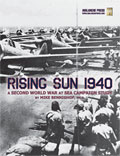
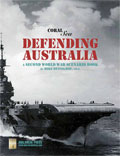
The Emperor’s Sword:
Design Notes, Chapter One
by Mike Bennighof, Ph.D.
February 2026
 Second World War at Sea: The Emperor's Sword is an alternative-history take on World War Two in the Pacific. I like delving into alternative history, but I do wish the stories to be at least reasonably plausible. And so the background of The Emperor’s Sword is set in what we call The Long War, the same as that of our Plan Z expansion that takes place in the Atlantic. Second World War at Sea: The Emperor's Sword is an alternative-history take on World War Two in the Pacific. I like delving into alternative history, but I do wish the stories to be at least reasonably plausible. And so the background of The Emperor’s Sword is set in what we call The Long War, the same as that of our Plan Z expansion that takes place in the Atlantic.
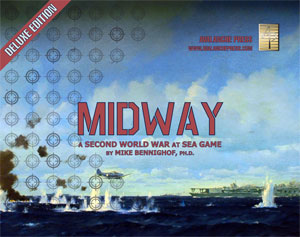
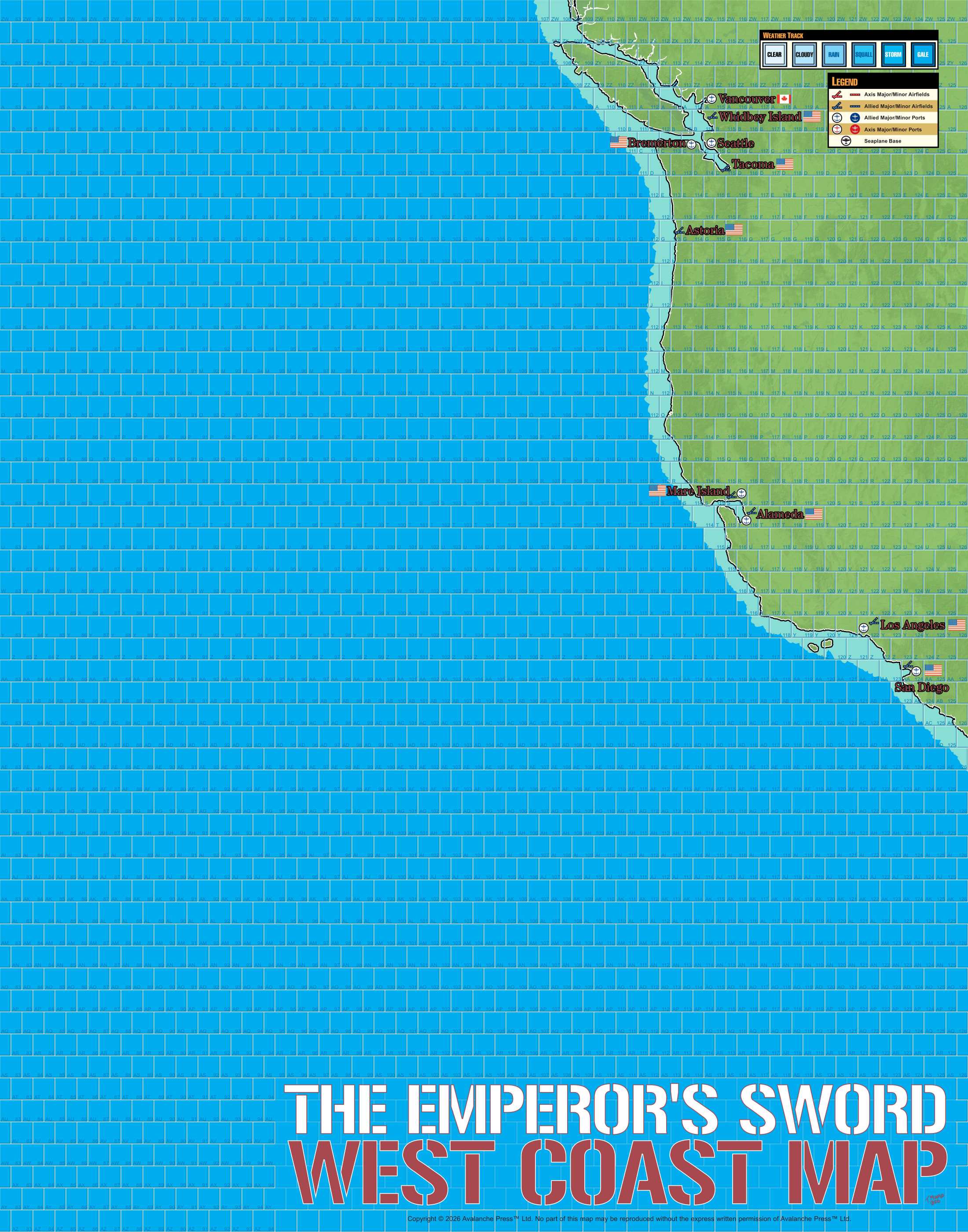
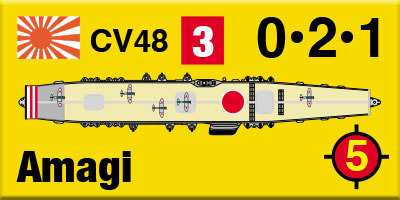
The Emperor’s Sword is an expansion set for Second World War at Sea: Medway Deluxe edition. You’ll need a copy of Midway to play any of the scenarios in The Emperor’s Sword. It comes with a map extending the operational map from Midway all the way eastwards to the U.S. West Coast. And you get 420 new pieces, adding the drawing-board aircraft carriers, cruisers, battleships and warplanes that never actually saw service. But now they do.
In The Emperor’s Sword, war comes to the Pacific in the last month of 1943, and it’s the Americans who start it. The Japanese Empire of this reality has been on a fifty-year tear of economic, population, and territorial growth, and that brings on a head-on collision with America’s Manifest Destiny.
 Our alternative history opens exactly two years later than the actual Pacific War, and during that span, both sides have continued to build up their naval and air forces. When war comes, both Japan and the United States wield the new aircraft carriers, battleships, and cruisers that in our own reality never left the blueprint stage. That, of course, is the entire reason for the existence of The Emperor’s Sword. Our alternative history opens exactly two years later than the actual Pacific War, and during that span, both sides have continued to build up their naval and air forces. When war comes, both Japan and the United States wield the new aircraft carriers, battleships, and cruisers that in our own reality never left the blueprint stage. That, of course, is the entire reason for the existence of The Emperor’s Sword.
For purposes of this expansion, the big difference in the background is that Hawaii is a prefecture of the Japanese Empire. The majority of the population is Japanese, including the commercial and political classes. The Imperial Navy has built a major naval base in the broad estuary of the Pearl River on Oahu; the islands also host a large garrison of the Imperial Army and airfields stuffed with Japanese warplanes. The islands export their sugar and coffee to Japan and obtain their manufactured goods there; the people vote in Japanese elections, and the young men serve the Emperor as soldiers and sailors.
These are not American territories. But they do form the outer barrier of the Empire, its defense against the barbarians found to the east. And to many Americans, they’re also a barrier to America’s God-given right to expand westwards. Hawaii represents the economic wall strangling American fortunes, the cause of the Great Depression. An attack on Hawaii will be seen as a righteous blow against Japanese arrogance.
In our first chapter, the Americans attack the Japanese naval base in the Pearl River Estuary (what another reality would call Pearl Harbor). In our story’s first act, the Americans launch their attack with seven aircraft carriers: six converted battle cruisers of the Lexington class, and the massive Lafayette, converted from the great liner Normandie. The Americans still haven’t fully perfected the art of the mass air strike, but they’re better at in than they were a few years previously.

This is an excuse to use the Pearl Harbor Display from Midway Deluxe, except with Japanese dreadnoughts on Battleship Row and American planes attacking them. The historical scenario (in Midway Deluxe) is loaded with special rules to re-create, in game form, the situation on the morning fo 7 December 1941. Since I got to make up the story, I greatly reduced that; the Japanese are caught by surprise, but they recover quickly. Which is bad news for the Americans, because they can’t attack in one single wave.
While the Japanese Combat Air Patrol steadily increases in strength, the American waves do have the opportunity to whittle down its numbers. That helps clear the way for the last wave, that from the supercarrier Lafayette. Lafayette is not very survivable in a combat environment (she was built for luxury, not warfare), but she has a huge flight deck that can handle gigantic new aircraft like the TB2D Skypirate, with its contra-rotating double propellors and load of four (yes, four) torpedoes per plane.
The American player is not straightjacketed into a Pearl Harbor attack; he or she can try attacking the carriers of the First Air Fleet instead. They’re nearby, but much better-prepared to defend themselves.
Our story assumes that the Americans attack Pearl Harbor, achieving moderate success. Only moderate, because we didn’t give you all of these wonderful toys and then not let you use them. The Japanese are in good enough shape to launch a counter-strike of their own and send out a surface action group conducting exercises off Hawaii to attack the Americans. And so, you almost immediately get to use that wonderful new West Coast operational map.
The American attack on Pearl Harbor leaves the First Air Fleet, anchored in Lahaina Roads, intact and ready for battle. The seven American carriers have more than twice the total deckload of the four Japanese flattops, but two of the American carriers have been damaged by the prompt Japanese counter-strike. That means that the Americans must shepherd them back home to the West Coast and turn to fight the Japanese to protect the damaged ships. And since the Japanese are hot to pursue the Americans as far as they must, even to the brink of to their West Coast bases, bringing on carrier battles and surface actions. That, of course, brings the glorious new West Coast map into play.
The Midway map presents Hawaii as a chain of islands in the middle of nowhere. Which is not entirely wrong. Adding the West Coast map puts that into perspective: there’s a lot of blue between San Francisco and Oahu, but it’s not an infinite distance. The Americans have a place to go, and the Japanese can visit them there.
Like other Second World War at Sea scenario sets, The Emperor’s Sword gets plenty of battle scenarios (the ones that take place on the Tactical Map, where the ships and planes fight) to go with the operational scenarios (the big ones, that you play out on the maps of Hawaii and the West Coast and the ocean between). We gave you all of these powerful new battleships, so of course you need to fight with them. The attack on Pearl River/Harbor is a carrier affair, and so is the pursuit of the raiders back to San Diego. But now that war has been declared, the Empire will strike back, and that brings the battleships into action in Chapter Two.
Order The Emperor’s Sword Here.
Sign up for our newsletter right here. Your info will never be sold or transferred; we'll just use it to update you on new games and new offers.
Mike Bennighof is president of Avalanche Press and holds a doctorate in history from Emory University. A Fulbright Scholar and NASA Journalist in Space finalist, he has published an unknowable number of books, games and articles on historical subjects.
He lives in Birmingham, Alabama with his wife and three children.
Want to keep Daily Content free of third-party ads? You can send us some love (and cash) through this link right here.
|