The Emperor’s Sword:
American Battleships, Part One
by Mike Bennighof, Ph.D.
November 2025
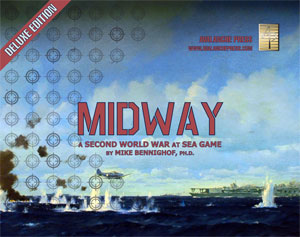
 The Emperor’s Sword is a massive, alternative-history expansion set for Second World War at Sea: Midway. You get to add plenty of new ships, both Japanese and American, designed or proposed and never actually built. Huge aircraft carriers and mighty battleships fighting for the Hawaiian Islands. This is what wargames are all about. The Emperor’s Sword is a massive, alternative-history expansion set for Second World War at Sea: Midway. You get to add plenty of new ships, both Japanese and American, designed or proposed and never actually built. Huge aircraft carriers and mighty battleships fighting for the Hawaiian Islands. This is what wargames are all about.
The U.S. Navy already has a great many battleships in Midway: the battle line from Pearl Harbor, the battleship under refit at the time of the Japanese attack, and the battleships rushed to the West Coast from the Atlantic Fleet soon afterwards. Thirteen battleships all told, but only one of them a modern, fast battleship of the type that helped win the actual Pacific War. All of the others are modernized dreadnoughts dating back a full generation.
The Emperor’s Sword redresses that, adding thirteen more modern, fast battleships. Well, some of them are faster than others. Let’s have a look at them.
More North Carolina
The Second London Naval Treaty, signed by the United States, Britain and France in 1930, limited the size of new battleships to 35,000 tons’ displacement, their maximum gun caliber to 14 inches, and placed a moratorium on building them until 1937. The U.S. Navy’s General Board requested design proposals in May 1935, fairly late given the long lead times for designing and building such ships, and the first sketches that July.
Various factions tossed in their input, as the Board studied not just different designs, but very different philosophies regarding the emphasis to be placed on speed, protection, and firepower. On 35,000 tons, something would have to give. They finally settled on a design that offered some speed (27 knots), a dozen 14-inch guns in three quadruple turrets, and protection adequate against her own armament.
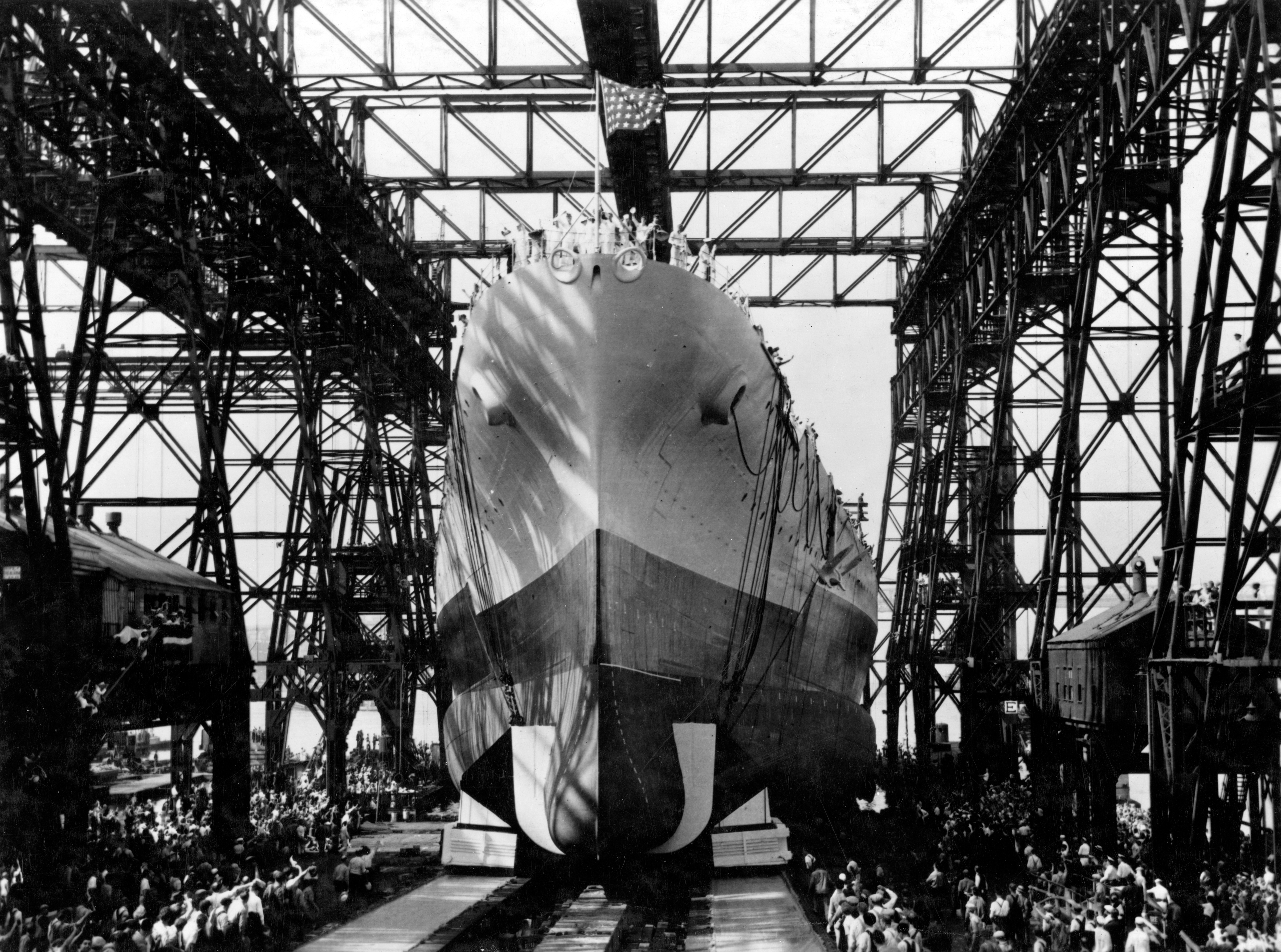
North Carolina is launched at New York Navy Yard. 13 June 1940.
And then came the political wrangling. The General Board wanted a class of four ships, and President Franklin Roosevelt did not disagree. FDR did not, however, see the political will for a four-ship class. Deficit hawks in Congress insisted on cutting the defense budget despite evidence of a looming war. Pacificist feeling ran high and in 1936, when the ships were authorized for construction, FDR was running for re-election. He submitted a request for just two ships, both to be built at Navy yards to keep costs down.
Could FDR have wrangled the full class of four ships? That’s tough to judge, even with the benefit of hindsight. Labor problems, as executives tried to avoid following new laws regarding the minimum wage and 40-hour work week, plagued the private yards, while the Navy yards had trouble obtaining high-grade steel. The Navy had the construction capacity to take on two more battleships, but four ships would of course drive up the appropriation in the face of deficit worries, and would be seen as a much more aggressive move than building just two.
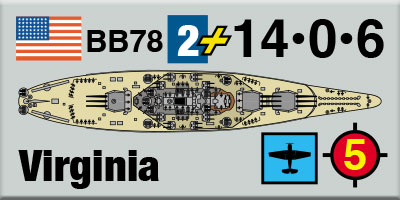
We’ve given the admirals and FDR their wishes in The Emperor’s Sword, with two more North Carolina class battleships, Virginia and Nebraska. Assumed to have been laid down in 1937 and 1938 just like North Carolina and Washington, and likewise completed in the spring of 1942, all four ships would have been ready for action by early 1942.
The Original North Carolina
When design work for North Carolina had been completed, the United States still held to the Second London Treaty’s cap of 14-inch guns as the maximum allowable caliber. She was therefore designed to carry a dozen of a new-model 14-inch gun, designated the 14-inch/50 Mark B in most literature (since the gun never officially went into service, it never received a “Mark” numerical designation). The gun was designed to be more powerful than the 14-inch guns arming the older U.S. battleships, with a quicker rate of fire (two rounds per minute, as opposed to 1.75 rounds per minute from the old guns). No prototype was completed before the 14-inch guns would be swapped for 16-inch weapons.
That came about because of an “escalator clause” in the Second London Treaty. When the Japanese and Italians still refused to sign the agreement after a 1 April 1937 deadline, any of the three signatories could begin arming their battleships with 16-inch guns instead. Secretary of the Navy Claude Swanson, a staunch advocate of naval construction during his years in the Senate before joining Roosevelt’s cabinet, delayed the decision until July 1937; with neither new battleship yet begun, he apparently did not wish to threaten their funding. Not until October were the shipyards told of the decision, which came after North Carolina had already been laid down. Alterations to the ships’ plans halted construction until February 1938.
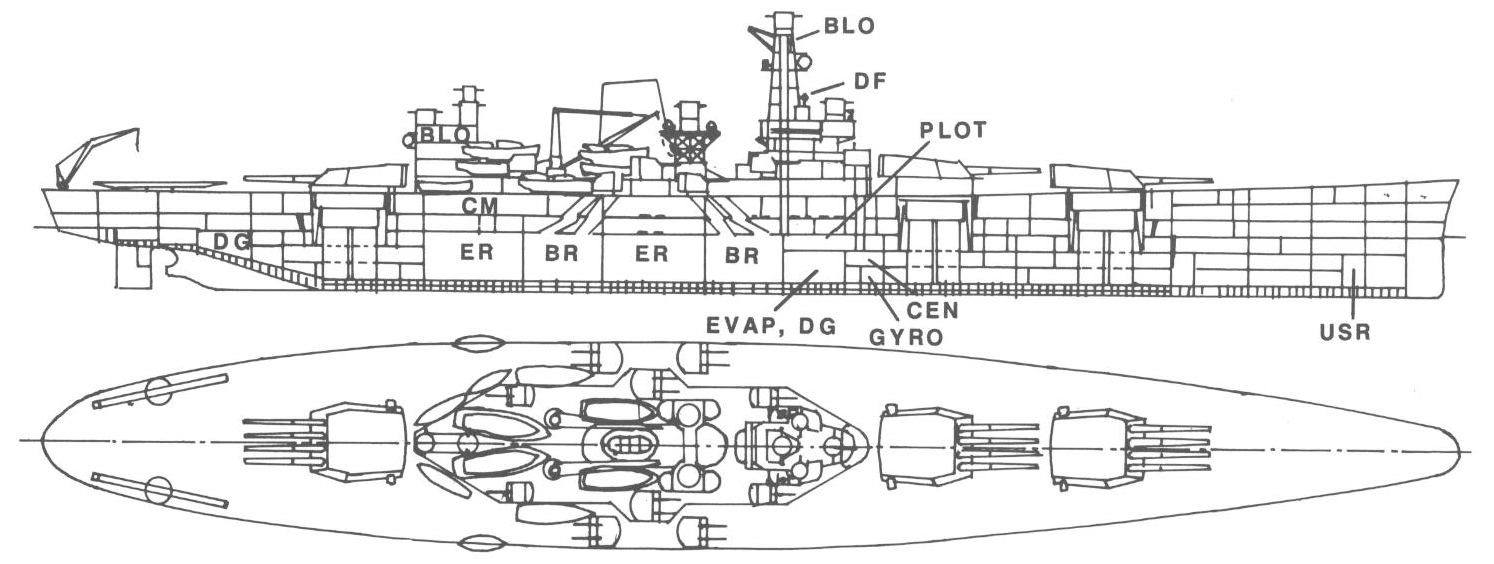
The “final” design of North Carolina, with quadruple turrets for 14-inch guns.
The ships had been designed to accept a triple 16-inch turret in place of the intended quadruple 14-inch turret; a few other changes had to be made to accommodate this swap. That also meant that North Carolina and Washington violated a sacred principle of American battleship design, that a battleship had to carry sufficient armor to resist her own weapons. Given that the 16-inch/45 Mark 6 rifle was designed and tested before the 14-inch Mark B was even off the drawing board, it appears that the U.S. Navy never intended to arm this class with 14-inch guns.
That would have been far more difficult had the North Carolina class been ordered in 1936 and laid down when the General Board wished, at the first possible date allowed under the First London Naval Treaty (1 January 1937). Just like the Royal Navy, the U.S. Navy would have begun the modern battleship age with ships armed with 14-inch guns.
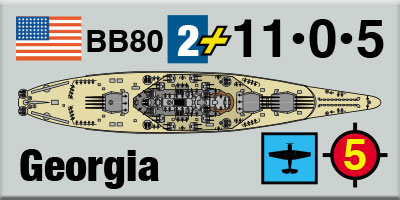
We’ve included four of these ships in The Emperor’s Sword, assuming political will for an early start date (and for a full class of four ships). That would have required enormous political confidence on the part of FDR, confidence that would not have been misplaced. Roosevelt and his running mate, Cactus Jack Garner, crushed the Republican ticket of Alf Landon and Frank Knox, winning over 60 percent of the popular vote and 523 electoral votes to eight for the Republicans. It was the greatest landslide in American history, eclipsed only once since (by Lyndon Johnson in 1964).
Given Landon’s poor campaign style (he mostly stayed home and let surrogates do the work), FDR had cause to be more confident. Confidence that could have led to a fuller public embrace of the naval program he endorsed in private. We’ve given the four new battleships the names Georgia, Rhode Island, Connecticut and South Carolina, though likely the first two would have been North Carolina and Washington. They’re assumed to have been ordered in Fiscal Year 1936 and laid down in early 1937, with the four ships of the North Carolina class ordered under FY1937 and land down in 1938.
Order The Emperor’s Sword Here.
Please allow an extra six weeks for delivery.
Sign up for our newsletter right here. Your info will never be sold or transferred; we'll just use it to update you on new games and new offers.
Mike Bennighof is president of Avalanche Press and holds a doctorate in history from Emory University. A Fulbright Scholar and NASA Journalist in Space finalist, he has published an unknowable number of books, games and articles on historical subjects.
He lives in Birmingham, Alabama with his wife and three children.
Want to keep Daily Content free of third-party ads? You can send us some love (and cash) through this link right here.
|