The Emperor’s Sword:
American Battleships, Part Two
by Mike Bennighof, Ph.D.
January 2026
 While we position The Second Great War as our battleship-centric alternative history, we have plenty of them in The Long War (the one with Plan Z and The Emperor’s Sword), too. In Part One we looked at some of the new American battleships found in The Emperor’s Sword, extra units of the North Carolina class and a variant design with a dozen 14-inch guns. The Americans get two more classes beyond those, some of the best-known ships that never were. While we position The Second Great War as our battleship-centric alternative history, we have plenty of them in The Long War (the one with Plan Z and The Emperor’s Sword), too. In Part One we looked at some of the new American battleships found in The Emperor’s Sword, extra units of the North Carolina class and a variant design with a dozen 14-inch guns. The Americans get two more classes beyond those, some of the best-known ships that never were.
Iowa Extended
With the Iowa class, the treaty limits that held back the preceding North Carolina and South Dakota classes had been raised from 35,000 tons’ to 45,000 tons’ maximum displacement. Design work began on the new battleship in 1938, with an emphasis on raising her speed to 33 knots to run down and overwhelm the much smaller Japanese Kongo-class fast battleships as well as the big Japanese heavy cruisers, and enable her to escort fast aircraft carriers.
The new ship would be very long, with fine lines to help attain that speed as well as a gigantic power plant. Studies had looked at a very fast version of North Carolina, 35,000 tons with eight 14-inch guns in two quadruple turrets; this new ship would draw on those proposals, but retain the main armament of nine 16-inch guns. The added displacement would allow for a new-model, 50-caliber 16-inch gun to be fitted in the new class.
This would provide a ship with substantially better speed than South Dakota, better gunnery range and striking power, and the same protection. The new ship did not receive universal acceptance: some within the Navy worried that such a leap in capabilities would make the six preceding battleships obsolete. All of these ships were well-advanced in their construction, but none of them had yet commissioned.
The Navy’s General Board agreed that the two ships authorized for Fiscal Year 1939 would be of the new, fast type. The Navy ordered Iowa and New Jersey in July 1939; Brooklyn Navy Yard laid down Iowa in June 1940, and Philadelphia Navy Yard began work on New Jersey three months later.
No new battleships would be authorized for Fiscal Year 1940, and for the 1941 budget, the General Board leaned toward moving on from the Iowa class. Two battleships had been authorized, and the board decided to compromise with one more Iowa and the first of a projected five ships of the slower, much more powerful alternative that became the Montana class.
Rear Admiral Robert J. Ghormley, then the head of War Plans, made an eloquent plea to build a fourth Iowa rather than the first Montana. A full division of fast battleships would provide needed carrier escorts, as heavy cruisers could not stand up to the Japanese Kongos. They also would defend supply lines against raids by the fast Japanese ships. The Board relented, approving two more ships, Wisconsin and Missouri; the Navy placed the orders on 12 June 1940.
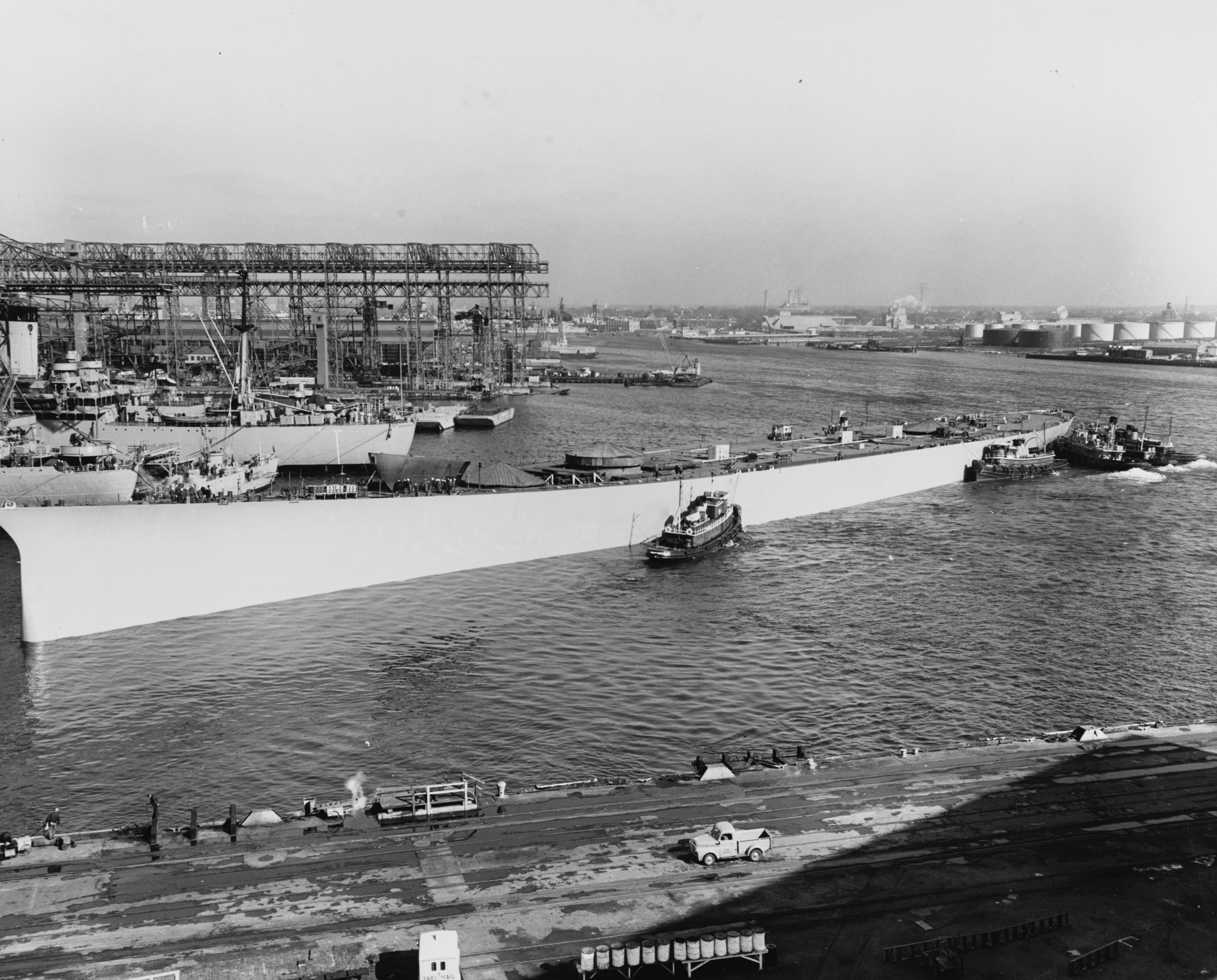
The incomplete Kentucky is floated out of drydock. 20 January 1950.
After that, the General Board intended to move on to the bigger ship, but then France fell to the Germans in June 1940. On 19 July 1940, President Franklin Roosevelt signed the Two-Ocean Navy Act, which provided for a massive naval buildup including two more battleships to be built immediately. Newly-appointed Secretary of the Navy Frank Knox (the 1936 Republican candidate for vice president) decreed that, to speed construction, all of the 257 new ships would follow the design of the last class of their type. Knox allowed a few exceptions, but denied the General Board’s pleas to replace the two additional units of the Iowa class with two Montanas.
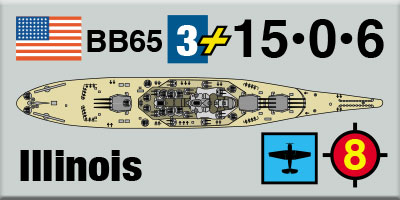
Accordingly, the Navy ordered Illinois and Kentucky in September 1940. Other more pressing projects delayed their construction, and Kentucky was finally laid down in March 1942 and Illinois in September. Neither would be completed, but they’re present in The Emperor’s Sword, escorting the powerful fast carrier task force as intended.
The Slow Option
Early design studies for the ship that became Iowa included slower, 27-knot ships (45,000-ton improved versions of South Dakota) that applied their increased displacement to greater firepower. This concept more closely hewed to then-current thought within the Navy, which held protection and firepower to be far more important than high speed, and judged the 27 knots of North Carolina and South Dakota to be adequate.
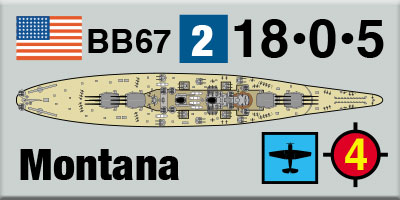
Initial designs held to the 45,000-ton limit, but once the limitation treaties fell, the General Board asked for a battleship of maximum fighting power that could still fit through the Panama Canal. Alternative armament arrangements included three quadruple turrets with 16-inch guns (12 total), two triple and one quadruple turrets with 16-inch guns (10 total), three or four twin turrets with 18-inch guns (six or eight total), or four quadruple turrets for 14-inch guns (16 total). The design finally settled on four triple turrets with 50-caliber, 16-inch guns. Suggestions to upgrade the secondary armament with a new, automatic 6-inch dual-purpose gun fell away (along with the proposals for anti-aircraft cruisers carrying this weapon) when it became obvious that the new gun would always be at least a year away from completion. It would eventually be completed in 1943, with the first ship to carry it commissioning in 1948.
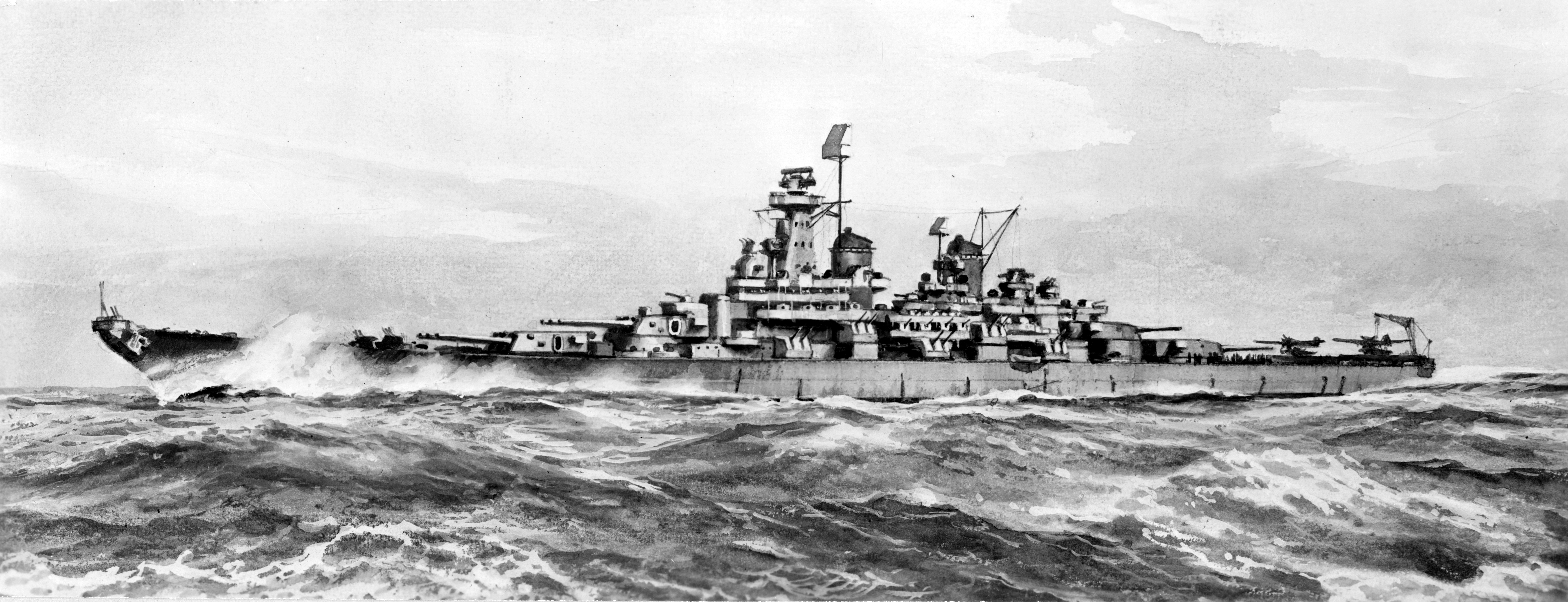
Official U.S. Navy depiction of the Montana class.
Montana would be a huge ship, weighing in at 63,000 tons and carrying substantially thicker armor than previous American battleships. She would have the same secondary armament as Iowa, and the same speed as South Dakota.
The General Board had hoped to build four of them, but the Two-Ocean Navy Act authorized five, and these were duly ordered from Navy Yards. Steel shortages caused constant delays in laying them down, and the General Board complained that the United States had adequate steel production, but the metal was not being efficiently allocated (the same shortage delayed widening the Panama Canal; the new battleships had been designed to fit the new canal width). Balked at their attempts to save the Montana class, the General Board shifted to plead for the replacement of Illinois and Kentucky with the first two Montanas; this effort also failed.
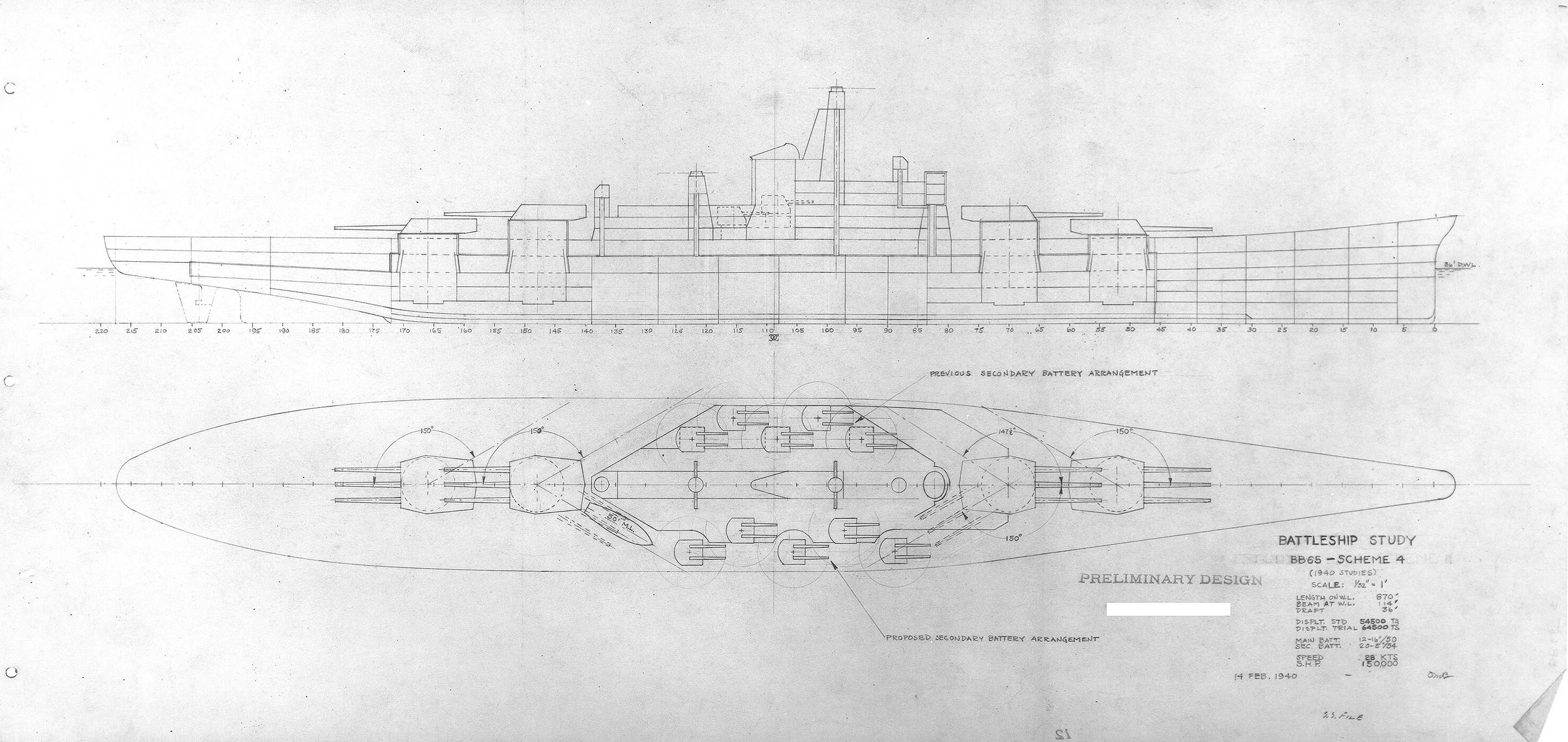
Official design sketch of the ship that would have been Montana, dated 14 February 1940.
In April 1942, Roosevelt ordered the class suspended, and this became a formal cancellation in July 1943. By this point, the Navy’s needs had shifted toward more destroyers, submarines, and aircraft carriers. Even if sufficient steel could have been found, it was not going to go toward new battleships. The mighty Montana would never be built, but she’s right there in The Emperor’s Sword with all four of her sisters. She’s a powerful ship, a match for the four ships of the Japanese Yamato class. And in our alternative history, she gets to fight them, in daylight and night actions.
Order The Emperor’s Sword Here.
Please allow an extra six weeks for delivery.
Sign up for our newsletter right here. Your info will never be sold or transferred; we'll just use it to update you on new games and new offers.
Mike Bennighof is president of Avalanche Press and holds a doctorate in history from Emory University. A Fulbright Scholar and NASA Journalist in Space finalist, he has published an unknowable number of books, games and articles on historical subjects.
He lives in Birmingham, Alabama with his wife and three children.
Want to keep Daily Content free of third-party ads? You can send us some love (and cash) through this link right here.
|