South Pacific:
First Guadalcanal, Part Three
by Mike Bennighof, Ph.D.
November 2025
 Atlanta, armed with sixteen rapid-fire 5-inch guns, dealt out punishment that, along with shells from Helena and San Francisco, sank Akatsuki. She in turn suffered hits from Akatsuki and Hiei, and a devastating torpedo hit from either Inazuma or Ikazuchi that knocked out all but auxiliary power. Still more damage came from San Francisco. The American flagship hit Atlanta with a whopping nineteen 8-inch shells, killing many of her crew including Read Admiral Norman Scott and spraying the wreck with tell-tale green dye. She would remain afloat through the next day before finally sinking. Atlanta, armed with sixteen rapid-fire 5-inch guns, dealt out punishment that, along with shells from Helena and San Francisco, sank Akatsuki. She in turn suffered hits from Akatsuki and Hiei, and a devastating torpedo hit from either Inazuma or Ikazuchi that knocked out all but auxiliary power. Still more damage came from San Francisco. The American flagship hit Atlanta with a whopping nineteen 8-inch shells, killing many of her crew including Read Admiral Norman Scott and spraying the wreck with tell-tale green dye. She would remain afloat through the next day before finally sinking.
Ships fired at one another at point-black range, their guns depressed to a flat trajectory including 20mm, 25mm, and 40mm anti-aircraft automatic cannons never intended to be used against surface targets. Both sides managed to shoot at friendly ships, though none inflicted as much damage as San Francisco did to Atlanta.
Aboard the Japanese battleships, Abe ordered the gunners to extract the Type 3 incendiary shells from the main guns and load armor-piercing rounds. The accounts of surviving Japanese officers differ on whether this actually happened, or if they fired the bombardment ammunition at the Americans instead (the latter seems much more likely).
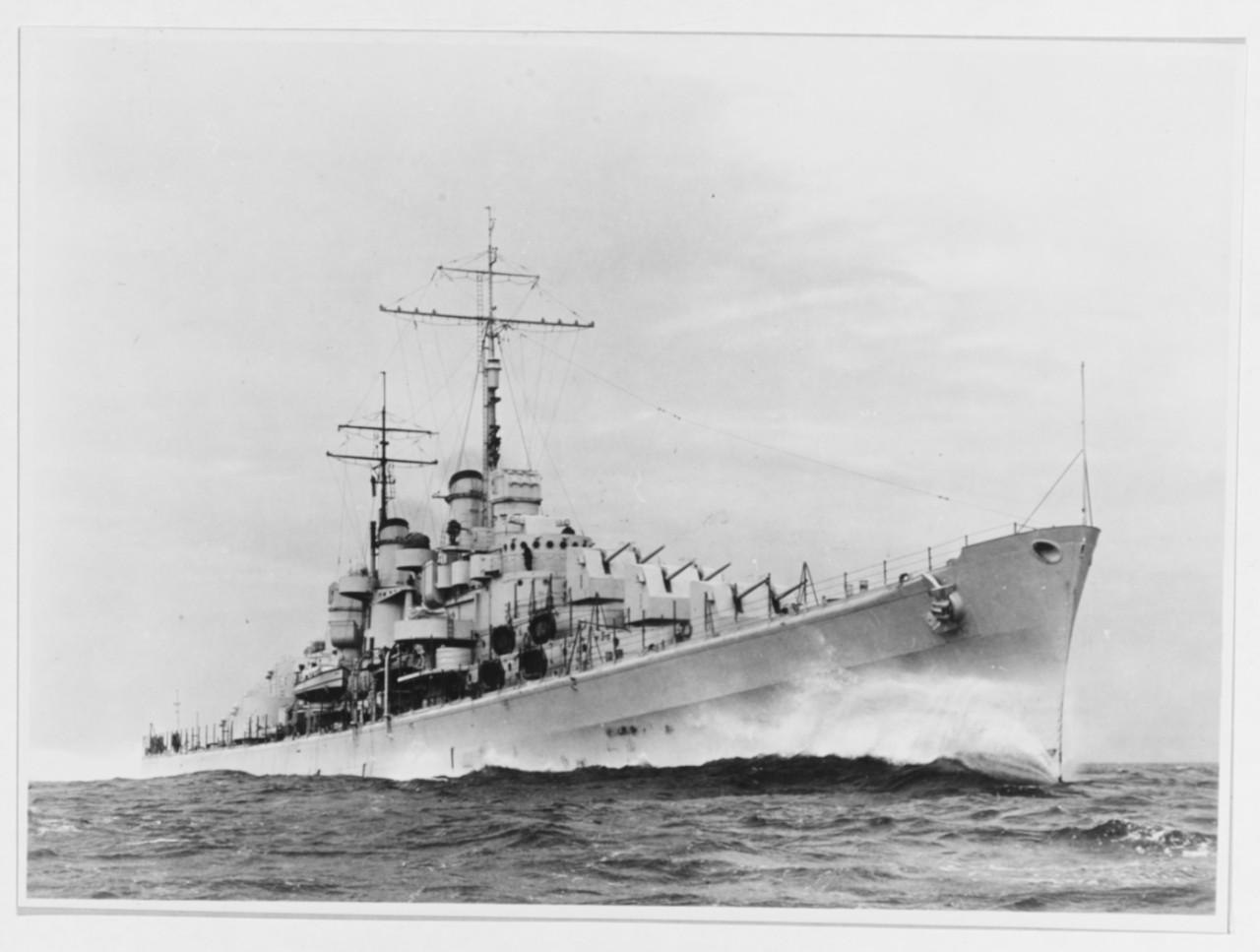
Anti-aircraft cruiser Atlanta on her speed trials, November 1941.
Japanese battleships were notorious for their poor shooting, as unlike the cruisers and destroyers they conducted very little gunnery practice. But at ranges of less than 2,000 meters, even their little-exercised gun crews could not miss. Hiei’s first salvo of eight 14-inch (356mm) shells scored either seven or eight hits on Atlanta. Switching fire to San Francisco, the next American ship in line, Hiei and her consort Kirishima hit the American flagship a dozen times with 14-inch shells, plus another 35 hits from their 6-inch (152mm) secondary batteries. The barrage wrecked the cruiser’s upper works, with a shell from Kirishima destroying her bridge and killing both task force commander Dan Callaghan and San Francisco’s captain, Teddy Young. Only communications officer Bruce McCandless remained on his feet, and he took the battered cruiser alongside Hiei as though she were a sailing frigate and opened fire at point-blank range. This close, the old battle cruiser’s armor could be pierced by even 8-inch shells; San Francisco hit Hiei 17 times, and two of those penetrated the battleship’s steering compartment. Water poured through the opening and shorted out the generators powering her steering gear. On top of that damage, another shell jammed her rudder.
American destroyers also harassed the Japanese flagship, shooting up her upper works with 5-inch shells and spraying her bridge with automatic cannon fire that wounded Abe and killed his chief of staff, Commander Masakane Suzuki. Hiei could not depress her guns low enough to fire back at her tormentors, who in turn were too close to their target for their torpedoes to arm. Apparently nine American torpedoes struck Hiei during the surface battle, but none of them exploded.
Despite her damage, Hiei continued to exchange fire with Portland, and hit the destroyer Laffey with a Type 3 incendiary shell (likely loaded by mistake in the heat of battle) and the destroyer Monssen with three 14-inch armor piercing shells. A torpedo hit from the Japanese destroyer Yukikaze finished Laffey, while Hiei’s heavy shells were sufficient to sink Monssen.
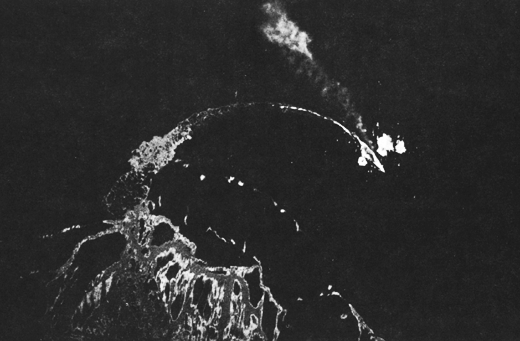
B-17 bombers attack the damaged Hiei. 13 November 1942.
Eight minutes after the fighting began, Abe cancelled the bombardment and ordered his surviving ships to withdraw. On the American side, command had devolved to Capt. Gil Hoover of Helena, who ordered disengagement at 0226. Only six American ships, of the sixteen that began the battle, could steam away under their own power. The Japanese, desperate to get the wounded Hiei out of range of the inevitable American air attack that would come when the sun rose, drew away to the north.
Hiei limped away at five knots, her crew trying desperately to stem the flooding so that they could make repairs. Abe transferred to the destroyer Yukikaze, while the destroyers Teruzuki, Shigure, Shiratsuyu, and Yugure formed an escort for the stricken battleship. Abe ordered Kirishima to turn back and establish a tow line once daylight came, but during her approach the American submarine Trout spotted her and launched five torpedoes, obtaining one hit. The torpedo failed to explode, but it was enough for Kirishima’s Capt. Sanji Iwabuchi to turn back.
The planes came at dawn. Avenger torpedo bombers assigned to Enterprise but operating from Henderson Field hit the slow-moving target with three torpedoes. They returned to base, re-armed, and came back just before mid-day to hit Hiei three more times. B-17 heavy bombers flew over and hit the circling battleship at least five times. The destroyers took off the surviving crew and finished the ship with still more torpedoes; 188 men died aboard Hiei.
On the Japanese side, Kirishima escaped with one 8-inch hit that did minor damage, and seven men killed by automatic weapons fire. Nagara, hit by one 5-inch shell, lost six men killed but likewise suffered only minor damage. Destroyers Yudachi and Akatsuki had been sunk. Amatsukaze suffered heavy damage, Samidare, Murasame, and Ikazuchi more moderate damage. Asagumo, Inazuma, Yukikaze, and Teruzuki escaped undamaged. Shigure, Shiratsuyu, and Yugure did not participate.
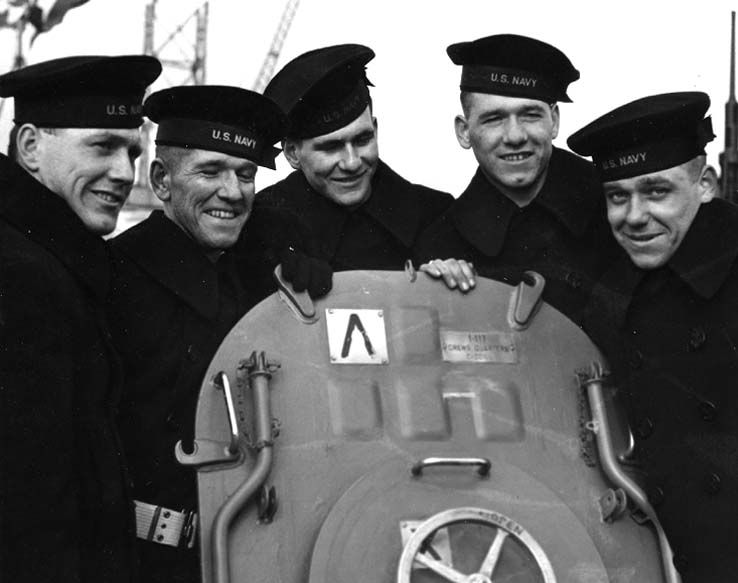
All five Sullivan brothers died with their ship, the anti-aircraft cruiser Juneau.
Atlanta attempted to follow Hoover’s group, but sank, leaving Hoover with his own cruiser plus the shattered San Francisco, the damaged anti-aircraft cruiser Juneau, the badly-damaged destroyer Sterett, and the undamaged destroyers Fletcher and O’Bannon. Hoover dispatched O’Bannon to a spot north of San Cristobal Island, the island south-east of Guadalcanal, to transmit his after-action report so as not to give away his position as his ships exited Ironbottom Sound and turned south for Espiritu Santo.
As they did so, Sterett pretended to depth-charge a sonar contact, probably the Japanese submarine I-26; the destroyer’s own sonar had been knocked out in the battle and her depth charges jettisoned An hour later, I-26’s Commander Minoru Yokota fired three torpedoes (all that he had available, as three of his sub’s tubes had been damaged when I-26 hit a coral reef in October) at the limping San Francisco. All three missed, but one almost hit Helena and another did strike Juneau amidships. The already-damaged cruiser’s magazine exploded; she broke in half and sank in less than 20 seconds, killing all but 115 of her crew of 678. Of the five Sullivan brothers of Waterloo, Iowa serving aboard Juneau, three were killed instantly, one drowned the next day and the last four or five days later.
With men in the water, Hoover ordered his now-reduced group to continue onward and abandon Juneau’s survivors. They remained adrift for four days before a PBY Catalina flying boat spotted the remaining survivors. The plane took six aboard, the seaplane tender Ballard picked up one more, and three made it to a small island where they were later rescued. The other 105 men died from exposure and drowning, or were ripped apart by sharks.
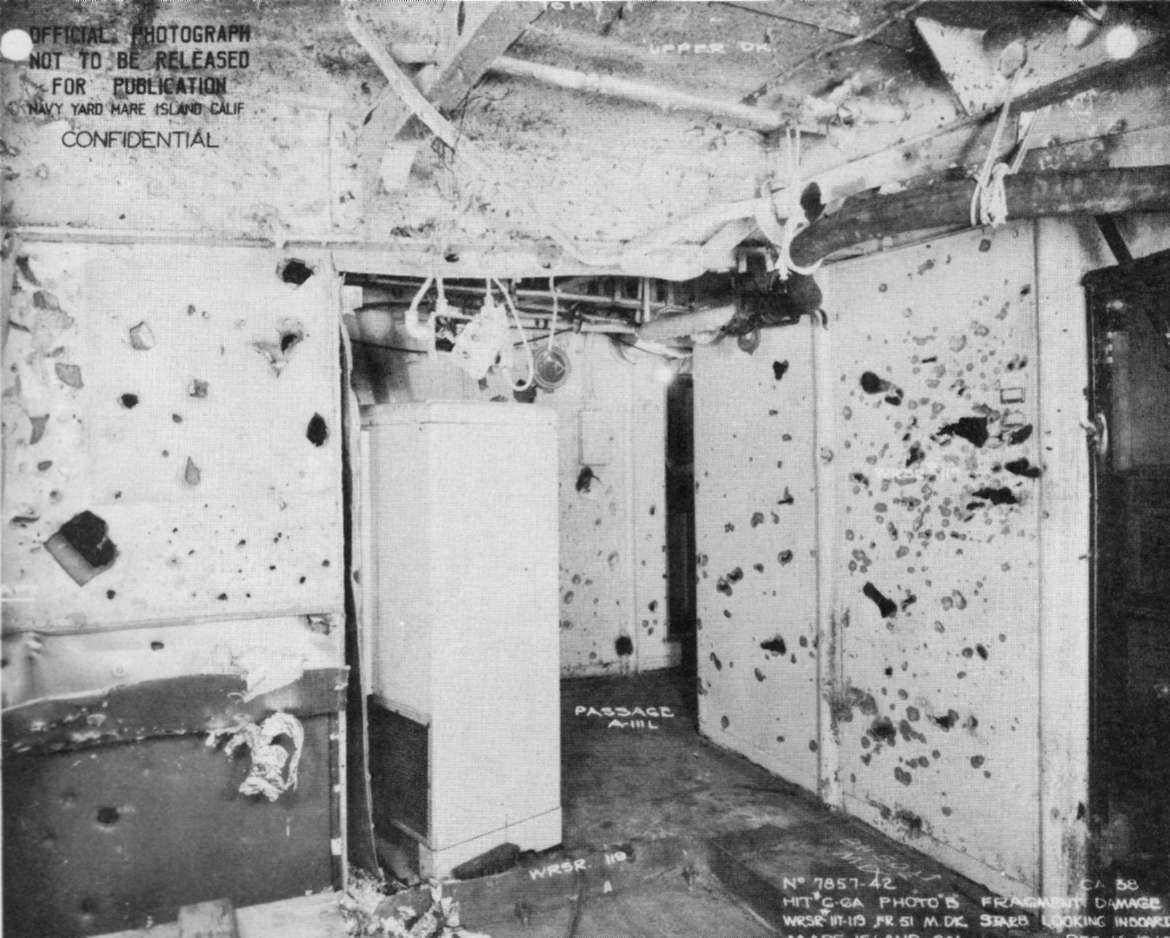
The splinter-riddled remains of San Francisco’s wardroom. Official photo from the ship’s damage report.
Hoover reported his decision to Halsey as soon as his ship arrived at Luganville on Espiritu Santo; Halsey fired him on the spot, yet did nothing to search for the survivors callously abandoned by Hoover. Chester Nimitz, the Pacific theater commander, confirmed Halsey’s decision and decreed that Hoover would never serve at sea again.
On the Japanese side, Yamamoto fired Abe, and directed Second Fleet commander Nobutake Kondo to take direct command of the next battleship mission into Ironbottom Sound. The effort to reinforce Guadalcanal would continue.
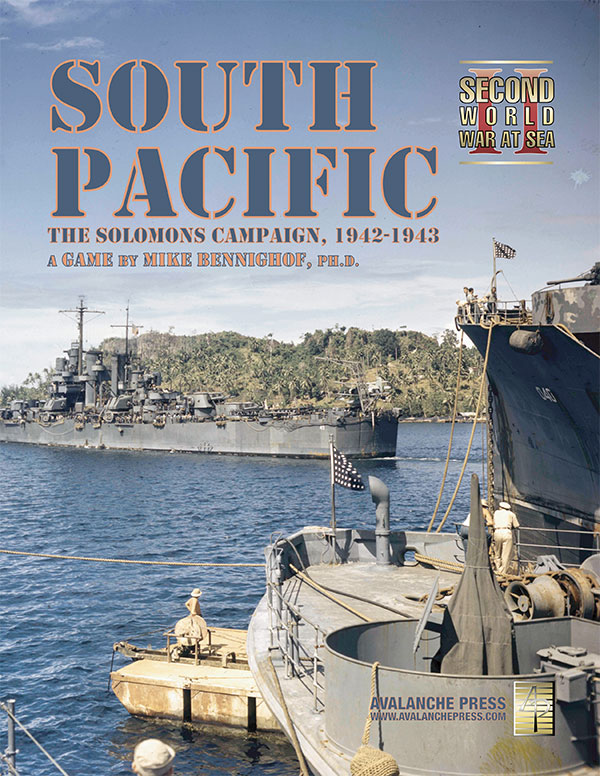
Order South Pacific Here.
Ironbottom Sound is a scenario book that expands Second World War at Sea: South Pacific. It comes with 36 new scenarios for South Pacific, extending the story through the Battle of Tassafaronga. All of the maps and pieces needed are included in South Pacific; the companion history book, Solomons Naval Campaign, comes bundled with Ironbottom Sound.
Order Ironbottom Sound Here.
Includes Solomons Naval Campaign book.
Order Solomons Naval Campaign Here.
Companion piece to Ironbottom Sound, or just read it separately.
Sign up for our newsletter right here. Your info will never be sold or transferred; we'll just use it to update you on new games and new offers.
Mike Bennighof is president of Avalanche Press and holds a doctorate in history from Emory University. A Fulbright Scholar and NASA Journalist in Space finalist, he has published a great many books, games and articles on historical subjects; people are saying that some of them are actually good.
He lives in Birmingham, Alabama with his wife, three children, and new puppy. He misses his lizard-hunting Iron Dog, Leopold.
Daily Content includes no AI-generated content or third-party ads. We work hard to keep it that way, and that’s a lot of work. You can help us keep things that way with your gift through this link right here.
|