| Sea of Iron:
Publisher’s Preview
By Mike Bennighof,
Ph.D.
July
2026
 When we released Second World War at Sea: Sea of Iron in 2015, I thought we’d crafted a very fine game, filled with both historical action and battles that might have been. Sea of Iron covers World War II in the Baltic from 1939 to 1945, which makes it quite different from games like Midway or Bismarck. The Baltic Sea is tiny, as seas go, but the Swedes, Soviets and Germans (and some smaller powers) bring many ships and planes to the table. A clash is pretty much inevitable. When we released Second World War at Sea: Sea of Iron in 2015, I thought we’d crafted a very fine game, filled with both historical action and battles that might have been. Sea of Iron covers World War II in the Baltic from 1939 to 1945, which makes it quite different from games like Midway or Bismarck. The Baltic Sea is tiny, as seas go, but the Swedes, Soviets and Germans (and some smaller powers) bring many ships and planes to the table. A clash is pretty much inevitable.
The new Playbook Edition includes the fully-revised Second Edition series rules, plus full-color play aids. The map’s been moved to a full-sized (28x22 inches) paper map; the play area is 18x12 inches with the rest taken up by charts and such. The pieces remain the same from the first edition: 560 of them, 140 of those double-sized ship pieces and the rest markers, small warships and transports, and airplanes. A great many airplanes.
What’s radically different are the scenarios. Sea of Iron may have been the last game we published before switching to the story-arc format that now dominates almost everything we publish. The first edition had 36 scenarios (16 operational scenarios, the ones that use the map of the Baltic Sea and may lead to tactical combat, and 20 battle scenarios, the ones that just use the tactical procedure). They were just presented in chronological order, with no connection between them. The Playbook edition retains 19 of the original scenarios, some of them heavily revised, and 22 new ones for a total of 41 scenarios.
In the story-arc format, scenarios are organized into chapters, with each chapter telling a story and using the scenarios to help move that narrative along. It’s unique in the world of wargames: you can still pick and choose individual scenarios to play, or you can play along with the story and see for yourself where the major inflection points lie.
The old edition of Sea of Iron had scenarios that didn’t fit my new vision of what the game should be. That set went very heavily into hypotheticals, in order to maximize surface action. In the decade-plus since that design, I’ve seen that the story-arc format can yield the same level of action, without having to compromise the story.

The Playbook Edition, therefore, puts its emphasis on the five major naval campaigns that took place on the Baltic during the war: the September 1939 invasion of Poland, the 1939-40 Winter War, the 1941 Axis sneak attack on the Soviet Union, and the 1944 German collapse on the Eastern Front. Those yielded plenty of possibilities to play with battleships, without going well off the historical events.
That also left some leftovers, chiefly focused on Sweden: the Swedes intervening in the war against the Soviets, and Sweden invaded by the Germans (an actual war plan). We’ll come back to the latter fairly soon with a Campaign Study, because it’s a chance to play with the Swedish fleet and the Germans.

The first chapter tackles the first naval campaign of World War II, as Germany invades Poland by land and seeks to wipe out Polish sea power. The Poles have a small squadron of very good and extremely well-manned destroyers, and some submarines. Poland intended for her fleet to fend off Soviet attacks on aid convoys coming from her ally, France; with Germany as the enemy, the little fleet had far less purpose and the Polish naval command sent it to Britain, where the ships and crews performed superbly.
We have scenarios for that daring escape. But Polish taxpayers gave their zlotych for a fleet that would fight for Poland, not for Britain. We also look at Polish opportunities to strike a blow against the Germans at sea; the rather lackadaisical German war planning pretty much overlooked the possibility that the Polish squadron might double back to catch them in a weakened state. So even in what seems like a hopeless mismatch, Poland is not yet lost.

Chapter Two, the Winter War, needed more extensive work, and more scenarios to flesh out the full story. The prior edition didn’t give proper due to Finnish coastal defenses: a network of heavy coastal defense guns, including 305mm (12-inch) guns in armored turrets, with the range of fire control to dominate Finnish coastal waters. Estonia had a similar network n the other side of the Gulf of Finland, and together they could constrict most of the open water with minefields to close the narrow gap between their coverage zones. We also didn’t give proper due to the odd nature of the Finnish skerries (the planet’s densest zone of small islands and rocks), and now have special rules for combat there.
If German naval planning for the war with Poland was lackadaisical, Soviet naval planning for the Winter War was non-existent. They should have easily deployed enough force to crush any Finnish response, but they didn’t. The Finnish armored ships have a chance. The Soviets also made no allowance for Swedish naval intervention, even as the Red Army staff fretted about the Swedish Army showing up on land.
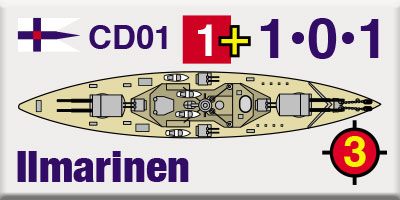
In June 1941, the Germans did have a plan for the naval side of Operation Barbarossa: together with their Finnish allies, mine the hell out of the Baltic. The Soviets pretty much had the same plan. Neither side appears to have given much thought to stopping the other side’s plans. The opportunity is there for either of them to do so. The chapter extends into the opening year of the Great Patriotic War, so we also cover the Soviet evacuation of Tallinn, the doomed Finnish Operation Nordwind, and the German assembly of a Baltic Fleet to contest a feared breakout of the Soviet Baltic Fleet’s heavy ships to neutral Sweden.
Chapter Four resumes the action with the German retreat from Russia itself into the Baltic States, and then out of the Baltic States. That means evacuations, shepherded by German warships, while the Soviets are trying to interfere. They’ll do so mostly with aircraft and submarines, but they still have a surface fleet (though it’s kind of rusty, both literally and metaphorically). The Germans are in disarray, so even a rusty fleet is a dangerous opponent.

And that’s the new Sea of Iron: 560 pieces, one full-sized paper map, one tactical map, rules and 41 scenarios. It’s a very fine package.
Order Sea of Iron (full game) Here.
Order Sea of Iron (Anarchy) Here.
No rules!
You’ll need the Second Edition rules from another Second World War at Sea game. Earlier edition rules will not work with this game.
Sign up for our newsletter right here. Your info will never be sold or transferred; we'll just use it to update you on new games and new offers.
Mike Bennighof is president of Avalanche Press and holds a doctorate in history from Emory University. A Fulbright Scholar and NASA Journalist in Space finalist, he has published a great many books, games and articles on historical subjects; people are saying that some of them are actually good.
He lives in Birmingham, Alabama with his wife and three children.
Daily Content includes no AI-generated content or third-party ads. We work hard to keep it that way, and that’s a lot of work. You can help us keep things that way with your gift through this link right here.
|