Ironbottom Sound:
Design Notes
by Mike Bennighof, Ph.D.
October 2025
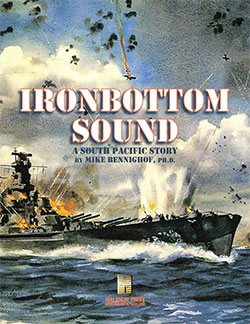 Ironbottom Sound is a scenario book that expands Second World War at Sea: South Pacific. It comes with 31 new scenarios for South Pacific, expanding the story and extending it through November 1942. All of the maps and pieces needed are included in South Pacific; the companion history book, Solomons Naval Campaign, comes bundled with Ironbottom Sound. Ironbottom Sound is a scenario book that expands Second World War at Sea: South Pacific. It comes with 31 new scenarios for South Pacific, expanding the story and extending it through November 1942. All of the maps and pieces needed are included in South Pacific; the companion history book, Solomons Naval Campaign, comes bundled with Ironbottom Sound.
I like writing history, both in narrative form (you know, like a book) and in game form. It’s the storytelling that I find fascinating, that, and discovering things and fitting them together to figure out why things happened.
The Solomons naval campaign of 1942 has plenty of story-telling opportunities, and we brought them out in game form with Second World War at Sea: South Pacific. South Pacific has 42 scenarios, starting with the beginning of the campaign and running through the Second Naval Battle of Guadalcanal (the 15 November 1942 slugfest in Ironbottom Sound also called the “Battleship Action”).
Second World War at Sea games are, as the name says, about naval campaigns and battles. They come with two types of scenarios: the operational scenario, which takes place on the operational map. That’s where fleets (and air groups) move and look for each other. When they fight, the action moves to the Tactical Map. Battle scenarios skip straight to the Tactical Map. That’s where ships fire at each other with guns and torpedoes.
That’s the basics. Those 42 scenarios in South Pacific tell a very solid story; we have all of the major naval actions around Guadalcanal from the invasion through the brutal night battles of mid-November that decided the campaign. South Pacific is an outstanding game, the crown jewel of the greatest naval wargame series ever made.
I still wanted to do more.
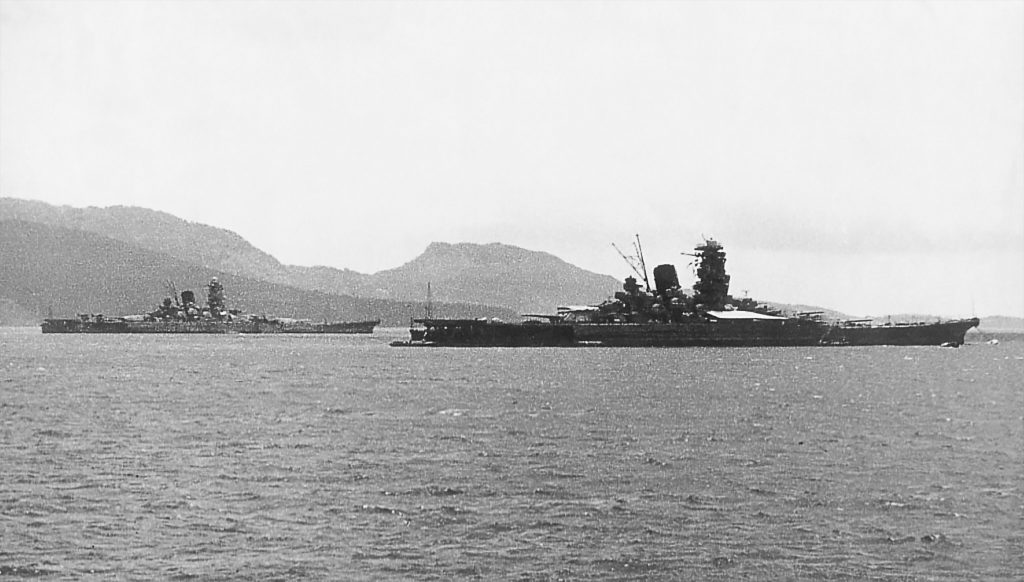
Hotel Yamato (left) and sister ship Musashi. Truk Lagoon, sometime in 1943.
I’ve come to understand that the game format can tell a story in many ways just as effectively as the narrative format. We’ve been doing this for a while now, what we call the story-arc format. South Pacific fit that very well, and I managed to get all of the famous battles into the package and tell what I consider a compelling, coherent story.
I faced some limits in crafting that story. The scenario book could not go over 64 pages and still fit in the game box (the first printing of South Pacific came in a box). And we aim for a scenario set of at least 30 but fewer than 50 scenarios. Anything more than that actually lowers sales, as some potential customers fear that they’ll never play them all.
While I do indeed have a doctorate in history from a top-flight grad program (just ask them, they’ll be glad to tell you), the Solomons campaign was never one of my research interests. I plunged into the project because I knew players would want the game, and that meant reading a great deal of secondary literature, and then looking into primary materials. Many of the after-action reports were available online; access to Department of Defense web resources has become rather dodgy in recent months. On the other hand, a lot of Japanese-language material has become available in recent years, and though machine translations are often unreliable (I don’t read Japanese), there’s a lot of information to be gained and insight into Japanese naval thinking.
While there’s a lot of literature devoted to the campaign, I still found myself asking questions that I wanted to study through game-play. While still a teenager first playing around with game design, my mentor and friend, the late Jack Greene, had told me that the Solomons campaign represented Japan’s only chance to win the war, as the moment to “jump down our throats with everything they had.” The late historian John Prados, another old friend (and game designer) said similar things from another angle, pointing to the Solomons rather than Midway as the moment when Japan irrevocably lost the war.
I’m not sure that I fully agree with either proposition; to my mind, Japan lost the war when the first bomb fell on Pearl Harbor. But I do find the question a compelling one: could the Japanese have scored a strategic victory in the Solomons, through greater commitment of forces and resources? And is it reasonable to posit that those forces and resources existed and could have been brought to bear?
I devoted one of the book’s two new chapters to this question, and most of the other new chapter as well. The first such chapter (Chapter Zero) looks at Japanese plans to make the new Lunga Point airfield (that the Americans would capture just before it became operational, and re-name Henderson Field) the linchpin of new offensive moves against New Caledonia and the New Hebrides. Despite the defeat at Midway and loss of four heavy carriers, the offensive mindset continued to hold sway. The Americans pre-empted these plans with their own offensive.
Without those four carriers, it’s a shoestring operation even with the base at Lunga Point. How feasible was it? You can play it out for yourself, but the commitment of not only ships and planes but fuel oil and the tankers to move it would have meant foregoing other operations (chiefly, in New Guinea) and would have required involvement by an un-cooperative Imperial Army.
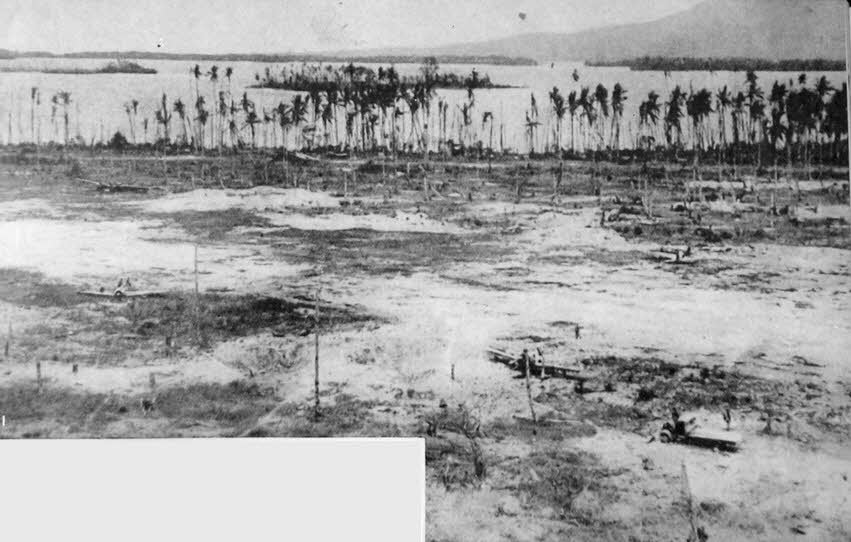
Munda Point Airfield, soon after its 5 August 1943 capture.
The other possibility came toward the end of the Guadalcanal campaign, when the Japanese high command belatedly realized that maybe they should build another airfield closer to Guadalcanal and not force their planes and pilots to fly from Rabaul at the very edge of their range. The order to build a field at Munda in the New Georgia Islands came too late to make much of a difference. Japanese construction abilities did not match those of the U.S. Navy Seabees, but were not negligible, either. The Japanese builders had less heavy equipment, and so relied on more manual labor (chiefly Korean conscripts). But they were actually good at their jobs, and could have had the airfield ready sooner, had the order come as soon as the Combined Fleet command realized that the Americans had come to stay.
The same directive called for a much greater commitment of carrier and surface forces, as soon as damage from the Battle of the Santa Cruz Islands had been repaired and air groups replenished. Those forces would instead cover the evacuation of Guadalcanal, but we get to use them offensively.
And beyond those new questions, I had more to say in the existing chapters. I added additional operational and battle scenarios to four of the five South Pacific chapters, both to try out some alternative possibilities, but mostly to break down the major battles (like Eastern Solomons and Santa Cruz) into smaller scenarios starting at decisive moments so that you as the player can make different decisions at the crux of the battle.
My initial vision for Ironbottom Sound had been to include a historical essay for each chapter, both the completely new ones and those from South Pacific. That quickly overwhelmed the available space, so I decided to split the project into a scenario book (Ironbottom Sound) and a history book (Solomons Naval Campaign). I’d already decided to do another project this way (Black Panthers/Separate But Heroes).
I wrote/designed Ironbottom Sound and Solomons Naval Campaign side-by-side, so while Solomons Naval Campaign is not a game book (it’s just the history), that history reflects the issues shown in the game scenarios. Even then, I ran out of space. I wanted to include historical chapters on those Japanese invasion plans, and about the older American battleships. But those landed on the cutting room floor. For Ironbottom Sound, so did the evacuation of Guadalcanal and the New Georgia campaign. We’ll be back to the Solomons in the future. For now, though, we have a very satisfying expansion to the South Pacific story.
Order South Pacific Here.
Order Ironbottom Sound Here.
Includes Solomons Naval Campaign book.
Order Solomons Naval Campaign Here.
Companion piece to Ironbottom Sound, or just read it separately.
Sign up for our newsletter right here. Your info will never be sold or transferred; we'll just use it to update you on new games and new offers.
Mike Bennighof is president of Avalanche Press and holds a doctorate in history from Emory University. A Fulbright Scholar and NASA Journalist in Space finalist, he has published a great many books, games and articles on historical subjects; people are saying that some of them are actually good.
He lives in Birmingham, Alabama with his wife and three children. He misses his lizard-hunting Iron Dog, Leopold.
Daily Content includes no AI-generated content or third-party ads. We work hard to keep it that way, and that’s a lot of work. You can help us keep things that way with your gift through this link right here.
|