Manila Bay 1898:
The Battle, Part One
by Mike Bennighof, Ph.D.
July 2026
 As soon as the American armored cruiser Maine exploded in Havana’s harbor, war between the United States and Spain appeared inevitable to most observers. The Americans began preparations almost immediately, but the Spanish reacted with much less urgency. As soon as the American armored cruiser Maine exploded in Havana’s harbor, war between the United States and Spain appeared inevitable to most observers. The Americans began preparations almost immediately, but the Spanish reacted with much less urgency.
Rear Admiral Patricio de Montojo, commanding the Spanish Pacific Squadron based in Manila, and Basilio Augustín, Captain-General of the Philippines, had no doubt that the American Asiatic Squadron would attack them as soon as war was declared. The Americans moved to Hong Kong, just across the South China Sea from the Philippine capital Manila, even before word came of Maine’s destruction. And while Montojo saw little that he could do to repel them, Augustín insisted that any war with the United States would be short and end in a decisive Spanish victory.
Spain had held the islands for well over three centuries, and for most of that time had ruled them from Mexico City. Direct communications with the archipelago remained limited decades after Mexican independence; a telegraph line, ordered in 1867, finally began operations in 1880. Unrest had built since the 1860’s, and in 1896 exploded into open rebellion as the central government had no wish to even hear the islanders’ rather mild demands for legal, social, and political equality with Peninsular Spaniards.
Harsh measures at first failed to quell the rebellion, and the Navy saw a great deal of action. Ships patrolled the more than 1,200 islands of the archipelago (the Spanish did not count uninhabitable rocks and reefs as islands) and sailors often fought ashore as naval infantry. Intercepting shipments of arms to anti-Spanish rebels (both Emilio Aguinaldo’s Katipunan movement on Luzon, and the ever-simmering Moro rebellion on Mindanao) became the Pacific Squadron’s primary task. Fighting eased some in December 1897 after the Spanish authorities signed a truce with the rebel leadership, bribing them to stop fighting. Aguinaldo took the Spaniards’ money, and promptly used it to buy weapons.
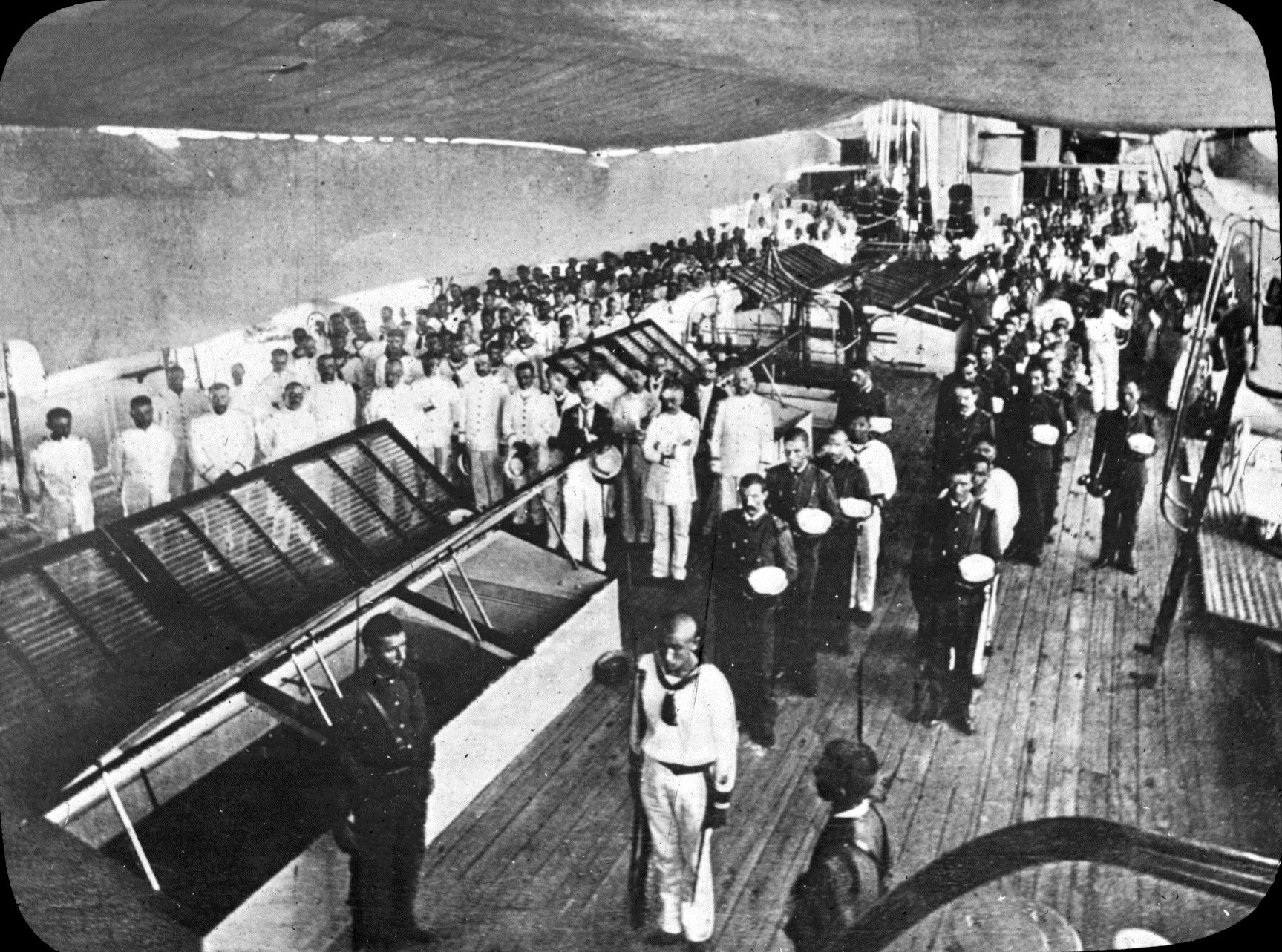
The crew of the Spanish flagship Reina Cristina follows word of the Spanish declaration of war with a prayer. 24 April 1898.
Montojo had served in the Philippines as a junior officer, fighting rebels there, and that remained his focus when he returned to command the Pacific Squadron in early 1898. Once Maine exploded on 15 February, the rest of the world understood that a Spanish-American war would likely follow. Montojo apparently did nothing to address that looming possibility, even as the Americans reinforced their Asiatic Squadron and moved it to Hong Kong to threaten Manila. He instead sketched plans for cheap gunboats for anti-insurgent missions, forwarding these to Madrid with an urgent plea that they be constructed. He did not, at this time, ask for reinforcements, ammunition, mines, or torpedoes.
When he arrived in the islands in early 1898, Montojo inherited 37 warships, most of them small gunboats of limited military value. Of his larger ships, all of them badly needed maintenance, and two of his seven cruisers could not even get their engines to turn over, while a third constantly took on water from leaks around her propellor casing. None of his ships had armor protection, beyond a thin armored deck on two of the smaller cruisers; one of the larger cruisers had a wooden hull.
The Pacific Squadron had been neglected for years, as the emphasis went to reinforcing and supplying the army garrison (perhaps 15,000 regulars and 10,000 locally-raised troops). Rather than an immediate start on repairs and overhauls, Montojo deployed his operable ships (including the flagship Reina Cristina) on patrols to make sure that the rebels had kept up their end of the December 1897 bargain. The Spanish usually sent their ships across the South China Sea to Hong Kong for drydock work; in fairness to Montojo doing so now, with the British very obviously willing to bend their neutrality in the Americans’ favor, probably would have been a bad idea. A large and innovative floating drydock of 11,000 tons’ capacity, capable of lifting any warship in Spanish service, had been ordered for the new Subic Bay naval yard, just west of the capital outside Manila Bay. Robert Stephenson of Tyneside, the British manufacturer, had just finished the dock but not yet commenced the immense towing job. The British government embargoed its export once war was declared, and afterwards it would be taken to the Spanish naval base at Port Mahón in the Balearic Islands.
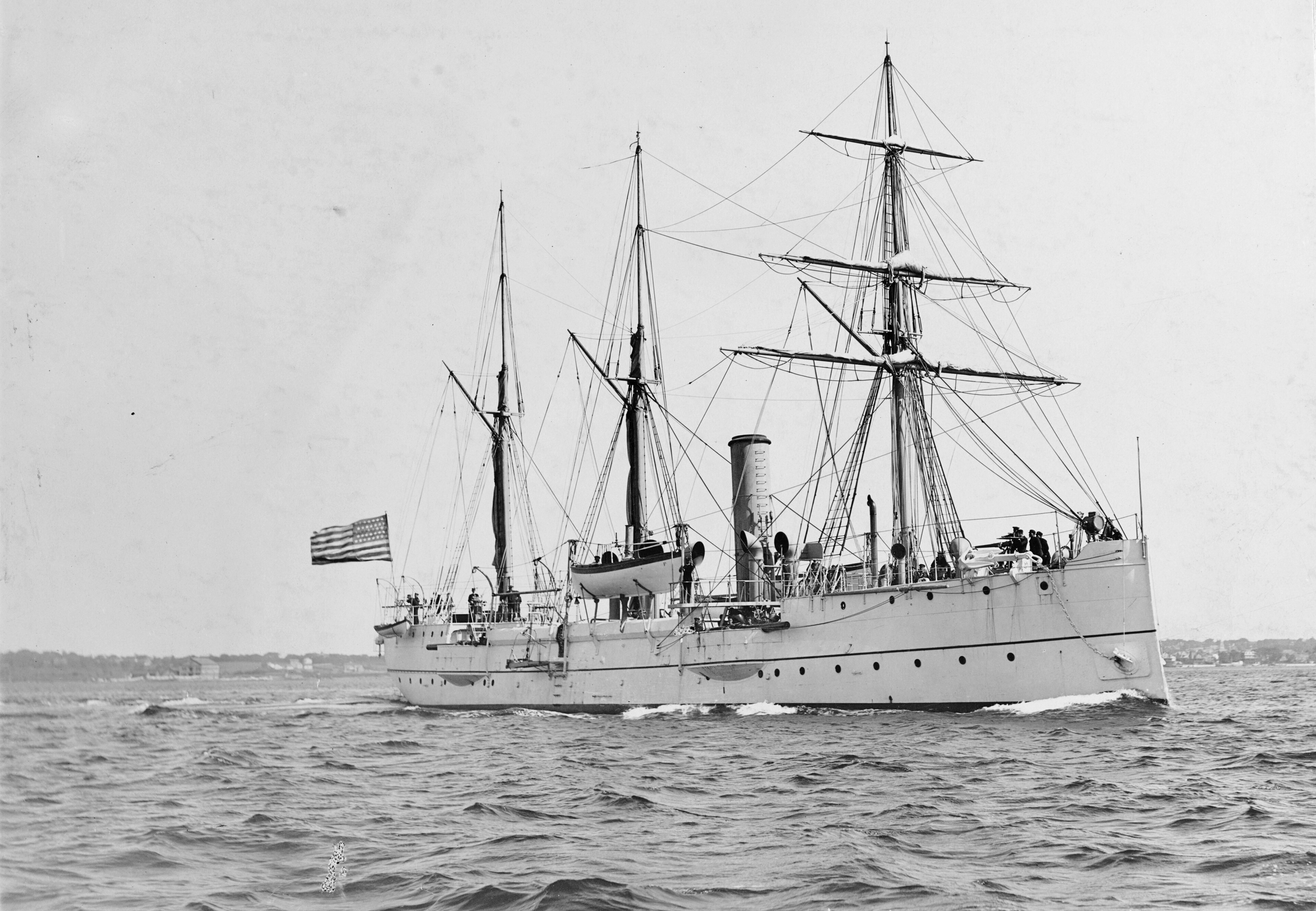
American 867-ton gunboat Petrel, known as the “Baby Battleship” for her improbable armament of four 6-inch guns.
Spain declared war on the United States on 23 April, following a series of American provocations, and only then did Montojo or his superiors in Madrid start to show any sense of urgency. The Spanish made frantic repairs to their ships, and the Navy Ministry ordered its forces in European waters to concentrate at Cadiz to form a reinforcement squadron bound for Manila. Montojo sought mines and torpedoes in the arsenals, finding few of the former and none of the latter. He ordered coast-defense batteries prepared, but when the Americans arrived on 1 May, most of the guns had not yet been mounted.
Worse yet, his crews had spent more time fighting ashore as naval infantry than in training for their actual assignments aboard their ships. Given the gift of two full months to drill his crews, Montojo did nothing to prepare his men for war. Faced with decrepit ships, manned by men more comfortable with a rifle than a naval gun or engine, without mines or coastal guns to augment his defense or channel American movement, or torpedoes to help balance the American advantage in firepower, Montojo had few good options. And while he was not responsible for all or even most of these deficiencies, he had done nothing to correct them.
And perhaps worst of all, the Americans knew all about his problems, thanks to detailed reporting from the United States consul in Manila, Oscar F. Williams. The Spanish authorities did not expel Williams from Manila until the declaration of war had become official, nor limit his access to the telegraph. The Spanish also had reports from their own consul in Hong Kong about the American squadron’s preparations (gathering vessels from distant stations, clearing their ships of combustibles, distributing ammunition newly-arrived from the States), but these apparently did not move Montojo until the declaration of war.
On the American side, George Dewey relieved Frederick V. McNair as commodore of the Asiatic Squadron, then at Nagasaki, Japan, on 3 January 1898. McNair believed that the most likely flashpoints lay at Port Arthur in Manchuria, where the British and Russians both sought to take over the Imperial Chinese naval base, and Tsingtao, where the Germans sought to seize the port. Assistant Secretary of the Navy Theodore Roosevelt, who had pressed for Dewey’s appointment, told him to prepare for an American war with Spain.
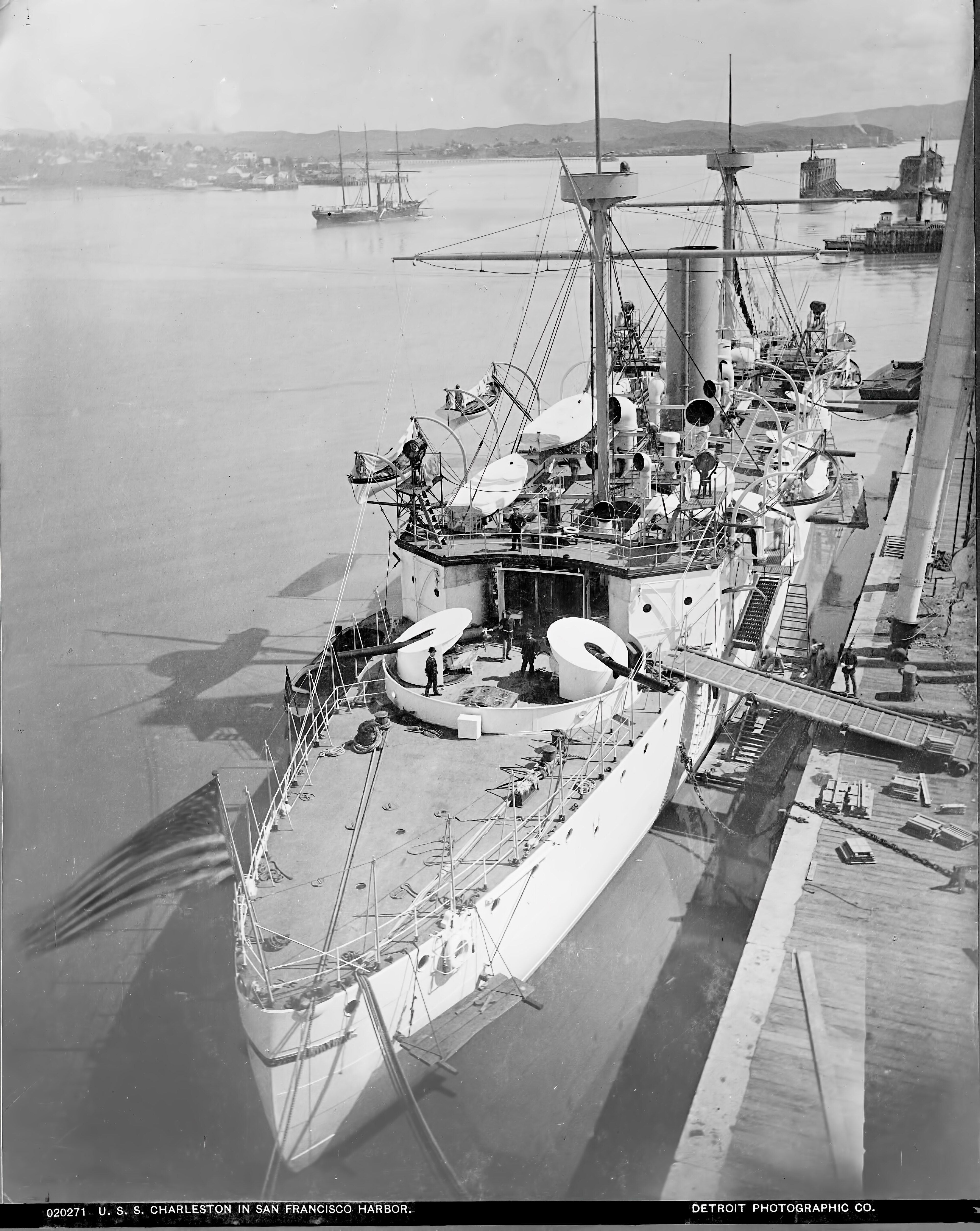
American cruiser Charleston, shown here at San Francisco, would not make it in time for the battle.
Dewey remained in Japanese waters for the next month, until Roosvelt ordered him to move to the British colony of Hong Kong. Dewey departed Yokohama on 11 February and arrived at Hong Kong on the 17th. He immediately wrote to Williams, asking about Spanish deployments, and on the following morning (18 February) learned that the armored cruiser Maine had exploded in Havana on 15 February.
Dewey had his flagship, the protected cruiser Olympia, the outdated protected cruiser Boston, and the gunboat Petrel, which had been involved in clandestine missions to support the Philippine guerilla movement. Well before the Maine explosion, Roosevelt had ordered the cruiser Raleigh, then the American station ship in the Levant, to pass through the Suez Canal and join Dewey at Hong Kong; she arrived on the 18th.
The revenue cutter McCullough, built at Philadelphia, had commissioned in December 1897. She had left for a cruise across the Atlantic, through the Suez Canal and on to California, where she would be stationed. When she reached Singapore on 8 April, new orders sent her to Hong Kong instead to join Dewey’s squadron.
Roosevelt sent the gunboat Concord, just returned to San Francisco from a patrol off Alaska, with a load of ammunition. His boss, Secretary of the Navy John D. Long, ordered the mothballed screw sloop Mohican re-commissioned, loaded with the rest of the ammunition available at San Francisco’s Mare Island Navy Yard and sent to Hawaii. There, she would transfer her cargo to the American station ship in the Hawaiian Islands, the cruiser Baltimore, and replace her on station while Baltimore steamed to Hong Kong to join Dewey. The cruiser Philadelphia, the long-time flagship of the Pacific Station, had de-commissioned in December at Mare Island, and was not brought back into service until July. The yard’s efforts went to bringing Charleston, Baltimore’s sister ship, back into service; she had de-commissioned in July 1896 but did not sail until 21 May despite frantic work. While awaiting developments in Hong Kong, Dewey prepared his ships for action, removing combustible furniture, pianos and woodwork, and drilling his crews.
Order Manila Bay Here.
Order Remember the Maine Here.
Order Remember the Maine (Anarchy) Here.
No rules! You’ll need the Second Edition rules from another Great War at Sea game. Earlier edition rules will not work with this game.
Sign up for our newsletter right here. Your info will never be sold or transferred; we'll just use it to update you on new games and new offers.
Mike Bennighof is president of Avalanche Press and holds a doctorate in history from Emory University. A Fulbright Scholar and NASA Journalist in Space finalist, he has published a great many books, games and articles on historical subjects; people are saying that some of them are actually good.
He lives in Birmingham, Alabama with his wife and three children.
Daily Content includes no AI-generated content or third-party ads. We work hard to keep it that way, and that’s a lot of work. You can help us keep things that way with your gift through this link right here.
|