Manila Bay 1898:
The Battle, Part Two
by Mike Bennighof, Ph.D.
August 2026
 While Dewey had ammunition, and could acquire food for his crews at Hong Kong, his ships also needed coal. Responding to Secretary Long’s urgent request, Commodore Arent S. Crowninshield, overseeing logistics for the Naval War Board, sought coal on the U.S. West Coast. He found none of sufficient quality and quantity, and instead suggested that the Navy buy a load in England and send it to Hong Kong. Told to buy coal wherever he could find it, Dewey purchased a British collier, Nanshan, with her load of coal and a freighter, Zafiro, to act as a store ship. He ignored orders to commission both ships into the Navy; as civilian vessels, they could enter neutral ports to buy coal and supplies. Each retained their civilian crew, with a single naval officer placed in command. While Dewey had ammunition, and could acquire food for his crews at Hong Kong, his ships also needed coal. Responding to Secretary Long’s urgent request, Commodore Arent S. Crowninshield, overseeing logistics for the Naval War Board, sought coal on the U.S. West Coast. He found none of sufficient quality and quantity, and instead suggested that the Navy buy a load in England and send it to Hong Kong. Told to buy coal wherever he could find it, Dewey purchased a British collier, Nanshan, with her load of coal and a freighter, Zafiro, to act as a store ship. He ignored orders to commission both ships into the Navy; as civilian vessels, they could enter neutral ports to buy coal and supplies. Each retained their civilian crew, with a single naval officer placed in command.
On 26 February, Roosevelt sent Dewey a telegram ominously headed, “Prepare for war.” Roosevelt told Dewey to see to his coal supplies, and to attack first the Spanish squadron and then the defenses of Manila should war break out. On 14 March, Williams sent a cable to Dewey, recounting the coastal defenses of Manila Bay (mostly old and unmounted guns, no mines or torpedoes, the only true coastal batteries at Manila itself). He noted that the Spanish had been informed that Dewey possessed seven warships and would attack Manila in the event of war (Dewey had five warships at the time, but had indeed been ordered to attack Manila). On 29 March the United States sent an ultimatum demanding that the Spanish leave Cuba, and on 19 April recognized Cuban independence. Two days later, Spain broke off diplomatic relations, and on the 23rd, Spain declared war on the United States. The U.S. Congress responded in kind two days later, back-dating the state of war to the 21st.
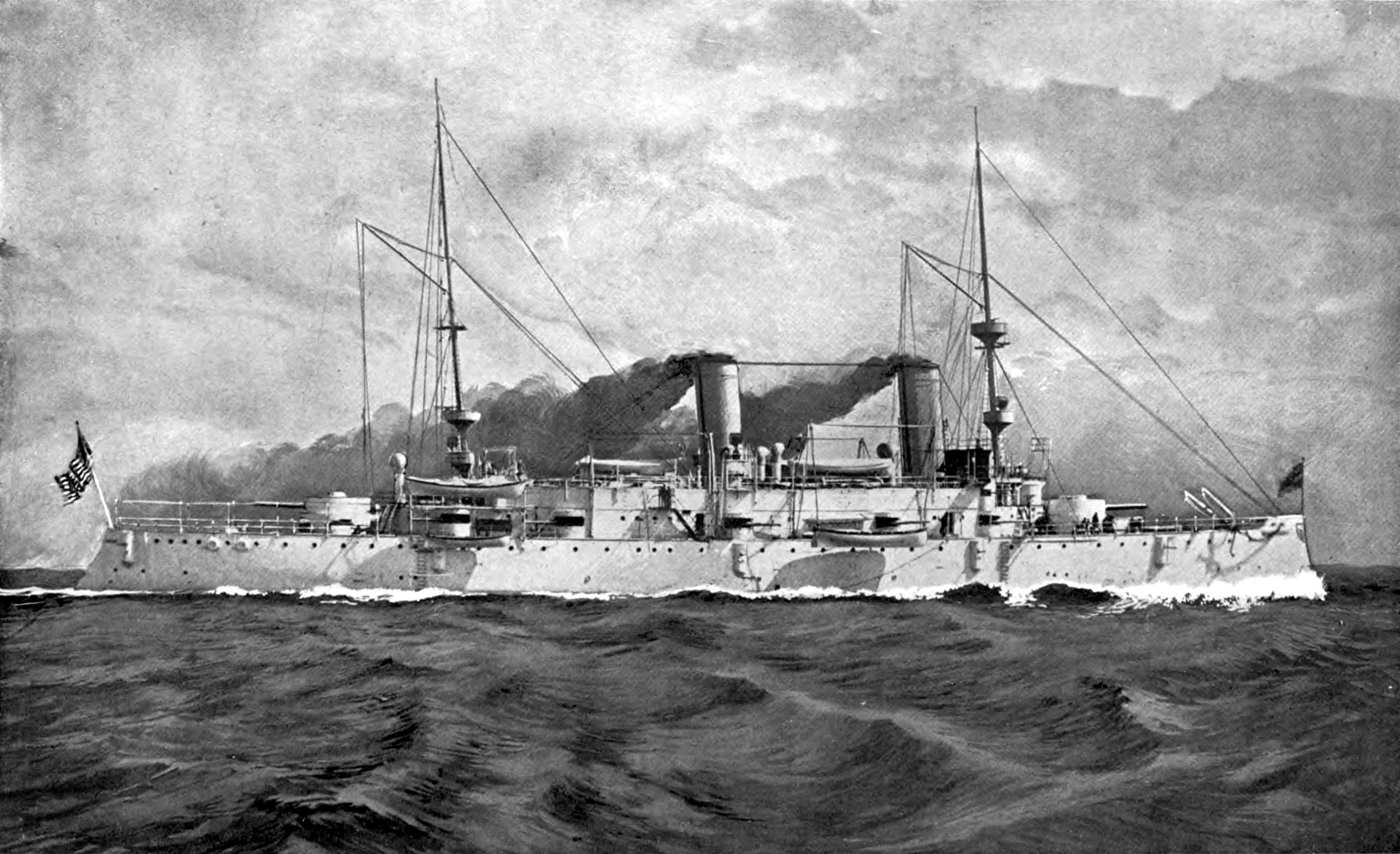
Dewey’s flagship, the protected cruiser Olympia.
Also on 25 April, though not yet aware of the declaration of war Dewey moved his squadron to Mirs Bay, within Chinese territorial waters at the time (it would become British-ruled in June 1898). They made final preparations (chiefly, painting over the rather lively white peacetime hulls and upperworks with gray) while waiting for Williams to join them with any last-minute information. Williams joined the squadron on 27 April, and Dewey set out for Manila that same day.
Spain’s declaration of war finally spurred Montojo to activity. On the 25th, the same day that Dewey moved to Mirs Bay, Montojo took his squadron to Subic Bay, just outside Manila Bay and fronting the South China Sea to the west. The Spanish had hoped to build a modern naval base there, but the work had not progressed far and none of the planned coast-defense guns had been installed though most of them had been delivered. Montojo found no mines or torpedoes in the arsenal there; his report does not address why he only searched the Subic arsenal now and not in February. The only steps taken had been the scuttling of the ancient gunboat San Quentin and two merchant ships in the eastern entrance channel, forcing any enemy to pass close to the toothless battery on Grande Island in the middle of the entrance to Subic Bay.
Montojo fretted that the bay’s deep water (40 meters) would make it difficult for his sailors to swim ashore after his squadron had been destroyed (“What a strange conclusion for a naval officer,” Dewey would comment afterwards). He does not seem to have considered sending his crews ashore to mount the coast-defense guns in their batteries. However, coastal artillery fell under the Royal Army’s purview, and not considered a priority.
While at Subic, Montojo received a cable from the Spanish consul in Hong Kong, Don Jose do Navarro, on 27 April informing him that the Americans had sailed from Mirs Bay and would touch first at Subic to attack the Spanish squadron and then move on to Manila.
“This telegram,” Montojo wrote in his report, “demonstrated that the enemy knew where they could find my squadron and that the port of Subic had no defenses.”
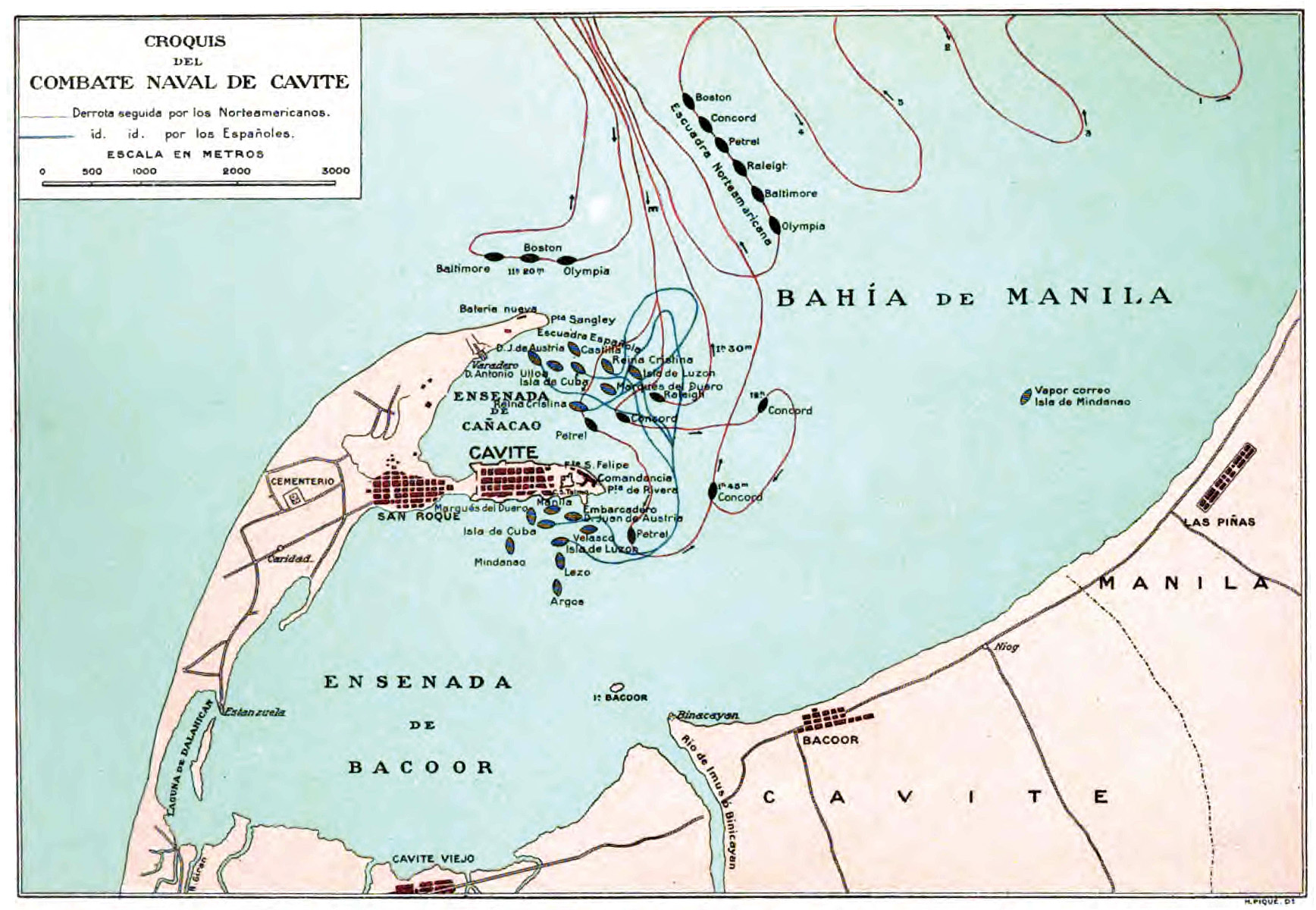
How the battle unfolded.
Montojo held a council of war, and all of his captains except Don Julio del Rio, commander of the Subic arsenal (and the man primarily responsible for its lack of preparations) endorsed a return to Manila to await the Americans there, where workable shore batteries did exist. The Spanish squadron began its slow return, with the transport Manila towing the decrepit wooden cruiser Castilla.
Montojo anchored his ships away from the city, so that shells would not fall among civilians, and in as shallow water as could be managed, to bring them as close as possible to the shore batteries. He ordered lighters of sand brought from Manila to hold the wooden Castilla in place and offer some protection to her fragile hull, since she couldn’t move anyway.
Dewey steamed across the South China Sea and reached Cape Bolinao in north-west Luzon on the morning of 30 April. The Americans headed southward along the coast at a leisurely 8 knots, and when they approached Subic Bay, Dewey detached the cruiser Boston and gunboat Concord to scout for Montojo. Concerned that just two ships might be overwhelmed, he then sent the cruiser Baltimore to join them. They found Subic Bay empty of Spanish warships, and encountered no fire from coastal batteries, either.
That afternoon, Dewey convened his own council of war. He told his captains that the squadron would enter Manila Bay during the coming nighttime darkness, in single file behind Olympia through the southern, wider entrance channel.
“If there are any mines in our path,” said Dewey, “the flagship will clear them away for you.”
The Americans exchanged a few shots with the batteries at the entrance to the bay as they steamed past, but none of the Spanish rounds found their targets. Dewey had coffee served to all hands at 0400 as dawn broke, but the Americans found the Spanish had not gone to Manila, either. Dewey’s ships steamed south-westward along the shoreline to Cavite, where at 0500 American lookouts spotted Montojo’s squadron.
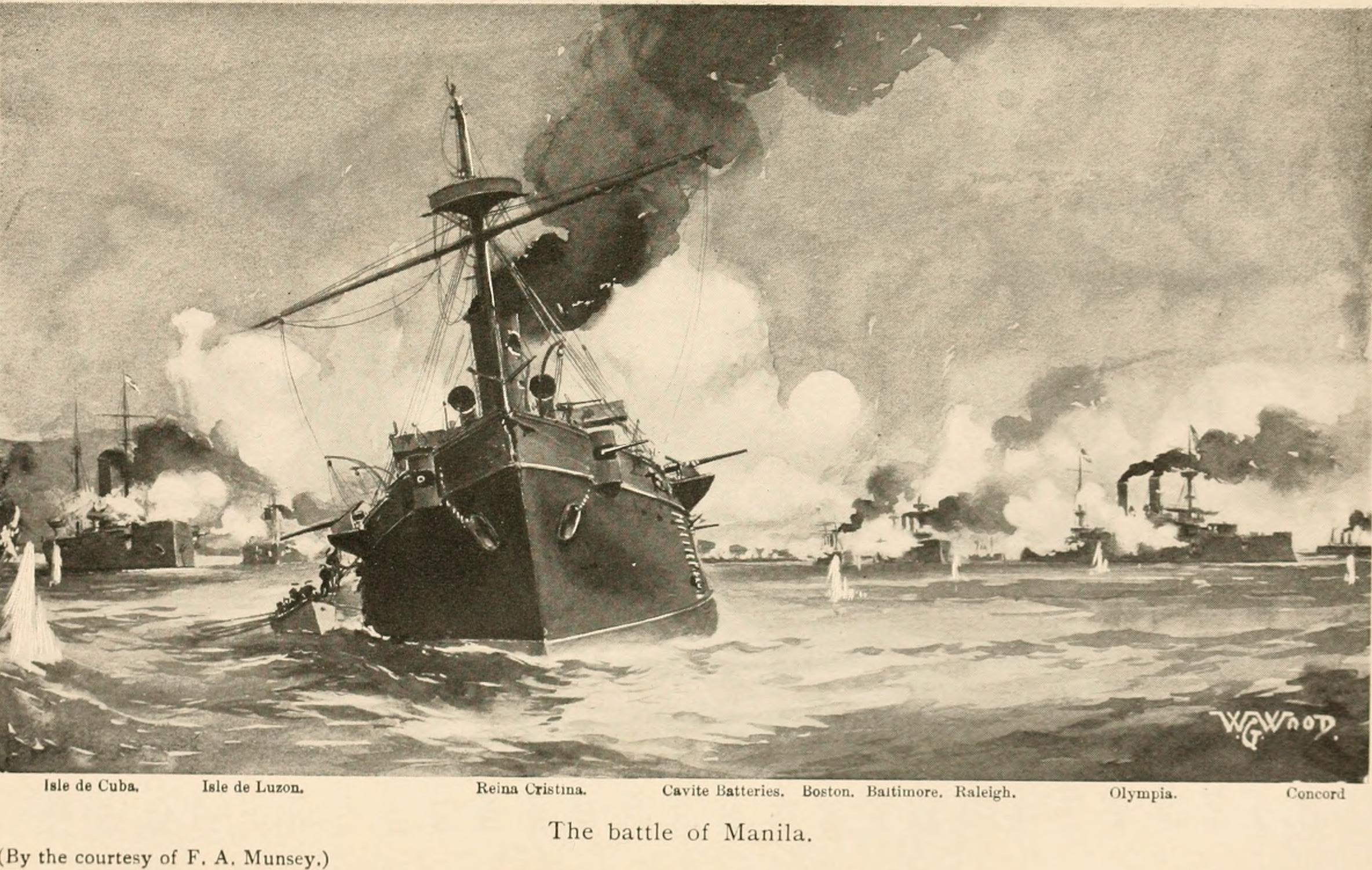
Things are not going well for the Spanish flagship Reina Cristina.
Montojo had arrayed his ships in a ragged line, with his flagship Reina Cristina and the sand-bound Castilla in the center. Dewey signaled his ships to “Prepare for action” at 0505, and began his approach. The Spanish opened fire first at 0515, not coming close to striking any American ships. At 0522 Dewey issued his famous order to Flag Captain Charles Gridley, “You may fire when you are ready, Gridley.” (Sometimes afterwards quoted as, “You may fire when ready, Gridley.”)
Gridley, who had damned the torpedoes in Mobile Bay with David Farragut as a young midshipman in 1864, was not ready. Olympia had only limited ammunition, and Gridley intended for every shot to count. Not until 0534 did Olympia’s main battery open fire, with the rest of the squadron joining in by 0541. The Americans followed a weaving pattern that allowed each broadside to fire in turn and brought their line ever closer to the Spanish, from an initial 6,000 yards on down to 2,000 yards by the time Dewey ordered them to cease fire at 0735, when they completed their fifth pass.
The Americans shot poorly, but given their tremendous volume of fire and the decrepitude of their targets, it didn’t really matter. The Americans steadily shot the Spanish ships to pieces, while the Spanish scored about 15 hits (sources vary on the exact number), most of them of little consequence. The Americans also destroyed two small steam launches they took for torpedo boats; the Spanish had no torpedoes and it’s not clear why these crews of these boats charged the Americans.
Mayhem reigned aboard the Spanish ships. The sand meant to hold Castilla in place failed to do so, and the wooden cruiser swung about on her anchor chain, exposing her landward side to the Americans, where all of her guns had been removed for emplacement ashore. At 0700, Montojo ordered Reina Cristina’s captain, Don Luis Cadarso y Rey to slip his anchor cable and attempt to ram the American flagship. Reina Cristina had already taken enormous punishment, including a hit that forced Cadarso to flood the ship’s magazine to prevent an explosion.

Cruiser Raleigh during the battle.
Olympia and the two ships astern of her, Baltimore and Boston, concentrated their fire on Reina Cristina as the range ticked down to 1,200 yards. With her steering gear shot away, fires consuming much of the deck and half of her crew killed or wounded, Cadarso ordered his men to abandon ship. Montojo – whose report mentions Cadarso just once and implies that Montojo commanded the flagship himself – headed off in a small boat for the gunboat Isla de Cuba, while Cadarso directed the evacuation of his many wounded. An American shell obliterated the brave captain while he worked to save his crew.
Montojo had himself rowed to Cavite, where he found the arsenal commander (and his second-in-command on the naval station), Capt. Enrique Sostao Ibáñez, waiting to offer fulsome congratulations for having repelled the American attack. Montojo informed him that the Spanish had been defeated, and the squadron destroyed. If the Americans returned, Ibáñez should have the remaining ships beached and their crews brought ashore. Montojo then left for Manila, apparently giving his second no further instructions, and from there sent a telegram to Madrid informing the Navy Ministry of “a disaster that I deeply regret.”
Dewey, told that only fifteen rounds of 5-inch ammunition remained per gun aboard Olympia, ordered his ships to cease fire and draw away to the center of the bay, telling the crews it was time for breakfast. Learning that his flagship had actually expended fifteen rounds per gun and still had plenty more, Dewey ordered his ships to return to the fray at 1055. The cruisers Olympia, Baltimore, and Raleigh closed the range to 2,000 yards to shoot up the remaining Spanish ships, and the two gunboats moved into Cavite’s harbor to wreak still more destruction. Dewey also sent A.W. Robbins, the master of a British merchant ship anchored in the bay, ashore with a message for Captain-General Basilio Augustín: if the shore batteries did not immediately cease fire, the Americans would bombard the city of Manila. The batteries ceased fire.
At 1230, a white flag appeared over Cavite, though all firing had since ceased and every Spanish ship had either been sunk or scuttled. Dewey sent the gunboat Petrel into the harbor to set fire to the remaining wrecks of Spanish warships. Spanish casualties amounted to 77 dead and 272 wounded; the Americans admitted to seven wounded and one man (the chief engineer of the cutter McCullough, which was not involved in the battle) dead of a heart attack. The American squadron also had 155 men desert during the campaign.
Dewey became a national hero in the United States. Gridley, apparently suffering from liver cancer, died a month later in excruciating pain. Montojo faced a court-martial in Madrid, but was acquitted with Dewey speaking on his behalf. Ibáñez, who surrendered the Cavite arsenal fully intact, would also be acquitted.
Three of the sunken Spanish cruisers would be raised by the Americans and brought into service as gunboats; the remainder were scrapped in place. Soon American troops would arrive to take possession of the Philippines and begin a grinding war against the Filipino rebels who had been shoved aside in President William McKinley’s quest for a new colony. But that’s another story.
Order Manila Bay Here.
Order Remember the Maine Here.
Order Remember the Maine (Anarchy) Here.
No rules! You’ll need the Second Edition rules from another Great War at Sea game. Earlier edition rules will not work with this game.
Sign up for our newsletter right here. Your info will never be sold or transferred; we'll just use it to update you on new games and new offers.
Mike Bennighof is president of Avalanche Press and holds a doctorate in history from Emory University. A Fulbright Scholar and NASA Journalist in Space finalist, he has published a great many books, games and articles on historical subjects; people are saying that some of them are actually good.
He lives in Birmingham, Alabama with his wife and three children.
Daily Content includes no AI-generated content or third-party ads. We work hard to keep it that way, and that’s a lot of work. You can help us keep things that way with your gift through this link right here.
|