Manila Bay 1898:
Publisher’s Preview
by Mike Bennighof, Ph.D.
July 2026
 I like designing historical games, and writing the history behind them. After all, I’ve made it my life’s work. One of the fun parts, to me at least, is learning things I didn’t know before. I like designing historical games, and writing the history behind them. After all, I’ve made it my life’s work. One of the fun parts, to me at least, is learning things I didn’t know before.
That happened a lot while researching Great War at Sea: Remember the Maine, and now the Campaign Study, Manila Bay 1898. Manila Bay 1898 expands the story of Remember the Maine into the Far East, with the Battle of Manila Bay and the campaign that led up to it (which wasn’t much of one), and different ways it might have played out (this part yields a very rich menu of possibility).
The historiography of the Spanish-American War’s naval campaigns turns out to be much thinner than I expected. The war turned the United States into an imperial power. The U.S. Navy fought a sea battle against a foreign enemy for the first time since 1815. Spain left the New World, while the United States expanded into Asia. Despite all that, the story remains mostly untold, and wartime myths still pervade what is said about the conflict.
A Campaign Study like Manila Bay 1898 can’t fill that gap, but it can and does correct some of the record. It’s grounded in original documents, and in what scholarship does cover the campaign. The outlines of the battle are well known: the Americans gathered at Hong Kong, steamed across the South China Sea to Manila, and destroyed the ill-prepared Spanish squadron there.
The interesting part lies in why the Spanish squadron did not put up a better fight. Spanish accounts in the immediate aftermath focused on the bravery of their sailors and the valiant Capt. Luis Cadarso y Rey of the Spanish flagship Reina Cristina, who would not abandon ship before his last man had left and died at his post. And while the Spanish indeed fought bravely, they also gave their lives in vain. Rear Admiral Patricio de Montojo, commanding the Spanish Pacific Squadron based in Manila, and Basilio Augustín, Captain-General of the Philippines, had done little to prepare the squadron and the colony for war.
Montojo had served in the Philippines as a junior officer, fighting rebels there, and that remained his focus when he returned to command the Pacific Squadron in early 1898. The U.S. battleship Maine exploded on 15 February, and the rest of the world understood that a Spanish-American war would likely follow. Montojo apparently did nothing to address the looming possibility of war, even as the Americans reinforced their Asiatic Squadron and moved it to Hong Kong to threaten Manila. He instead deployed his flagship to hunt for arms shipments heading to the rebels, and sketched plans for cheap gunboats for anti-insurgent missions, forwarding these to Madrid with an urgent plea that they be constructed. He did not, at this time, ask for reinforcements, ammunition, mines, or torpedoes.
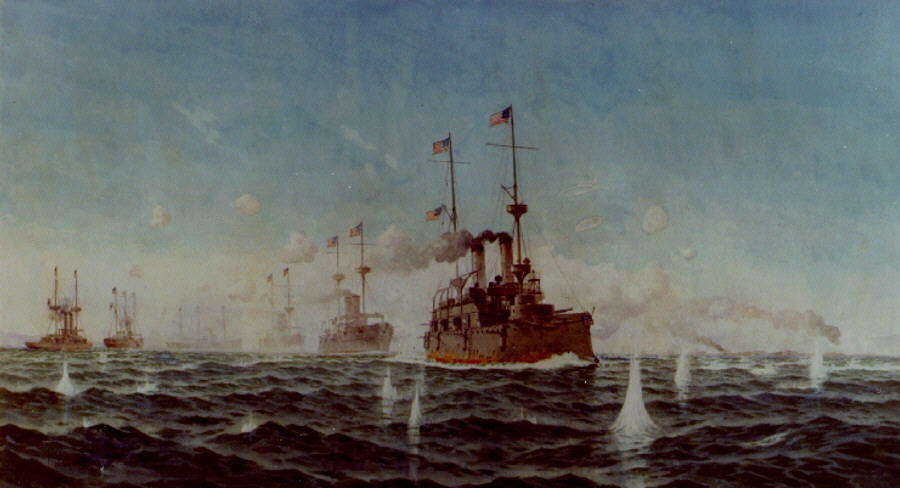
Dewey’s flagship Olympia leads the squadron into action.
American wartime propaganda would accuse Montojo of anchoring his ships in shallow water to start the battle, so that his sailors could more easily swim to shore. This is a slander; he did that after the Americans had shot up his hapless ships and the Spanish prepared to scuttle the surviving wrecks. The fault lies in what he did before the battle. Spain declared war on the United State son 23 April, following a series of American provocations, and only then did Montojo or his superiors in Madrid start to show a sense of urgency. The Spanish made frantic repairs to their ships, and the Navy Ministry ordered its forces in European waters to concentrate at Cadiz to form a reinforcement squadron bound for Manila. Montojo sought mines and torpedoes in the arsenals, finding few of the former and none of the latter. He ordered coast-defense batteries prepared, but when the Americans arrived on 1 May, most of the guns had not yet been mounted.
Manila Bay 1898, the Campaign Study, includes of course a historical scenario for the battle that actually took place. Spoiler alert: the Americans will shoot up the Spaniards with little danger to themselves. The Spanish are ill-armed, ill-protected, and almost immobile. The Americans actually aren’t that powerful, but they don’t have to be.
For me, and hopefully for you, the interest lies in what George Dewey might have met in Manila Bay on that dewy morning. He had a good idea of the condition of Spanish defenses; among their other sins, the Spanish authorities did not expel American Consul Oscar F. Williams from Manila until the declaration of war had become official, nor limit his access to the telegraph. The Spanish also had reports from their own consul in Hong Kong about the American squadron’s preparations (clearing their ships of combustibles, painting them in dull gray suitable for battle, distributing ammunition newly-arrived from the States), but these apparently did not move Montojo until the declaration of war.
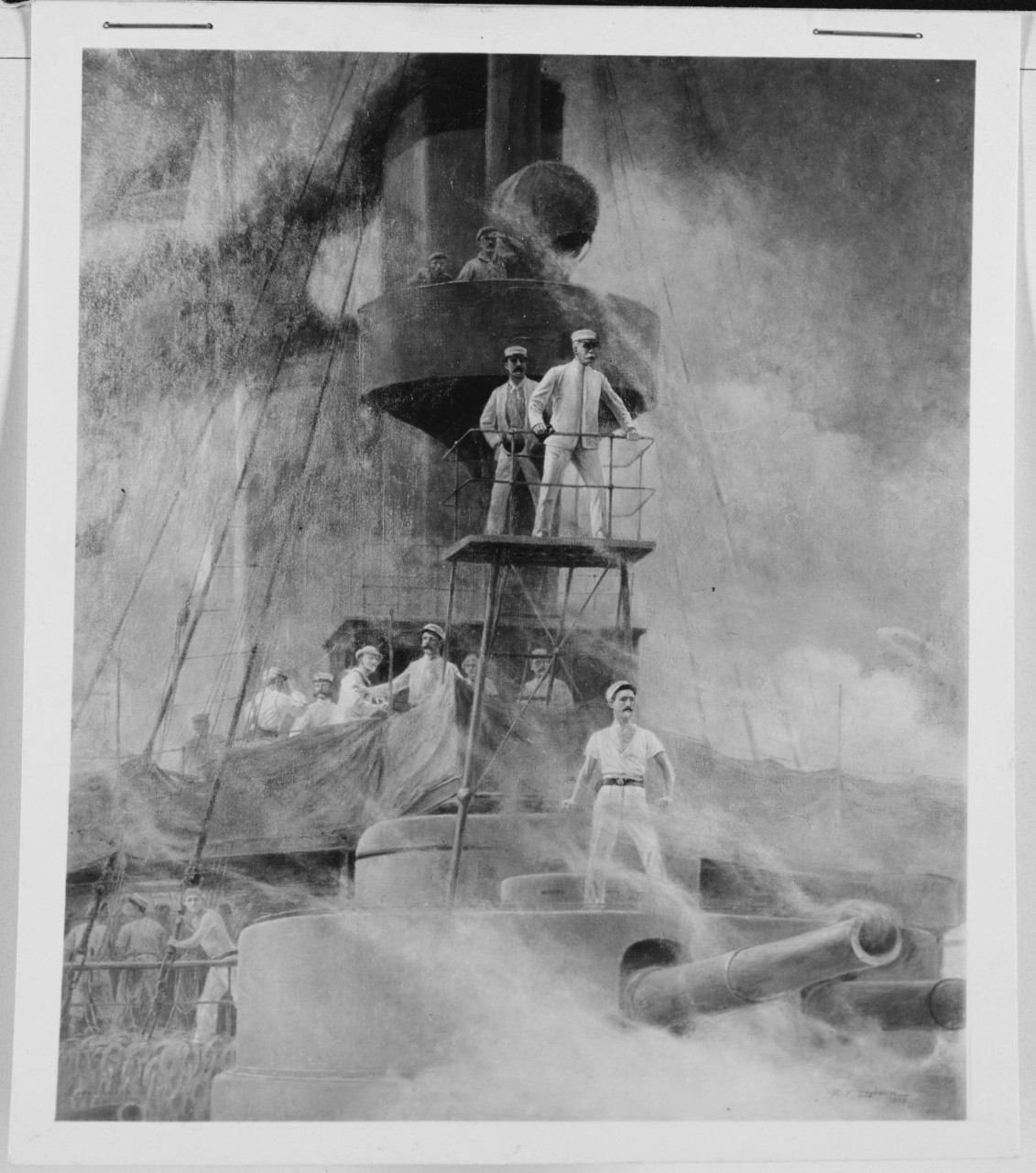
In the Navy, you can sail the seven seas. Dewey and his studly crew, aboard Olympia.
I don’t think our “what if?” chapters in Manila Bay 1898 are much of a stretch; they simply ask how the campaign might have played out had Montojo, Augustín, and Navy Minister Segismundo Bermejo y Merelo done their jobs with minimal competence. That would mean reacting to the situation in mid-February, after Maine exploded and the American press began baying for war, rather than waiting for the actual declaration of war to begin taking the threat seriously.
What might have been different had they done so? At a minimum, Manila Bay might have had active coastal defenses of guns and mines, and the ships have had torpedoes. Their sailors, many of whom had spent the preceding years fighting ashore as naval infantry, would have had two and a half months of gunnery and other drills. Their engines might have been brought into working order, had the long-awaited floating dry dock actually been brought to Subic Bay by early 1898.
That would give a competent Spanish commander options: scatter among the islands, confront Dewey at sea, or defend Manila with some hope of success. And that without reinforcements from home. Admiral Manuel de la Cámara y Livermore’s reinforcement squadron did not begin to gather and prepare until the declaration of war, and would not depart Spain until 15 June. When they did, none of the ships did so fully armed. With his ships at their full capabilities, Cámara would have been far closer to a match for Dewey.
The Americans would know this, and had potential reinforcements for Dewey that they did not bother to dispatch. Would they be enough? Possibly; the Spanish would have looked stronger on paper but even with the additional rounds of training, the Spanish would be at a disadvantage in terms of crew quality.
The American press would elevate the Battle of Manila Bay into an epic clash, which it was not. But it could have been a real fight, if Spain’s leaders had taken their responsibilities seriously.
Order Manila Bay Here.
Sign up for our newsletter right here. Your info will never be sold or transferred; we'll just use it to update you on new games and new offers.
Mike Bennighof is president of Avalanche Press and holds a doctorate in history from Emory University. A Fulbright Scholar and NASA Journalist in Space finalist, he has published a great many books, games and articles on historical subjects; people are saying that some of them are actually good.
He lives in Birmingham, Alabama with his wife and three children.
Daily Content includes no AI-generated content or third-party ads. We work hard to keep it that way, and that’s a lot of work. You can help us keep things that way with your gift through this link right here.
|