Manila Bay 1898:
The Ships, Part One
by Mike Bennighof, Ph.D.
August 2026
 The Spanish-American War saw the American New Steel Navy decisively defeat the venerable Spanish Armada and destroy both of its active squadrons. George Dewey’s Asiatic Squadron had a motley collection of cruisers and gunboats, but they badly out-gunned the Spanish Pacific Squadron and, unlike Patricio Montojo’s ships, all of them could move. The Spanish-American War saw the American New Steel Navy decisively defeat the venerable Spanish Armada and destroy both of its active squadrons. George Dewey’s Asiatic Squadron had a motley collection of cruisers and gunboats, but they badly out-gunned the Spanish Pacific Squadron and, unlike Patricio Montojo’s ships, all of them could move.
American naval shipbuilding and design had garnered little respect in world-wide naval circles since the 1883 decision to replace the U.S. Navy’s aging wooden screw frigates and coastal ironclads with more modern types. The earliest attempts suffered from poor design, corrupt purchasing practices, and lengthy building times, which made new ships often obsolete upon commissioning.
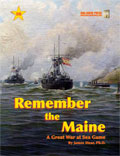
By 1898 these problems had eased somewhat. The ships of Dewey’s small fleet varied widely in their combat value. You’ll take them into battle in Manila Bay 1898; the pieces for them are found in Great War at Sea: Remember the Maine. Let’s have a look at them.
The First Steel Cruiser
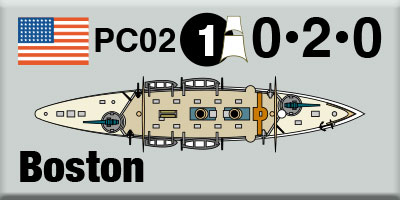
One of the first four ships of the New Steel Navy, the protected cruiser Boston (along with her sister Atlanta) had been designed by a committee of politicians and bureaucrats. The resulting ships had obsolete slow-firing guns (at a time when other navies had begun deploying quick-firing models) and too many of them, overloading the ships. The Navy’s lone admiral David Dixon Porter, then 71 and semi-retired, decided to weigh in, insisting that the new cruisers needed a full sail rig as well. The admiral got his way, and the cruisers carried a pair of masts for their sails; they would be removed immediately after the Spanish-American War.
The committee insisted that the ships had to carry a pair of 8-inch guns, fore and aft with the bow mount offset to port and the aft mount offset to starboard. The big guns could fire one round per minute (with a rate of fire about half that during actual combat conditions); the six 6-inch guns in an amidships casemate (three per side) could manage three rounds every two minutes. She had a thin armored deck, and her outdated engines could only make 13 knots even when new.
Boston took three years to complete, but another year of additional work before she began active service in 1888. She enforced Manifest Destiny in Central America and Hawaii, and joined the Asiatic Squadron in 1896. After the Battle of Manila Bay, she steamed back to China to help intimate the Imperial government there during the Guangxu Crisis, returning to the United States afterwards. She again supported American interventions in Central America, and in 1917 was converted to a freighter. She returned to the Navy and acted as a receiving ship and storage depot until her scuttling in 1946.
British Designs
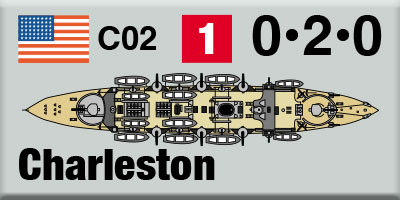
Unhappy with the original steel cruisers, the Navy turned to the British firm of Armstrong for the next ships. Commander F.E. Chadwick sailed to England and bought two sets of plans for ships to be built in American yards. The smaller ship would become Charleston and the larger, improved version Baltimore. Both ships would be laid down in 1887 (Charleston at Union Iron Works in San Francisco, Baltimore at Cramps & Sons in Philadelphia). A year later, Cramp & Sons laid down a further-improved Baltimore, her near-sister Philadelphia.
Armstrong’s did not provide original plans; Charleston would be built to the same plan as the Japanese cruiser Naniwa, while Baltimore’s draft came from a rejected proposal to Spain for the cruiser that became Reina Regente. Charleston displaced 3,700 tons, and carried the same armament as Boston: two 8-inch guns and six 6-inch guns. The 6-inch guns had sponson mounts, giving them better fields of fire, but initially they lacked even gun shields. The 8-inch guns shifted to barbette mounts along the centerline; the Naniwa design carried 10-inch guns but the Americans thought these too heavy. The design called for four torpedo tubes, but these would never be fitted.

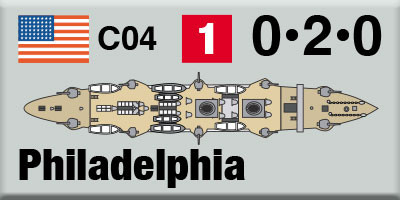
Baltimore weighed in at 4,400 tons and doubled the number of 8-inch guns, placing them in sponsons like the 6-inch guns. That meant that she had no heavier a broadside than Charleston. The weight of the guns and their mountings still seemed a problem, and Philadelphia substituted 6-inch guns in their place, for a uniform armament of ten 6-inch guns.
Chadwick apparently hadn’t noticed that the plans he bought did not make clear what engines the ships should carry; different drafts appeared to call for a different power plant. The Americans installed an old-style compound engine in Charleston, and gave new triple-expansion engines to Baltimore and Philadelphia. Charleston therefore remained abysmally slow at 13 knots, just like the first steel cruisers; Baltimore and Philadelphia both made a respectable 19 knots with their much more effective power plants. None of the three had much in the way of protection, just a 4-inch armored deck for Baltimore and Philadelphia, three inches for Charleston.
Charleston had served in the Pacific in the early 1890’s, and gone into reserve at San Francisco in 1896. Shipyard workers had not finished her overhaul in time for the Battle of Manila Bay, but she did capture Guam from the island’s bemused Spanish governor. She ran aground just north of Luzon in 1899 and became a total loss, but all of her crew survived.
Baltimore had been the American station ship in the Hawaiian Islands before the war, steaming to join Dewey in time to smite the Spaniards in Manila Bay. Afterwards she patrolled the Philippines and returned to New York for reconstruction, which took three years. She received an all-new, uniform main armament of a dozen modern 6-inch quick-firing guns, but this could not overcome her other flaws and in 1913 she entered the yard again for conversion to a minelayer. She helped lay the North Sea Barrage during the Great War and spent the years after as a receiving ship at Pearl Harbor. She was present for the Japanese attack in 1941, but not struck, and eventually towed out to sea and scuttled.
Philadelphia showed the flag off the West Coast in her first years, then went into reserve at San Francisco. Charleston had priority for re-activation, and Philadelphia did not return to service until July 1898. She then participated in the American seizures of Hawaii and Samoa, before becoming a receiving ship at Seattle before her scrapping.
That’s the first half of Dewey’s smal fleet. We’ll look at the rest of them next time.
Order Manila Bay Here.
Order Remember the Maine Here.
Order Remember the Maine (Anarchy) Here.
No rules! You’ll need the Second Edition rules from another Great War at Sea game. Earlier edition rules will not work with this game.
Sign up for our newsletter right here. Your info will never be sold or transferred; we'll just use it to update you on new games and new offers.
Mike Bennighof is president of Avalanche Press and holds a doctorate in history from Emory University. A Fulbright Scholar and NASA Journalist in Space finalist, he has published a great many books, games and articles on historical subjects; people are saying that some of them are actually good.
He lives in Birmingham, Alabama with his wife and three children.
Daily Content includes no AI-generated content or third-party ads. We work hard to keep it that way, and that’s a lot of work. You can help us keep things that way with your gift through this link right here.
|