| The Wine-Dark Sea:
The German Mediterranean Squadron
By Mike Bennighof, Ph.D.
November 2020
 The German commitment to the Mediterranean
Sea in the years before the First World War
started out as one of those minor political
maneuvers that took on a life of its own.
The flight of the battle cruiser Goeben and her consort Breslau to Constantinople
embarrassed the Royal Navy and would help
propel Ottoman Turkey into the war and onto
the path to destruction. The German commitment to the Mediterranean
Sea in the years before the First World War
started out as one of those minor political
maneuvers that took on a life of its own.
The flight of the battle cruiser Goeben and her consort Breslau to Constantinople
embarrassed the Royal Navy and would help
propel Ottoman Turkey into the war and onto
the path to destruction.
Germany had stationed a pair of old cruisers
at Constantinople for many years, and periodically
other cruisers and training ships entered
the Mediterranean for commitments of various
lengths. All this changed in November 1912,
when many foreign nations sent warships to
the Turkish capital in a demonstration designed
to force a negotiated end to the First Balkan
War.
Seeking to make an impression on the assembled
navies, the Germans sent Goeben, their newest warship. This practice had begun
earlier in the year, when her sister Moltke made a courtesy visit to the United States.
Much of the operations could be funded from
diplomatic rather than military accounts,
and this allowed the navy to test their new
ship and its crew on a long-range shakedown
cruise at minimal expense.
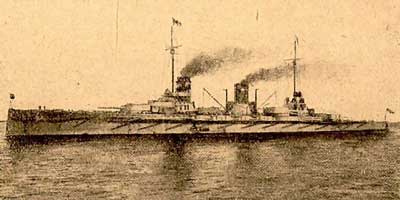
Goeben pre-war.
Both battlecruisers had been built by Blohm
und Voss’ private yard in Hamburg, and
the navy seems to have had concerns about
the quality of their engines. A long-range
deployment, the bureaucrats hoped, would reveal
defects more quickly than service at home.
Moltke crossed the Atlantic each
way flawlessly, and made an excellent impression
in her tour of East Coast ports. The admirals
considered the voyage a great success. Goeben, meanwhile, had problems. She entered
drydock at the Austrian naval base at Pola
in August 1913 for a turbine inspection, just
before her one-year warranty expired. German
officials found that her boiler tubes leaked,
and recommended their replacement.
 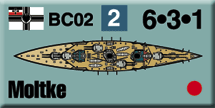
Goeben and Moltke each
carried ten 11-inch guns and had, on paper
at least, a top speed of 26 knots. Moltke made this speed, but Goeben always
had trouble doing so even after another overhaul at Pola in the summer of
1914. They displaced 22,000 tons
and had good armor protection, making them
the most powerful combination of firepower,
speed and armor in the Mediterranean.
Britain stationed the battle cruiser Inflexible in the Mediterranean in November 1912 as part
of the same international deployment that
brought Goeben to Constantinople.
Two sisters joined her in August 1913; the fourth
authorized ship, New Zealand, was
on a world cruise and had not returned by
the time war erupted in the summer of 1914.
Six late-model pre-dreadnoughts of the King
Edward VII class also cruised the Mediterranean
in the first half of 1913. These were individually
no match for Goeben, but as much
less capable Russian pre-dreadnoughts showed
in 1915, they could probably have defeated
her as a squadron. Inflexible was
smaller than Goeben and had eight
12-inch guns, and much weaker armor.
 
France did not commission her first dreadnought-type
battleship until the summer of 1914 and had
nothing to match the German ship, greatly
embarrassing her admirals. Austria-Hungary
and Italy each had dreadnought battleships
of much greater fighting power than Goeben, but these were not nearly as fast.
Two additional light cruisers joined the
squadron in April 1913, Strassburg and Dresden, rounding out the German commitment of four cruisers to the Mediterranean under the Triple Alliance naval convention. They helped show the flag
in Turkish waters before their withdrawal
in September. The navy planned to bring Goeben home at the same time, but given the agreement with Austria and Italy the diplomats did
not want to return her home just yet and prevailed
on the admirals to extend the deployment.
The navy agreed and sent out a new squadron
commander, Rear Admiral Wilhelm Souchon, and
also made the Mittelmeerdivision a permanent
command. Goeben would remain in the
Mediterranean another year, they decided,
and be replaced by Moltke in October
1914, when the new Derfflinger was
scheduled to join the High Seas Fleet.
Goeben spent most of her deployment
at Constantinople, but after his arrival Souchon
kept the squadron in the Central Mediterranean
most of the time. The big cruiser visited
Italian ports in early 1914, and Souchon received
new orders: In the eventuality of war, Goeben and Breslau were to interrupt French
military convoy traffic between Algeria and
southern France. Italian officials agrred
to supply coal for the operation and to attach
cruisers and destroyers to the squadron, but
not to place them under German command.

HMS Invincible. She wasn’t.
When Serbian terrorists assassinated the
Austrian Archduke Franz Ferdinand, Souchon
immediately saw the possibility of war and
brought his flagship back to Pola. After serious
effort, he managed to secure dockyard time
for Blohm & Voss technicians to replace Goeben’s boiler tubes. Austrian
captains, also seeking repairs for their ships
before war exploded, fumed and telegraphed
Vienna in vain anger. The 22,000-ton German
lemon received top priority.
Souchon’s squadron is the centerpiece
of Great
War at Sea: The Wine-Dark Sea. Goeben’s famous voyage is covered in multiple scenarios. Moltke, Magdeburg, Strassburg and Dresden also appear.
Don’t wait to put The Wine-Dark Sea on your game table! Join the Gold Club and find out how to get it before anyone else!
Sign up for our newsletter right here. Your info will never be sold or transferred; we'll just use it to update you on new games and new offers.
Mike Bennighof is president of Avalanche Press and holds a doctorate in history from Emory University. A Fulbright Scholar and award-winning journalist, he has published over 100 books, games and articles on historical subjects.
He lives in Birmingham, Alabama with his wife, three children and his dog, Leopold. Leopold needs no revisions.
|