Mindanao 1945:
Publisher’s Preview
by Mike Bennighof, Ph.D.
April 2026
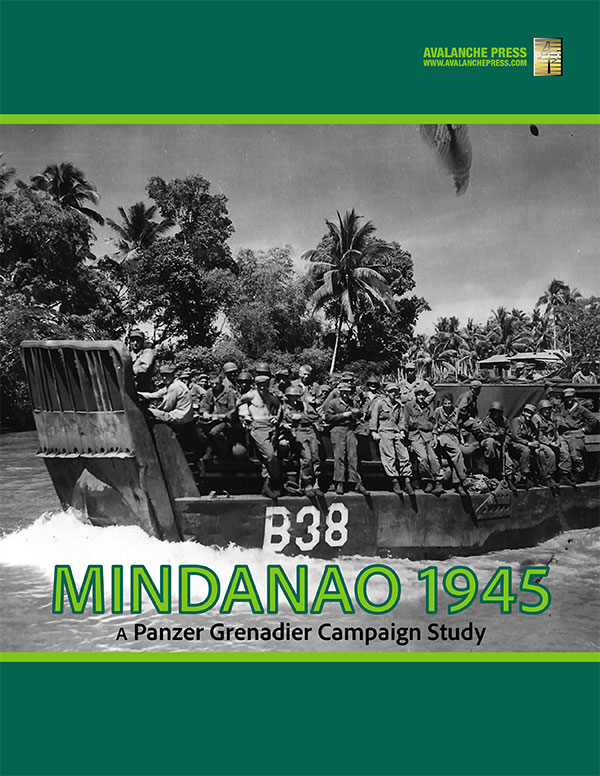 The Americans could have bypassed Mindanao. First, they captured Morotai in the Dutch East Indies in September 1944 and quickly built two large airbases there. That gave them a forward position just a few hundred miles south-east of Mindanao. Then they landed on Leyte in the central Philippines in October 1944, and on Luzon, the main island of the archipelago, in January 1945. That pretty much isolated the Japanese garrison on Mindanao. The Americans could have bypassed Mindanao. First, they captured Morotai in the Dutch East Indies in September 1944 and quickly built two large airbases there. That gave them a forward position just a few hundred miles south-east of Mindanao. Then they landed on Leyte in the central Philippines in October 1944, and on Luzon, the main island of the archipelago, in January 1945. That pretty much isolated the Japanese garrison on Mindanao.
The second-largest island in the Philippines, Mindanao did not have the population and agricultural base of Luzon or the Visayas, the string of large islands between Luzon and Mindanao. Japanese air power had been reduced to one operational plane, and though the garrison appeared large on paper, most of those numbers represented Air Force and Navy rear-area personnel. It still included combat troops, and the “not real soldiers,” as the combat troops tabbed their rear-echelon comrades, would show that they could fight and die just as fiercely, if with less skill.
Though Douglas MacArthur had made it a personal vow, the United States government and military leadership took seriously the promise to liberate the Philippines. The archipelago had been an American Commonwealth before the war, with the United States responsible for its defense. Once it fell to the Japanese in 1942, that broken promise had to be redeemed. None of the major Philippine islands could be bypassed and left to surrender later. They would have to be taken.
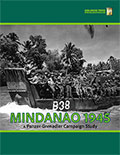
Panzer Grenadier: Mindanao 1945 is a Campaign Study, with 11 scenarios drawn from the battles that fulfilled that promise. It’s an expansion: you’ll need Saipan 1944 (for maps and pieces), Marianas 1944 (for more maps), Pacific Armor (for Philippine Guerillas), and Leyte 1944 (for American AND Japanese paratroopers) to play those scenarios. You’ll also need a 40mm anti-aircraft unit from Dragon’s Teeth for one scenario; it was a crucial unit in an important battle.
 Mindanao 1945 draws on more games/books than I usually prefer, but they’re all within the Saipan family (other than the 40mm). And they make up a continuing story, which I the sort of thing I prefer to publish. Mindanao 1945 itself came together very smoothly: three chapters of background history, three matching chapters of scenarios. This is exactly how I envision the Campaign Studies, and every now and then, one of them turns up exactly that way. Mindanao 1945 draws on more games/books than I usually prefer, but they’re all within the Saipan family (other than the 40mm). And they make up a continuing story, which I the sort of thing I prefer to publish. Mindanao 1945 itself came together very smoothly: three chapters of background history, three matching chapters of scenarios. This is exactly how I envision the Campaign Studies, and every now and then, one of them turns up exactly that way.
The campaign breaks fairly logically into three segments, and so the Campaign Study follows the same structure, with three chapters. Each of these scenario chapters has a battle game that ties the scenarios together; in short, the American is looking to conquer and the Japanese to survive. But there’s another twist that probably has helped keep this campaign relatively obscure in the historiography: the Americans are not always looking to wipe out the Japanese.
Our first chapter take place in the Visayas, the big islands between Luzon and Mindanao. They include Cebu, which boasts a very fine port at Cebu City, and American planners chose this site to marshal their forces for the upcoming invasion of Japan. That gave Cebu considerable importance to the Americans, and securing Cebu also meant securing its neighbors. In this small campaign, the Japanese fought the Americans, in places with determination and ferocity, and when they could no longer resist, they withdrew into the island’s interior of jungle-covered mountains. Unlike on Luzon and Mindanao, where American regulars and Filipino guerillas pursued them relentlessly, in the Visayas they cordoned off the Japanese refuges and left them there until the end of the war. This tacit truce – there’s no evidence of any contact, let alone agreement – meant that thousands of Japanese soldiers and rear-echelon staff survived to go home again.
We have four scenarios in the Visayas chapter, two taking place on Negros and two on Cebu. On Negros, you get to use those paratroopers (on both sides, fighting each other, as infantry) and the Japanese can try to blow themselves up and take some Americans with them. On Cebu, the Japanese have a huge, buried stockpile of ammunition that can blow up (it’s not clear whether this was an accident, but in the scenario, it’s deliberate). Then they have to attack the crater in the next scenario; this is where that 40mm anti-aircraft gun takes center stage.
 Once the fighting moved to Mindanao, it became more serious. The Americans devoted considerable resources to the island’s re-conquest; the Japanese did not deploy first-rate troops to hold it. The campaign was neatly divided into two segments, as both sides considered the east and west sides of the island to be separate theaters. That makes it pretty easy to split our chapters, too. Once the fighting moved to Mindanao, it became more serious. The Americans devoted considerable resources to the island’s re-conquest; the Japanese did not deploy first-rate troops to hold it. The campaign was neatly divided into two segments, as both sides considered the east and west sides of the island to be separate theaters. That makes it pretty easy to split our chapters, too.
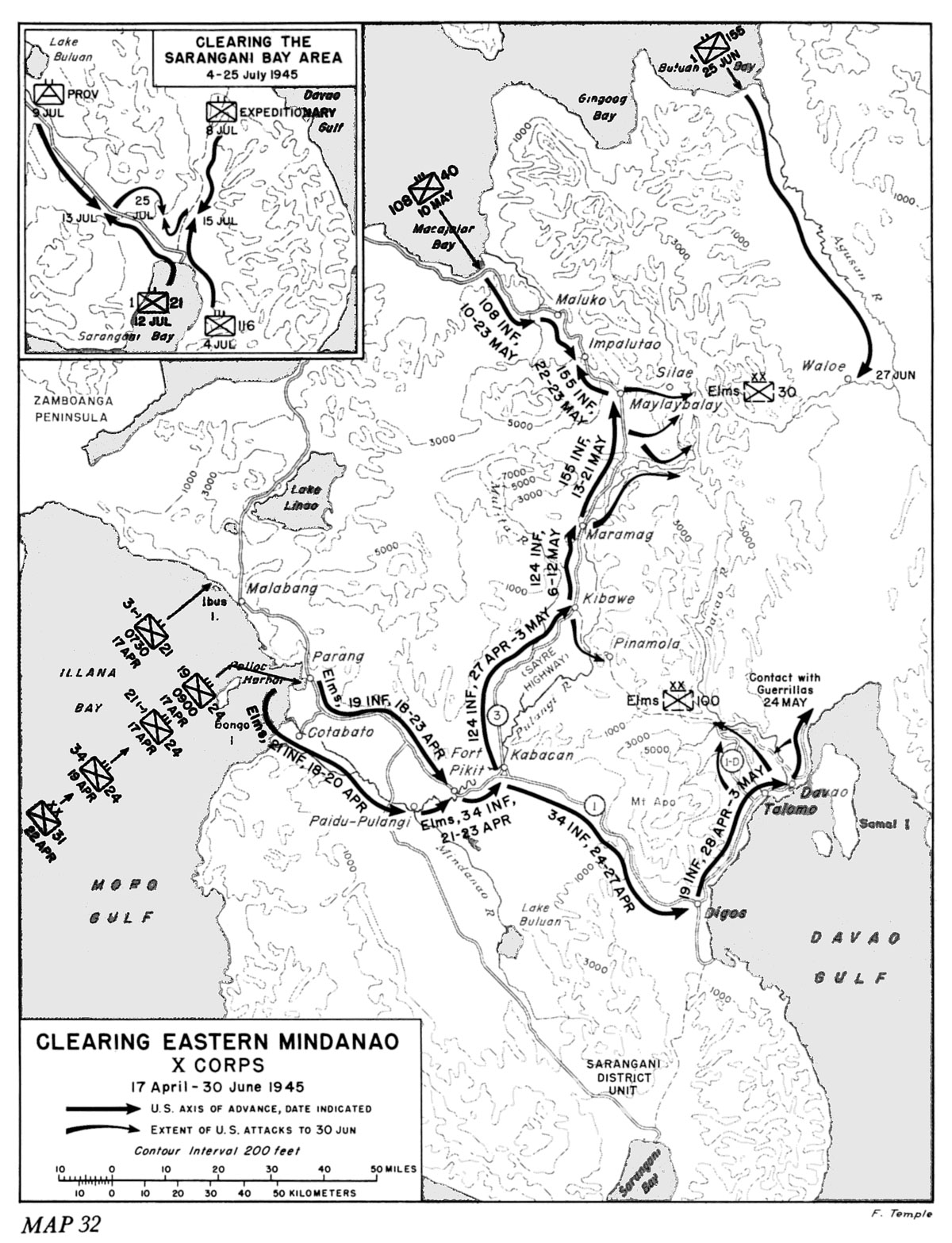
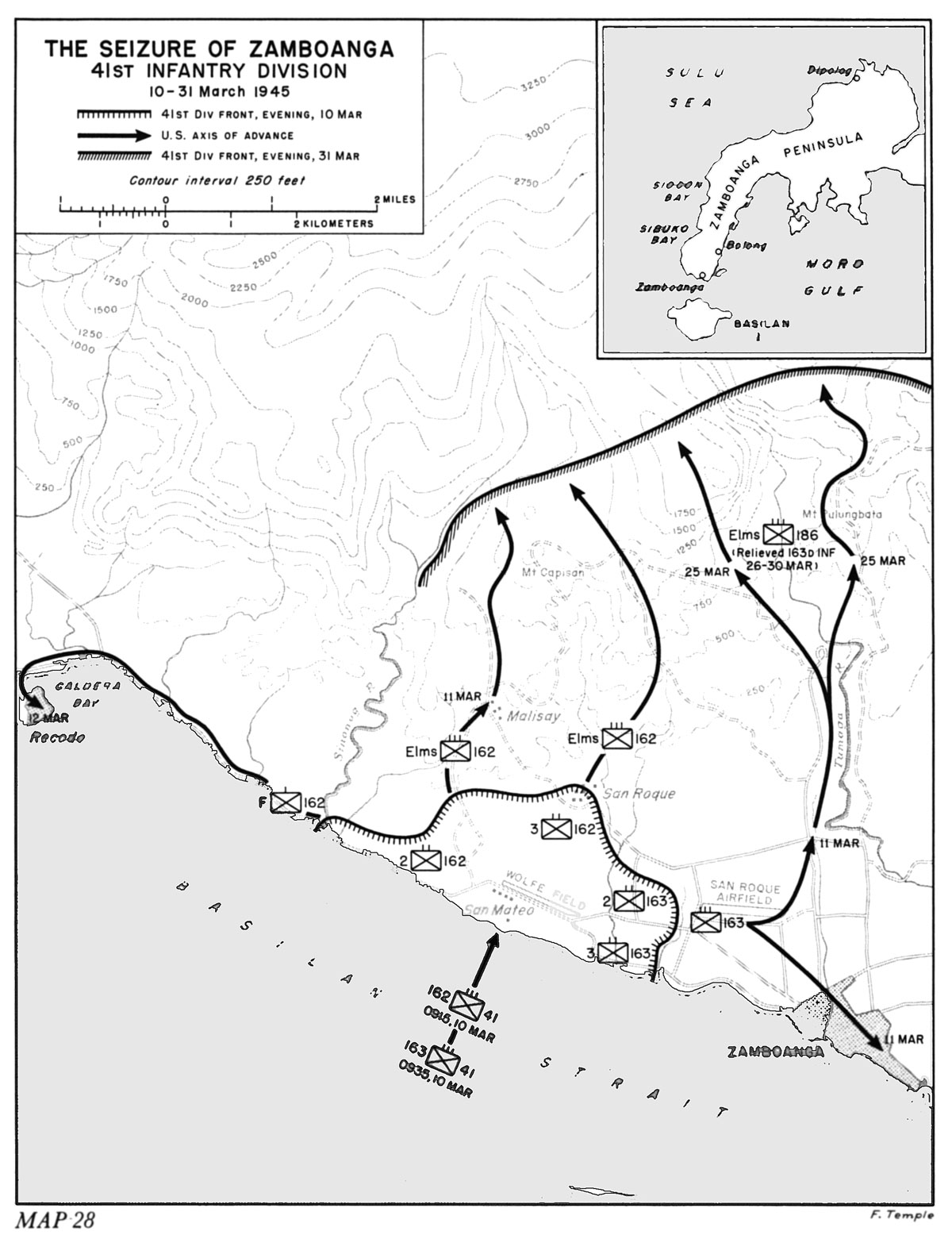
For the second chapter, it’s off to the Zamboanga Peninsula, where the major port city of Zamboanga rests at the tip of an extremely long and narrow peninsula. It’s weird enough geography that both sides treated it as though it were a separate island. The Japanese pulled back from the city and fortified themselves in the rocky jungle that makes up the peninsula’s spine, and not for the last time in this campaign the local division commander responded with a brutal and bloody frontal assault. That went against the intentions, and directives, from both corps and army commands, whose commanders did not want to rack up long casualty lists in a backwater campaign. The rest of the chapter takes place further to the east, where the Americans are trying to push up the Sayre Highway and cut off the Japanese defenders of Davao from their northward retreat.
The four scenarios of Chapter Three take us to the fighting for Davao and the subsequent Japanese retreat. The Japanese stood and fought here, and some initial reluctance; one f their two regular infantry regiments was made up of Korean rank-and-file with Japanese officers, and they hadn’t been very willing when they thought Japan was winning the war. Yet they fought north of Davao. The Japanese command expected the Americans to use their numbers and mobility to outflank them, but once again the division commander fell back on a bloody frontal assault. Then came the pursuit.
While it’s not a well-known campaign, Visayas/Mindanao is pretty much a perfect topic for a Panzer Grenadier Campaign Study: it’s geographically contained, and the story has a clear beginning, middle, and end. You get to use some unusual units in very rough terrain, with the prospect of fearsome infantry combat, something at which the Panzer Grenadier system excels.
This is a good little book. You’ll like it.
Order Mindanao 1945 Here.
Pacific Island Battles
Fight for Saipan, Guam, Tinian, Leyte, Luzon, and Mindanao: six maps, 671 pieces, 151 scenarios. One hundred and fifty-one scenarios.
Read More Here
• Saipan 1944
• Pacific Armor
• Mindanao 1945
• Leyte 1944
• Marianas 1944
Retail Price: $211.95
Package Price: $180
Gold Price: $144
Storm the Beaches.
Sign up for our newsletter right here. Your info will never be sold or transferred; we'll just use it to update you on new games and new offers.
Mike Bennighof is president of Avalanche Press and holds a doctorate in history from Emory University. A Fulbright Scholar and NASA Journalist in Space finalist, he has published a great many books, games and articles on historical subjects; people are saying that some of them are actually good.
He lives in Birmingham, Alabama with his wife and three children.
Daily Content includes no AI-generated content or third-party ads. We work hard to keep it that way, and that’s a lot of work. You can help us keep things that way with your gift through this link right here.
|