Mindanao 1945:
Scenario Preview, Part One
by Mike Bennighof, Ph.D.
January 2026
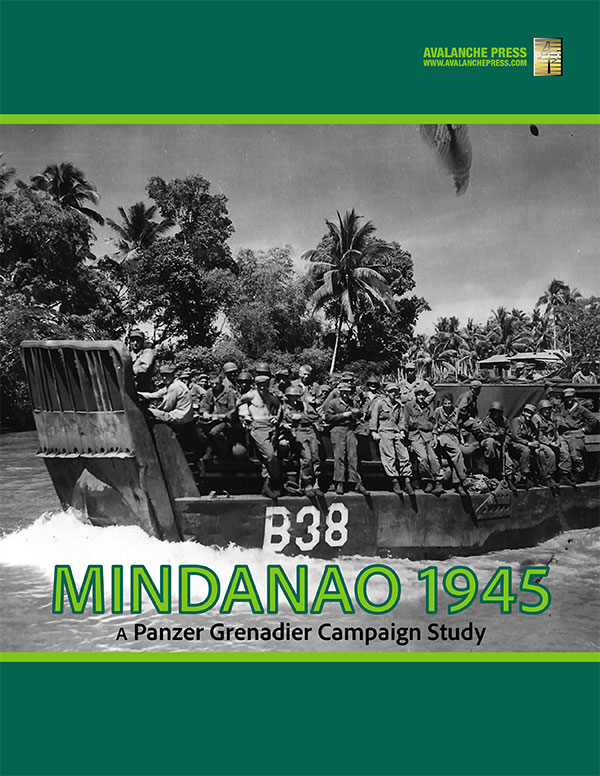 Panzer Grenadier: Mindanao 1945 is a Campaign Study, featuring 11 new scenarios based on the battles for control of the Visayas and Mindanao. You'll need Saipan 1944, Dragon’s Teeth (two pieces for one scenarios), Marianas 1944 and Leyte 1944 to play them all. Panzer Grenadier: Mindanao 1945 is a Campaign Study, featuring 11 new scenarios based on the battles for control of the Visayas and Mindanao. You'll need Saipan 1944, Dragon’s Teeth (two pieces for one scenarios), Marianas 1944 and Leyte 1944 to play them all.
Panzer Grenadier: Saipan 1944 has become what we call a “toybox” game, one that provides the maps and pieces to allow us to explore many other battles outside those covered by the game itself. That’s true of most games in the series, but Saipan has been very fruitful in this regard, something I never expected when we first published it.
Mindanao 1945 is a Campaign Study, what we call our little books and history and scenarios. It uses Saipan 1944 as a base for maps and pieces, and draws in more pieces and maps from Marianas 1944, Leyte 1944, and Pacific Armor (all of them expansions for Saipan). Plus, two pieces from Dragon’s Teeth.
All of that allows us to tell a tale that’s seldom told: the American campaigns in 1945 to subdue the Japanese occupiers of the southern Philippines. They had been bypassed and most of the commanders felt the war had ended for them with that. But the Americans had pledged to liberate the Philippines, and so they invaded both the Visayas and Mindanao. And that’s the basis for our story. Let’s look at the first chapter’s scenarios:
Scenario One
Kono’s Inner Fortress
9 April 1945
The middle of northern Negros Island presented a tangle of hills and jungles, cut by streams and dirt roads. The Japanese pulled back into this area to tie down the Americans for as long as they could. Having failed to bring away the heavy anti-aircraft guns from the airfields of northern Negros, the Japanese commander, Lt. Gen. Takeshi Kono, relied on his lightly-armed infantry to sacrifice themselves.
Conclusion
Backed by plentiful artillery support, the American 185th Infantry Regiment attacked the center of the Japanese line, soon running into well-concealed Japanese positions. Hard fighting won them their objectives, but the Japanese pulled back in good order, leaving behind small teams armed with aerial bombs, who set them off when the Americans entered their lines. Securing the next, even more formidable Japanese line would require greater firepower.
Notes
The Japanese have a strong position, but not a lot with which to defend it beyond their own rifles and a willingness to blow themselves up for the Emperor. The Americans have their awesome artillery, a slight edge in numbers, and a definite edge in firepower.
Scenario Two
The Rock Regiment
17 April 1945
As the Americans pressed the Japanese deeper into the jungle-covered hills of north-central Negros, their enemies became ever-more determined to resist the advance. The 40th Infantry Division called in its attached regiment of paratroopers. The 503rd Parachute Infantry had already seen combat on Luzon and jumped onto the fortress-island of Corregidor. An amphibious landing on 7 April brought them to Negros, and now they would enter the thick of the fighting, on the left of the 185th Infantry Regiment.
Conclusion
With heavy weather grounding all air support, the paratroopers pushed forward slowly. Without roads, they hired Filipinos to hand-carry their supplies forward, while the Japanese – including the last remnants of the 2nd Raiding Brigade - continued to resist stubbornly. It would take two more weeks before the Americans secured the high ground.
Notes
American paratroopers lead the way, into a dense jungle hell. They have added tank support, but without any roads, it’s going to be hard to use them. And if they do succeed in fixing and assaulting the enemy, the Japanese are still able to blow themselves up and take any nearby Americans with them.
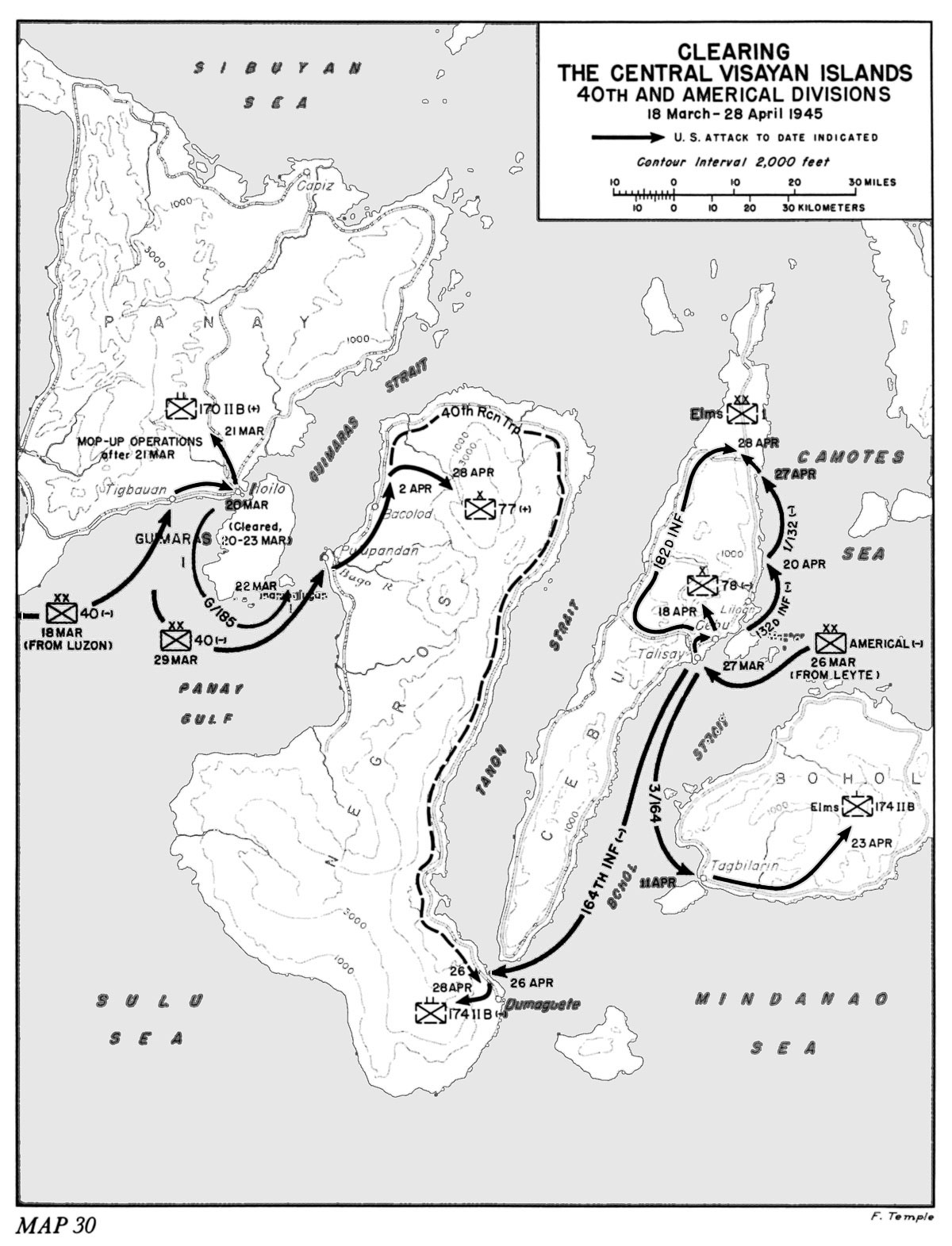
The Visaya Battleground of 1945.
Scenario Three
The Crater
29 March 1945
The Japanese had left thousands of mines emplaced around Cebu City and the nearby beaches but had not positioned any troops to cover them with fire. At Gochan Hill just north of the city, they had also placed many mines, but this time the 78th Infantry Brigade had dug in on the hill and driven off the American 57th Engineer Battalion trying to remove them. They would have to be removed.
Conclusion
Whether the explosives were an ammunition stockpile set off by American engineers (the Japanese version) or a vast mine placed by the dastardly Japanese (the version in the U.S. Army’s official history), twenty Americans were killed and one tank destroyed when it exploded. The Americans, stunned by the blast, fell back into Cebu City to try again the next day.
Notes
It’s another drive up and over a Japanese-held hill. There are not many Japanese, but they do have a gigantic bomb buried somewhere on the board. So, we get a little game-within-a-game of when to explode (well, try to explode) this secret weapon.
Scenario Four
Gochan Hill
30 March 1945
The Americans could, unofficially, tolerate the Japanese withdrawing deep into the interior of Cebu to wait out the war, as they had done on Panay, and leave them there unmolested. But the Japanese position on Gochan Hill overlooked Cebu’s magnificent harbor, and the massive detonation on the 29th only made Maj. Gen. William H. Arnold, commanding the Americal Division, that much more determined to kick the enemy off the hill.
Conclusion
Backed by copious artillery and armor, the 182nd Infantry drove the Japanese off the hilltop and secured their perimeter around Cebu City. The fighting would move inland and continued for the next month, with the Americal Division flinging itself into fruitless frontal assaults before finally attempting to outflank the Japanese, who then simply [pulled back deeper into the jungles.
Notes
The Americans are back for another try, this time with more firepower. The Japanese scorned the Americal Division, and the record (like these scenarios) shows that they weren’t completely wrong.
And that’s all for Chapter One. Next time, we sail for Mindanao and Chapter Two.
Order Mindanao 1945 Here.
Pacific Island Battles
Fight for Saipan, Guam, Tinian, Leyte, Luzon, and Mindanao: six maps, 671 pieces, 151 scenarios. One hundred and fifty-one scenarios.
Read More Here
• Saipan 1944
• Pacific Armor
• Mindanao 1945
• Leyte 1944
• Marianas 1944
Retail Price: $211.95
Package Price: $180
Gold Price: $144
Storm the Beaches.
Sign up for our newsletter right here. Your info will never be sold or transferred; we'll just use it to update you on new games and new offers.
Mike Bennighof is president of Avalanche Press and holds a doctorate in history from Emory University. A Fulbright Scholar and NASA Journalist in Space finalist, he has published a great many books, games and articles on historical subjects; people are saying that some of them are actually good.
He lives in Birmingham, Alabama with his wife and three children. He misses his lizard-hunting Iron Dog, Leopold.
Daily Content includes no AI-generated content or third-party ads. We work hard to keep it that way, and that’s a lot of work. You can help us keep things that way with your gift through this link right here.
|