Mindanao 1945:
Scenario Preview, Part Three
by Mike Bennighof, Ph.D.
January 2026
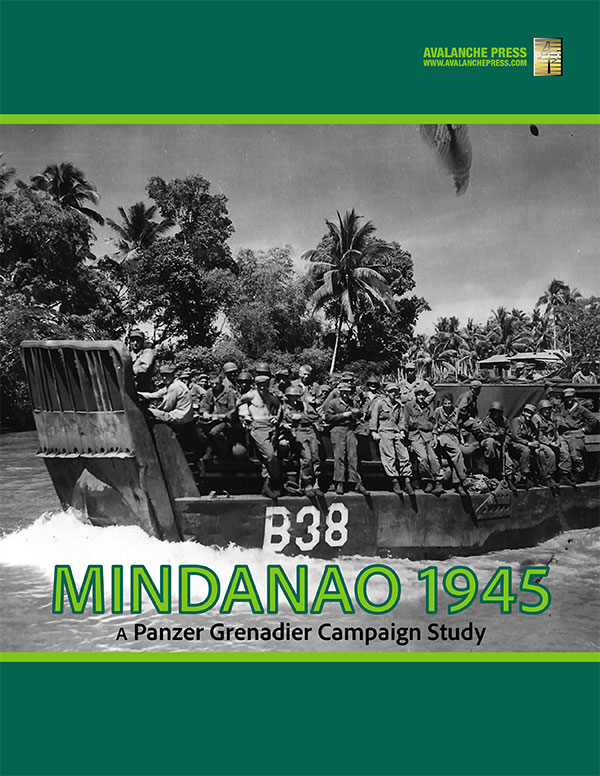 Panzer Grenadier: Mindanao 1945 is a Campaign Study, featuring 11 new scenarios based on the battles for control of the Visayas and Mindanao. You'll need Saipan 1944, Dragon’s Teeth (two pieces for one scenarios), Marianas 1944 and Leyte 1944 to play them all. Panzer Grenadier: Mindanao 1945 is a Campaign Study, featuring 11 new scenarios based on the battles for control of the Visayas and Mindanao. You'll need Saipan 1944, Dragon’s Teeth (two pieces for one scenarios), Marianas 1944 and Leyte 1944 to play them all.
Unless it’s part of the broader battle for the Philippines, the historiography of the Battle for Mindanao (including Zamboanga, and the Visayas for that matter) is pretty thin. The guerilla movement and civilian experience get a little attention from Philippine historians. The U.S. Army’s official history has some operational accounts, that are for the most part better than the usual official narrative, but include the jarring statement that: “Little purpose can be served by describing in detail the mountain fighting in northern Negros.” That’s sort of the whole purpose.
In its place, we have some unit histories, some individual memoirs, and some description in the Japanese National Defense Institute exhaustive volume on the Battle of Luzon. Mindanao did not see a climactic battle, or mass murder, like Manila; it was a backwater and the 1,000 Americans and 12,000 Japanese killed in action there would be forgotten.
A problem? Not really. Finding stuff out is why I do this job. Let’s have a look at the final scenario chapter of Mindanao 1945, the Battle for Davao (actually the hinterlands of Davao, but that’s what the U.S. Army called it).
Scenario Eight
Libby Airdrome
5 May 1945
The Japanese held Libby Airdrome, an airfield seven miles west of Davao. That position dominated the approaches to Davao; plus, the Americans wanted to put the airfield into operation for their own purposes. After four days of indecisive fighting, the 24th Infantry Division brought up reinforcements for a stronger push to eject the defenders.
Conclusion
The high ground north of the airfield had been a linchpin of the Japanese defensive line outside Davao, and the Americans sought to unravel this line by taking the airfield and the hills. The 21st Infantry Regiment secured the airfield on the fifth day of fighting but could not push the Japanese off the hills.
Notes
The Americans are on the attack, but this time the Japanese have some heavy support weapons (that can hurt their tanks!) and actually have artillery support. The Americans have a lot of force, but they also have a lot of objectives.
Scenario Nine
Balked at Mintal
8 May 1945
The Japanese had dug in along Highway 1D, a dirt track heading north-west out of Davao and into the interior of Mindanao. The American 24th Infantry Division staff hatched a plan to unhinge those defenses by capturing the hilly ground just to the west. That might be enough to provoke a general retreat by the Japanese, who could then by contained in some out-of-the-way wilderness and left until the end of the war.
Conclusion
The 21st Infantry attempted a pincer attack east of the Talomo River near Mintal, but the Japanese poured down a rain of artillery, mortar and machine gun fire. The Americans recoiled and would try again a few days later as part of a general offensive.
Notes
Just a small scenario, with the Americans headed uphill against well-entrenched Japanese with actual support weapons to help out. The Americans have brought no tanks or airplanes along. They probably should have.
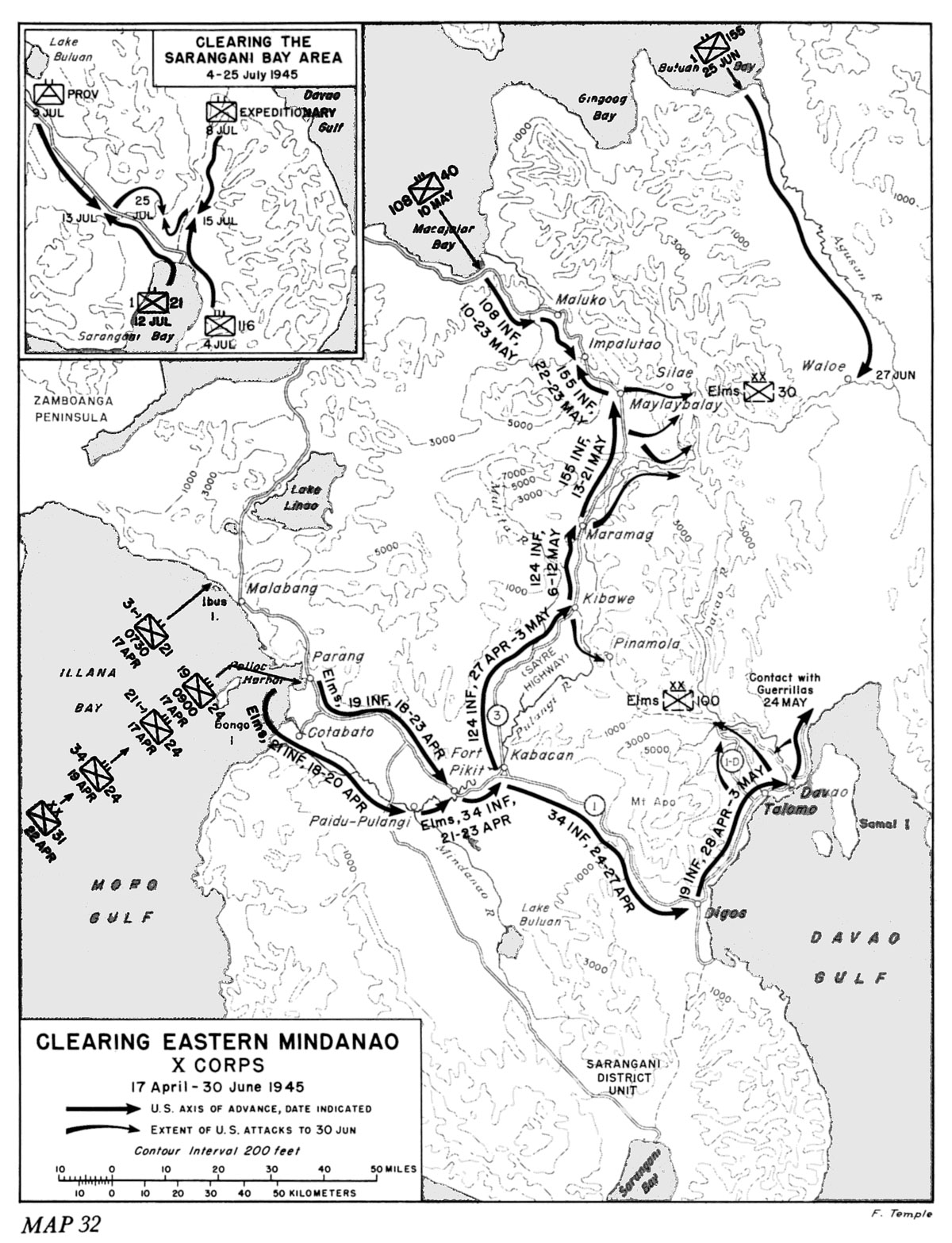
The Mindanao Campaign.
Scenario Ten
Tibungco Beach
15 May 1945
Since the American capture of Davo, they had attempted to drive up the coastline to make contact with the Philippine guerillas, who in turn had been fighting to push to Japanese away from the beaches to allow them to join up with the Americans. Most of the Japanese on this flank had been pulled back into the center of the Japanese line, but a blocking force remained to keep the Americans and Filipinos apart.
Conclusion
The Japanese fought hard to keep the American 19th Infantry Regiment and their allies apart, and on the initial day of the offensive managed to hold off the attackers. It would take a full week before the beach zone could be declared under control and weapons and supplies could flow tot eh guerillas.
Notes
The Americans are trying to drive up the beach and link up with the Filipinos coming down from the north. There aren’t many Filipinos, so it’s the Americans who have to do the hard work. The Japanese don’t necessarily have to make a stand on the beach – they can try defending the inland jungle and then dashing back to the shore zone to interrupt the American line of communications. Well, they can try.
Scenario Eleven
Two Roads North
20 May 1945
As the 19th Infantry fought to make contact with the Filipino guerrillas of the 107th Division, along the shoreline north of Davao, the 21st Infantry made a well-supported frontal assault straight up Highway 1D. The Japanese had prepared for just such an American move, reinforcing their lines and bringing reserves into position behind them. Nothing they did could prepare them for American firepower.
Conclusion
Veterans called the fighting along Highway 1D the worst they had faced in the Pacific War. The Japanese put up a wall of fire against the American assault and drove them back with repeated counterattacks. On 29 May, the 100th Infantry Division began a disorderly retreat to the north.
Notes
The Japanese have a lot of troops and, by Japanese standards, a lot of firepower. The Americans bring more troops and much more firepower, but they have to accomplish a lot with those advantages if they want to win this fight.
And that’s all!
Order Mindanao 1945 Here.
Pacific Island Battles
Fight for Saipan, Guam, Tinian, Leyte, Luzon, and Mindanao: six maps, 671 pieces, 151 scenarios. One hundred and fifty-one scenarios.
Read More Here
• Saipan 1944
• Pacific Armor
• Mindanao 1945
• Leyte 1944
• Marianas 1944
Retail Price: $211.95
Package Price: $180
Gold Price: $144
Storm the Beaches.
Sign up for our newsletter right here. Your info will never be sold or transferred; we'll just use it to update you on new games and new offers.
Mike Bennighof is president of Avalanche Press and holds a doctorate in history from Emory University. A Fulbright Scholar and NASA Journalist in Space finalist, he has published a great many books, games and articles on historical subjects; people are saying that some of them are actually good.
He lives in Birmingham, Alabama with his wife and three children.
Daily Content includes no AI-generated content or third-party ads. We work hard to keep it that way, and that’s a lot of work. You can help us keep things that way with your gift through this link right here.
|