Atlantic Breakout
Plan BCR, Part One
by Mike Bennighof, Ph.D.
June 2025
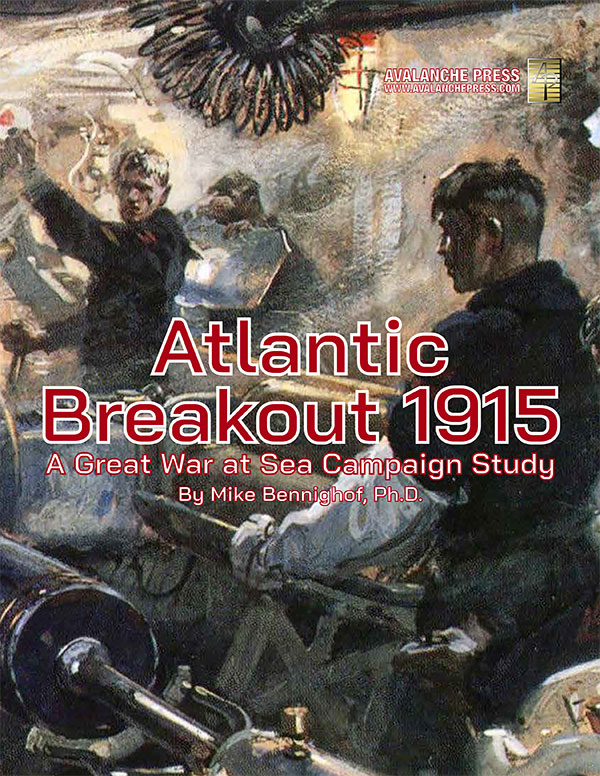 In July 1917, John “Black Jack” Pershing, commander of the new American Expeditionary Force set to join the fighting in France, sent a brief cable to U.S. Army headquarters in Washington: “A million men by May.” Shortly afterwards, a second cable expanded on that demand, that the AEF would need to reach three million men to assure victory in the War to End All Wars. In July 1917, John “Black Jack” Pershing, commander of the new American Expeditionary Force set to join the fighting in France, sent a brief cable to U.S. Army headquarters in Washington: “A million men by May.” Shortly afterwards, a second cable expanded on that demand, that the AEF would need to reach three million men to assure victory in the War to End All Wars.
Those men first would have to be armed, clothed, and trained. And then they would have to be transported across the Atlantic Ocean to Europe. The first troop convoy departed in May 1917, with the millionth man landing on 30 June 1918. By November the second million had arrived, thanks to a potent surge in U.S. shipbuilding.
Most of the soldiers traveled aboard converted ocean liners. Britain’s Royal Navy hurriedly removed those requisitioned passenger ships that had been converted into armed merchant cruisers from patrol service and re-fitted them to carry troops. German submarines represented only a minor danger in the middle of the ocean, as the boats of that era could not easily obtain a firing solution on a fast-moving target. The troop ships would be most vulnerable to submarines as they entered coastal waters and approached their destination port.
In mid-ocean, though, the huge convoys packed with American troops on their way to France would be vulnerable to surface raiders. Too fast to be tracked by submarines, they could easily be run down by a German cruiser loose in the wide Atlantic. In May 1918, with the German submarine campaign having apparently failed, the American Naval Planning Section in London put forward Plan BCR (“Battle Cruiser Raid”) to deal with the possibility of one or more German battle cruisers erupting into the Atlantic with the intent of attacking a troop convoy.
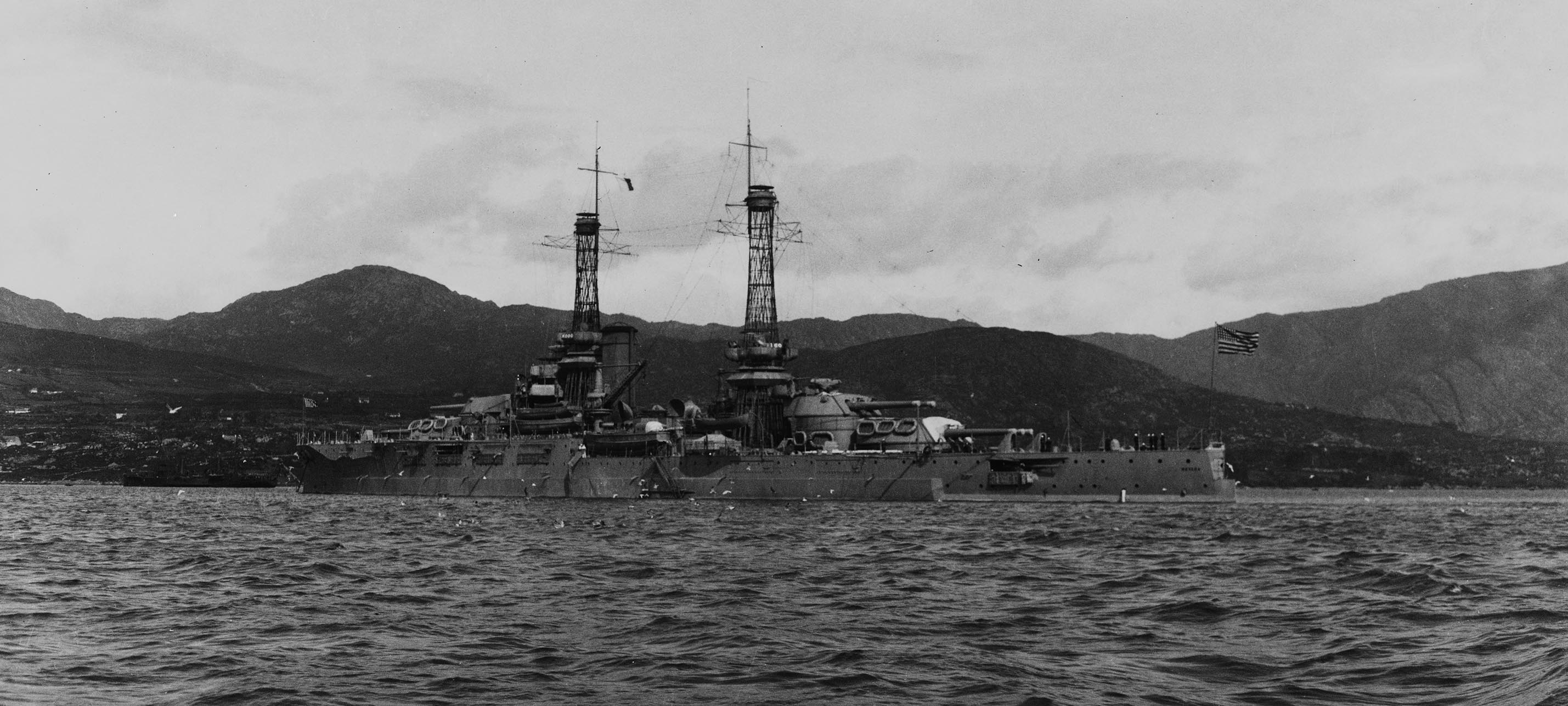
Nevada anchored at Berehaven, 1918.
Unknown to the Americans, the German fleet command ultimately decided that the high potential of losing one or more battle cruisers was not worth the possible reward. The Americans for their part believed that the chance to drown 20,000 or more doughboys in the frigid Atlantic was indeed worth the risk. Plan BCR would not be formally adopted by both navies until 10 October, but the Americans began operating under its provisions almost right away.
Facing personnel shortages by 1918, the Royal Navy began de-commissioning its still-serving pre-dreadnought battleships, making them unavailable for convoy escort. The Admiralty asked the Americans to attach a division of battleships to the Grand Fleet, and four coal-burning dreadnoughts of Battleship Division Nine arrived in December 1917, with a fifth joining them in February 1918 after repairs to grounding damage. The American ships, now styled the Sixth Battle Squadron of the Grand Fleet, had an American squadron commander, Rear Admiral Hugh Rodman, who served in turn under the Grand Fleet’s Sir David Beatty.
The request specified ships powered by coal, which could be provided from British sources. That also provided a fig leaf to cover American reluctance to place their most modern dreadnoughts under British command. Some secondary histories accept this rationale at face value and simply state that oil fuel was not available at Scapa Flow, the Grand Fleet’s base just north of Scotland.
This is not true: the British fleet included five oil-fired dreadnoughts including the fleet flagship Queen Elizabeth. By 1918, the new tank farm on the island of Lyness in Scapa Flow could hold 32,000 tons, about enough oil to fuel the five Queen Elizabeth-class battleships twice. That would not be sufficient if four to six more oil-fueled dreadnoughts joined them, and the tanks had been difficult to build under wartime conditions. But it was not impossible.
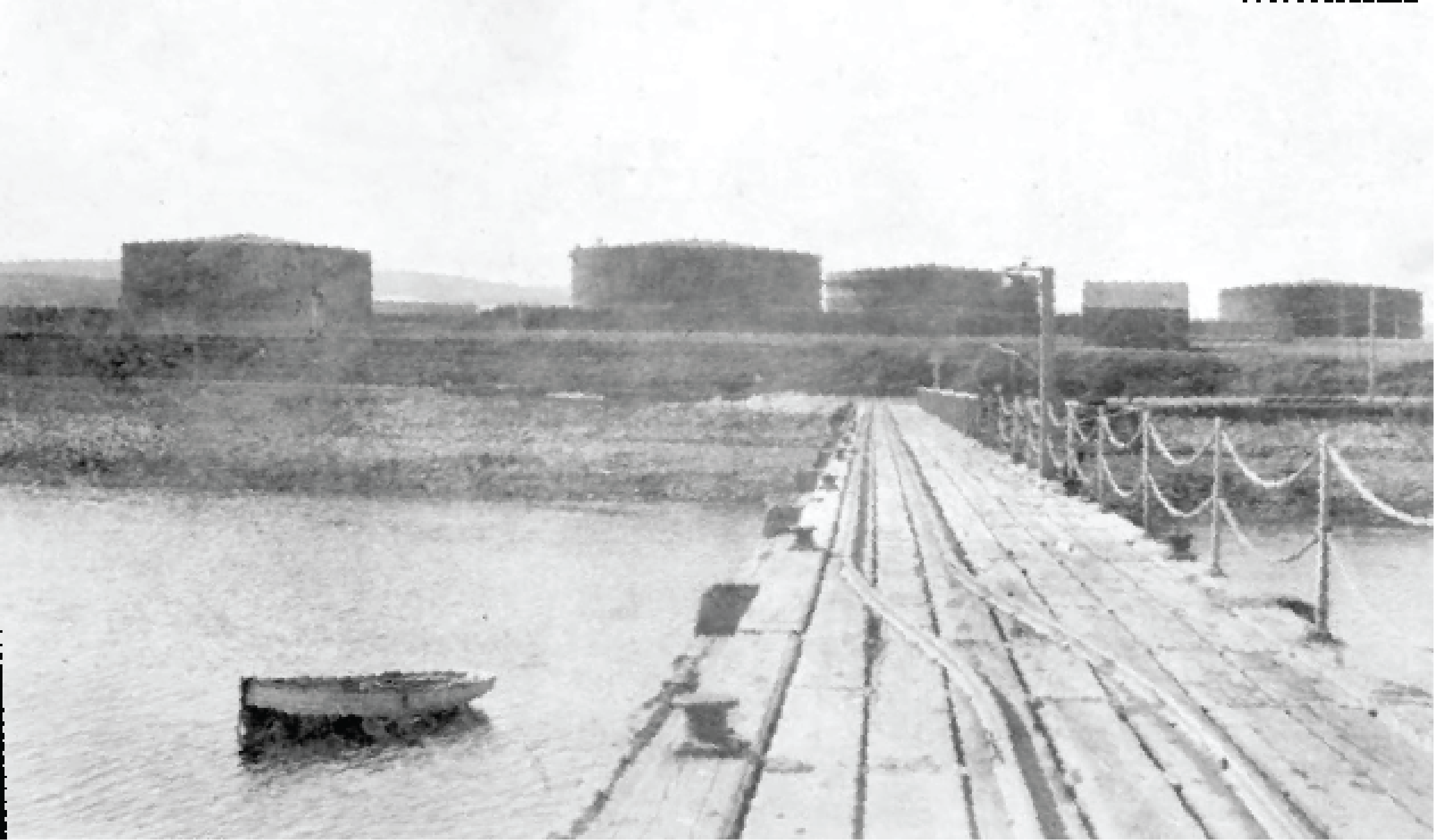
The oil tanks of Lyness Island, Scapa Flow.
The United States boasted the world’s third-most powerful fleet in 1917 (after Britain and Germany), with fourteen dreadnought battleships in service and three more close to completion. The U.S. Atlantic Fleet included all of the Navy’s dreadnoughts. Five of them would serve with the Grand Fleet (Battleship Division Nine, with Delaware, Florida, Wyoming, New York, and Texas; Arkansas would replace Delaware in August 1918). Rodman declined a sixth ship, North Dakota, believing her turbines to be unreliable; she spent the war training gunners and engineers, and receiving a new set of turbines.
The two oldest dreadnoughts, South Carolina and Michigan, had been designed to the old fleet speed of 18 knots, just like the pre-dreadnoughts, and were not considered front-line units. They and the ten newest pre-dreadnoughts (the Virginia and Connecticut classes) would provide close escorts for the troop convoys. The six big armored cruisers of the Pacific Fleet would transfer to the Atlantic to join them.
The four most modern dreadnoughts (Battleship Division Eight, with Arizona, Pennsylvania, and the brand-new New Mexico and Mississippi) would operate out of Hampton Roads as a reaction force to pursue any German battle cruiser spotted in the western Atlantic. The remaining three (Battleship Division Six, with Utah, Nevada and Oklahoma) would move to Bantry Bay in southwestern Ireland, and perform the same task to chase German battle cruisers in the eastern half of the ocean. Two armored cruisers (Montana and North Carolina) would go to Halifax in Nova Scotia on the same mission; Chief of Naval Operations William S. Benson immediately realized that, no matter how much the American admirals loved their big cruisers, a single Iron Dog would send them both to the bottom of the Atlantic with little effort. They would instead join the close escort forces.
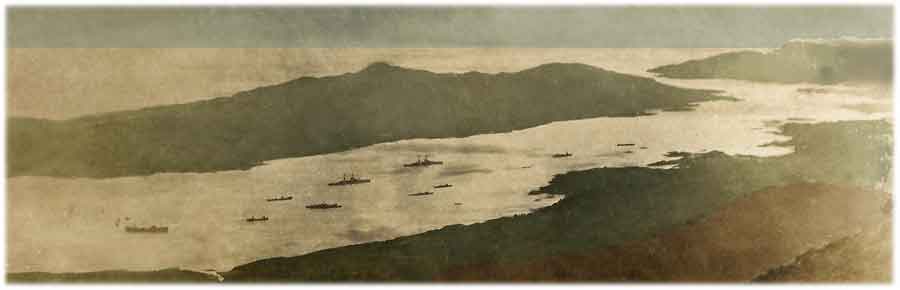
Nevada and Oklahoma, and several destroyers, in Berehaven Harbor. Bere Island is behind them, with Bantry Bay beyond.
With the five dreadnoughts at Scapa Flow and the six armored cruisers pulled in from the Pacific Fleet, this deployment marked a total commitment of American naval strength to the war against Germany. Warming relations with Japan helped make the Americans willing to go all-out to defeat Germany, holding back nothing for the Pacific. Soon after the Americans entered the war in April 1917, the Japanese agreed to provide a cruiser to patrol Hawaiian waters. And in November 1917, American Secretary of State Robert Lansing and Japanese special envoy Kikujiro Ishii hashed out the Lansing-Ishii Agreement, in which both sides pledged not to take advantage of the war to bolster their position in Asia.
None of the American heavy ships, whether battleships or armored cruisers, had the speed to effectively engage a German battle cruiser. To make up for this deficit, Atlantic Fleet commander Henry Mayo suggested appealing to the Japanese for the deployment of their four Kongo-class battle cruisers in the Atlantic. These would operate out of Hampton Roads as a rapid pursuit force to track down German battle cruisers. Someone on the British side countered that this was best achieved by attaching the Japanese ships to the British Grand Fleet at Scapa Flow. The American record does not name names, but Grand Fleet commanders Sir John Jellicoe and later Sir David Beatty had been very open about their desire to add the Japanese battle cruisers to their scouting forces. Caught between their allies’ wishes, the Japanese demurred and kept their impressive big ships at home. Probably not coincidentally, this also removed the chance for American officers to closely inspect them.
You can order Atlantic Breakout right here.
Sign up for our newsletter right here. Your info will never be sold or transferred; we'll just use it to update you on new games and new offers.
Mike Bennighof is president of Avalanche Press and holds a doctorate in history from Emory University. A Fulbright Scholar and NASA Journalist in Space finalist, he has published a great many books, games and articles on historical subjects; people are saying that some of them are actually good.
He lives in Birmingham, Alabama with his wife and three children. He misses his lizard-hunting Iron Dog, Leopold.
Daily Content includes no AI-generated content or third-party ads. We work hard to keep it that way, and that’s a lot of work. You can help us keep things that way with your gift through this link right here.
|