Atlantic Breakout
Plan BCR, Part Two
by Mike Bennighof, Ph.D.
June 2025
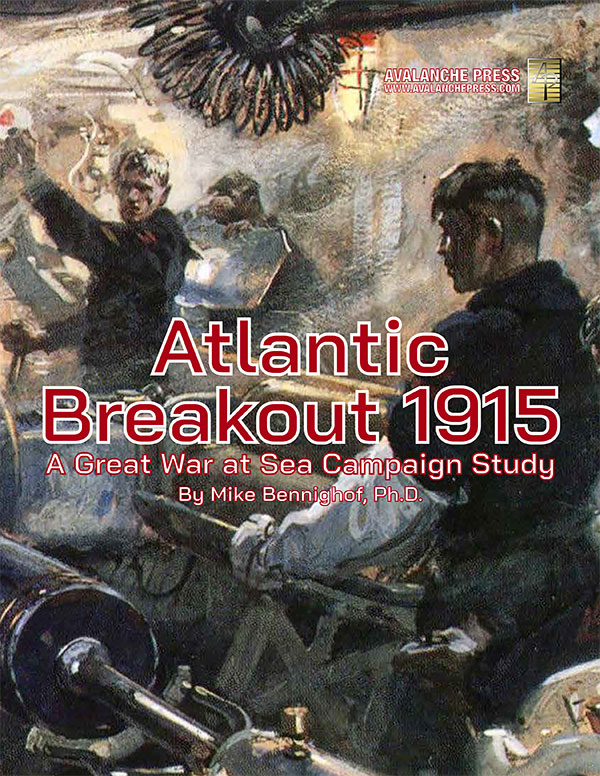 Nevada and Oklahoma departed Hampton Roads on 12 August 1918, arriving at Berehaven in Bantry Bay eleven days later. Division commander Rear Admiral Thomas Rodgers temporarily flew his flag from Nevada while awaiting the division flagship, Utah. Following her turbine repairs, Utah rolled into Bantry Bay on 10 September, bringing with her Atlantic Fleet commander Mayo, who came along to lend his weight to discussions with the local British commanders and then tour American naval forces in the United Kingdom. A flotilla of destroyers had already arrived, their duties to be split between convoy escort on their own, and supporting the battleships. Nevada and Oklahoma departed Hampton Roads on 12 August 1918, arriving at Berehaven in Bantry Bay eleven days later. Division commander Rear Admiral Thomas Rodgers temporarily flew his flag from Nevada while awaiting the division flagship, Utah. Following her turbine repairs, Utah rolled into Bantry Bay on 10 September, bringing with her Atlantic Fleet commander Mayo, who came along to lend his weight to discussions with the local British commanders and then tour American naval forces in the United Kingdom. A flotilla of destroyers had already arrived, their duties to be split between convoy escort on their own, and supporting the battleships.
Bantry Bay is a narrow, deep inlet in County Cork in the south-west of Ireland. Berehaven, hosting a small British naval base, lies on the northern shore near the bay’s mouth. The port itself is considered one of the world’s finest natural harbors. In 1918 it had no railroad, and only minimal road connections to the rest of Ireland. It was an isolated location, where the Americans would see little of their British hosts. This suited the American admirals just fine.
The Americans brought along six months’ worth of stores stuffed aboard their ships: everything from spare socks to ammunition to non-perishable food. They seem to have anticipated a poor relationship with their British hosts, and so made plans to depend on them for nothing but coal (for just one battleship) and fresh food. Mayo, in an 18 September letter to Benson, seems shocked to find the local British commander, Rear Admiral Lewis Bayly, both helpful and friendly.
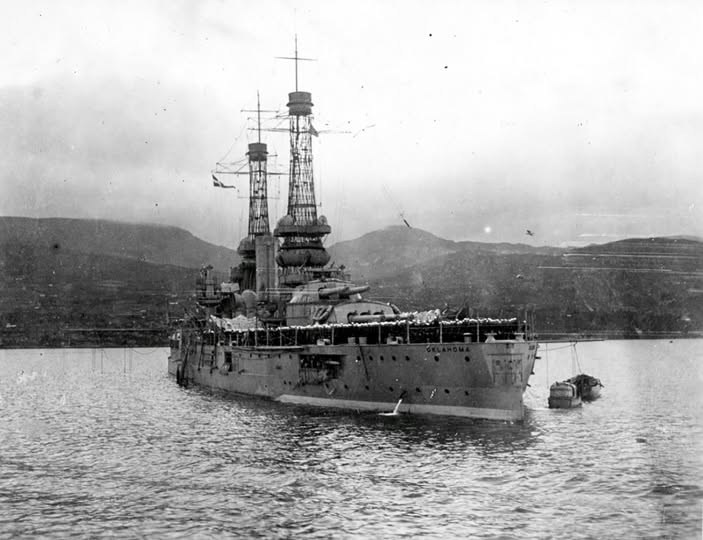
Oklahoma at Berehaven, 1918.
Nevada and Oklahoma both burned oil rather than coal, and represented a marked shift in American battleship design philosophy. While they carried the same main armament as the preceding New York class (ten 14-inch guns) they did so in four turrets rather than five, to concentrate the most vital parts of the ship. These (magazines and engine spaces) would be protected by thick armor, and the less-important areas by none at all. This “all-or-nothing” scheme became the American standard.
Utah, several years older, had ten 12-inch guns in five turrets like the other first-generation American dreadnoughts. Her sister Florida had gone to Scapa Flow, but Utah had been rejected for that assignment and attached to Battleship Division Six with Nevada and Oklahoma, and would go to Ireland with them. Though a less capable fighting ship than the other two, she had more spacious flag quarters, a better communications array, and a reputation as a good sea-boat in rough waters.
To provide fuel for Nevada, Oklahoma, and the destroyers, the Navy quickly leased the tanker Alabama, a 6,600-ton vessel built in 1901. After a hurried refit, during which the Navy re-named her Amabala (“Alabama” spelled backwards), she took aboard a Navy crew and a load of oil. She joined an outbound convoy at Halifax, and brought home the oil to Bantry Bay on 17 September. Amabala provided all of the squadron’s needs from that initial load of fuel until 8 November, when she topped off from a British tanker and resumed her duties.
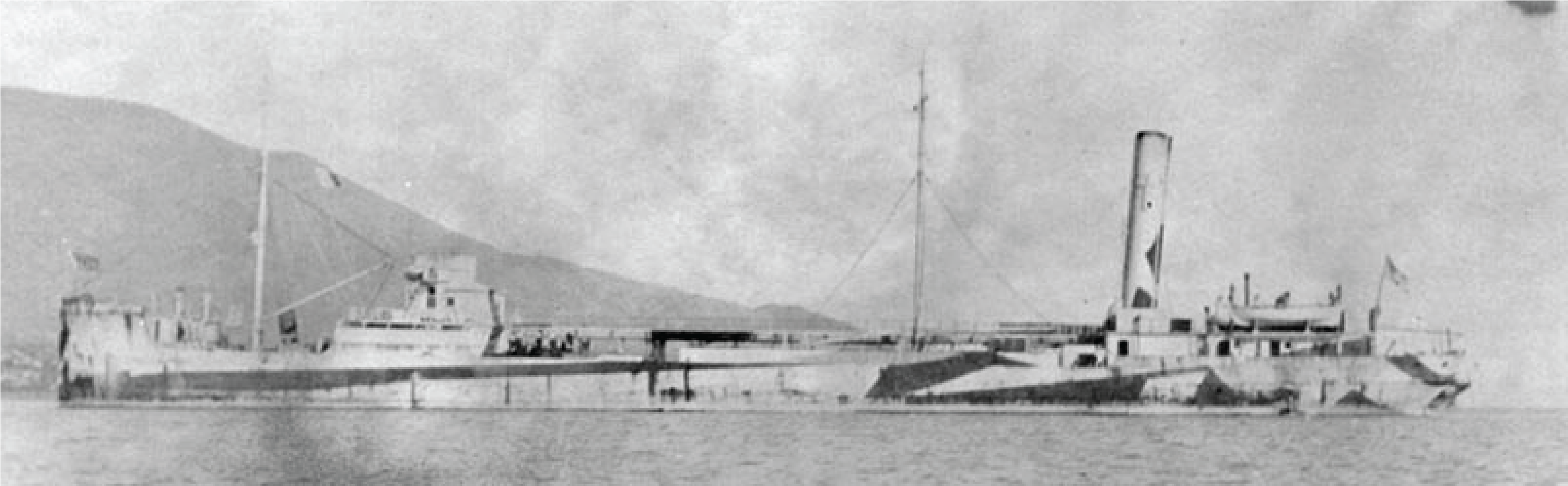
Tanker Amabala bringing to oil to Bantry Bay, 1918.
Mayo also writes that upon his arrival he visited Nevada to thoroughly discuss the deployment with Rodgers, who felt that the battleships might be better positioned in the Azores. The Germans also had a battle cruiser in the Mediterranean. Goeben had been badly damaged by mines in January 1918 and would not return to service until 1930, but the Americans did not know this and feared that she might somehow steam past the combined British, French, and Italian fleets in the Mediterranean and through the narrow Strait of Gibraltar to sortie into the Atlantic. The Planning Section had looked at this exceedingly remote possibility, and ultimately decided to send a seaplane detachment to the Portuguese-ruled islands and keep the battleships in Ireland, where they could counter German raiders seeking out the troop convoys during their approach to the main debarkation point at Brest.
The American battleship crews, traditionally well-schooled and constantly drilled, had added many new, often very young crewmen during the rapid mobilization. This would be a major problem, since Battleship Division Six had no ready supply of ammunition ashore in Ireland. That limited gunnery exercises, but Utah and Oklahoma did steam out of the bay in late September for live firing, escorted by British minesweepers provided by Bayley. Rough weather kept the little ships from going to sea on most days, and without the little ships, the big ships could not safely venture out, either.
The older pre-dreadnoughts could only be used for training, while even the newer ones suffered from mechanical problems. A handful of ships ended up undertaking most of the escort missions, with Virginia, Nebraska, and Georgia (all of the older Virginia class) responsible for more than half of the sorties. The two oldest dreadnoughts, Michigan and South Carolina, managed just one trip each, and each of them had a propellor fall off during the voyage.
All of the pre-dreadnoughts, and even some of the dreadnoughts, gave up secondary guns for use as land-based artillery, coast-defense guns, or to arm merchant ships. Several enterprising pre-dreadnought captains had their crews fit out the now-empty casemates as extra coal bunkers, to extend their ship’s limited range (the pre-dreadnoughts could only make the round-trip carrying extra coal, and even then, several experienced dangerous fuel shortages before reaching home). Stuffing the casemates with coal added over 500 tons’ weight very high on the ship, and Louisiana almost capsized in heavy weather with her imbalanced fuel load.
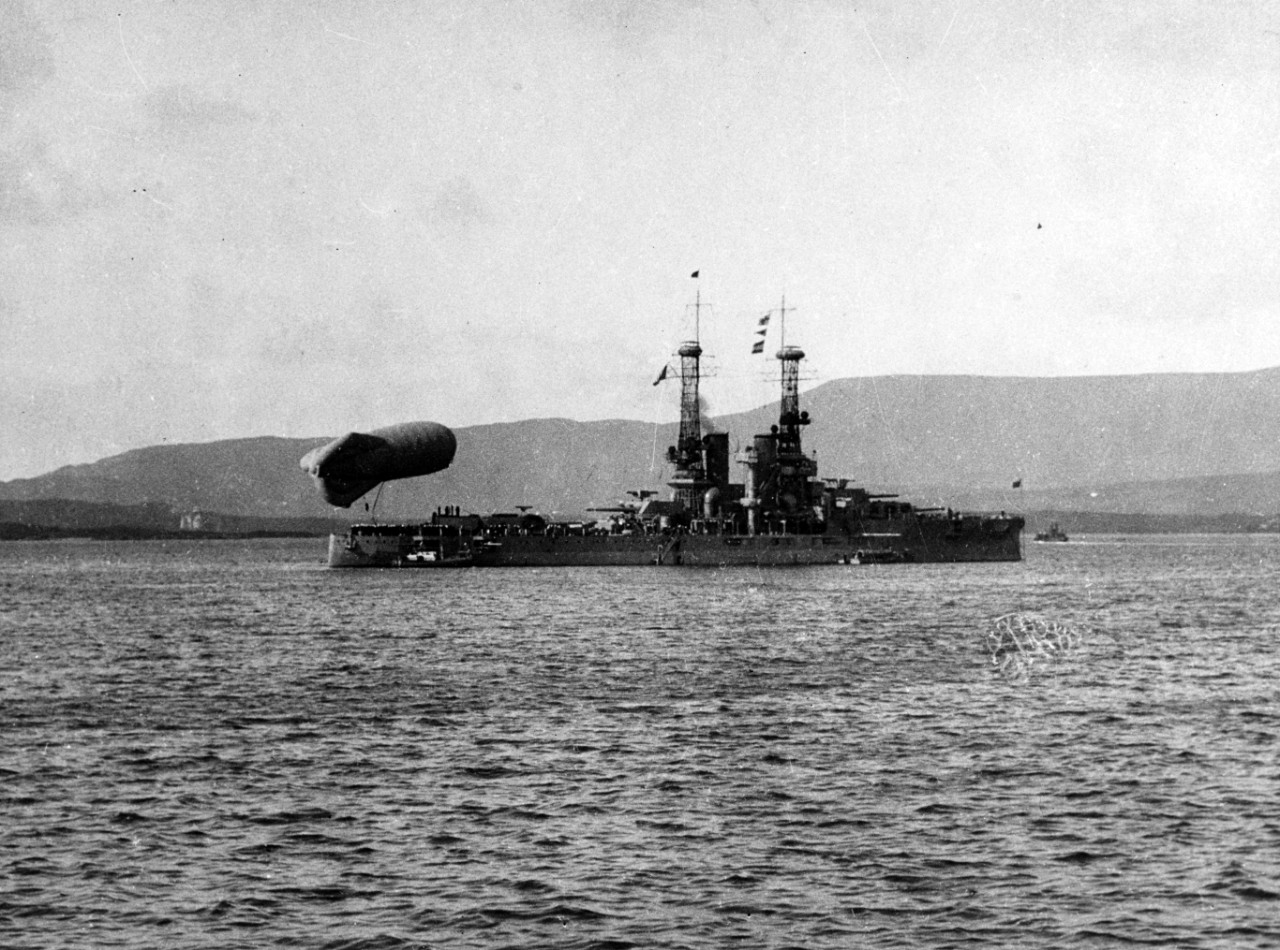
Utah and her rubber cow in Bantry Bay, 1918.
In early October, the American naval attaché in Switzerland, Capt. Henry Hughes Hough, reported a rumor that two German battle cruisers had left Kiel on 29 September, seeking to attack the U.S. troop convoys. Convoy HX-51, a fast convoy of fourteen British passenger liners carrying American troops, had left New York bound for Liverpool on 5 October, escorted by the British armored cruiser Achilles. Convoy HC-20, meanwhile, was also inbound for Liverpool, bearing a mixture of Canadian and American soldiers, with Convoy HC-21 right behind it. With three troop convoys in close proximity and the possibility of German cruisers at sea, the danger seemed extreme.
The three battleships sortied from Bantry Bay on the 14th, accompanied by seven American destroyers (Stevens, Downes, Terry, Sampson, Conyngham, Beale, and Allen). Extremely rough weather limited their speed to 15 knots as they fought through heavy swells. Each battleship brought along its kite balloon, meant to warn of enemy submarines; high winds carried off Oklahoma’s balloon, while Utah’s exploded following a lightning strike. Utah inflated her spare balloon, and lightning claimed that one as well. None of the “rubber cows” were manned at the time of its loss.
The battleships found no Germans, nor did they locate Convoy HC-20. They did meet each of the other two convoys, and accompany them into coastal waters. Afterwards they returned to Bantry Bay even though a fourth troop convoy, HX-52 outbound from New York, also approached with a dozen British liners bearing American troops. This convoy had its own heavy escort, the armored cruiser Montana and pre-dreadnought battleship Nebraska.
That would be the only sortie for Battleship Division Six. Spanish influenza had already started to work its way through the ships’ crews, exceedingly vulnerable in their closed environments. “The general spirit is gloomy,” one Nevada sailor confided to his diary. “Everyone sees many of his shipmates groping around looking like hooded ghosts.”
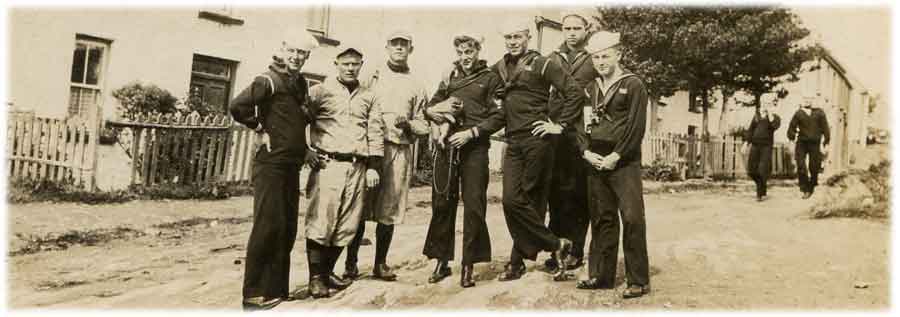
American sailors ashore at Berehaven. The sailor in the middle holds a monkey.
The caseload overwhelmed the ships’ infirmaries, and medical staff set up tents on the battleships’ decks to accommodate the overflow (this also tacitly admitted that the battleships would not be leaving the bay again any time soon). Over one-third of the crew on each ship contracted the disease at some point. Eleven Nevada crewmen died, along with four from Utah and six from Oklahoma including her gunnery officer.
The Irish deployment lasted for 80 days. Weather usually limited training exercises to pierside in Queenstown, or in the relatively calm waters of Bantry Bay; flu shut them down completely for at least two weeks. This did cut down on the need for extra oil and coal, but left the battleship crews restless and bored. Utah’s mascot, a fox terrier named Dixie, rampaged through the bayside towns, assaulting sheep, other dogs, and at least one Royal Navy officer before receiving a ban on shore leave. Rodgers’ staff obtained a plot of land on Bere Island, a large island across Berehaven Harbor from the port town mostly owned by the Royal Navy, and marked out fields for baseball and football. They also organized competitive sailing races.
Other sailors found a different sport: heading into Berehaven and nearby Bridgewater, small towns with a small number of pubs frequented by members of the pro-independence Sinn Fein (many of them participants in the still-raw 1916 Easter Rising). The American swabbies brawled enthusiastically with the Irish rebels, inflicting beatings so severe that Oklahoma’s newly-appointed captain, Charles B. McVay Jr., found it necessary to offer formal apologies and financial compensation to the mayors of Berehaven and Bridgewater. As Mayo had noted in his September letter, conscription had not been enforced in the area, which avoided renewed rebellion but left the young men still at home. Sinn Fein resented the Americans for supporting the British government in the war and considered Irish-Americans among them traitors. The conflict started with small bands of Irish ambushing American armed guards at shore facilities, beating them, taking their weapons, and leaving them bound and gagged. Then it progressed to bar fights. And then the Americans left before it could go further.
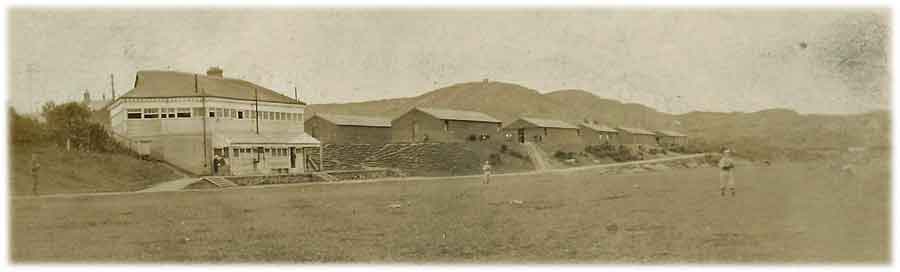
The American baseball field on Bere Island; Royal Navy barracks in the background.
Nevada steamed out of Bantry Bay on 18 November, to join the Grand Fleet’s American squadron for the ceremony marking the surrender of the German fleet. She arrived too late. Oklahoma and Utah departed for Britain on the 26th, and the three ships reunited to escort Woodrow Wilson on his arrival in France in December before returning to the United States. Twenty-three years later, all three battleships would be sunk by Japanese aircraft at Pearl Harbor.
While the Irish deployment seems un-necessary in retrospect, at the time American naval planners deeply feared for the huge convoy packed with soldiers. No comparable sealift had ever been attempted, with just over two million American troops delivered with the loss of fewer than 700 to accidents and enemy action. The Navy proved that it could operate modern battleships in a remote location with essentially no shore facilities, knowledge that would inform the ever-ongoing planning for a future naval war with Japan.
The deployment of pre-dreadnoughts and armored cruisers on the North Atlantic convoy routes represented a major undertaking that strained American resources. While several of the relatively old ships suffered mechanical breakdowns, much of their inability to maintain full mission availability also came thanks to the Spanish influenza. The pre-dreadnoughts had much worse habitability than the more modern battleships, and they had been crammed with additional coal. With heavy seas and bad weather forcing the portholes closed, the crew quarters became a festering crucible of disease. Only Nebraska (just 11 years old, despite her striking obsolescence in the dreadnought age, with her two-story gun turrets) managing to undertake back-to-back convoy escort missions. Fortunately for the ships and men involved, the operations only lasted for three months
This was not 1941; signals intelligence was not as advanced as it would become a generation later, and air recon remained very limited in its effectiveness. The Allied navies could not be sure whether a German battle cruiser had entered the North Atlantic, or not. Without battle cruisers of their own, or provided by the Japanese, the U.S. Navy did the best that it could, assigning its best warships to counter the threat.
You can order Atlantic Breakout right here.
Sign up for our newsletter right here. Your info will never be sold or transferred; we'll just use it to update you on new games and new offers.
Mike Bennighof is president of Avalanche Press and holds a doctorate in history from Emory University. A Fulbright Scholar and NASA Journalist in Space finalist, he has published a great many books, games and articles on historical subjects; people are saying that some of them are actually good.
He lives in Birmingham, Alabama with his wife and three children. He misses his lizard-hunting Iron Dog, Leopold.
Daily Content includes no AI-generated content or third-party ads. We work hard to keep it that way, and that’s a lot of work. You can help us keep things that way with your gift through this link right here.
|