| Red God of War:
The
Air Force’s Army
By Mike Bennighof, Ph.D.
April 2017
 By late 1941, the German Army had suffered enormous losses
in its attempt to conquer the Soviet Union — over 160,000
killed and 570,000 wounded. Divisions had become shadows of
their original strength, numbering at best a few hundred infantrymen.
And a Soviet counter-offensive threatened to destroy these
pitiful remnants if they were not reinforced quickly. By late 1941, the German Army had suffered enormous losses
in its attempt to conquer the Soviet Union — over 160,000
killed and 570,000 wounded. Divisions had become shadows of
their original strength, numbering at best a few hundred infantrymen.
And a Soviet counter-offensive threatened to destroy these
pitiful remnants if they were not reinforced quickly.
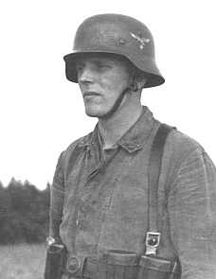
Into the breach stepped Hermann Göring, commander of
the German Air Force. Göring had opposed the invasion,
predicting disaster, but now saw an opportunity to re-assert
some of his waning influence. The Air Force, he promised,
would provide the necessary reinforcements — as Air Force
units, wearing Air Force uniforms under Air Force command.
With 1.6 million men under its colors, the Air Force had the
surplus personnel available and Göring was determined
to keep them under his command. National Socialist ardor would
make up for the lack of training and experience. Adolf Hitler
asked for 50,000 men, and Göring eventually delivered
several times that number.
Seven hastily organized regiments entered combat in January
and February. Most of the personnel came from the small Air
Force security detachments that had already been sent to the
front's rear area. Each had four infantry battalions, a company-strength
mortar battalion and a battery of 88mm anti-aircraft guns.
Five of them fought in the Demyansk sector as an ad-hoc division
commanded by Air Force Gen. Eugen Meindl, an experienced paratroop
leader. Meindl’s division staff had been formed around that
of the crack independent Airborne Assault Regiment, but the
positives ended there. He added a battalion of Air Force skiers,
formed by combing the service for young men with ski experience
— infantry experience, however, was not a requirement. But
Meindl had no artillery beyond the 88mm guns of his regiments,
and no engineers or other support services beyond a signals
unit.
The "division" went into the front lines outside
the "Demyansk Pocket" soon after its arrival, and
suffered enormous casualties. Though formed from young and
physically fit recruits, those officers who had any infantry
experience were older men who had gained it during the First
World War. The Air Force had elite parachute regiments, but
these units released very few of their officers or, most
importantly, non-commissioned officers. Lacking this backbone,
the field regiments performed poorly.
While often described as "lacking infantry training,"
this is not exactly accurate. Like the German Navy, the Air
Force retained many of the basic training regimens of its
Imperial predecessor. New recruits entered "Flieger Regiments"
for basic training, where they learned to march and also the
basics of infantry combat. All of the Air Force’s clerks,
mechanics and even pilots had started their military careers
by learning to handle a rifle.
Battlefield performance had no impact on the Air Force’s
next step: to organize "Air Force Field Divisions" for
frontline service. The Flieger Regiments formed the basis
of most of these new divisions, with their instructors giving
them a small cadre of experienced officers and NCOs. By October
1942, eleven such divisions had been formed, with seven more
joining them by the end of the year. Two more were formed
in the early months of 1943, giving Göring an army of
20 such divisions, and Meindl’s unit was re-formed into two
more.
The new divisions were smaller than their Army counterparts,
though the Army's divisions would soon shrink in size to match
them. Each had two infantry regiments (styled "Air Force
Light Infantry"), each of three battalions. Each was
to have a four-battalion artillery regiment armed in the same
manner as an Army regiment, with three battalions of 105mm
howitzers and one of 150mm guns, but few of them met this
standard. Most had fewer battalions, and some had 75mm mountain
guns or former French or Polish pieces in place of the German-made
weapons specified in the order of battle.
Support units were on a much lower scale than in Army formations.
Most had a full-sized anti-tank battalion, but only a company
of engineers. Some had a bicycle company in place of the reconnaissance
battalions found in Army divisions; others did without recon
troops at all.
Ten of the divisions were rushed to the front at the end
of 1942, with performance even worse than that of Meindl’s division.
The 8th Field Division was sent to join the attempted relief
of Stalingrad in November 1942, less than a month after it
had been officially formed. It still lacked two of its infantry
battalions and most of its artillery when it blundered into
a Soviet tank column in the middle of a blinding snowstorm.
The 2nd Field Division went to 9th Army, where it was flung
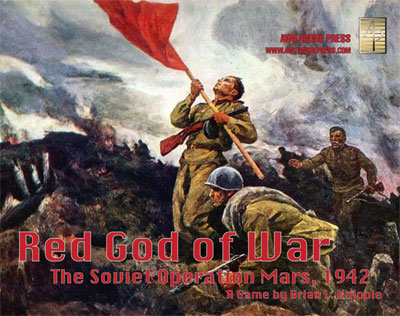
into the line to hold against the Soviet "Operation Mars,"
subject of our Red God of War game. It took
the first brunt of combat surprisingly well, but as days went
by the unit’s initial enthusiasm ebbed and casualties mounted.
Soon it was completely shattered, while nearby Army units
continued to fight.
It’s difficult to assess the combat performance
of the Air Force divisions, pawns in the complex internal politics of the Nazi state’s
feudal organization. As in latter-day imperial states,
the criticism had to be parsed very carefully. The troops
were often praised for their enthusiasm and physical fitness,
with Army generals pointing out that many enlisted men "wasted"
there would make fine NCOs and junior officers if only given
the benefits of Army training and leadership. Never were they
compared to allied formations like the Italian and Romanian
divisions often fighting alongside them, even though these
units usually did much better in combat especially when their
outdated weaponry and lack of motor transport is taken into
account.
But their troops were not Aryan, and in the Third Reich race
came first, followed by class. By praising the troops but
damning their officers, the Army played to Hitler's race and
class prejudices very effectively. In the fall of 1943 he
finally gave in to their intrigues, ordering all the Field
Divisions transferred to the Army. While most generals hoped
to disband the units and send the manpower into the general
replacement pool, as a sop to Göring's pride Hitler ordered
that the divisions be maintained intact. A large-scale swap
of officers took place, with the Air Force re-claiming its
best personnel and the Army sending new leaders. The Air Force
also re-claimed its anti-aircraft gunners and weapons from
the divisional flak battalions.
Four divisions had not survived to be transferred, and a
fifth was disbanded. The remaining divisions kept their designations,
but continued to suffer heavy losses. As they became run down,
the Army did not send them home for rebuilding — the practice
with its other divisions — but instead disbanded them. Only
one seems to have survived until the end of the war.
Regardless of the truth behind the performance of the Air
Force troops, the Army was correct in its criticism of the
wasted effort. The Air Force had to re-create an entire supply,
training and logistical system that already existed. But bureaucratic
empires by their nature are inefficient, and none yield turf
without a death struggle. To transfer manpower to another
service risks the appearance that the service is less relevant,
risking future funding.
How
will you play the game? Buy Red God of War TODAY!
Mike Bennighof is president of Avalanche Press and holds a doctorate in history from Emory University. A Fulbright Scholar and award-winning journalist, he has published over 100 books, games and articles on historical subjects.
He lives in Birmingham, Alabama with his wife, three children and his dog, Leopold.
|