Pacific Armor:
Scenario Preview, Part Two
by Mike Bennighof, Ph.D.
February 2026
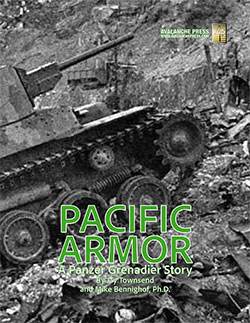 In the hierarchy of resource competition, the Imperial Japanese Army stood several steps below the Imperial Navy. That would send troops into battle with decidedly inferior armored vehicles, and not nearly enough of them. In the hierarchy of resource competition, the Imperial Japanese Army stood several steps below the Imperial Navy. That would send troops into battle with decidedly inferior armored vehicles, and not nearly enough of them.
One place the Japanese did muster their armor and deploy it in mass was on Luzon in the Philippines. It’s a large island with plenty of tank-friendly country, and there the Japanese 2nd Tank Division met the American invasion. The Americans brought no armored division of their own, but all of their infantry divisions had an attached tank battalion, and some had a second one, plus tank destroyers.
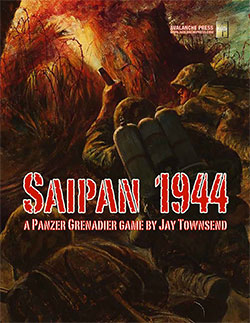
Those tank-against-tank clashes are the theme of Panzer Grenadier: Pacific Armor, an expansion for Saipan 1944. You’ll also need Elsenborn Ridge, Marianas 1944, and Leyte 1944 to play all of the scenarios. Let’s have a look at the second chapter, three scenarios from the American capture of Clark Field:
Chapter Two
The Capture of Clark Field
The U.S. Army’s Signal Corps established Clark Field in 1919, just to the east of Fort Stotsenberg, a cavalry post. From the start, the new airbase had multiple runways, and it expanded throughout the 1920’s and 1930’s to become the center of American military aviation in the Far East. The Japanese quickly made it the center of their own air power in the Philippines and even expanded the complex.
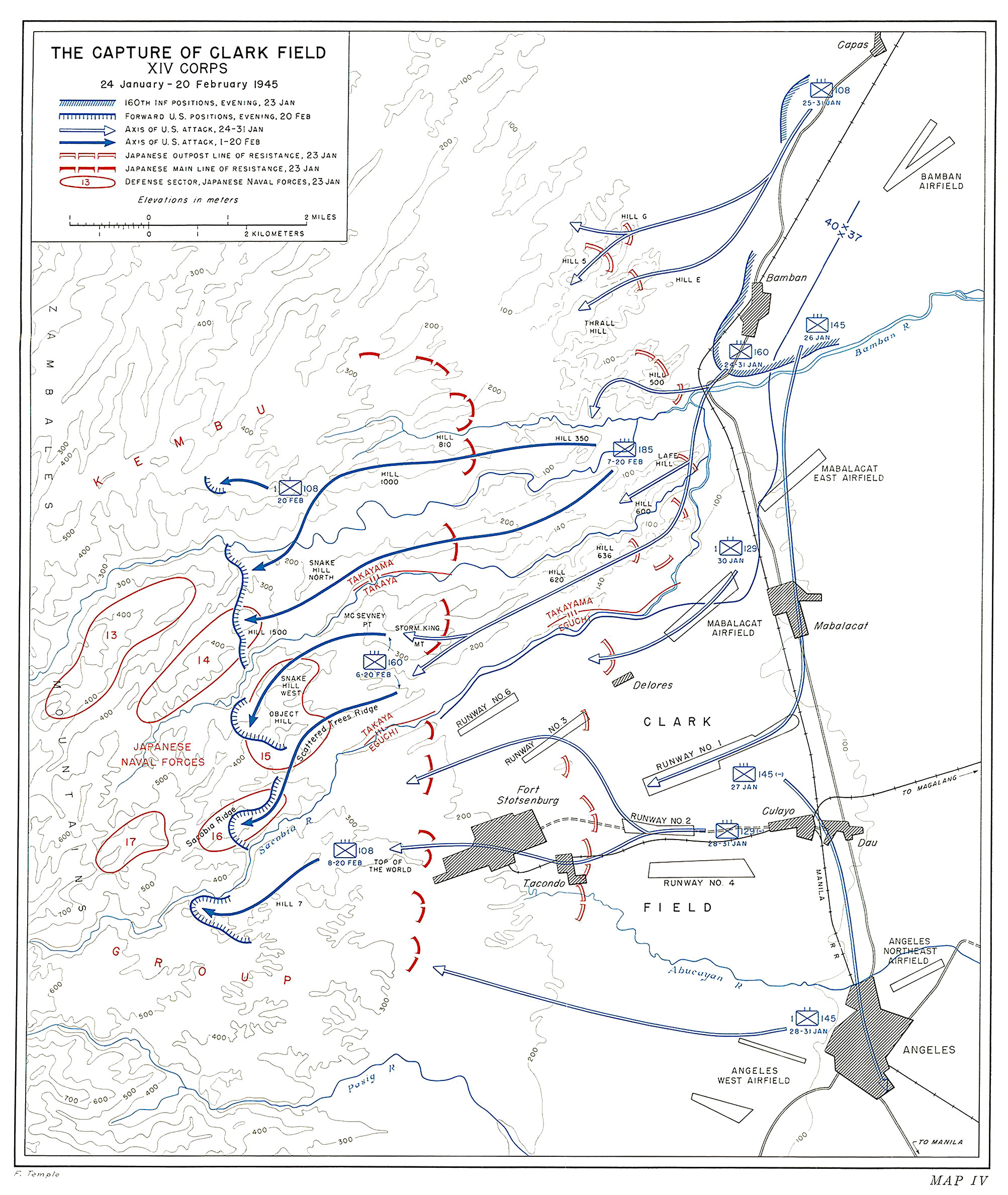
The capture of Clark Field. Open in new tab to vastly embiggen the image.
By early 1945, “Clark Field” included fifteen separate airstrips, plus hangars, workshops, revetments and other facilities. The entire complex stretched for more than twenty kilometers. Much of it had been damaged by American bombing, but by this point in the war, the Americans excelled at returning damaged airbases to full service.
All of that made it a key objective of the American invasion. Given its location, it could not be seized in the first days after the landing. The American Sixth Army, marching south from the Lingayen Gulf beaches, reached the Clark Field area in the last days of January, and launched a broad front attack to capture the complex and the surrounding flatlands.
Scenario Eight
Mabalacat Airfields
28 January 1945
 The Illinois National Guardsmen of the 129th Infantry Regiment, backed by tank support, spearheaded the attack on Clark Field. The Japanese Kembu Group had 30,000 men with which to defend the complex, but most of these were service personnel and other rear-area types, and what combat troops the group did include had little organization and few heavy weapons. Lt. Col. Seizuke Eguchi, charged with stopping the 129th Infantry, had five airfield construction battalions, a loosely-organized battalion of replacements, and some anti-aircraft guns. But he did have a great many land mines. The Illinois National Guardsmen of the 129th Infantry Regiment, backed by tank support, spearheaded the attack on Clark Field. The Japanese Kembu Group had 30,000 men with which to defend the complex, but most of these were service personnel and other rear-area types, and what combat troops the group did include had little organization and few heavy weapons. Lt. Col. Seizuke Eguchi, charged with stopping the 129th Infantry, had five airfield construction battalions, a loosely-organized battalion of replacements, and some anti-aircraft guns. But he did have a great many land mines.
Conclusion
The Japanese service personnel offered little opposition at the two Macalabat airfields (East and West), but Eguchi’s handful of combat infantry met the Americans with automatic weapons fire, and the anti-aircraft gunners laid down withering fire that stalled the armored advance. Having failed to even penetrate the extensive minefields, the Americans would attack again on the following morning. Combat engineers eventually dug 1,350 mines out of this sector.
Notes
All of those minefields are going to be the best defense the Japanese have to offer. Well, that, and some anti-aircraft guns firing in ground-combat mode, that can poke some nasty holes in those Sherman tanks.
Scenario Nine
Counterattack at Fort Stotsenburg
29 January 1945
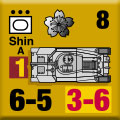
 Having held their ground against the American attack, the Eguchi Group planned a morning counterattack to match the successful attack by the Takaya Group against the 160th Infantry in the hilly ground on Eguchi’s left. To aid in the assault, Eguchi had been given the aid of two depleted companies of tanks and one of assault guns. Having held their ground against the American attack, the Eguchi Group planned a morning counterattack to match the successful attack by the Takaya Group against the 160th Infantry in the hilly ground on Eguchi’s left. To aid in the assault, Eguchi had been given the aid of two depleted companies of tanks and one of assault guns.
Conclusion
Eguchi’s boss, Maj. Gen. Rikichi Tsukada, had risen through the Air Corps ranks and commanded airborne troops. He hoped to restore the original Japanese line of resistance and hold it for at least two more days. But this initial counter-attack did little to move the Americans, and so the tank-assisted attack would resume in the late afternoon.
Notes
The Japanese are on the attack, with armored support. Well, a little armored support. The Americans are pretty tough already, and they’re going to get tougher when their reinforcements show up. This will be a tough one for the Emperor’s tankers.
Scenario Ten
Ho-Ro Rampage
29 January 1945
 Following the failure of his morning attack, Eguchi called in more men and ordered his accompanying armor (the 8th Independent Tank Company) to regroup for another attempt. During the morning attack the two Ho-Ro self-propelled 150mm howitzers had stood off and provided artillery support. Eguchi told Lt. Fumio Washimi, commanding the 1st Independent Self-Propelled Artillery Company, to do the same for the afternoon attack. Washimi had ideas of his own. Following the failure of his morning attack, Eguchi called in more men and ordered his accompanying armor (the 8th Independent Tank Company) to regroup for another attempt. During the morning attack the two Ho-Ro self-propelled 150mm howitzers had stood off and provided artillery support. Eguchi told Lt. Fumio Washimi, commanding the 1st Independent Self-Propelled Artillery Company, to do the same for the afternoon attack. Washimi had ideas of his own.
Conclusion
Washimi claimed that he could not make out targets amid all the smoke and explosions, and so he took his pair of Ho-Ro vehicles into the middle of the fray. He had fired off his high-explosive ammunition during the morning attack, and needed to close with the Americans to use the very effective 150mm shaped-charge rounds. His report claims that the Ho-Ro suddenly encountered four M18 tank destroyers looming through the smoke, and destroyed two of them, then ambushed a platoon of M4 Shermans, knocking out three of them. Both Ho-Ro escaped, but shrapnel from a near miss killed or wounded all of the crewmen of one vehicle.
Notes
The Ho-Ro is just one reduced platoon, but it does have special morale abilities in this scenario. It’s probably not enough to recapture Mabalacat East all by itself, but it can do some serious damage before its demise. American accounts of this battle, not surprisingly, do not match Washmi’s.
Order Pacific Armor Here.
Please allow an extra six weeks for delivery.
Order Saipan 1944 Here.
Please allow an extra six weeks for delivery.
Sign up for our newsletter right here. Your info will never be sold or transferred; we'll just use it to update you on new games and new offers.
Mike Bennighof is president of Avalanche Press and holds a doctorate in history from Emory University. A Fulbright Scholar and NASA Journalist in Space finalist, he has published a great many books, games and articles on historical subjects; people are saying that some of them are actually good.
He lives in Birmingham, Alabama with his wife and three children. He misses his lizard-hunting Iron Dog, Leopold.
Daily Content includes no AI-generated content or third-party ads. We work hard to keep it that way, and that’s a lot of work. You can help us keep things that way with your gift through this link right here.
|