Pacific Armor:
Japanese Armor, Part One
by Mike Bennighof, Ph.D.
February 2026
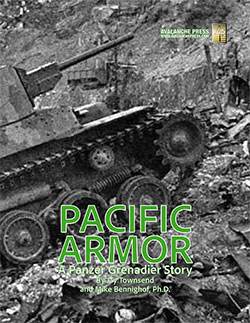 Japan came late to tank development, not producing her first prototype tank until 1927. Japan had no domestic automobile industry in those days, which hampered tank development. Both the Imperial Army and the government financing them agreed that Japanese tanks needed to be made in Japan; the generals did not want to be dependent on imported vehicles and parts, while the money-counters did not wish to pay import prices and shipping costs. But Japan lagged behind the rest of the world in all sorts of motor vehicle categories; Toyota began serial production of the first truck built in Japan in 1935, and then only after prodding from the Imperial Army. Japan came late to tank development, not producing her first prototype tank until 1927. Japan had no domestic automobile industry in those days, which hampered tank development. Both the Imperial Army and the government financing them agreed that Japanese tanks needed to be made in Japan; the generals did not want to be dependent on imported vehicles and parts, while the money-counters did not wish to pay import prices and shipping costs. But Japan lagged behind the rest of the world in all sorts of motor vehicle categories; Toyota began serial production of the first truck built in Japan in 1935, and then only after prodding from the Imperial Army.
A British Mark IV tank was imported in 1918, along with a British crew to demonstrate its capabilities. Over the next several years the Imperial Army obtained a total of 16 tanks of various models, and in 1925 decided to form a force of four tank battalions. A few Renault M1917 light tanks were imported to train a cadre.
Type 89
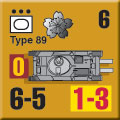 The prospect of large-scale actions in China renewed Japanese interest in tanks. Mitsubishi Heavy Industry finally received an order in 1929 for Japan’s first domestic tank, a design derived from the British Vickers Medium C. The Type 89 like most Japanese weapons took its title from the Japanese year in which it was introduced - 2589 or 1929, 2589 years from the divine founding of the Japanese monarchy in 660 B.C. The Type 89 carried a short-barreled 57mm gun, could make 15 miles per hour and weighed 12 tons. It had only 15mm of armor, sufficient to keep out machine-gun fire but little else. The vehicle went into series production in 1931. The prospect of large-scale actions in China renewed Japanese interest in tanks. Mitsubishi Heavy Industry finally received an order in 1929 for Japan’s first domestic tank, a design derived from the British Vickers Medium C. The Type 89 like most Japanese weapons took its title from the Japanese year in which it was introduced - 2589 or 1929, 2589 years from the divine founding of the Japanese monarchy in 660 B.C. The Type 89 carried a short-barreled 57mm gun, could make 15 miles per hour and weighed 12 tons. It had only 15mm of armor, sufficient to keep out machine-gun fire but little else. The vehicle went into series production in 1931.
The Type 89 first saw action in the Shanghai Incident in February 1932, where some problems became evident. Improvements to the Type 89 followed, including an air-cooled diesel engine that showed promise as a power plant for tanks; most Japanese tanks that followed would be powered by engines derived from this model. The Mitsubishi diesel, produced in 6-, 8- and 12-cylinder versions, greatly reduced the risk of fire, used less fuel and did not require the high-grade gasoline that Japan increasingly could not produce as the war dragged on.
The Type 89 made up about half the Japanese tank force facing the Red Army at the Battle of Nomonhan in 1939, where it was completely outclassed by Soviet BT-type fast tanks. Their last wide-spread use came in 1941 and early 1942 during the invasion of the Philippines, where even the American M3 light tank proved superior, and in Burma against British and Indian forces.
Type 95
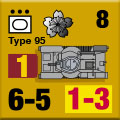 Designed to replace the Type 89, the Type 95 would be a much smaller tank better suited for production by Japanese industry, cheaper and using less high-grade steel. The requirements called for a lightly-armored infantry-support vehicle, fast enough to accompany truck-mounted infantry into battle. The Army’s Technical Bureau presented a design for a 7.5-ton tank, with 12mm of armor and a top speed of 45 kilometers per hour, drawing heavily on the widely exported British-made Vickers Six-Ton Tank. Main armament would be a new model 37mm gun derived from a Hotchkiss design, and two 7.7mm machine guns. For the world of 1934, this Type 95 Ha-Go was on the cutting edge of tank design. Unfortunately for its crews, they would still be driving the same tank a decade later. Designed to replace the Type 89, the Type 95 would be a much smaller tank better suited for production by Japanese industry, cheaper and using less high-grade steel. The requirements called for a lightly-armored infantry-support vehicle, fast enough to accompany truck-mounted infantry into battle. The Army’s Technical Bureau presented a design for a 7.5-ton tank, with 12mm of armor and a top speed of 45 kilometers per hour, drawing heavily on the widely exported British-made Vickers Six-Ton Tank. Main armament would be a new model 37mm gun derived from a Hotchkiss design, and two 7.7mm machine guns. For the world of 1934, this Type 95 Ha-Go was on the cutting edge of tank design. Unfortunately for its crews, they would still be driving the same tank a decade later.
Six different manufacturers produced the Ha-Go, which became the most numerous tank in Japanese service with roughly 2,300 delivered (sources differ on the exact number). It remained in service until the end of the Pacific War, seeing action in every theater where Japanese troops engaged in combat. Along with the Imperial Japanese Army, the Imperial Navy bought the little tank for its Special Naval Landing Forces. Fifty machines were exported to Thailand in early 1941, and some worn-out vehicles passed on to the puppet Empire of Manchukuo in 1943 and 1944.
The Ha-Go performed well during the campaigns in China, as none of the Chinese armies had much in the way of anti-tank capability. It proved useful in the Philippines, Malaya and Burma in 1942, also. When it met American forces, the 75mm guns of Sherman and Grant tanks, and bazooka rockets, all blew through the thin armor. Even .50-caliber machine guns could punch holes in the Ha-Go. Along with thin armor, the small, one-man turret forced the tank commander to load and fire both the main gun and the rear-facing machine gun (which actually fired at an angle). He also had to operate a hand-crank to turn the turret.
But the Ha-Go was cheap and numerous, so it remained in front-line service. The Royal Thai Army junked the last of theirs in 1952.
Type 97
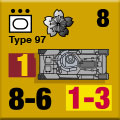 The Japanese cavalry branch, then still holding a great deal of influence in the Empire’s military bureaucracy, liked the Type 95 light tank very much. The infantry did not, wishing for a bigger tank with thicker armor and a bigger gun, even if that came at the cost of some speed. Bureaucratic infighting over the new tank’s specifications (in essence, a cheaper version vs. a more capable tank) led to the Army Technical Bureau building two prototypes in 1937. A fortuitous funding surge brought about by the outbreak of open war in China led to the larger (15-ton) and more expensive, but more capable, tank being chosen as the Type 97 Chi-Ha. The Japanese cavalry branch, then still holding a great deal of influence in the Empire’s military bureaucracy, liked the Type 95 light tank very much. The infantry did not, wishing for a bigger tank with thicker armor and a bigger gun, even if that came at the cost of some speed. Bureaucratic infighting over the new tank’s specifications (in essence, a cheaper version vs. a more capable tank) led to the Army Technical Bureau building two prototypes in 1937. A fortuitous funding surge brought about by the outbreak of open war in China led to the larger (15-ton) and more expensive, but more capable, tank being chosen as the Type 97 Chi-Ha.
The new tank took a great many features from the Type 95 light tank, though enlarged. With infantry support its primary mission, armament consisted of a short-barreled 57mm gun to fire high-explosive rounds plus two 7.7mm machine guns (one in the hull, one at the back of the turret). The turret, offset to the right, now could house two men but still had to be hand-cranked. The gunner adjusted the cannon by sticking his shoulder into it and shoving the barrel. Requirements included armor sufficient to protect against 37mm anti-tank fire; in practice, this was found lacking and both German-made 37mm guns deployed by the Chinese and 45mm guns used by the Soviets penetrated the Chi-Ha’s plating.
Like the Type 95, six manufacturers churned out the new tank (not the same six; in addition to Japanese factories, the Type 97 was also built at the South Manchuria Army Arsenal in Mukden, Manchuria). They turned out 1,162 of them before production ceased in early 1942. Combat at Nomonhan against the Soviets showed the Chi-Ha unfit for the modern mechanized battlefield, and a crash program ensued to produce a better-armed replacement.
New Turret Chi-Ha
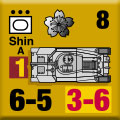 Design work began on the Shinhoto (“New Turret”) Ch-Ha, also called the Type 97-kai, in the summer of 1939. It would retain the chassis of the Type 97 with a new turret. The Army wanted a long-barreled 57mm gun, to give the tank a better weapon than the Soviet tanks encountered at Nomonhan, but cost and time considerations (no such weapon existed) led to the adoption of a modified version of the then-new Type 1 47mm anti-tank gun. The tank version fired the same ammunition as the anti-tank gun. Design work began on the Shinhoto (“New Turret”) Ch-Ha, also called the Type 97-kai, in the summer of 1939. It would retain the chassis of the Type 97 with a new turret. The Army wanted a long-barreled 57mm gun, to give the tank a better weapon than the Soviet tanks encountered at Nomonhan, but cost and time considerations (no such weapon existed) led to the adoption of a modified version of the then-new Type 1 47mm anti-tank gun. The tank version fired the same ammunition as the anti-tank gun.
The new turret had to be much larger than the old, to accommodate the much sharper recoil of the high-velocity gun. That allowed it to fit three crewmen, making the tank far more efficient, but it didn’t give any more armor protection than the unmodified Chi-Ha. That would have to wait for the next model. Japanese factories (including the one in Manchuria) produced 930 of the new model in 1942 and 1943, when it ceased production in favor of the new Type 1. In addition, about 300 of the old Chi-Ha were re-fitted with the new turret; some of these received the better-armored turret from the Type 1 medium tank.
Those would be the Japanese tanks that saw action against the Allies. But they had more and better ones, in their arsenals and on the drawing boards. We’ll look at those next time.
Order Pacific Armor Here.
Please allow an extra six weeks for delivery.
Order Saipan 1944 Here.
Please allow an extra six weeks for delivery.
Sign up for our newsletter right here. Your info will never be sold or transferred; we'll just use it to update you on new games and new offers.
Mike Bennighof is president of Avalanche Press and holds a doctorate in history from Emory University. A Fulbright Scholar and NASA Journalist in Space finalist, he has published a great many books, games and articles on historical subjects; people are saying that some of them are actually good.
He lives in Birmingham, Alabama with his wife and three children. He misses his lizard-hunting Iron Dog, Leopold.
Daily Content includes no AI-generated content or third-party ads. We work hard to keep it that way, and that’s a lot of work. You can help us keep things that way with your gift through this link right here.
|