Pacific Armor:
Japanese Armor, Part Two
The Next Generation
by Mike Bennighof, Ph.D.
February 2026
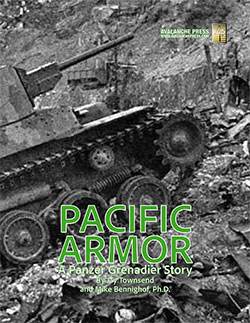 The Imperial Japanese Army rushed the first ten Shinhoto Chi-Ha tanks with their high-velocity guns to the Philippines, where the General Staff hoped they would meet the American M3 Stuart light tank in battle. That didn’t happen, but the Japanese did discover that their new tanks could not stand up to British and American anti-tank guns. The Shinhoto had always been seen as a stopgap, but the General Staff now understood that the gap had widened. The Army needed a new tank. The Imperial Japanese Army rushed the first ten Shinhoto Chi-Ha tanks with their high-velocity guns to the Philippines, where the General Staff hoped they would meet the American M3 Stuart light tank in battle. That didn’t happen, but the Japanese did discover that their new tanks could not stand up to British and American anti-tank guns. The Shinhoto had always been seen as a stopgap, but the General Staff now understood that the gap had widened. The Army needed a new tank.
Type 1
The Shinhoto Chi-Ha gave Japanese tankers a better gun but sent them into action behind the same thin armor. In 1940, designers began work on a new Type 1 Che-He, a very similar tank but with improved protection (especially to the turret) and a more powerful engine to move the now-heavier tank at a better speed than the Type 97.
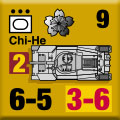 The Che-He kept the same turret with the same gun, but with armor going to 50mm rather than the 33mm of the Chi-Ha. It remained offset slightly to the right and would fit in the same ring. The turret was enlarged, allowing a loader to join the gunner and commander, and no longer did the gunner have to adjust the cannon with his shoulder. The enlarged turret could also stow 20 more rounds for the main gun (making 121 now). An unknown number of Type 97 tanks received this turret when upgraded to Shinhoto status, rather than the earlier version. The Che-He kept the same turret with the same gun, but with armor going to 50mm rather than the 33mm of the Chi-Ha. It remained offset slightly to the right and would fit in the same ring. The turret was enlarged, allowing a loader to join the gunner and commander, and no longer did the gunner have to adjust the cannon with his shoulder. The enlarged turret could also stow 20 more rounds for the main gun (making 121 now). An unknown number of Type 97 tanks received this turret when upgraded to Shinhoto status, rather than the earlier version.
The Chi-He would be the first Japanese tank built with welding (and flush bolts) rather than rivets. It was also the first in which every tank had its own radio (previously, these had been limited to the platoon and company commanders’ vehicles).
Production did not begin until 1943; as with aircraft, the Japanese military kept older models in production long past their sell-by date, so as not to slow the assembly lines to switch patterns. Production numbers are confused, likely because of the turrets used in Shinhoto conversions, but it appears that 170 of them were manufactured in 1943 and 1944.
The Chi-He represented a substantial step forward, despite carrying on much of the previous tank’s design. Had it gone into production when first designed, it would not have been far behind the cutting edge of 1940: early models of the Panzer III, the Soviet BT-7 or Italian M13/40. But it entered service when the Americans fielded the M4 Sherman, which would have obliterated the Chi-He in an even fight.
That fight would never happen. All of the production models remained in Japan, assigned to the 4th Tank Division. Some writers claim that the Chi-He saw action on Luzon in 1945, but this appears to be a reference to the Shinhoto Chi-Ha with Chi-He turret.
A variant of the 47mm-armed Chi-He, the Type 2 Hoi, replaced the 47mm gun with a short-barreled 75mm gun derived from the Type 41 mountain gun. The gun tank was to accompany the Chi-He into battle to deal with soft targets and fortifications, but production halted after only 30 vehicles had been built, as a new tank with a long-barreled 75mm gun promised to fulfill both functions.
Type 3
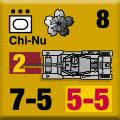 Japan’s next medium tank would also be a stopgap, the Type 3 Chi-Nu. The Chi-Nu also adapted the chassis of the Type 97: slightly longer, wider, and heavier. It kept the same Type 100, 240-horsepower air-cooled diesel engine as the Type 1, causing speed to drop from 44 to 39 kilometers per hour. Armor protection remained the same. Japan’s next medium tank would also be a stopgap, the Type 3 Chi-Nu. The Chi-Nu also adapted the chassis of the Type 97: slightly longer, wider, and heavier. It kept the same Type 100, 240-horsepower air-cooled diesel engine as the Type 1, causing speed to drop from 44 to 39 kilometers per hour. Armor protection remained the same.
The difference came in the main armament, and the turret to house it. The Type 3 Chi-Nu carried the Type 3 75mm gun derived from the Type 90 field gun, derived from a French Schneider design that was itself the descendant of the famed French 75. The Type 90 was a sophisticated weapon, with excellent qualities both as a field gun and in anti-tank combat. But it was difficult to manufacture, and hard to maintain in the field, which led to its losing its place on the manufacturing lines to the simpler but less capable Type 38.
The Type 3 tank gun gave the Type 3 Chi-Nu a weapon that could penetrate the American M4 Sherman. To house the new tank gun and its deep recoil, the Type 3 required a much larger turret, with a very high silhouette. This turret had been designed for the Type 4 Chi-To medium tank, a constantly-delayed project intended to mount a long-barreled 75mm gun developed from an anti-aircraft gun.
All tank projects slowed to a crawl in June 1943, when the Defense Ministry made formal what had already been an informal rule: all projects for land-oriented weaponry – tanks, artillery, anti-tank guns – were to be paused or scrapped, and all effort re-directed toward naval and aerial warfare. The tank designers continued their work slowly, drawing funding from the leftover 1943 appropriations.
Mitsubishi completed the prototype in September 1944, and mass production began at two factories a month later. The new tank had welded construction throughout. Constant shortages of high-grade steel (the Navy had priority) slowed production, and only 166 of them had rolled off the assembly lines when the war ended. All of them would be held in Japan and issued to the 4th, 5th, and 6th Independent Tank Brigades stationed in Kyushu awaiting the American invasion. The tank had been rushed from design to production, and likely would have manifested mechanical issues had it actually seen combat.
Type 4
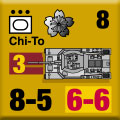 The tank the Imperial Army awaited, the Type 4 Chi-To, had first been requested in the summer of 1941. It morphed from a modified Type 97 Chi-Ha into a completely new vehicle, and there its troubles began. The tank the Imperial Army awaited, the Type 4 Chi-To, had first been requested in the summer of 1941. It morphed from a modified Type 97 Chi-Ha into a completely new vehicle, and there its troubles began.
The original requirement called for a high-velocity 47mm gun, the same weapon that armed the Shinhoto Chi-Ha and Type 1 Chi-He. This changed to a 57mm long-barreled gun, and then a 75mm gun. With each such change, the vehicle needed substantial re-design, and work halted while the new gun completed development.
The final weapon chosen, the Type 5 Long Tank Gun, was derived from the successful Type 4 75mm anti-aircraft gun, developed in turn by reverse-engineering a copy of the Swedish Bofors 75mm Moel 1929 anti-aircraft gun. The Japanese captured one of the 28 bought by the Nationalist Chinese government and deployed to defend Nanjing in 1937. That heritage meant that the first prototype of the tank gun had a semi-automatic loader, but this proved overly complex and would not have been present on the production model.
The Type 4 was not designed to counter the American M4 Sherman; the original requirement came in response to armored combat against the Red Army in 1939 at Nomonhan. The Japanese did not have to face modern Soviet tanks until August 1945, but they did have reports from the Germans detailing their qualities. While the Type 4 would probably have held its own against the Sherman, it was intended to face the T34. Against the T34/85, it would still have been terribly overmatched.
The production plan called for 35 tanks per month, with welded construction for the chassis and a three-piece cast turret. Like the Type 3, Type 4’s design team was drastically cut back in June 1943. For similar reasons, the Type 5 Long Tank Gun did not finish testing until March 1945, and Osaka Army Arsenal, charged with producing the weapon, struggled to complete two of them per month. By the time Japan surrendered in August 1945, only two prototypes of the Type 4 had been assembled and only eleven guns had been manufactured by the Osaka Arsenal.
Japan never committed to mass production of tanks; materials and skilled labor went to the factories and shipyards making aircraft and warships. The Empire did not have the resources to compete with the United States on land, sea, and air. The new-model tanks would have forced the Americans to commit more of their own modern weapons, and more troops, to the Pacific War. But it’s unlikely that they would have altered the outcome.
Order Pacific Armor Here.
Please allow an extra six weeks for delivery.
Order Saipan 1944 Here.
Please allow an extra six weeks for delivery.
Sign up for our newsletter right here. Your info will never be sold or transferred; we'll just use it to update you on new games and new offers.
Mike Bennighof is president of Avalanche Press and holds a doctorate in history from Emory University. A Fulbright Scholar and NASA Journalist in Space finalist, he has published a great many books, games and articles on historical subjects; people are saying that some of them are actually good.
He lives in Birmingham, Alabama with his wife and three children. He misses his lizard-hunting Iron Dog, Leopold.
Daily Content includes no AI-generated content or third-party ads. We work hard to keep it that way, and that’s a lot of work. You can help us keep things that way with your gift through this link right here.
|