Pacific Armor:
Japanese Armor, Part Three
Variant Armored Vehicles
by Mike Bennighof, Ph.D.
February 2026
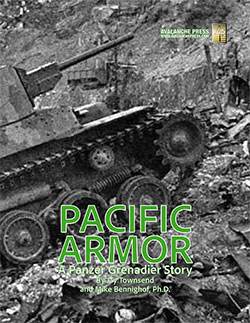 The Japanese received some assistance from their German allies regarding tank design: some reports on enemy vehicles and blueprints of the latest German tanks. The Japanese paid for several samples (the Germans insisted on cash), but these would never be delivered. The Japanese received some assistance from their German allies regarding tank design: some reports on enemy vehicles and blueprints of the latest German tanks. The Japanese paid for several samples (the Germans insisted on cash), but these would never be delivered.
One idea the Japanese did pick up from the Germans was the notion of building many variant vehicles on the same chassis as their tanks: assault guns, self-propelled artillery, tank destroyers.
Type 1 Ho-Ni
Tank Destroyer
While the Shinhoto Chi-Ha’s long-barreled 47mm gun gave better anti-tank performance than the low-velocity 57mm gun of the unmodified Type 97 Chi-Ha, it was not capable of knocking out the improved Soviet tanks the Japanese were sure would soon appear. Each tank regiment would, in theory, receive a company of mobile tank destroyers equipped with a more capable gun.
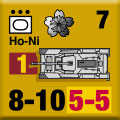 Design work on the Type 1 Ho-Ni began in December 1939. This immediately prompted a bureaucratic scuffle between the armored forces and the artillery branch, over whether this new vehicle was a tank or a mobile artillery piece. The gunners won out, which assured that the Ho-Ni would languish in development and not see much action. Design work on the Type 1 Ho-Ni began in December 1939. This immediately prompted a bureaucratic scuffle between the armored forces and the artillery branch, over whether this new vehicle was a tank or a mobile artillery piece. The gunners won out, which assured that the Ho-Ni would languish in development and not see much action.
The designers settled on the Type 90 field gun as the weapon for the Ho-Ni; that would appease both factions as it was a capable artillery piece that also had good anti-tank performance. A modified version would arm the Type 3 Chi-Nu medium tank. But the artillery branch insisted that the mount allow it to fire with enough elevation to achieve a range of 12,000 meters in the artillery role (as a field gun, it had a maximum range of 14,000 meters). That meant that the gun had to be placed in an open-topped mount, rather than an enclosed turret or gunhouse.
Testing commenced in May 1941 and finished that October, but production did not begin until the following summer. The low priority placed on tank production was even lower for the Ho-Ni, and Hitachi made 138 of this model and a variant, the Ho-Ni II, carrying a 105mm howitzer.
The 2nd Tank Division on Luzon had four Ho-Ni I models, assigned to the 2nd Mobile Artillery regiment. Though usually detailed as mobile artillery, they engaged American Shermans in the January tank battles; their crews at least claimed great success. All four vehciles (all of them 75mm models) were lost to American air attacks.
The 4th Tank Division in Kyushu had a complete battalion of them, 16 vehicles (eight each of the 75mm and 105mm variants), each vehicle with its own dedicated half-track munitions carrier. In November 1944 they were detached from their parent division and shipped to Luzon. American carrier planes sank all of their transport, and only 20 men of the battalion made it ashore where they fought as infantry and appear to have all perished.
Some Ho-Ni saw action in Burma and in China, but most remained at home awaiting the invasion that never came.
Type 4 Ho-Ro Self-Propelled Gun
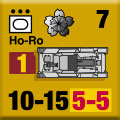 Among the blueprints delivered to Japan, the Grille self-propelled howitzer caught the eye of the Army Technical Bureau. They ordered up a design of their own, based on the Type 97 Chi-Ha chassis, and armed with the Type 38 150mm howitzer. Among the blueprints delivered to Japan, the Grille self-propelled howitzer caught the eye of the Army Technical Bureau. They ordered up a design of their own, based on the Type 97 Chi-Ha chassis, and armed with the Type 38 150mm howitzer.
The Type 38 had been ordered from Krupp in 1905 as a siege gun but arrived too late for use in the Russo-Japanese War. It became the Imperial Army’s standard siege gun and saw action at the siege of Tsingtao in 1914. After Krupp provided samples, production shifted to Osaka Army Arsenal. In all 224 were built; it’s not clear how many were delivered from Krupp but that number appears to have been small. The Imperial Russian Army ordered 800 of them from Osaka Arsenal in 1917; only 16 had been delivered when the Tsarist regime collapsed.
From the start, the Type 38 proved a disappointment. Designed to be pulled by eight horses, the Japanese soon found that it had to be dis-assembled to be moved, a slow and tedious process. That limited its use with the field armies, and it would be repeatedly retired and brought back into service. Thus, when the Army Technical Bureau looked for a weapon to arm their new vehicle, they found plenty of Type 38 howitzers lying unused in various arsenals.
The Type 4 Ho-Ro greatly resembled its German inspiration, with an open-topped fighting compartment built up on the forward end to house the howitzer. Weight rose by two tons (14.3 tons to 16.3) yet the engine remained the same, dropping the new vehicle’s speed. The ancient howitzer did have shaped-charge and high-explosive anti-tank (HEAT) rounds, so though it was intended for infantry support, the Ho-Ro had a respectable anti-tank capability.
Mistubishi ran off four or five prototypes in 1944 (some sources claim a full dozen, but this does not appear to be true). Three of them rushed to the Philippines to equip the 1st Self-Propelled Artillery Company, under the direct command of 14th Area Army; one was lost when their transport was sunk while unloading. The remaining two (one more may have been received later) fought American tanks at Clark Field, claiming an improbable score of a dozen Shermans and three M18 Hellcats destroyed. Both of the valiant Ho-Ro would eventually fall victim to American tank and machine-gun fire.
Up to 20 production models appeared in 1945, all of them held in Japan with the 28th Tank Regiment.
Type 5 Ho-Ru Experimental Tank Destroyer
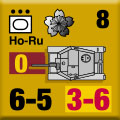 In February 1945, the Japanese Fourth Army directed its Technical Branch to design a simple tank destroyer and contract with a local manufacturer to build it. The result was the Type 5 Ho-Ru, a small but fully armored vehicle based on the Type 95 Ha-Go light tank. In February 1945, the Japanese Fourth Army directed its Technical Branch to design a simple tank destroyer and contract with a local manufacturer to build it. The result was the Type 5 Ho-Ru, a small but fully armored vehicle based on the Type 95 Ha-Go light tank.
The very small tank destroyer would carry the same high-velocity 47mm gun as the Shinhoto Chi-Ha, which by this point in the war had little ability to stop American tanks. A prototype was finished in June, and a production order given to Kobe Steel for 50 units. Since the purchase order came from a field headquarters and not the Army Ministry’s Ordnance Bureau or the newly formed Ministry of Munitions, it came with no funding. The directors at Kobe Steel knew their priorities and would not build the vehicles without payment. They billed the Army Ministry for 50 Ho-Ru vehicles, as though they had been completed and delivered, but don’t appear to have actually produced any of them.
Soko Sagyo Ki (SS-Ki) Work Machine
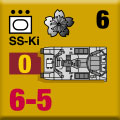 Not a tank but a multi-purpose engineering vehicle derived from the Type 89 tank, the SS-Ki had been used since 1930 to clear mines, move heavy objects, dig holes, and perform many other tasks. Vehicles had cranes, hoists, poison-gas-sprayers and other equipment, but all of them were also equipped to act as flame throwers with three nozzles on each vehicle. They were not very fast, though, and so after some use in the front lines at Tianjin in 1937 against the Chinese, they saw little combat. Not a tank but a multi-purpose engineering vehicle derived from the Type 89 tank, the SS-Ki had been used since 1930 to clear mines, move heavy objects, dig holes, and perform many other tasks. Vehicles had cranes, hoists, poison-gas-sprayers and other equipment, but all of them were also equipped to act as flame throwers with three nozzles on each vehicle. They were not very fast, though, and so after some use in the front lines at Tianjin in 1937 against the Chinese, they saw little combat.
Second Tank Division had two dozen of them, assigned to its engineer regiment which apparently did try to use them in a combat role.
Order Pacific Armor Here.
Please allow an extra six weeks for delivery.
Order Saipan 1944 Here.
Please allow an extra six weeks for delivery.
Sign up for our newsletter right here. Your info will never be sold or transferred; we'll just use it to update you on new games and new offers.
Mike Bennighof is president of Avalanche Press and holds a doctorate in history from Emory University. A Fulbright Scholar and NASA Journalist in Space finalist, he has published a great many books, games and articles on historical subjects; people are saying that some of them are actually good.
He lives in Birmingham, Alabama with his wife and three children. He misses his lizard-hunting Iron Dog, Leopold.
Daily Content includes no AI-generated content or third-party ads. We work hard to keep it that way, and that’s a lot of work. You can help us keep things that way with your gift through this link right here.
|