Saipan 1944:
U.S. Marine Pieces
by Mike Bennighof, Ph.D.
February 2026
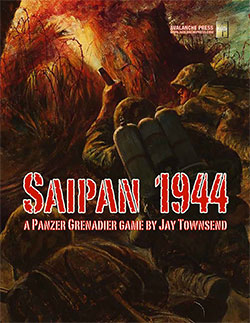
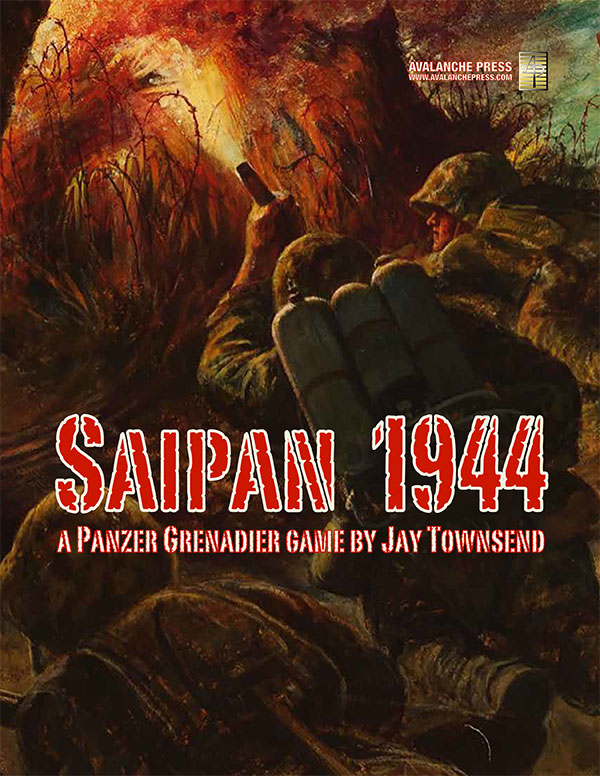 Panzer Grenadier: Saipan 1944 is the centerpiece of the series’ look at the Pacific War. Of the series’ 22 games that are either in print or scheduled for upcoming release, only Saipan 1944 is set during the Japanese-American War. That makes it more than a little unique. Panzer Grenadier: Saipan 1944 is the centerpiece of the series’ look at the Pacific War. Of the series’ 22 games that are either in print or scheduled for upcoming release, only Saipan 1944 is set during the Japanese-American War. That makes it more than a little unique.
Saipan 1944 comes with the standard sheet of Panzer Grenadier 165 markers, and 330 more for the units and leaders you’ll use to play the scenarios. That’s pretty standard for a Panzer Grenadier game. All of them are the beautiful silky-smooth pieces we’ve used in our games for over a decade.
Four armies fought for Saipan: the U.S. Army, the United States Marine Corps, the Imperial Japanese Army, and the Imperial Japanese Navy’s Special Naval Landing Forces. That makes for a colorful array of contestants, who fought this battle in deadly earnest.
The United States Marine Corps
By the summer of 1944, the Marine Corps fielded four full divisions, with another in the process of formation and yet one more beginning to come together. Two of those four active divisions would bear the brunt of the fighting on Saipan, with a third bobbing offshore in reserve. After nearly two years of war, the Marines had honed their amphibious landing techniques, finally acquired first-line weapons, and crafted an organization that suited combat with the Japanese.
That organization existed mostly on paper. The Marine divisions had adopted the structure, but under the pressure of combat battalion commanders re-formed the Weapons Companies abolished under the new tables. That brought the machine-gun platoons back together for concentrated firepower but encouraged battalion commanders to ignore the copious artillery support now available to them.
Units in Panzer Grenadier are platoons, but it’s really a battalion/regimental scale game. So all of those issues are pretty clearly shown in the game. You pull all of those weapons platoons together, at the price of not having them spread out to back your infantry. But you usually have plenty of artillery on call to give you that needed firepower.
Like the players, the Marines had read the rulebook. Now they had to figure out how things actually worked.
Marine Rifle
The Marine rifle platoon had been steadily evolving throughout the war and now had reached what the Marine generals considered perfection. The platoon numbered 46 men, divided into three 13-man squads. Each squad deployed three fire teams, each built around a Browning Automatic Rifleman and led by a corporal. The platoon was built for maximum firepower to counter the perception of massed Japanese banzai charges. Which did happen, just not as commonly as was believed in Quantico.
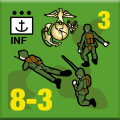 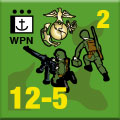
The Marines liked the BAR very much and complemented it with Garand M1 semi-automatic rifles in the hands of the other riflemen. It was not a true light machine gun, drawing from a box magazine rather than a belt, but the Fire Team concept maximized its good qualities.
The heavy machine-gun platoons, now assigned to the rifle companies, had a paper strength of six .30-caliber Browning Model 1919 medium machine guns. They also held, “in reserve,” six Browning Model 1917 heavy machine guns. In practice, the Marine machine gunners deployed as many of the weapons as they could carry. The platoon had three squads, each with 17 men and two machine guns. The M1919 weighed in at 45 pounds including the tripod, which made it too heavy for use as a squad automatic weapon (hence the reliance on the BAR); it also required a crew of five. The heavy machine gun weighed in at 103 pounds with a crew of six.
The lack of manpower severely limited the use of the heavy machine guns, which usually remained well in the rear. They saw some use on Saipan, with a squad sometimes unpacking one to add a third machine gun for perimeter defense or to attack caves, but there do not seem to be any instances of all of a platoon’s 12 weapons being used at once (which was just barely feasible but would leave no one to fetch ammunition).
Engineers
The new 1944 division structure emphasized devolving tasks and firepower to lower-level units, what Marine doctrine called “pushing downward.” That applied to combat engineering tasks as well as automatic weapons, and rifle squads found themselves toting flamethrowers and demolition charges. Engineers would train the riflemen in their use and sometimes appear in small groups to oversee their deployment in combat; they also helped group flamethrowers for maximum effect.
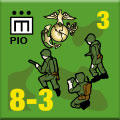 
The older division structure had included a three-battalion engineer regiment, with battalions of combat engineers, pioneers, and construction engineers (the latter provided by the Navy). Under the new table, the division had just one, with three combat engineer companies and one shore party company. That put far more strain on the engineers, and so the rifle companies were expected to help themselves. That resulted in some attacks stalling on Saipan to wait for the engineers, and others moving rapidly as Marines blew up Japanese positions with the glee that only a 19-year-old handed a satchel charge can muster.
Mortars and Rockets
Just as had been done with the machine guns, the new organization pushed mortars downward and emphasized lighter tubes more suited for island fighting. The M2 60mm mortar, a licensed French Brandt design, continued to be issued to heavy weapons platoons (its firepower is included in those pieces). The new Marine organization also issued the 60mm tube to battalion mortar platoons as an alternative to the 81mm weapon. Commanders could choose to use the lightweight tube in rugged conditions when mobility meant more than firepower.
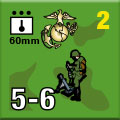 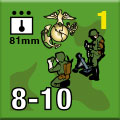 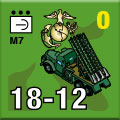
The mortar platoons usually fielded their 81mm tubes instead. The M1 mortar was likewise licensed from Brandt, the same weapon that armed most of the armies of World War II (including the Japanese). Marine battalions, too often in the eyes of their generals, relied on their mortar platoons rather than artillery for fire support on Saipan.
Artillery
Marine divisions had gone to war in 1942 with a relatively lightweight artillery component: partially in recognition of the island conditions in which they would fight, partially because the Marines stood behind the Army in line for new weapons and equipment, and partially because ships’ guns could theoretically supply plenty of firepower (big guns, but not as responsive or precise as conventional artillery). By 1944 this had become less of an issue, and Saipan would be large enough for Marine artillery to play a more important role than naval gunfire.
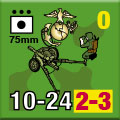 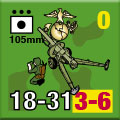 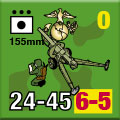
Marine divisions kept their two battalions of light artillery (75mm pack howitzers); these had been part of their artillery regiments since their formation in 1941. By 1944, the pack howitzer allotment had dropped from three to two battalions (12 tubes in each battalion), joined now by two medium artillery battalions with the standard M3 105mm howitzer (again, 12 tubes per battalion) and one heavy artillery battalion with a dozen 155mm M1 howitzers. In contrast, an Army division (one of which, the New York National Guard’s 27th Infantry Division, saw action on Saipan) had three battalions of 105mm howitzers and one of 155mm howitzers. The Marine division had more tubes, but threw less metal.
Beyond the divisional battalions, the Americans landed four Army battalions (two of 155mm howitzers, two of 155mm cannon) and one Marine 155mm cannon battalion. All of these came under the unified command of an Army general, Arthur Harper. During the battle, all of the Marine generals present complained that their subordinates did not often tap this wealth of high-explosive firepower.
Marine Armor
Unlike Army practice, Marine divisions included an organic tank battalion (the 27th Infantry Division came to Saipan with two attached tank battalions). Like other Marine units, they initially made do with second-line vehicles as the Army had first priority for new tanks. By the summer of 1944, both Marine tank battalions deployed to Saipan had been equipped with relatively modern tanks: three companies each with fifteen M4 Shermans, and one with M5 Stuart light tanks.
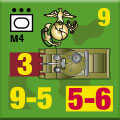 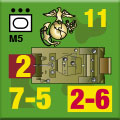 
The Marines did not field Shermans with the 76mm gun on Saipan; the 75mm gun seemed better suited for destroying fortifications and it could easily deal with the Japanese tanks encountered on the island. Alongside Stuart tanks with the standard 37mm gun, the battalions also included flamethrower-equipped versions known as “Satan.”
Mobile Firepower
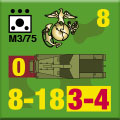
While the Marine tank battalions had drawn shiny new Shermans, the anti-tank companies received the M3 GMC (Gun Motor Carriage), a Great War-era “French 75” field gun mounted on a halftrack. It had proven inadequate in the Army’s defense of the Philippines and battles in Tunisia, giving way to fully-tracked tank destroyers armed with actual anti-tank guns. The cast-offs went to the Pacific with the Marines. Against Japanese tanks, the French 75 proved still adequate. The half-tracks saw more use as mobile artillery able to put direct fire on Japanese emplacements and fortified caves.
At the cutting edge of weapons technology, the Marines also deployed the M7 “Shoot-and-Scoot” mobile rocket launcher. This consisted of three launch racks, each of twelve cells, each cell holding a Navy 4.5-inch rocket (also mounted on landing craft and PT boats), on a standard M-2-4 one-ton cargo truck. Each Marine division on Saipan brought along a Provisional Rocket Detachment with a dozen trucks. They performed well, for the most part, delivering high-intensity fire on short notice. What had not been recognized before their commitment to battle was the tendency of the cells to fall out of alignment when jostled by the trucks’ movement over rough terrain. And so the rockets would fly off in odd directions, sometimes striking friendly forces. They also fired a great many rockets, and the detachments’ personnel did not include dedicated ammunition handlers. So they often ran out of rockets and were reduced to begging crews of the Navy’s rocket-armed landing craft for some of theirs.
Amphibious Tractors
The LVT amphibious tractor had been developed shortly before the war but was first used on a large scale to deliver Marines to the beach in November 1943 at Tarawa. For the Saipan landings, all over the first wave would go ashore in LVTs, accompanied by gun-armed LVT-A versions that after the landings would serve as light tanks.
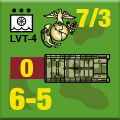 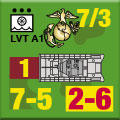 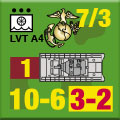
The LVT-A did not serve as a very good light tank. It was a big target, and the A-4 turret had an open top. But it did give added firepower with their short-barreled 75mm howitzers (the A-4 model) and 37mm gun (the A-1 version). And unlike actual tanks, the LVT was considered disposable. Experience on Tarawa had shown that so many mechanical problems cropped up during the landings and subsequent combat that the LVTs were not worth salvaging and repairing. They would be left to rust on each conquered island, with new vehicles issued for the next landing.
And those are the Marine pieces of Saipan 1944.
Order Saipan 1944 Here.
Sign up for our newsletter right here. Your info will never be sold or transferred; we'll just use it to update you on new games and new offers.
Mike Bennighof is president of Avalanche Press and holds a doctorate in history from Emory University. A Fulbright Scholar and NASA Journalist in Space finalist, he has published a great many books, games and articles on historical subjects; people are saying that some of them are actually good.
He lives in Birmingham, Alabama with his wife and three children.
Daily Content includes no AI-generated content or third-party ads. We work hard to keep it that way, and that’s a lot of work. You can help us keep things that way with your gift through this link right here.
|