South Pacific:
Shokaku-Class Carriers, Part One
by Mike Bennighof, Ph.D.
August 2025
 Japan built her first two purpose-built large carriers, Soryu and Hiryu, under the limits of the 1922 Washington naval agreement. In 1936, Japan declared that she would no longer be bound by such treaties, and declined to participate in the Second London Naval Conference. The Imperial Navy would now pursue a policy of building the most powerful warships of each type, seeking individual superiority since they expected to be outnumbered in a naval war with the United States. Japan built her first two purpose-built large carriers, Soryu and Hiryu, under the limits of the 1922 Washington naval agreement. In 1936, Japan declared that she would no longer be bound by such treaties, and declined to participate in the Second London Naval Conference. The Imperial Navy would now pursue a policy of building the most powerful warships of each type, seeking individual superiority since they expected to be outnumbered in a naval war with the United States.
The Third Supplemental Naval Armaments program, passed by the Imperial Diet in early 1937 provided for 71 new warships, at a cost of 806 million yen. The core of the program would be two 35,000-ton battleships (the Yamato class, actually coming in at 72,000 tons), at a cost of 108 million yen apiece, and two 24,500-ton aircraft carriers (the Shokaku class, actually coming in at 32,000 tons), costing 83 million yen apiece. Nearly half of the appropriation went to these four super-warships.
The new carriers, to be named Shokaku (“Soaring Crane”) and Zuikaku (“Auspicious Crane”) would be the largest yet built anywhere from the keel up (the converted American and Japanese battle cruisers and battleship were larger ships, though not as capable as much smaller purpose-built aircraft carriers). They shared the bulbous bow of the Yamato-class battleships built under the same program, and the unusual rudder arrangement with two rudders, one placed in front of the other.
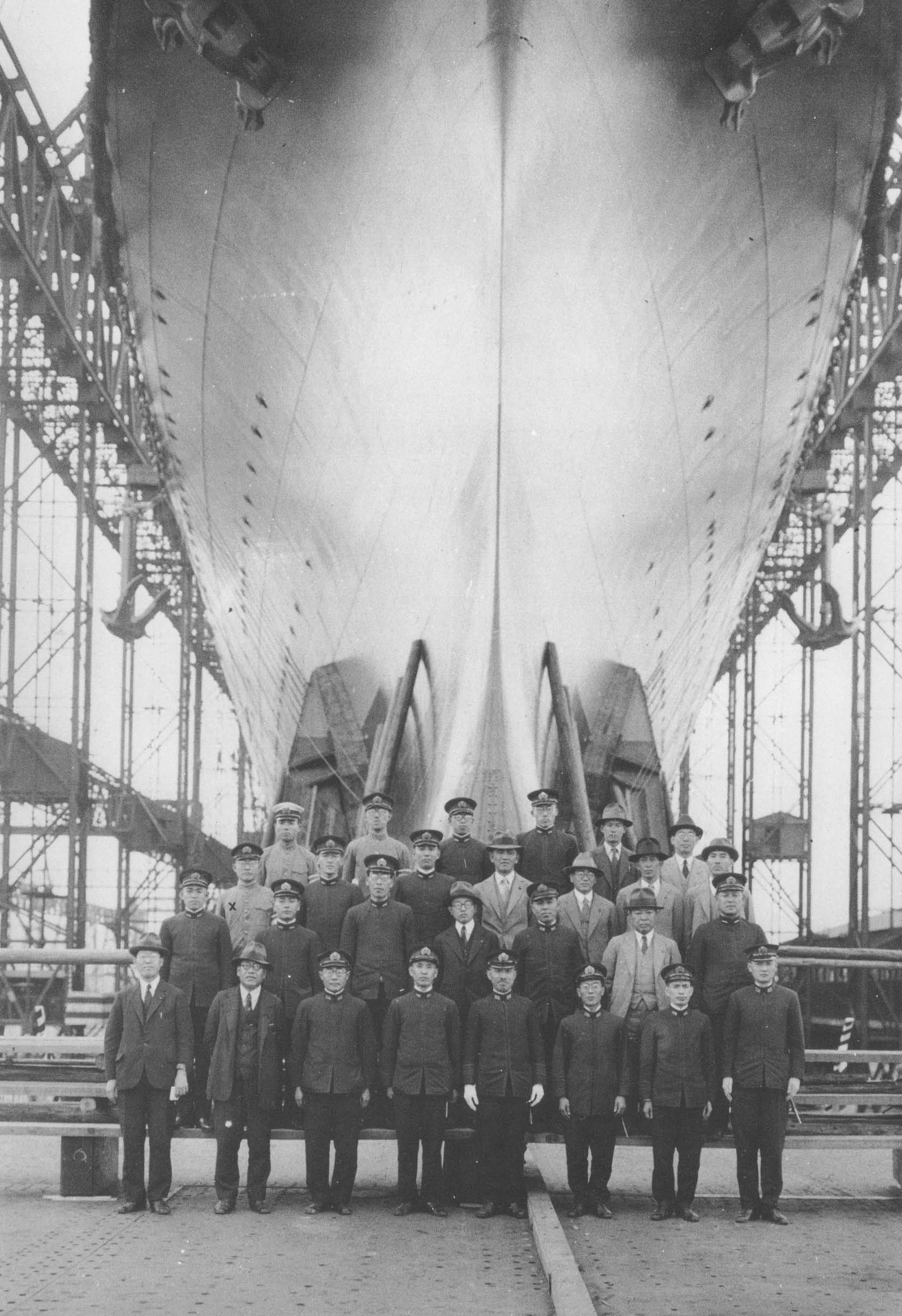
Shokaku and her chief builders just before launch, 30 May 1939. Note the bulbous bow. |
Shokaku would be a big ship, weighing in at 32,100 tons, on a hull 257 meters long. She would also be very fast, with a long, slender hull to help boost her speed, and a massive propulsion system: eight Kampon water-tube boilers and four turbines driving four shafts, to yield a top speed over just under 34.5 knots. The 160,000-horsepower output of that system would be the most of any Japanese warship ever completed, including the huge Yamato-class super-battleships.
The ship’s design would benefit from experience gained with previous carriers. Shokaku would have an island on her starboard side, which made for better airflow than the port-side island of Hiryu, and it would be located about one-third of the way from the bow rather than the midpoint of the flight deck as in previous Japanese carriers. The designers took into account the rapidly-increasing size, weight, and speed of high-performance aircraft; Shokaku would never operate the biplanes for which she was initially designed but would have been capable of handling the late-war generation of Japanese carrier planes, had they been deployed. Like other Japanese carriers, Shokaku did not have a catapult; planes took off under their own power. She and her sister were fitted to carry one, but the Japanese did not develop a carrier catapult before the end of World War Two.
Shokaku had two hangar decks, with the lower deck not quite stretching the full length of the ship. Three elevators served both hangars. Her initial air group had 18 A6M fighters (plus two disassembled planes in reserve), 27 D3A dive bombers (plus five reserve planes) and 27 B5N torpedo bombers (also with five in reserve). That gave the ship an active air group of 72 planes, plus a dozen more spares.
After some discussion of fitting 203mm guns like Akagi and Kaga for use against surface targets, the design team went with a purely anti-aircraft armament. Initially she had sixteen 127mm Type 89 heavy anti-aircraft guns in eight twin mounts, and eighteen 25mm light anti-aircraft weapons in six triple mounts. Both guns suffered from a low rate of fire compared to comparable weapons fielded by other nations, but the 25mm gun (a licensed French design) was nearly useless. Even so, more and more of them would be fitted to both ships as the war progressed.
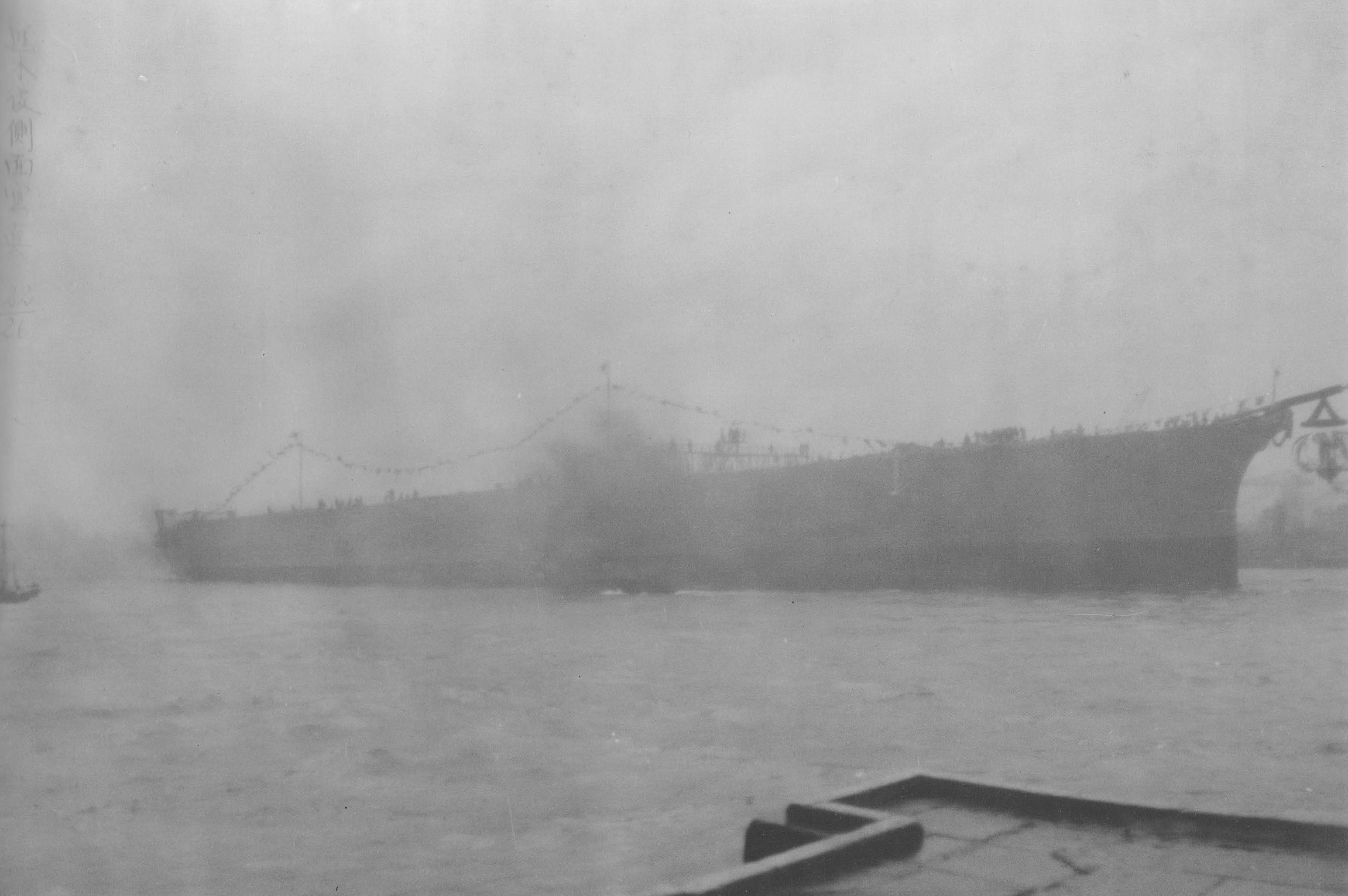
Shokaku is launched amidst a driving rain. 1 June 1939.
Japanese doctrine, at least at the time of Shokaku’s design, called for a carrier to defend herself from enemy aircraft, with her anti-aircraft guns, her speed and maneuverability, and most of all her fighter planes. The carrier’s escorts served to protect her from enemy surface ships (thought to be a grave danger), not against air attack. Shokaku had better protection than previous Japanese carriers, though still not enough to keep out even six-inch shellfire. She did have more attention to damage control, including steel curtains to divide the hangars into smaller spaces in case of fire, and fire-suppression equipment.
Yokosuka Navy Yard laid down Shokaku in December 1937, and Kawasaki’s Kobe yard laid down her sister Zuikaku five months later. Shokaku commissioned in August 1941, and Zuikaku in September, when both ships joined to form the Fifth Carrier Division. They would remain tied together for most of their brief and very active careers.
Air groups began forming for both carriers in May 1941. Though these would be described as “inexperienced” by Japanese staffers and officers from the four older heavy carriers, their squadrons included a leavening of veteran aircrew from the other carriers. This attitude permeated the upper ranks at both the First Air Fleet (the force including all six of Japan’s heavy carriers) and the Combined Fleet. The fliers from the two carriers were seen as second rate, and so the carriers could be detached on a secondary mission and their absence would not affect the outcome of First Air Fleet’s primary mission. And with that decision, Japan lost any slim chance she had to win the Pacific War.
That prejudice had some grounding in reality. Neither carrier commissioned in time for their squadrons to participate in the intense rehearsals for the attack on Pearl Harbor, conducted at Kagoshima Bay. The air groups only finished forming in early October, with many slots filled by green, raw flight school graduates. Unlike the other Japanese carrier squadrons, they had never trained for night-time operations.
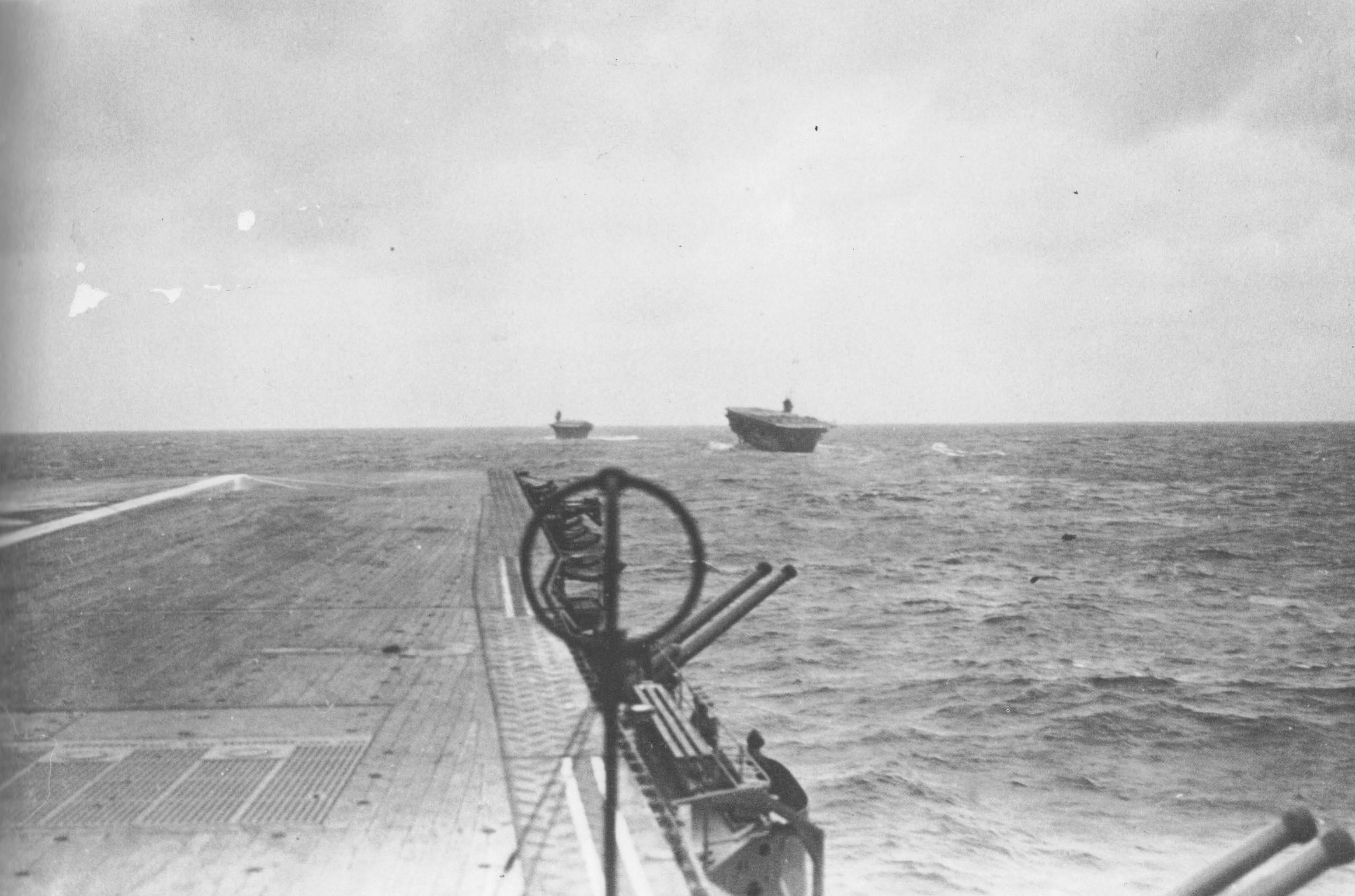
Zuikaku on her way to attack Pearl Harbor, trailing Akagi (center) and Kaga (right).
The twins participated in the Pearl Harbor attack, with their planes given secondary targets like American airfields. The fliers performed well there, and in subsequent attacks on the Australian-held port at Rabaul and Darwin in northern Australia as they continued to train and improve.
They would also join the First Air Fleet’s raid into the Indian Ocean in April 1942, an attempt to disrupt the British position there and if possible, destroy the British Eastern Fleet. And now Japan’s inability to truly stand up to the Allies began to show. Both carriers had their air groups re-organized, dropping from 72 active planes to 63 each, evenly divided between fighters, dive bombers, and torpedo bombers. Even with an unbroken string of victories behind them, attrition had begun eating away at Japanese air strength.
Order South Pacific Here.
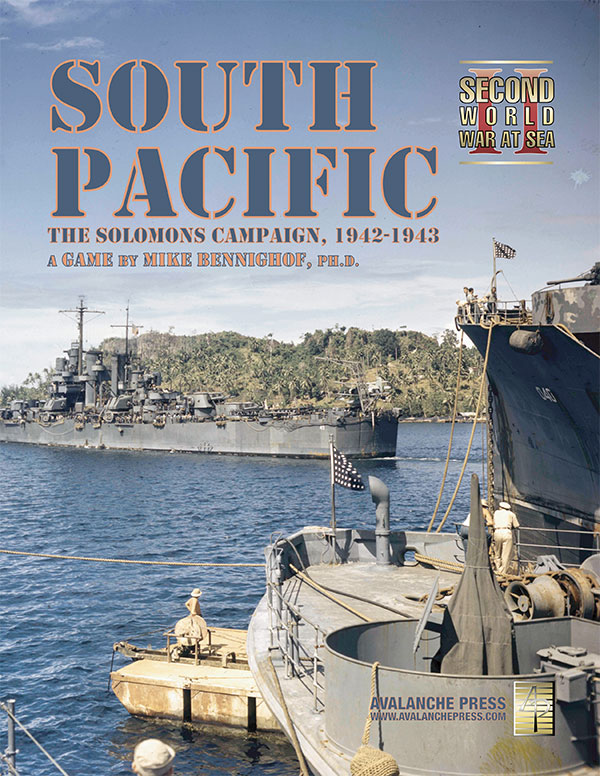
Ironbottom Sound is a scenario book that expands Second World War at Sea: South Pacific. It comes with 36 new scenarios for South Pacific, extending the story through August 1943 and the campaign for New Georgia. All of the maps and pieces needed are included in South Pacific; the companion history book, Solomons Naval Campaign, comes bundled with Ironbottom Sound.
Order Ironbottom Sound Here.
Includes Solomons Naval Campaign book.
Order Solomons Naval Campaign Here.
Companion piece to Ironbottom Sound, or just read it separately.
Sign up for our newsletter right here. Your info will never be sold or transferred; we'll just use it to update you on new games and new offers.
Mike Bennighof is president of Avalanche Press and holds a doctorate in history from Emory University. A Fulbright Scholar and NASA Journalist in Space finalist, he has published a great many books, games and articles on historical subjects; people are saying that some of them are actually good.
He lives in Birmingham, Alabama with his wife and three children. He misses his lizard-hunting Iron Dog, Leopold.
Daily Content includes no AI-generated content or third-party ads. We work hard to keep it that way, and that’s a lot of work. You can help us keep things that way with your gift through this link right here.
|