South Pacific:
Scenarios & History, Part Three
by Mike Bennighof, Ph.D.
August 2025
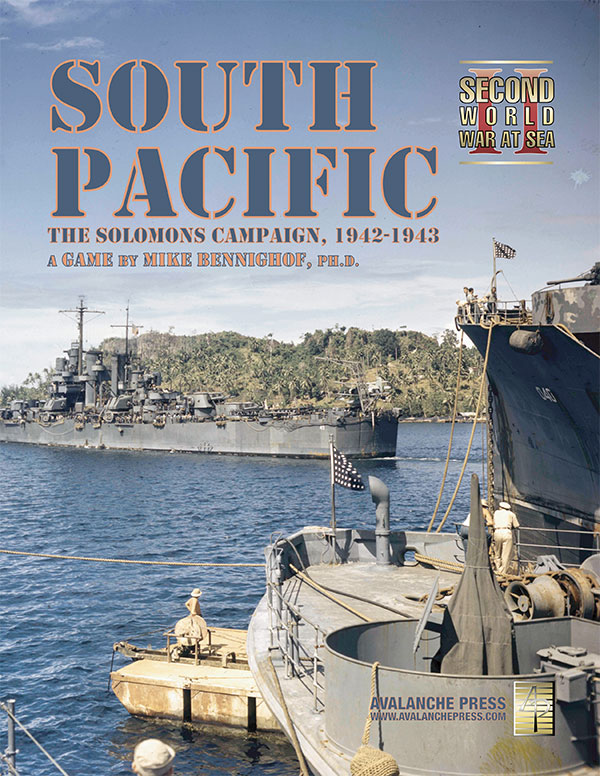 Ironbottom Sound is a scenario book that expands Second World War at Sea: South Pacific. It comes with 36 new scenarios for South Pacific, extending the story through August 1943 and the campaign for New Georgia. All of the maps and pieces needed are included in South Pacific; the companion history book, Solomons Naval Campaign, comes bundled with Ironbottom Sound. Ironbottom Sound is a scenario book that expands Second World War at Sea: South Pacific. It comes with 36 new scenarios for South Pacific, extending the story through August 1943 and the campaign for New Georgia. All of the maps and pieces needed are included in South Pacific; the companion history book, Solomons Naval Campaign, comes bundled with Ironbottom Sound.
The Battle of the Eastern Solomons in late August 1942 cost the Japanese the light carrier Ryujo, and cost the Americans the services of the heavy carrier Enterprise for close to two months. Just days later, a Japanese submarine torpedoed and damaged the carrier Saratoga, but the carrier Hornet (meant to replace Wasp, which needed turbine repairs) arrived to restore some of the American carrier strength. And then in mid-September another Japanese submarine torpedoed and sank Wasp, leaving the Americans with just one carrier.
That’s the situation facing the Allied player in Chapter Three of Second World War at Sea: South Pacific. The Axis player is aware of American strength (it’s kind of hard to hide the history); his or her historical counterparts had an idea what had happened (since the submarine skippers reported their successes), but could not take full advantage of the situation given their own losses of carrier planes and skilled aircrew.
In South Pacific, I wanted to cover all of the operations, at least all of the interesting ones, instead of just those that rated a battle name and an Osprey Campaign book. I couldn’t fit all of them into the game’s scenario book, and so we added an additional book, Ironbottom Sound, with still more. And a historical study to go along with it, called Solomons Naval Campaign.
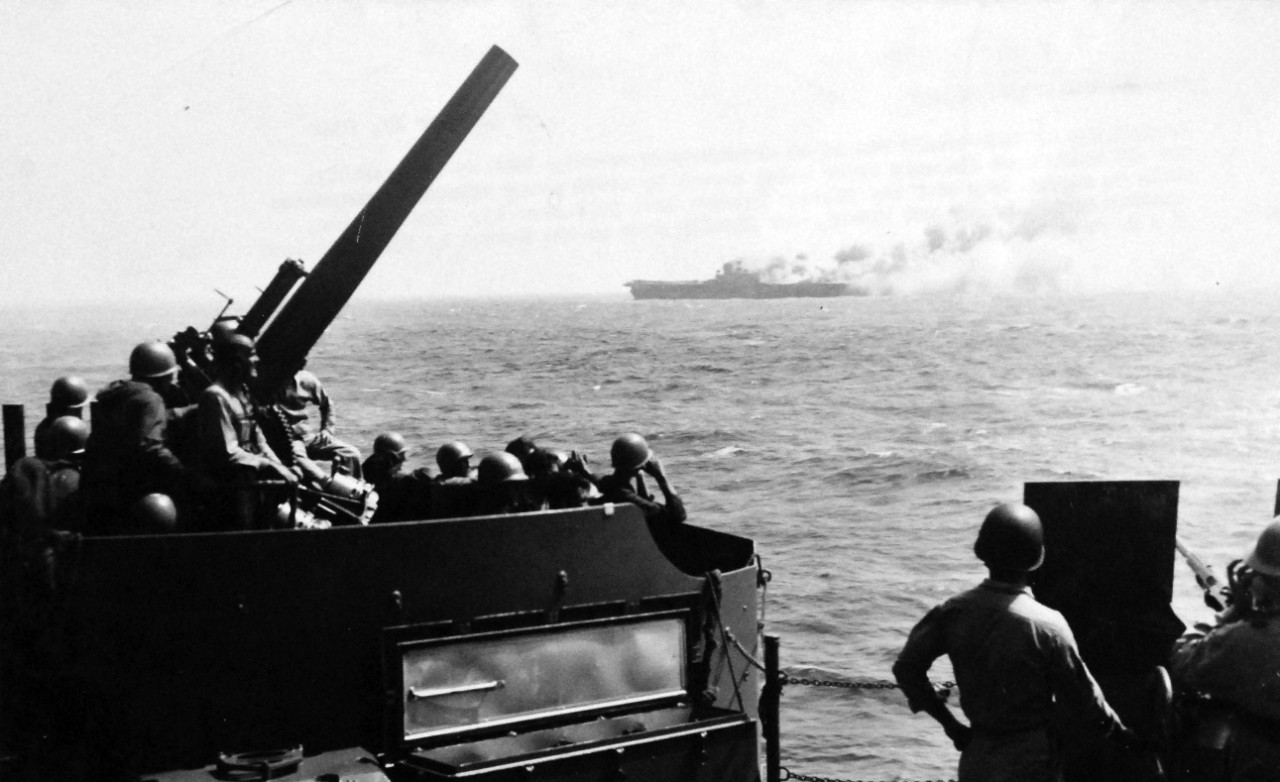
Aircraft carrier Wasp is burning.
Chapter Three is the shortest chapter in South Pacific, with two operational scenarios and two battle scenarios to go along with them. Ironbottom Sound adds four more, two of each flavor. In the first operational scenario, both sides are trying to reinforce their ground troops on Guadalcanal; the Japanese carriers are not yet ready to intervene in force, while the American concentrate on getting their own transports to Guadalcanal from Luganville on Espiritu Santo (be sure to check the scenario clarifications).
In early September, the Japanese began a major effort to reinforce their troops on Guadalcanal. Destroyers brought troops by night, while seaplane carriers landed artillery and supplies. The Japanese carrier fleet did not initially sortie to cover them, only going to sea after the operations had begun and not coming close to the Solomons.
The American carriers sortied to intercept the Japanese reinforcement efforts, but along their way the Japanese submarine I-19 launched a single spread of six torpedoes that sank the carrier Wasp and destroyer O’Brien, and damaged the fast battleship North Carolina badly enough force her return to Pearl Harbor. For a time, the Americans operated with just one carrier (Hornet) in the South Pacific.
Wasp was lost in the midst of a long operation during which both sides shepherded reinforcements to the island: the Japanese aboard warships making fast runs by night, the Americans with old-fashioned troop transports protected by most of the U.S. Navy’s fighting strength in the Pacific.
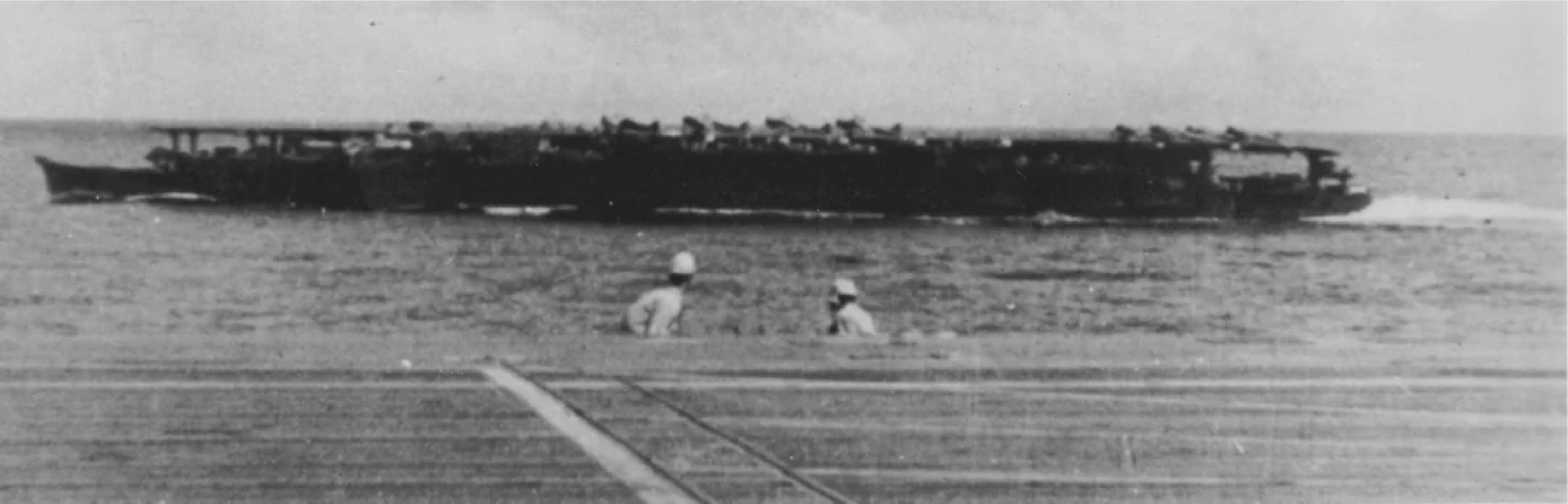
Light carrier Zuiho, seen from Shokaku during their 10-23 September 1942 deployment.
South Pacific addresses those two weeks in one long scenario, plus a small battle scenarios based on an actual incident, in which the Japanese came upon Allied transports in the act of unloading but declined to attack due to the powerful escort lurking nearby. Given the strategic importance the Japanese high command had attached to Guadalcanal, this was likely a mistake: the destruction of the 7th Marine Regiment, its equipment, and its supplies would have had a profound morale as well as material impact on the American defenders of Henderson Field. In the hard calculus of the campaign, the likely loss of several destroyers was probably worth the risk.
When I designed the original scenario, I already knew that we would be pressed for space in the South Pacific scenario book, so I didn’t break it down into shorter scenarios to highlight important parts of the action. That’s our usual response with more famous battles, but as this operation did not lead directly to combat, I decided to let it stand. Later I came to regret that choice, so we have a shorter scenario in Ironbottom Sound (the book) that picks up the action with the Marine convoy in Ironbottom Sound (the sound). Wasp has burned and gone to the bottom of the Coral Sea, the Americans are down to one operating carrier, but the Marines must make it to the beaches of Lunga Point. The Japanese aren’t fully aware of the Americans’ distress, but they have two big aircraft carriers just north of the Solomons.
This is what I like about designing these games: the opportunity to dig deeply into a historical event, and look at where the critical choices occurred. Digging deeply is what South Pacific (like all the other Second World War at Sea games) is all about. So, we have the long scenarios looking at the bigger picture of operations (in short, running supplies and reinforcements to Guadalcanal, and stopping the other guy from doing so) but also zoom in for key decision points. Leigh Noyes, in command of the American carriers after Fletcher’s wounding, chose to back away from the Japanese north of the Solomons rather than press closer to launch his own strike.
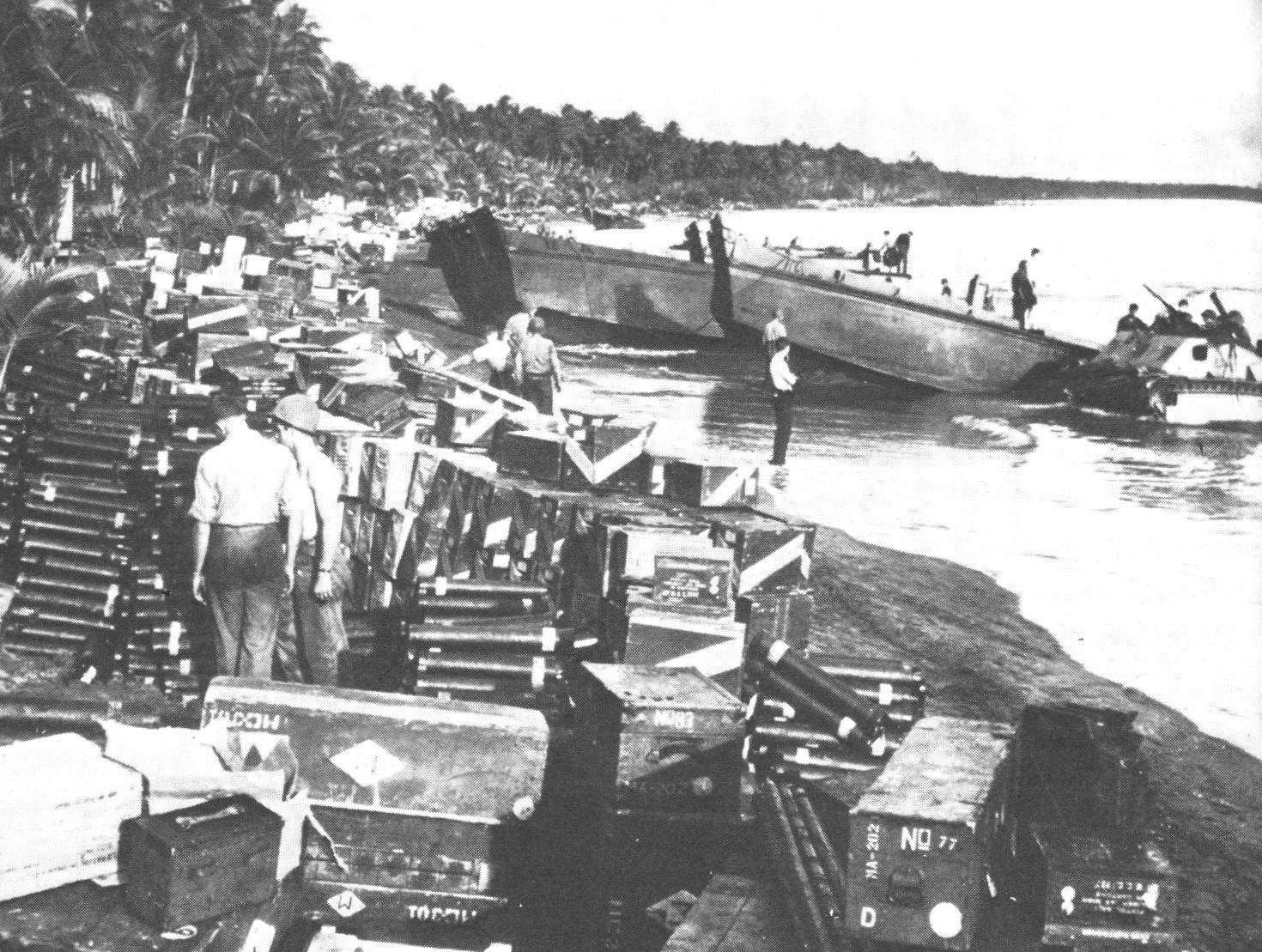
Unloading supplies at Lunga Point, Guadalcanal.
Was that the best decision? Probably, but you can test that proposition yourself. The American theater commander, Robert Ghormley, held back his remaining cruisers to screen his carriers rather than commit them to surface combat to try to interrupt the Japanese nighttime re-supply efforts and bombardments. The Americans had already lost five heavy cruisers at Savo Island (four sunk and one damaged badly enough to be put out of action) and only operated four at Eastern Solomons (Hornet brought two more with her from Peal Harbor when she arrived a few days later). Committing them to surface combat would have been an enormous risk, but possibly the only way to stop what Marines called the Japanese “Cactus Express” (“Tokyo Express” to the American media; “rat missions” to the Japanese).
The Japanese, likewise, did not back the rat missions with heavier ships; that came later, once their position grew more desperate. It took some time for their higher levels of command to accept that the Americans were serious about taking and keeping Guadalcanal. They did commit their carrier fleet into the waters of the Solomons, however, but don’t seem to have recognized that the decisive fleet battle around which Japanese fleet doctrine had been based for decades (the Kantai Kessen) stood before them. The Americans were committing all of their carriers and fast battleships; the Japanese held back their own battleships. The Hotel Yamato served as a floating office for Combined Fleet commander Isoroku Yamamoto, while the other battleship at Truk, Mutsu, was considered too slow to fight off Guadalcanal at night and escape out of range of American air attacks before dawn broke.
Yet this was the decisive moment. If the Japanese were to break the Americans, these weeks after the Battle of the Eastern Solomons represented their best chance.
South Pacific, the game, and Ironbottom Sound, the scenario expansion, let you try out all of those propositions. The fleets fought no major engagements throughout September and well into October, but not because they were inactive. You can seek out battle and decide for yourself if Noyes and Ghormley were too cautious (probably not), or if the poker-playing Yamamoto should have tossed more chips onto the table (probably so).
And that’s the approach I took to the September 1942 chapters of South Pacific and Ironbottom Sound. Next time we’ll look at a different chapter.
Order South Pacific Here.
Order Ironbottom Sound Here.
Includes Solomons Naval Campaign book.
Order Solomons Naval Campaign Here.
Companion piece to Ironbottom Sound, or just read it separately.
Sign up for our newsletter right here. Your info will never be sold or transferred; we'll just use it to update you on new games and new offers.
Mike Bennighof is president of Avalanche Press and holds a doctorate in history from Emory University. A Fulbright Scholar and NASA Journalist in Space finalist, he has published a great many books, games and articles on historical subjects; people are saying that some of them are actually good.
He lives in Birmingham, Alabama with his wife and three children. He misses his lizard-hunting Iron Dog, Leopold.
Daily Content includes no AI-generated content or third-party ads. We work hard to keep it that way, and that’s a lot of work. You can help us keep things that way with your gift through this link right here.
|