Ironbottom Sound:
Scenarios & History, Part Four
by Mike Bennighof, Ph.D.
September 2025
 Ironbottom Sound is a scenario book that expands Second World War at Sea: South Pacific. It comes with 31 new scenarios for South Pacific, expanding the story and extending it through November 1942. All of the maps and pieces needed are included in South Pacific; the companion history book, Solomons Naval Campaign, comes bundled with Ironbottom Sound. Ironbottom Sound is a scenario book that expands Second World War at Sea: South Pacific. It comes with 31 new scenarios for South Pacific, expanding the story and extending it through November 1942. All of the maps and pieces needed are included in South Pacific; the companion history book, Solomons Naval Campaign, comes bundled with Ironbottom Sound.
South Pacific, the game, concludes with the fierce mid-November night battles in Ironbottom Sound. Those make up the game’s fifth chapter; I had hoped to include many more but they simply would not fit in the space available. And that was the genesis of the Ironbottom Sound scenario book, to expand the South Pacific scenario set and tell more of the story in game form.
The Battle of Tassafaronga took place on the last night of November 1942. A squadron of Japanese destroyers led by Raizo Tanaka raced down the New Georgia Channel, known to the Americans as “The Slot” to toss oil drums packed with food and medical supplies overboard, then race back home to Rabaul. In theory, the starving men ashore could them pull the drums (linked together by rope) to shore. It didn’t work that way in practice, with most of the drums sinking or drifting away.
Opposing them, theater commander William Halsey had thrown together a surface action group that, on paper, looked quite powerful enough to annihilate Tanaka’s eight destroyers: four heavy cruisers, one light cruiser, and four destroyers. Halsey tacked on two more destroyers at the last minute, so late that task force commander Carleton Wright, himself a last-minute arrival, ordered them to trail along behind his other ships and stay out of the way, as there had been no opportunity to share Wright’s battle plans with the destroyer captains.
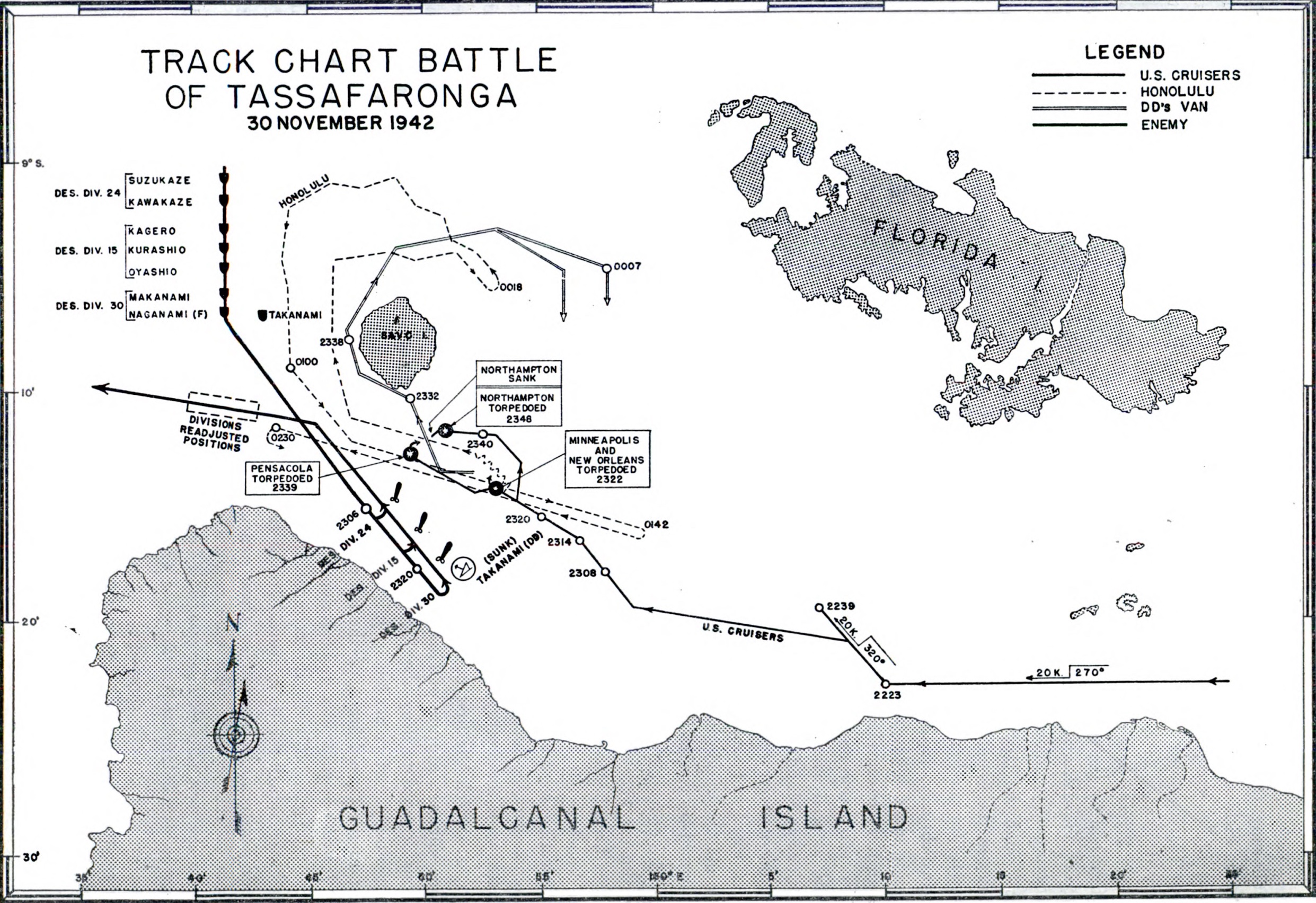
U.S. Navy chart of the battle. Open in new tab to embiggen.
Tanaka, given the nickname “Tenacious Tanaka” by U.S. Navy official historian Samuel Eliot Morison (despite no one, Japanese or American, actually calling him this), proved quite the opposite on this night and quickly lost control of the battle. Like Wright’s, his force had been thrown together from different destroyer divisions, and the boats fought by division and individual destroyer.
They did so very well. Wright had arrayed his cruisers in an unorthodox line-abreast approach, which meant that when the Japanese destroyers approached from his left flank, they had five potential targets in front of them. If their torpedoes missed the first cruiser, given the extreme range of the weapons they still had a chance of hitting the second, third, fourth and fifth ship behind her. All four American heavy cruisers took torpedo hits, with one sunk and the others suffering heavy damage. Only vastly improved damage control procedures kept the outcome of Tassafaronga from rivaling the disaster of Savo Island in August 1942.
Due to interference from the nearby land mass of Guadalcanal, the American gunnery radar could only identify one Japanese destroyer, and the cruisers shot her to pieces. The Americans had suffered a smashing defeat, which their public relations machine turned into a smashing victory. The Japanese for their part also considered the mission a failure, as the supply cannisters had not reached the starving men on the island.
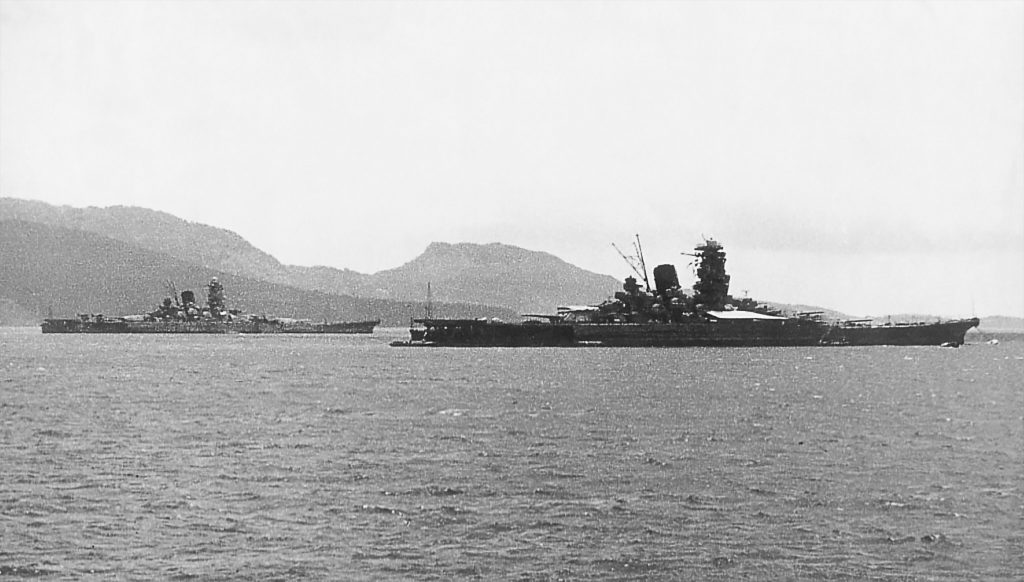
Hotel Yamato (left) and sister ship Musashi. Truk Lagoon, sometime in 1943.
The Japanese need to supply Guadalcanal had not vanished, but American surface combat power in the Solomons pretty much had. The destroyer runs continued, futilely dropping their supply drums. The Americans now deployed PT boats and aircraft to seek out and sink the drums with machine-gun fire before they could be gathered by the waiting troops ashore.
The Americans did have a final reserve of surface combat power: the two old battleships of the Fourth Battleship Division. One of the Japanese captains at Tassafaronga claimed to have torpedoed and sunk a “Texas-class battleship,” probably mistaking the similar profile of the heavy cruiser Pensacola. So, we also have a battle scenario deploying Colorado and Maryland against a later run of the Tokyo Express. They’re slow but wield massive firepower; that may not be enough against the Type 93 oxygen-fueled torpedo.
And then we move on to some magical thinking, a specialty of the Imperial Japanese Navy’s various staffs. The Japanese fought the Guadalcanal campaign with aircraft based on New Britain, at the far end of The Slot, a distance that many of their combat planes could not cover at all, and their fighters could only accomplish by using belly tanks and then having only a very limited time to loiter over the target.
Finally, on 18 November, just after their defeat in the surface battles of Guadalcanal, the Imperial Naval General Staff issued Directive No. 169, calling for construction of an airfield much closer to Guadalcanal, on New Georgia, and the transport of a fresh infantry division to Guadalcanal under cover of planes based at this new field.
That such a base might have come in handy during the preceding months was no secret, yet the Navy took no action to make it happen. While Japanese construction units were not up to the level of the U.S. Navy’s Seabees, they did continually improve during the war and were quite capable of building such a field. When they did build the Munda Point airfield, it came into service much too late for use in the Guadalcanal campaign, but did spark a U.S. invasion of New Georgia to seize it.
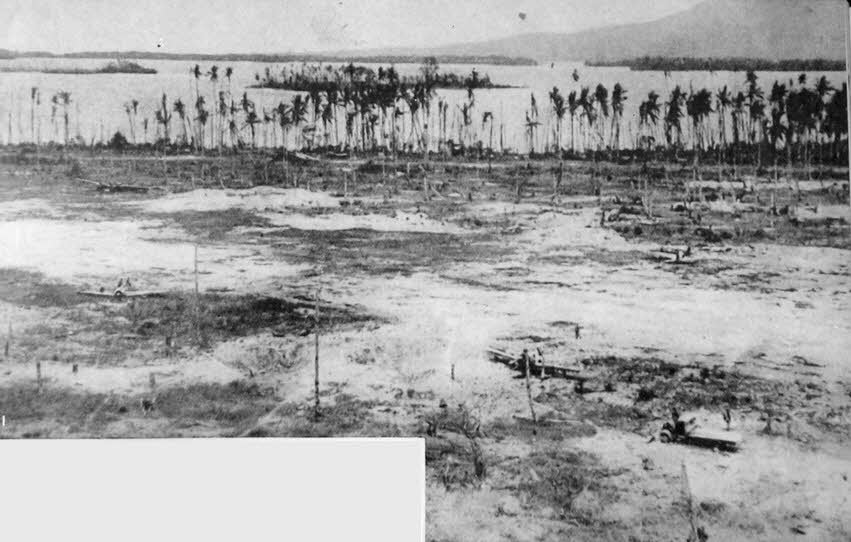
Munda Point Airfield, soon after its 5 August 1943 capture.
Despite their losses in Ironbottom Sound, the Japanese retained significant surface assets in the South Pacific, mostly thanks to Combined Fleet commander Isoroku Yamamoto’s failure to follow the ancient military principle of concentration of force. As in prior campaigns (notable at Coral Sea, or in the “Strike South” through the Dutch East Indies), the Japanese only deployed just enough force to accomplish the mission, and no more. If calculations of enemy strength were mistaken, or something simply went wrong, failure was almost assured. The Japanese Navy’s way of war demanded that everything go exactly as planned.
This time, the general staff gave Yamamoto a direct order to deploy all possible force to assure delivery of the 51st Infantry Division. In our scenario, the admiral actually obeys this time, deploying his flagship (the super-battleship Yamato) to cover the convoy. That allows us to have the steel giant fight against the modern American battleships. We can’t have this wonderful Ironbottom Sound tactical map and not let you put Yamato on it.
In reality, Yamamoto was relieved of the doubtlessly unwelcome thought of deploying his comfortable flagship (christened Hotel Yamato by bitter Japanese sailors). The airfield would open on 1 December 1942, a significant achievement for the Navy’s construction troops. But delays crept into operational planning, as Yamamoto’s staff now considered whether Guadalcanal should be reinforced or evacuated. The Navy made its formal recommendation to withdraw from the island on 12 December.
Is Munda Point a game changer? You can try that out for yourself; by December 1942 both sides are worn down. Had construction begun two months earlier, when it first became apparent that Japanese fliers needed to be based closer to their target, the campaign could have ended very differently.
Order South Pacific Here.
Order Ironbottom Sound Here.
Includes Solomons Naval Campaign book.
Order Solomons Naval Campaign Here.
Companion piece to Ironbottom Sound, or just read it separately.
Sign up for our newsletter right here. Your info will never be sold or transferred; we'll just use it to update you on new games and new offers.
Mike Bennighof is president of Avalanche Press and holds a doctorate in history from Emory University. A Fulbright Scholar and NASA Journalist in Space finalist, he has published a great many books, games and articles on historical subjects; people are saying that some of them are actually good.
He lives in Birmingham, Alabama with his wife and three children. He misses his lizard-hunting Iron Dog, Leopold.
Daily Content includes no AI-generated content or third-party ads. We work hard to keep it that way, and that’s a lot of work. You can help us keep things that way with your gift through this link right here.
|