Linienschiffe 1919:
The New British Ships
by Mike Bennighof, Ph.D.
December 2025
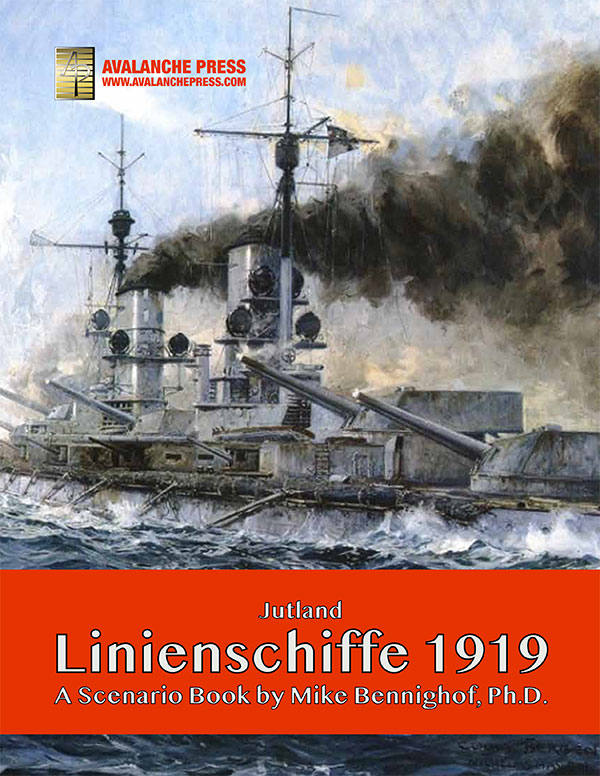 Jutland: Linienschiffe 1919 is an expansion for Great War at Sea: Jutland, all about the drawing-board battleships, battle cruisers, and cruisers drawn up for the German High Seas Fleet, but never actually constructed. While most of the additions are German (that’s why the book’s called Linienschiffe), we’ve also got some extra British ships, planned but not built. Because you definitely need to put your super-battleships against the other guy’s super-battleships. Jutland: Linienschiffe 1919 is an expansion for Great War at Sea: Jutland, all about the drawing-board battleships, battle cruisers, and cruisers drawn up for the German High Seas Fleet, but never actually constructed. While most of the additions are German (that’s why the book’s called Linienschiffe), we’ve also got some extra British ships, planned but not built. Because you definitely need to put your super-battleships against the other guy’s super-battleships.
The Royal Navy
Just like Germany, Britain had drawing-board projects as well, of course. The war placed the same burdens on industry in Britain as it did in Germany, and stretched British financial resources to almost the point of collapse by the end of 1916. Only hefty loans from American banks, followed by direct American intervention in April 1917 to rescue those banks’ investments, kept the United Kingdom solvent. In such an environment, Britain did manage to build a few new heavy ships – but not nearly as many as the Admiralty deemed necessary.
Rest of the R-Class

In May 1914, after lengthy consideration, the Royal Navy ordered three more ships of the Revenge class, two from private yards and one from a naval shipyard. These would replace the three dreadnoughts that Canada had promised to fund; that project fell apart when Canadian politicians wanted their dollars spent in Canadian shipyards, employing Canadian workers.
When war broke out two months later, the Admiralty cancelled the ship assigned to a naval yard (Resistance) and, to avoid paying penalties, suspended the two private contracts (Renown and Repulse). Those contracts would later be used in a bureaucratic subterfuge by First Sea Lord Sir John Fisher to build two poorly-designed battle cruisers despite a wartime moratorium on new capital ship construction. The gun turrets would be re-used, but otherwise these were new ships from the keel up.
Rather than three dreadnoughts, the Admiralty probably would have been better off ordering three repeats of the battle cruiser Tiger, and saved about 10 percent on each ship. Renown, Repulse, and Resistance never existed as R-class battleships, but we’ve included them in Linienschiffe 1919.
Improved Queen Elizabeth
In September 1915, American banker J.P. Morgan, serving as Britain’s purchasing agent in the United States, arranged a $500 million private loan package for Britain and France. It was at the time the largest single loan ever made, and though it had no U.S. Government involvement or guarantee, a year later the very real threat of default and consequent Wall Street collapse would lead directly to American involvement in the war.
That massive loan infused the British Exchequer with fresh cash. In November 1915 it provided more money for warship construction, allowing the Admiralty to lift the ban on new battleship construction. The money would only fund ships, not facilities, and so any new battleship could be no larger than Queen Elizabeth, and carry no larger guns than the now-standard 15-inch Mark I.
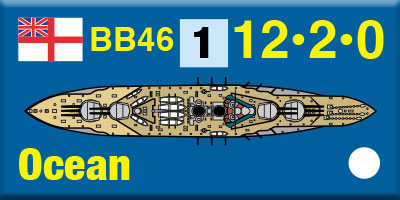
Simply repeating Queen Elizabeth was deeply unsatisfactory; the new ship would have to somehow be better than the last. The new First Sea Lord, Admiral Sir Henry Jackson, wanted a ship with more guns, even if she lost some speed. But she could not be any longer than Queen Elizabeth, so Sir Henry suggested mounting ten guns in two triple and two twin turrets. That brought technical objections from the constructors, and the project died at that stage. But in Linienschiffe 1919 we do have four examples of Sir Henry’s new, heavily-gunned dreadnoughts. The Ocean class shares the Queen Elizabeth hull, widened somewhat to accommodate the wider barbette under the triple turret. The added weight drops her speed to 22 knots; in game terms, that means Speed 1.
Even Heavier Guns

Part of the opposition to Sir Henry’s dreadnought came from a growing desire for an even heavier main armament. A new 18-inch gun had been tested, and pressure mounted from those possessing this secret to get it onto a battleship.
That ship would be derived from the battle cruiser Hood: slower, more heavily armored, and carrying eight 18-inch Mark I guns in four twin turrets. This gave enormous firepower, but the bigger guns and thicker armor also added enormous weight. On paper, the ship would be expected to make 27 knots, but that seems unreasonable so we rated her at the same 22 knots as Sir Henry’s 10-gun Queen Elizabeth. There are four of them in Linienschiffe 1919, and they’re among the most powerful ships in the Great War at Sea series.
A British Fast Armored Cruiser
Independently of one another, the Germans and British both studied concepts for a fast armored cruiser – a ship with lines much like a battle cruiser, but carrying intermediate-caliber guns and intended to fight other cruisers. Such a ship would be a cheaper alternative to battle cruisers for missions far from European waters.
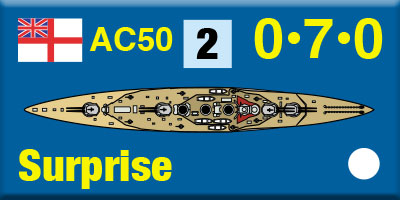
Sir John Jellicoe had suggested such a ship as early as 1908, and revived it in 1912 with the construction of the battle cruiser Tiger. The Director of Naval Construction sketched a smaller version of Tiger, a very handsome 18,000-ton ship armed with eight 9.2-inch guns (probably a new-model gun). She would make a top speed of 29 knots, at the time sufficient to run down any enemy cruiser she might encounter on the high seas. This ship would not be approved, though she would have been very useful, and we’ve included four of them in our book.
More Destroyers
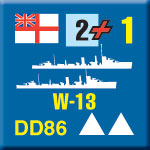
To accommodate the staff and communications gear required by a destroyer flotilla commander, in 1916 the Royal Navy ordered five enlarged destroyers to serve as flagships. These destroyer leaders carried more guns (four rather than the usual three) than the fleet destroyers and with their greater size had much better sea-keeping qualities in the rough North Sea. Impressed by their qualities, the Admiralty ordered the destroyer leader design as their next fleet destroyer, and increased their armament from 4-inch guns to 4.7-inch guns, and raised the number of torpedo tubes from four to six.
None of these “Modified W” class boars made it to the Grand Fleet before the war ended, though most of them saw action in the next war. They do appear in Jutland, but we’ve included ten more pieces for them so that the Grand Fleet can be escorted exclusively by the new-model destroyers.
Order Linienschiffe 1919 Here.
Please allow an extra six weeks for delivery.
Sign up for our newsletter right here. Your info will never be sold or transferred; we'll just use it to update you on new games and new offers.
Mike Bennighof is president of Avalanche Press and holds a doctorate in history from Emory University. A Fulbright Scholar and NASA Journalist in Space finalist, he has published a great many books, games and articles on historical subjects; people are saying that some of them are actually good.
He lives in Birmingham, Alabama with his wife and three children.
Daily Content includes no AI-generated content or third-party ads. We work hard to keep it that way, and that’s a lot of work. You can help us keep things that way with your gift through this link right here.
|