Jutland: The Baltic Sea
Design Notes, Part Two
by Mike Bennighof, Ph.D.
June 2025
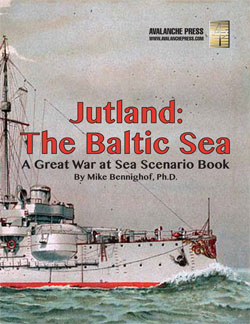 Jutland: The Baltic Sea is an expansion book for Great War at Sea: Jutland’s Second Edition, and that made it pretty easy to choose the pieces to include with the book. The Russians had a series of fleet expansion programs between 1908 and 1914, and they looked at dozens of designs for new battleships and battle cruisers. They made their preferences clear, and so I selected those to go in the book. Helpfully, they usually chose the most visually interesting designs, which I appreciated since I also drew the ship art that went on the new pieces. Jutland: The Baltic Sea is an expansion book for Great War at Sea: Jutland’s Second Edition, and that made it pretty easy to choose the pieces to include with the book. The Russians had a series of fleet expansion programs between 1908 and 1914, and they looked at dozens of designs for new battleships and battle cruisers. They made their preferences clear, and so I selected those to go in the book. Helpfully, they usually chose the most visually interesting designs, which I appreciated since I also drew the ship art that went on the new pieces.
The next challenge came in crafting scenarios so players could play with them. I went with six chapters, all in our story-arc format. The first two, I described in Part One of these design notes. They split fairly neatly in half: three of them center the Russian dreadnought programs, and the other three are more varied (Russian battle cruisers, Swedish fleet planning, and German coast-defense ships).
The three Russian dreadnought chapters roll out with more dreadnoughts available in each chapter, mirroring the Russian building programs. These, as we learn in the book, crashed upon several financial and industrial realities. Russian shipyards, and the factories that supplied the needed armor plate, machinery, weapons and so on, simply were not up to the task of building warships of this size and sophistication. That they managed it at all is quite an amazing feat, but doing to took them much longer than a British, German or even an Italian shipyard would have for a similar vessel.
 The obvious answer would have been to order the ships from British builders. This was Baltic Fleet commander Nikolai von Essen’s proposed solution, and it did gain some traction. Financing the new acquisitions would have been an issue, given Russia’s dependence on French bond issues for its military buildup, and then there’s the question of the British government’s willingness to heighten tensions with Germany by taking on such a huge arms order. The obvious answer would have been to order the ships from British builders. This was Baltic Fleet commander Nikolai von Essen’s proposed solution, and it did gain some traction. Financing the new acquisitions would have been an issue, given Russia’s dependence on French bond issues for its military buildup, and then there’s the question of the British government’s willingness to heighten tensions with Germany by taking on such a huge arms order.
We don’t have those worries, and can explore just what Essen and his fleet could have accomplished with a powerful dreadnought fleet. The third chapter gives the Russians a pair of huge, fast battleships with thick armor and 16-inch guns, plus four copies of the British Royal Sovereign class. These were the ships Essen hoped to build in Britain, and they give the Russians six ships with considerable fighting power; the Germans have nothing to match the powerful fast battleships. But they do have numbers even after this Russian spending spree.
 This is the fleet that can straight-up challenge the High Seas Fleet, with 23 dreadnoughts. And in the scenario set, that’s what they do, steaming into German waters seeking battle, and challenging German moves against Riga. That also brings on large-scale fights between battleship fleets, which is why you play Great War at Sea. This is the fleet that can straight-up challenge the High Seas Fleet, with 23 dreadnoughts. And in the scenario set, that’s what they do, steaming into German waters seeking battle, and challenging German moves against Riga. That also brings on large-scale fights between battleship fleets, which is why you play Great War at Sea.
What limited success the Russians enjoyed in the Russo-Japanese War came courtesy of their armored cruiser squadron, and that made them very much aware of the value of fast ships with heavy guns. That put new battle cruisers at the top of their shopping list, and they began construction on a class of four that would never see completion. They also entertained proposals from foreign shipyards for more of them, and we have one of these offerings made cardboard. What we’ve called the Varyag class sports sixteen 12-inch guns, making her an unusual ship. But she caught the Russian admirals’ eyes, though she would ultimately be rejected for not having all of her guns on the main-deck level.
 She’s here, though, giving the Russians a large squadron of fast, heavy ships to belly up to the High Seas Fleet’s Iron Dogs. In the fourth chapter, we have a German battle cruiser raid, and the Russian battle cruisers out to stop it. This is the chapter I ended up having to shorten, as I’d gone way past the page limit with the others. She’s here, though, giving the Russians a large squadron of fast, heavy ships to belly up to the High Seas Fleet’s Iron Dogs. In the fourth chapter, we have a German battle cruiser raid, and the Russian battle cruisers out to stop it. This is the chapter I ended up having to shorten, as I’d gone way past the page limit with the others.
While the Russians get most of the new pieces and are at the center of most of the new scenarios, I didn’t want to leave out the other Baltic powers. Sweden maintained a fleet of small armored ships, coast-defense vessels utterly incapable of standing up to the new-model dreadnoughts built by Germany and Russia. But the Swedes did have much more capable ships on the drawing board, should they muster the political will and the finances to build them.
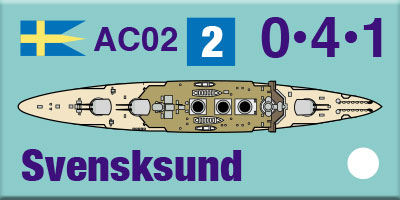
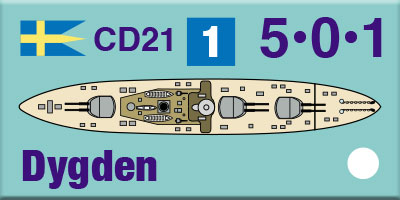 They’re still not capable of fighting a true battleship one-and-one, but Swedish doctrine called for them to hunt in packs, supported by torpedo boats, and that does make them much more formidable, especially in an Archipelago Battle (see Part One of these design notes). The new ships are based on actual proposals for coast-defense ships with 305mm (12-inch) guns; they would have been lacking in protection which is a serious problem when facing enemy dreadnoughts with more and often larger guns. The Swedes also get two classes of proposed fast cruisers to support the coast-defense fleet. They’re still not capable of fighting a true battleship one-and-one, but Swedish doctrine called for them to hunt in packs, supported by torpedo boats, and that does make them much more formidable, especially in an Archipelago Battle (see Part One of these design notes). The new ships are based on actual proposals for coast-defense ships with 305mm (12-inch) guns; they would have been lacking in protection which is a serious problem when facing enemy dreadnoughts with more and often larger guns. The Swedes also get two classes of proposed fast cruisers to support the coast-defense fleet.
The fifth chapter puts those Swedish concepts to the test, in action against the Russians. These are the operations the Swedes foresaw as likely. First, they have to fend off a Russian invasion of Gotland, the big island in the center of the Baltic that has been at the center of Russian aims in the Baltic from the time of Peter the Great through the reign of Vlad the Barbarian.
 And the Swedes had aggressive aims of their own, coveting the Åland Islands that stretch between Sweden and Finland. And also giving up plenty of opportunities to both fight archipelago battles, and see if Swedish doctrine for them actually works. Even with plenty of places to hide, it still seems best to bet on the bigger guns. And the Swedes had aggressive aims of their own, coveting the Åland Islands that stretch between Sweden and Finland. And also giving up plenty of opportunities to both fight archipelago battles, and see if Swedish doctrine for them actually works. Even with plenty of places to hide, it still seems best to bet on the bigger guns.
The book wraps up with the Germans, zeroing in on the Reichstag faction that agreed with the generals, that the Navy should be an adjunct to the Army, limited to coast-defense vessels that could protect the seaward flank in a ground campaign. And we have those little ships, using the actual proposal for an improved “Sea Piglet” with 280mm guns and no redeeming qualities. Plus a much more formidable ship designed for Greece.
 The Germans can use their fleet of little ships to battle the Swedes and their equally-crapulent coast-defense ships, as the Germans attempt an invasion of southern Sweden. And they can try to repel the Swedes as they prey on German commerce along the Baltic coast, the region known as Swedish Pomerania until 1815. And while neither side’s ships are all that good, they do have a great many of them. More challenging is the battle between the new-model Swedish coast-defense ships, with bigger guns, and the German pre-dreadnoughts, which are actually out-gunned by the Swedes. The Germans can use their fleet of little ships to battle the Swedes and their equally-crapulent coast-defense ships, as the Germans attempt an invasion of southern Sweden. And they can try to repel the Swedes as they prey on German commerce along the Baltic coast, the region known as Swedish Pomerania until 1815. And while neither side’s ships are all that good, they do have a great many of them. More challenging is the battle between the new-model Swedish coast-defense ships, with bigger guns, and the German pre-dreadnoughts, which are actually out-gunned by the Swedes.
And that’s what we have in The Baltic Sea: 70 new pieces, 39 new scenarios. And you’ll be able to play them online through War at Sea Fleet Command, our officially-sanctioned exclusive partners for online play of Great War at Sea games.
You can order The Baltic Sea right here.
The Epic of Jutland
The greatest naval game ever made, and four expansions that make it even greater.
• Jutland 2e.
• Jutland: North Sea 1914.
• Jutland: Dogger Bank 1915.
• Jutland: Risk Fleet.
• Jutland: Baltic Sea.
Retail Price: $278.95
Package Price: $225
Gold Club Price: $180
Sing of the Epic Here.
Sign up for our newsletter right here. Your info will never be sold or transferred; we'll just use it to update you on new games and new offers.
Mike Bennighof is president of Avalanche Press and holds a doctorate in history from Emory University. A Fulbright Scholar and NASA Journalist in Space finalist, he has published a great many books, games and articles on historical subjects; people are saying that some of them are actually good.
He lives in Birmingham, Alabama with his wife and three children. He misses his lizard-hunting Iron Dog, Leopold.
Daily Content includes no AI-generated content or third-party ads. We work hard to keep it that way, and that’s a lot of work. You can help us keep things that way with your gift through this link right here.
|