| Black Panthers:
761st Scenario Preview, Part Two
By Mike Bennighof, Ph.D.
August 2026
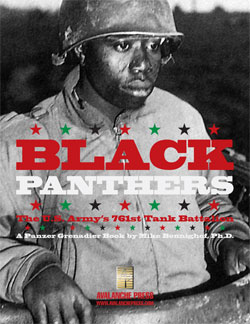 The first edition of Panzer Grenadier: Black Panthers tried to do too much,to be both a history of segregated African-American African-American units in the Second World War (along with the racism that made such formations necessary, if Black soldiers were to see combat at all) and a game expansion with scenarios for Panzer Grenadier: Elsenborn Ridge. The limited format meant that I didn’t get to tell the full story as I wished in either format. Plus, I wanted a book of history that I could show to non-gamer friends and family. The first edition of Panzer Grenadier: Black Panthers tried to do too much,to be both a history of segregated African-American African-American units in the Second World War (along with the racism that made such formations necessary, if Black soldiers were to see combat at all) and a game expansion with scenarios for Panzer Grenadier: Elsenborn Ridge. The limited format meant that I didn’t get to tell the full story as I wished in either format. Plus, I wanted a book of history that I could show to non-gamer friends and family.
And so, we split the project. Separate, But Heroes is the Historical Study, and I’ve been able to greatly expand on the story told in the first edition of Black Panthers. The 761st gets its full story told up through the end of the war and the battalion’s subsequent disbandment. And we flesh out the tale of Race in America even more.
Black Panthers is now purely a game book. The 24 scenarios of the first edition have been expanded to 41 in the Second Edition. That likewise allowed me to bring the Black Panthers all the way to the end of the war. But first, they had to fight their way through Lorraine. Let’s have a look at the second chapter.
761st Tank Battalion
The Lorraine Campaign: Part Two
The first two days of combat for the 761st Tank Battalion would be among the most intense it ever experienced. The third day would be little better, but the 26th Infantry Division shifted its front and found the seam between two German People’s Grenadier divisions. After a break for maintenance while the infantry absorbed replacements, the Black Panthers resumed the advance with the 26th Infantry Division. And for the first time, they would encounter enemy tanks.

Panther tanks knocked out by 761st and 4th Armored Shermans outside Guebling.
During this phase of the campaign, Sgt. Ruben Rivers would be awarded the battalion’s sole Medal of Honor for a rearguard action against enemy Panther tanks in which Rivers and his crew were killed. His White company commander wished to nominate him for the award, but only in 1997 was his Distinguished Service Cross upgraded.
Scenario Six
Breaking Away
10 November 1944
 Despite heavy losses, the 26th Infantry Division and its attached tank battalion pressed forward. With the 4th Armored Division now threatening to break through just to the north, the Germans began a calculated retreat from their hillside positions. The Americans followed closely on their heels, determined not to let them escape easily. Despite heavy losses, the 26th Infantry Division and its attached tank battalion pressed forward. With the 4th Armored Division now threatening to break through just to the north, the Germans began a calculated retreat from their hillside positions. The Americans followed closely on their heels, determined not to let them escape easily.
Conclusion
The Germans conducted a skillful withdrawal, escaping with much of their force intact. The Americans took firm control of Morville-les-Vic after days of see-sawing combat in the town, which provided some shelter against the steady, miserable mixture of snow, freezing rain and sleet.
Notes
The Germans are defending some really strong positions, but they need to give them up and leave without running away too fast. It’s an unusual scenario, in that the Germans can’t leave too soon, so the Americans will need to close up with them quickly.
Scenario Seven
Koecking Ridge
11 November 1944
 The ridge line behind Hill 310, marked as Koecking Ridge on staff maps but uniformly referred to as “Hill 309” by the troops, became the next target for the 26th Infantry Division and its supporting tanks. Patton had hoped to break the Metz defenses by 11 November, his birthday, but since that would not happen, he ordered a renewed attack on the defenses supported by copious army-level artillery. The ridge line behind Hill 310, marked as Koecking Ridge on staff maps but uniformly referred to as “Hill 309” by the troops, became the next target for the 26th Infantry Division and its supporting tanks. Patton had hoped to break the Metz defenses by 11 November, his birthday, but since that would not happen, he ordered a renewed attack on the defenses supported by copious army-level artillery.
Conclusion
A torrent of automatic weapons fire devastated the American infantry, while anti-tank guns – probably including the potent new Jagdpanzer IV/70 – worked over the tanks. Lt. Charles Barbour’s platoon reeled in shock after its lead tank, commanded by Sgt. George Shivers, simply exploded. White infantrymen rose from safety to rescue the Black tank crews; a tall white sergeant from the 101st Infantry – never identified – was cut in half pulling the badly wounded Black Sgt. Johnnie Stevens out of his burning tank.
Notes
This is a tough one for the Americans. The Germans hold the high ground, they’re only slightly outnumbered, and they have a heavily-armored tank destroyer with a very big gun. It’s just a small scenario, but it should be an intense one.
Scenario Eight
D is for Dog
11 November 1944
 The entire 26th Infantry Division would see action on Armistice Day. Hints that the Germans had begun to retreat caused the division and corps command to press their subordinate units to attack with renewed vigor. South-east of Hill 310, barring the approach to the back side of Koecking Ridge, the town of Haraucourt-sur-Seille still held Germans. Dog Company’s light tanks would clear some of the high ground to allow the Shermans to bombard the town and hasten the German retreat without embroiling the tanks and infantry in more house-to-house fighting. The entire 26th Infantry Division would see action on Armistice Day. Hints that the Germans had begun to retreat caused the division and corps command to press their subordinate units to attack with renewed vigor. South-east of Hill 310, barring the approach to the back side of Koecking Ridge, the town of Haraucourt-sur-Seille still held Germans. Dog Company’s light tanks would clear some of the high ground to allow the Shermans to bombard the town and hasten the German retreat without embroiling the tanks and infantry in more house-to-house fighting.
Conclusion
The Americans met unexpected resistance in the woods south of Haraucourt, losing several Shermans and several more Stuarts, and failing to get into position to bring the town under direct fire. The Germans would be able to pull out here without harassment from the American tanks.
Notes
This is just a small scenario, with the Americans trying to get their Shermans close enough to bring a key German position under direct fire, and the Germans of course using the terrain to stop them. The Germans aren’t very mobile, but they do have enough firepower to hold their ground if the Americans oblige by coming right at them.
Scenario Nine
“We’ll fight them.”
19 November 1944
 On the 18th, medic Ray Roberson diagnosed Sgt. Ruben Rivers with gangrene in a massive leg wound suffered two days earlier. Rivers refused evacuation and morphine, only allowing the medic to clean and dress the wound. He led Lt. Robert Hammon’s platoon of tanks to an overwatch position, from which they could cover the rest of Able Company as it and the infantry advanced on the town of Bourgaltrouff. The remainder of the company came under accurate fire from German Panther tanks, and company commander David J. Williams ordered Rivers to withdraw. Rivers showed the same respect for Williams’ commands that he had over evacuation for his wound. “I see them,” he snapped over the radio. “We’ll fight them.” On the 18th, medic Ray Roberson diagnosed Sgt. Ruben Rivers with gangrene in a massive leg wound suffered two days earlier. Rivers refused evacuation and morphine, only allowing the medic to clean and dress the wound. He led Lt. Robert Hammon’s platoon of tanks to an overwatch position, from which they could cover the rest of Able Company as it and the infantry advanced on the town of Bourgaltrouff. The remainder of the company came under accurate fire from German Panther tanks, and company commander David J. Williams ordered Rivers to withdraw. Rivers showed the same respect for Williams’ commands that he had over evacuation for his wound. “I see them,” he snapped over the radio. “We’ll fight them.”
Conclusion
The German Panthers shot up the approaching Black Panthers, and were in turn engaged by Rivers and other tanks of his platoon. That allowed the rest of the company and its accompanying infantry to withdraw, but Rivers was killed along with Hammond and a number of other tank crewmen. Rivers’ stand against the Panthers allowed the rest of the company to escape; Ruben Rivers would be awarded the Medal of Honor for this action in 1997.
Notes
Ruben Rivers was a brave man; a Sherman even with the 76mm gun and adjusted armor rating (Black Panthers Shermans are rated at 4 armor, the new standard for Panzer Grenadier) is greatly outmatched by a Panther – and these Panthers come from a veteran panzer division.
Scenario Ten
Battalion Strength
17 November 1944
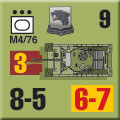 While Able Company spearheaded the drive on Bourgoltroff, the rest of the battalion gathered for one of the rare times when the Black Panthers would fight as (almost) a unified battalion. Together with the 328th Infantry Regiment, which had received hundreds of nearly-raw replacements, they would assault the German defenses in front of the small city of Dieuze. While Able Company spearheaded the drive on Bourgoltroff, the rest of the battalion gathered for one of the rare times when the Black Panthers would fight as (almost) a unified battalion. Together with the 328th Infantry Regiment, which had received hundreds of nearly-raw replacements, they would assault the German defenses in front of the small city of Dieuze.
Conclusion
The German positions at Dieuze had withstood an attack by an entire Combat Command of 4th Armored Division just a few days previously. Shattered Sherman hulls and the blackened remains of a massive fire from a trio of exploding gasoline trucks marked the No-Name Division’s failure. Dieuze had been the center of German artillery in this sector and the big guns brought down heavy fire to help defend the position. The Black Panthers had to content themselves with destroying several anti-tank batteries with fire from the battalion’s assault gun platoon. Fourth Armored returned to the attack and captured Dieuze shortly afterwards.
Notes
This was one of the few occasions when the entire 761st Tank Battalion (or something close to it) fought together rather than parceled out by the company or even the platoon. So we had to include a scenario for it. The Americans have the numbers, but the Germans, they have an 88mm anti-aircraft gun.
Scenario Eleven
Disaster at Honskirch
26 November 1944
Following several days of only sporadic fights against German rear-guards, some of them less determined than others, the 26th Infantry Division came up against stiffer resistance. The village of Honskirch, heavily defended by anti-tank guns, concertina wire and a lengthy anti-tank ditch. Capt. Charles “Pops” Gates of Charlie Company had scouted the approach, noting that deep mud would force the tanks to stay on the lone road approach. Gates told Col. Ben R. Jacobs of 328th Infantry Regiment of his concerns; Jacobs ordered the attack to go forward with 11 tanks and just one company of infantry.
Conclusion
As Gates predicted, the attack was a disaster; the initial attack was halted along the road when German gunners knocked out the last tank in the column and proceeded to shoot up those in front of it. The 761st’s executive officer, Maj. Russell Geist, rushed forward on foot to organize a rescue of the crews, ordering the assault guns to fire whatever they had, as fast as they could. Out of high-explosive ammunition, they blazed away with white phosphorous rounds. The Army Official History would record this as a “smoke screen.” Jacobs would be fired a month later, after ordering his troops to shoot Germans attempting to surrender (orders which were ignored).
Notes
Most books about the 761st take Gates’ recollection that an unnamed colonel was fired after this incident as fact; Gates was mistaken and Jacobs (the only 26th Infantry Division regimental or battalion commander relieved during the war) kept his job for another month. He deserved to be canned on the spot, and this scenario shows why – it’s going to be costly for the Americans.
Scenario Twelve
Champagne Breakfast
3 December 1944
American troops had taken Sarre-Union, a town on the French side of the border known for bottling champagne, on the 2nd. But a sharp German counter-attack the following morning drove the Americans out of most of the town, and that afternoon the Americans returned to take it back, this time bringing tank support with them.
Conclusion
The Black Panthers helped the infantry secure all of Sarre-Union, and to fend off an afternoon counter-attack. The tankers and infantry “liberated” (that is, looted) vast quantities of champagne; many drank until they became sick. Even so, the Shermans drove off with wooden cases of bottles strapped to their engine decks.
Notes
The Americans have a dual task here; first, to hold off the Germans, who have tanks while the Americans have none. Then to kick them out, once the Americans get tank support of their own plus infantry reinforcements.
And that’s Chapter Two. Next up, we’ll look at Chapter Three.
Order Black Panthers Here.
Includes Separate, But Heroes. Use coupon code DANA for 20-off
Separate, But Heroes
The fought Jim Crow and the Nazis. Our book, Separate, But Heroes, tells the story of the segregated African-American 761st Tank Battalion along with that of other African-American units and a general history of Race in America.
Order Separate, But Heroes Here.
Just the history. Use coupon code DANA for 20-off
Sign up for our newsletter right here. Your info will never be sold or transferred; we'll just use it to update you on new games and new offers.
Mike Bennighof is president of Avalanche Press and holds a doctorate in history from Emory University. A Fulbright Scholar and NASA Journalist in Space finalist, he has published a great many books, games and articles on historical subjects; people are saying that some of them are actually good.
He lives in Birmingham, Alabama with his wife and three children.
Daily Content includes no AI-generated content or third-party ads. We work hard to keep it that way, and that’s a lot of work. You can help us keep things that way with your gift through this link right here.
|