| Black Panthers:
761st Scenario Preview, Part Three
By Mike Bennighof, Ph.D.
August 2026
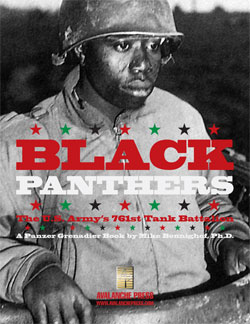 I never planned to make the Battle of the Bulge so central to the Panzer Grenadier series. It shouldn’t have surprised me; the game system is optimized for tank-infantry combined arms battles, and that’s the essence of the 1944-1945 battles in the Ardennes, too. I never planned to make the Battle of the Bulge so central to the Panzer Grenadier series. It shouldn’t have surprised me; the game system is optimized for tank-infantry combined arms battles, and that’s the essence of the 1944-1945 battles in the Ardennes, too.
There’s an impression within the tiny wargame industry that the Battle of the Bulge is overdone, and that’s not completely wrong. But what’s overdone are the opening phases, when the Germans are the ones beating on the Americans. The second half, when it’s the Americans doing the wiping out, someone gets overlooked. I’ve long wondered why that might be; I have some ideas.
The Black Panthers showed up in the Ardennes just in time for the ass-kicking phase. Let’s have a look at Chapter Three of Panzer Grenadier: Black Panthers Second Edition, the first of two devoted to erasing the bulge:
761st Tank Battalion
Battle of the Bulge
The German offensive in the Ardennes opened on 16 December 1944. At the time, the 761st Tank Battalion had been attached to the green 87th Infantry Division, fighting well to the south of the new combat zone. At first the 87th Infantry Division and the attached Black Panthers remained at the front in Lorraine, covering for other Third Army divisions that had turned north.

Salvaging a 761st Tank Battalion Sherman knocked out near Tillet. January 1945.
Their turn came on 23 December. Bringing the tanks over icy roads took a full week, but on 30 December the Black Panthers rejoined the 87th Infantry Division in the line just west of Bastogne. The time of retribution had arrived.
Scenario Thirteen
Fortress Remagne
31 December 1944
 The green 87th Infantry Division attempted to drive back the Germans west of Bastogne as soon as they entered the line. Without tank support, the attack failed at the cost of heavy casualties. On the next day they tried again, this time with the aid of the black Panthers. The Germans had converted the village of Remagne into a small fortress, manned by an elite division. The green 87th Infantry Division attempted to drive back the Germans west of Bastogne as soon as they entered the line. Without tank support, the attack failed at the cost of heavy casualties. On the next day they tried again, this time with the aid of the black Panthers. The Germans had converted the village of Remagne into a small fortress, manned by an elite division.
Conclusion
The tanks and infantry pressed forward into the teeth of a well-prepared German defense, and despite heavy losses pushed the Germans out of Remagne. George S. Patton’s plan for the American counter-offensive around Bastogne called for maximum pressure on the Germans regardless of American casualties, and here that goal was achieved at the anticipated cost in blood.
Notes
The Germans are tough, they have plentiful anti-tank weaponry and they occupy great defensive terrain. The American infantry is green, but the Black tankers are combat-tested by this point. The Americans have good numbers, but they’ll need them, as they have a very high bar to pass to win this one – they need to push the Germans completely off most of the board and punish them with casualties.
Scenario Fourteen
Wooden Walls
1 January 1945
 The 87th Infantry Division’s attack plan assigned the village of Pironpré to the 3rd Battalion of the 347th Infantry Division, supported by the 761st Tank Battalion’s Baker Company. The 345th Infantry had failed on the previous day, in the face of stout resistance by the 902nd Panzer Grenadier Regiment of the Panzer Lehr (Armored School) Division. At first it seemed to the Americans that these Germans were not nearly so tough as they seemed. Then they found the main line of resistance. The 87th Infantry Division’s attack plan assigned the village of Pironpré to the 3rd Battalion of the 347th Infantry Division, supported by the 761st Tank Battalion’s Baker Company. The 345th Infantry had failed on the previous day, in the face of stout resistance by the 902nd Panzer Grenadier Regiment of the Panzer Lehr (Armored School) Division. At first it seemed to the Americans that these Germans were not nearly so tough as they seemed. Then they found the main line of resistance.
Conclusion
The Americans easily captured the village of Jenneville, but suffered terrible losses in front of Pironpré. The Germans had converted a lumber yard into a makeshift fortress, and their tanks would fire from in between the stacks of logs and then roll behind them for protection; the Americans at first could not locate the source of this deadly fire and when they did, their armor-piercing shells were absorbed by the wood. The infantry – still clad in olive drab field jackets - tried to charge across the snow-covered ground and were mown down like a scene from 1914 rather than 1945. After terrible losses in both men and machines the attackers pulled back for the night.
Notes
This time the Black Panthers face the vaunted Panzer Lehr. It’s just a small scenario, and the Germans have a formidable position plus they get to hold it with Panther tanks. This is a very tough scenario for the Americans, who don’t have much of a numerical edge, no air support and deep snow on top of it.
Scenario Fifteen
Tank Hunters at Dusk
1 January 1945
 While the 3rd Battalion bled in front of Pironpré, the 347th Infantry Regiment’s 1st Battalion, supported by the 761st Tank Battalion’s Charlie Company, tried to move forward as the eastern prong of a two-pronged attack. Like their comrades to the west, they made very good progress at first, taking most of their objectives with only nominal opposition. But when dusk came, so did the tank destroyer battalion of Panzer Lehr. While the 3rd Battalion bled in front of Pironpré, the 347th Infantry Regiment’s 1st Battalion, supported by the 761st Tank Battalion’s Charlie Company, tried to move forward as the eastern prong of a two-pronged attack. Like their comrades to the west, they made very good progress at first, taking most of their objectives with only nominal opposition. But when dusk came, so did the tank destroyer battalion of Panzer Lehr.
Conclusion
The Americans had not expected the Germans to strike back, nor to do so with armored support. But the Germans had planned for this moment, when American fighter-bombers would no longer be targeting anything that moved. The German tank destroyers’ weapons badly outclassed the Shermans’ armor, and the Black Panthers lost four of their tanks to German fire while the tanks and infantry were pushed back to their start line.
Notes
This is one of the rare scenarios in the book with the Germans on the attack, and they’re doing it behind a wedge of armored behemoths – Hunting Panther tank destroyers with battleship-scale armor and 88mm guns. The Shermans of the Black Panthers might be able to work their way around them for flank shots, if they can wade through the deep snow.
Scenario Sixteen
“Fuck the King of Belgium”
4 January 1945
 The small crossroads town of Tillet didn’t seem like a strategic spot – it lay at the bottom of a picturesque valley, with a rugged hill behind it. But the canny troops of the Supreme Leader’s Escort Brigade turned it into the linchpin of their defense, with infantry within the town covered by anti-tank guns, tank destroyers and tanks in overwatch positions on the hill. A staff officer from 87th Infantry Division told tankers of the 761st Tank Battalion to stop burning trees from a royal forest preserve. “Fuck the king of Belgium,” Capt. David J. Williams of Able Company told him. Then came simple orders that Williams liked even less: “Take Tillet.” The small crossroads town of Tillet didn’t seem like a strategic spot – it lay at the bottom of a picturesque valley, with a rugged hill behind it. But the canny troops of the Supreme Leader’s Escort Brigade turned it into the linchpin of their defense, with infantry within the town covered by anti-tank guns, tank destroyers and tanks in overwatch positions on the hill. A staff officer from 87th Infantry Division told tankers of the 761st Tank Battalion to stop burning trees from a royal forest preserve. “Fuck the king of Belgium,” Capt. David J. Williams of Able Company told him. Then came simple orders that Williams liked even less: “Take Tillet.”
Conclusion
Both sides considered that the other had had the better of the fighting. Capt. Williams had suggested a feint at the hill to draw the Germans away from Tillet, but the Germans failed to take the bait. Col. Otto Remer of the Escort Brigade, on the other hand, lamented that the Americans had managed to overrun two of his unsupported companies almost without firing a shot and took away over 60 prisoners when they retreated. Remer’s recollections, from a May 1947 interrogation undertaken while he was still imprisoned for war crimes, often (perhaps deliberately) confuse dates and places.
Notes
According to Panzer Grenadier Headquarters, we have published 2,958 Panzer Grenadier scenarios (and I don’t believe that includes Black Panthers). Games and books now in production push that over 3,000. Of those 3,000-plus, this one has the best title of all.
Scenario Seventeen
Hitler’s Escort Service
8 January 1945
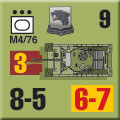 Repelled in their first attack on Tillet, the Black Panthers participated in some probes of the village, but a full-scale attack was delayed by a very successful German nighttime spoiling attack that disrupted the infantry. Once the infantry had recovered themselves, the tanks and infantry went after Tillet again, this time concentrating on the eastern flank of the German position. Repelled in their first attack on Tillet, the Black Panthers participated in some probes of the village, but a full-scale attack was delayed by a very successful German nighttime spoiling attack that disrupted the infantry. Once the infantry had recovered themselves, the tanks and infantry went after Tillet again, this time concentrating on the eastern flank of the German position.
Conclusion
Attacking from the other side of Tillet, the Americans again failed to take the town, at the cost of heavy casualties. While standard American practice told tank crews to return to the rear when their vehicles were knocked out, the 761st’s tankers took out their personal weapons (generally M3 submachine guns) and joined the white infantrymen in their foxholes. This time, no one told them the war was segregated.
Notes
The Americans have tossed in even more tanks and plenty of infantry, but the German defense is stout, in tough terrain and bristling with anti-tank weapons (including 88mm flak guns and Panther tanks). It’s a tall order for the Americans, but they do have that excellent Black Panther morale going for them.
Scenario Eighteen
The Fall of Tillet
9 January 1945
Once again, the remnants of the 761st Tank Battalion and the battered 87th Infantry Division would hurl themselves at Tillet. By this point the tank battalion had lost half of its Shermans, while the infantry desperately looked for promised relief by the 17th Airborne Division. But the Germans had suffered as well, and the American division command staff hoped that one last assault would break them.
Conclusion
This time, both sides pushed all their remaining chips into center of the table. Bad weather continued to keep Allied air support away, but the American infantry broke into Tillet and took it after hours of savage house-to-house and hand-to-hand fighting. Remer, a war criminal and chronic liar, would claim that his Escort Brigade had been on the verge of withdrawing anyway. The truth was that his elite grenadiers were beaten in a straight-up fight by a green American outfit backed by an unwanted Black tank battalion.
Notes
By this point, the American infantry is wearing down, but they come with substantial numbers and strong Black Panther support – the Black tankers are still eager to kill Germans, and Hitler’s Escort Service (a spectacularly stupid unit name) is a prime target for their wrath. It’s good to wrap the scenario set with an American victory.
And that’s Chapter Three. Next up, we’ll look at the brand-new Chapter Four.
Order Black Panthers Here.
Includes Separate, But Heroes. Use coupon code DANA for 20-off
Separate, But Heroes
The fought Jim Crow and the Nazis. Our book, Separate, But Heroes, tells the story of the segregated African-American 761st Tank Battalion along with that of other African-American units and a general history of Race in America.
Order Separate, But Heroes Here.
Just the history. Use coupon code DANA for 20-off
Sign up for our newsletter right here. Your info will never be sold or transferred; we'll just use it to update you on new games and new offers.
Mike Bennighof is president of Avalanche Press and holds a doctorate in history from Emory University. A Fulbright Scholar and NASA Journalist in Space finalist, he has published a great many books, games and articles on historical subjects; people are saying that some of them are actually good.
He lives in Birmingham, Alabama with his wife and three children.
Daily Content includes no AI-generated content or third-party ads. We work hard to keep it that way, and that’s a lot of work. You can help us keep things that way with your gift through this link right here.
|