| Black Panthers:
761st Scenario Preview, Part Four
By Mike Bennighof, Ph.D.
August 2026
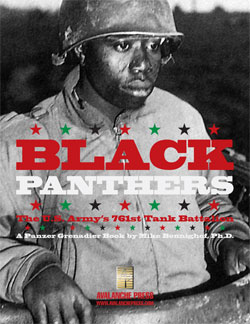 The scenario set from the first edition of Panzer Grenadier: Black Panthers is very good; for the second, we just added 17 more of them, in three new chapters. That lets us tell the full story of the 761st and 784th Tank Battalions in combat, from their first experience through the end of the war. The scenario set from the first edition of Panzer Grenadier: Black Panthers is very good; for the second, we just added 17 more of them, in three new chapters. That lets us tell the full story of the 761st and 784th Tank Battalions in combat, from their first experience through the end of the war.
Of the two, the 761st is by far the more famous, and it spent far more time fighting the Germans. As a “Bastard Battalion” attached to infantry divisions for tank support, the 761st often remained in the line when their parent division withdrew for rest. They fought very few engagements against enemy tanks, and almost all of the battles they waged in January 1945 involved supporting American infantry making a grinding advance to eject the Germans from Belgium.
Let’s have a look at Chapter Four of Panzer Grenadier: Black Panthers Second Edition, which shows the Black Panthers fighting alongside the 87th Infantry and 17th Airborne Divisions in the second half of January 1945.
Campaign Four
Last Days of the Bulge
Very few who actually fought in the Ardennes in December 1944 and January 1945 even heard the name “Battle of the Bulge” until much later. The name only makes sense when one looks at a map, and so it appealed to newspaper editors. On the ground, the Americans GI’s just fought the Germans.
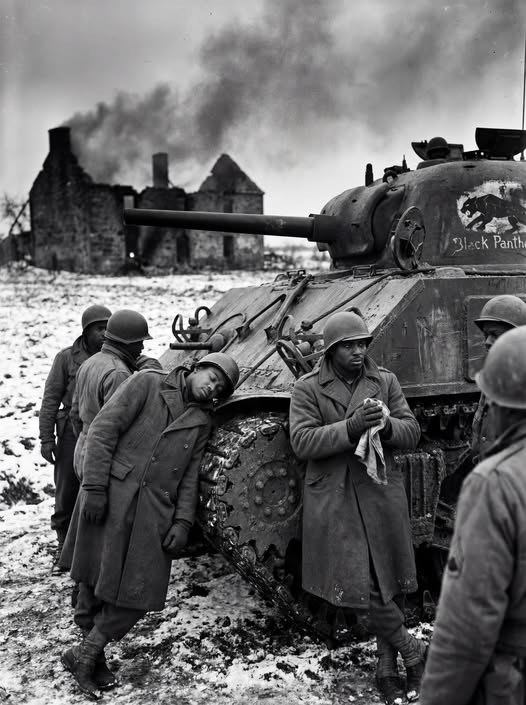
A tred crew of Black Panthers during the Battle of the Bulge.
While the 87th Infantry Division to which they had been attached pulled out of the line, the 761st Tank Battalion would get no reprieve from combat after the fall of Tillet. Nearly three more weeks of hard fighting remained, as the Americans pressed the Germans back to and beyond their starting line.
Scenario Nineteen
Thunder From Heaven
14 January 1945
 After the fall of Tillet, the remaining tanks of the 761st Tank Battalion shuffled eastward to join the newly-arrived 17th Airborne Division. The paratroopers, though terribly green, had entered their first combat enthusiastically, and now they would have tank support. The first task of the combined arms team would be to eject the Germans from the small town of Wicourt, astride the vital road from Bastogne north to Houffalize. After the fall of Tillet, the remaining tanks of the 761st Tank Battalion shuffled eastward to join the newly-arrived 17th Airborne Division. The paratroopers, though terribly green, had entered their first combat enthusiastically, and now they would have tank support. The first task of the combined arms team would be to eject the Germans from the small town of Wicourt, astride the vital road from Bastogne north to Houffalize.
Conclusion
Blizzard conditions made the advance miserable for all of the Americans, but the paratroopers did not seem to care. This time, the Black Panthers and their accompanying infantry pushed the Germans out of the town on their first try, securing another vital point on the road out of Bastogne.
Notes
Now fighting alongside the paratroopers, the Black Panthers face a storm of ice, sleet, and Germans. The Germans have a strong position well-backed by anti-tank guns, but the Americans have a good combined-arms balance of infantry, armor, and artillery (fairly weak artillery, as the 17th Airborne Division had nothing bigger than a 75mm pack howitzer in its artillery battalions).
Scenario Twenty
Panzers in the Forest
23 January 1945
 For the past week, the 17th Airborne Division had been sliding to its right to take over the positions of 11th Armored Division, which in turn slid rightward to allow the 101st Airborne Division to leave the front line. From their new positions, the paratroopers and Black Panthers resumed their advance, looking to seize a ridge line south-east of the town of Wathermal. For the past week, the 17th Airborne Division had been sliding to its right to take over the positions of 11th Armored Division, which in turn slid rightward to allow the 101st Airborne Division to leave the front line. From their new positions, the paratroopers and Black Panthers resumed their advance, looking to seize a ridge line south-east of the town of Wathermal.
Conclusion
The deadly explosions in the tree-tops rained down steel shards and turned the trees into additional shrapnel. The Germans pulled out of the woods in disarray, leaving the road to Wathermal open to the paratroopers and Black Panthers.
Notes
It’s not a very large scenario, with the Germans dug in along a line of wooded hills and the Americans needing to eject them. The Black Panthers’ timed-delivery tactic can be devastating, but there’s only the one assault gun platoon.
Scenario Twenty-One
Streets of Wathermal
23 January 1945
 With the “panzers” in the forests driven off or destroyed, the 513th Parachute Infantry pressed on to the town of Wathermal itself. With heavy losses among the medium tank companies to both enemy action and mechanical breakdown, the light tanks of Dog Company, previously employed on supply and ambulance runs, moved up to spearhead the assault. With the “panzers” in the forests driven off or destroyed, the 513th Parachute Infantry pressed on to the town of Wathermal itself. With heavy losses among the medium tank companies to both enemy action and mechanical breakdown, the light tanks of Dog Company, previously employed on supply and ambulance runs, moved up to spearhead the assault.
Conclusion
The light tanks lacked the firepower and protection of the Shermans, to the extent that they rarely saw front-line combat by this point in the war. In this rare instance of the 761’s Dog Company taking the lead, they did so successfully, expelling the Germans and securing the crossroads town. The German division had been worn down by a month of steady fighting and weeks of defeat, but still retained the ability to defend itself.
Notes
Those light tanks are not Shermans, and they’re not going to survive an encounter with the German anti-tank battery. The American player will need that support, but it going to have to work them forward carefully to avoid the kill zone.
Scenario Twenty-Two
Fixed Bayonets
24 January 1945
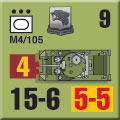 With Wathermal secured, the airborne with their attached tanks crossed into the northern tip of Luxembourg. South of the Belgian town of Espeler, just over the border, the Germans had left a rear guard dug in atop a wooded hill. The 513th Parachute Infantry Regiment closed in to eject them, with support from what few tanks Able Company of the 761st could get moving. With Wathermal secured, the airborne with their attached tanks crossed into the northern tip of Luxembourg. South of the Belgian town of Espeler, just over the border, the Germans had left a rear guard dug in atop a wooded hill. The 513th Parachute Infantry Regiment closed in to eject them, with support from what few tanks Able Company of the 761st could get moving.
Conclusion
The Germans hung on stubbornly, and under covering fire from the 761st’s assault guns, a platoon of the 513th’s Company F reached an irrigation ditch some 200 meters from the German positions. “Fix bayonets,” Lt. Sam Calhoun snarled. “Let’s go.” Some of the Germans stood to meet the Americans, but the rest fled. Once again, the deadly airbursts had un-nerved the defenders.
Notes
It’s just a small scenario, with the Germans defending a woods-covered hill and the Americans looking to throw them off of it. It’s going to be hard to get the tanks up close, but the assault guns (Shermans armed with a 105mm howitzer) have skilled crews that can mimic the effects of the deadly proximity fuze.
Scenario Twenty-Three
Kreuzberg Sonata
27 January 1945
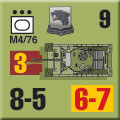 The 87th Infantry Division relieved the 17th Airborne on the evening of 26 January, and the next morning began an advance from the just-captured area around Espeler. There would be no relief for the Black Panthers, who spearheaded the attack on the town of Kreuzberg by the 346th Infantry Division. The sleet and snow had been replaced by rain for the past few days, turning the ground to deep, unforgiving mud. The 87th Infantry Division relieved the 17th Airborne on the evening of 26 January, and the next morning began an advance from the just-captured area around Espeler. There would be no relief for the Black Panthers, who spearheaded the attack on the town of Kreuzberg by the 346th Infantry Division. The sleet and snow had been replaced by rain for the past few days, turning the ground to deep, unforgiving mud.
Conclusion
Weak German resistance initially gave the Americans a false sense of confidence; the enemy did not contest the approach to Kreuzberg, but then fought fiercely within the town itself. German artillery and mortar fire also became much more accurate. Even so, the Golden Acorns and Black Panthers ejected the Germans. On the following day, the Battle of the bulge would be officially declared at an end. Someone forgot to tell the Germans.
Notes
The Black Panthers are back to supporting the Golden Acorn Division, who’ve revived their spirits with the break from the front the tankers did not receive. The People’s Grenadiers are missing home, but they do have anti-tank guns and artillery support, so they’re not giving up this last bit of Belgium without a fight. I have waited a very long time to use this title for a scenario.
Scenario Twenty-Four
The Capture of Heuem
30 January 1945
East of St. Vith, the 87th Infantry Division continued its advance despite the official end of the battle two days earlier. The division’s two forward regiments worked to clear the highway heading eastward from St. Vith into the Germany. The 345th Infantry Regiment, backed by the 761st’s Baker Company, would capture the well-defended town of Heuem.
Conclusion
The 761’s tanks knocked out three machine-gun positions set up in fortified houses, but lost one Sherman to an ambush by German assault guns. The infantry cleared the town, taking several houses in close assaults before the German defense broke and the People’s Grenadiers retreated.
Notes
Those Mire conditions are going to make a mess of the American advance. They have plenty of advantages, from morale to artillery to leadership to armor, but the mud is relentless. The Germans do get an assault gun to help them.
Scenario Twenty-Five
The Capture of Atzerath
30 January 1945
While its sister regiment attacked Heuem, just to the west the 346th Infantry Regiment marched on Atzerath, another key point on the highway out of St. Vith. The 761st could only supply the five tanks remaining to Charlie Company, and so the division staff bolstered the Black Panthers with a newly-arrived platoon from the 602nd Tank Destroyer Battalion and a tank company borrowed from 7th Armored Division.
Conclusion
The 560th People’s Grenadier Division had been part of the initial attack, but many of its personnel had only arrived in January, in effect giving it fresh reinforcements. Even so, a broad American flanking movement including the 761st’s Charlie Company (listed in the 3rd Army and 87th Infantry Division after-action reports as a “platoon,” as it only had five tanks) unhinged the German defense. With the road back to Germany now broken by the 345th Infantry, the remnants of the defense scattered into the forests.
Notes
I initially designed this action and the preceding one as one single scenario, a large one suitable for team play. I try to include one of those in every expansion book. But that needed Ardennes 1944 for a river board and more Americans, so I went with two smaller scenarios instead. The Germans are in a bad way when they’re the ones counting on General Mud to save them.
And that’s Chapter Three. Next up, we’ll look at the brand-new Chapter Four.
Order Black Panthers Here.
Includes Separate, But Heroes. Use coupon code DANA for 20-off
Separate, But Heroes
The fought Jim Crow and the Nazis. Our book, Separate, But Heroes, tells the story of the segregated African-American 761st Tank Battalion along with that of other African-American units and a general history of Race in America.
Order Separate, But Heroes Here.
Just the history. Use coupon code DANA for 20-off
Sign up for our newsletter right here. Your info will never be sold or transferred; we'll just use it to update you on new games and new offers.
Mike Bennighof is president of Avalanche Press and holds a doctorate in history from Emory University. A Fulbright Scholar and NASA Journalist in Space finalist, he has published a great many books, games and articles on historical subjects; people are saying that some of them are actually good.
He lives in Birmingham, Alabama with his wife and three children.
Daily Content includes no AI-generated content or third-party ads. We work hard to keep it that way, and that’s a lot of work. You can help us keep things that way with your gift through this link right here.
|