| The
German Destroyer Hermes
By Mike Bennighof
February 2019
 On 6 May 1941, German troops entered the
Scaramanga Naval Yard at Salamis near Athens.
German air attacks had heavily damaged much
of the yard’s facilities. Among the
victims was a floating drydock that had sunk
on 20 April with the damaged Greek destroyer Vasilefs Georgios inside. All captured
warships became the property of the Royal
Italian Navy, but the Italians noted that Vasilefs Georgios carried a German
main armament and offered the Kriegsmarine
the chance to take over the vessel instead. On 6 May 1941, German troops entered the
Scaramanga Naval Yard at Salamis near Athens.
German air attacks had heavily damaged much
of the yard’s facilities. Among the
victims was a floating drydock that had sunk
on 20 April with the damaged Greek destroyer Vasilefs Georgios inside. All captured
warships became the property of the Royal
Italian Navy, but the Italians noted that Vasilefs Georgios carried a German
main armament and offered the Kriegsmarine
the chance to take over the vessel instead.
The Italians also figured the Germans would
be more likely to supply fuel oil for one
of their own ships, and considered a German
destroyer even with all the attendant organizational
problems and lower efficiency better than
an Italian one they could not use due to lack
of fuel. Curious about the destroyer’s
British engines and design, the Germans accepted
and began refitting the damaged ship.
Vasilefs Georgios had suffered two
near misses from Stuka dive bomber attacks
on 12 and 13 April. A number of her aft compartments
had flooded, and she suffered further damage
to a propeller shaft when the floating dock
sank. Repair work proceeded slowly, and the
ship finally joined the German Navy on 21
March 1942, but needed another six weeks of
dockside work before being declared ready
for action.
Captured German destroyers carried alphanumeric
designations: Z for destroyer, followed by
a letter for country of origin, then a sequential
number. Vasilefs Georgios became ZG3
(ZH1 and ZH2 were allotted to ex-Dutch destroyers).
Usually operating with Italian warships, the
designation confused Italian officers and
radio operators, and so in August she was
rechristened Hermes, a name reflecting
her Greek origin, supposed high speed, and
most importantly one that both Italians and Germans pronounced
in similar fashion.
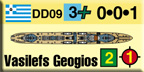 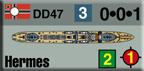
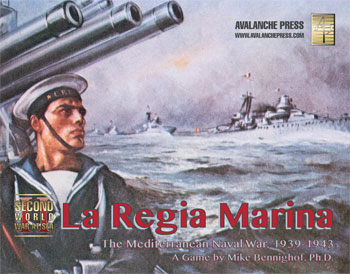
As Hermes, she appears in Second
World War at Sea: La Regia Marina. She is also present
in Greek colors as Vasiliefs Georgios and
makes several appearances in this guise.
The Royal Hellenic Navy ordered Vasiliefs
Georgios in 1936 as a near-copy of the
Royal Navy’s G-class fleet destroyers.
She and her sister Vasilissa Olga had
German-made main and anti-aircraft guns, and
Dutch fire-control gear. The two ships were
laid down in 1937, launched in 1938 and delivered
in February 1939.
Each displaced 1,350 tons in Greek service,
with four 127mm main guns (the same then arming
current German destroyers), four German-made
37mm anti-aircraft guns and eight British-made
21-inch torpedo tubes. They had British-made
Parsons geared turbines and Yarrow boilers
and a designed speed of 36 knots, but had
been fitted with smaller propellers than called
for by the designers and never made this mark. Vasiliefs Georgios had admiral’s
quarters and was designated as the Greek fleet
flagship pending the arrival of a new cruiser
projected to be ordered in 1939.
The Germans added five 20mm anti-aircraft
guns and a pair of machine guns, plus mine
rails and sonar. This raised her displacement
to 1,440 tons. The damaged propeller shaft
was never fully repaired and the Germans could
not obtain bigger propellers, and Hermes never
topped 33 knots and more often had a top speed
of 30 knots. Her officers found the British-made
engines much more reliable than the high-pressure
plants of German destroyers; where a German-built
destroyer would often be out of service for
weeks after a major operation, Hermes could
be turned around and sent back to sea as soon
as she refueled, operating for example from
1 June until 14 October before needing her
boilers cleaned.
Hermes undertook her first mission
on 1 June 1942, escorting a small convoy from
Salamis to Crete along with two Italian torpedo
boats. Her first commander was Fregattenkapitän
Rolf Johannesson, who came to his new ship
from the destroyer Erich Steinbrinck. Except
for the handful of “followers”
Johannesson had been allowed to bring along
from his old command, most of his crew of
10 officers and 215 crewmen came straight
from Kriegsmarine training depots and very
few of them had ever been to sea.

Hermes in German service.
Through the summer and into early 1943, Hermes escorted convoys in the Aegean Sea and
occasionally from Crete to Tobruk. In August
she was alerted to participate in the attacks
on the Allied “Pedestal” convoy,
joining three Italian light cruisers at Navarino
on the west coast of Greece, but the force’s
sortie was ultimately cancelled.
In April 1943 Hermes received a new
commanding officer, Fregattenkapitän
Curt Ressel of the destroyer Bernd von Arnim,
and a new mission. Ordered to Sicily to help
defend the reinforcement convoys streaming
to Tunisia, she sank the British submarine Splendid on 21 April 1943. Hermes joined Italian destroyers serving as fast
transports, and on the 30th was badly damaged
by British aircraft.
She was towed to the old French naval base
at La Goulette for repairs, but with Allied
forces rapidly approaching her crew was ordered
into action as ground troops. Hermes was
scuttled to help block the harbor entrance.
Ressel then apparently panicked, abandoning
his men and making his way aboard a transport
to Trapani in Sicily to “make a timely
report about the loss of the ship.”
A few crewmen were killed in the fighting,
but most showed no more enthusiasm than their
commander and surrendered.
Don’t wait to put La Regia Marina on your game table! Join the Gold Club and find out how to get it!
Sign up for our newsletter right here. Your info will never be sold or transferred; we'll just use it to update you on new games and new offers.
Mike Bennighof is president of Avalanche Press and holds a doctorate in history from Emory University. A Fulbright Scholar and award-winning journalist, he has published over 100 books, games and articles on historical subjects.
He lives in Birmingham, Alabama with his wife, three children and his dog, Leopold.
|