Road to Dunkirk:
Britain’s
25-Pounder
By Mike Bennighof, Ph.D.
October 2021
 In 1933, the British Army called for new designs for an
artillery piece to replace both the 18-pounder field gun and
4.5-inch howitzer that had been the standard medium field
peices of the Great War. Testing took place in 1938, and the
Mark I model entered service the next year. This weapon consisted
of the new gun mounted on surplus 18-pounder carriages, and
was commonly known as the 18/25-pdr. In 1933, the British Army called for new designs for an
artillery piece to replace both the 18-pounder field gun and
4.5-inch howitzer that had been the standard medium field
peices of the Great War. Testing took place in 1938, and the
Mark I model entered service the next year. This weapon consisted
of the new gun mounted on surplus 18-pounder carriages, and
was commonly known as the 18/25-pdr.
The hybrid weapon did not continue long in production, and
most of them were lost in the rapid evacuations of British
troops from France and Norway in 1940. The Mark 2 model appeared
in 1940 with its own carriage. Unlike most contemporary artillery
pieces, the new model 25-pounder had a traverse wheel allowing
the crew to fire through a full 360 degrees without moving
the weapon. Over 12,000 of these would be produced by war’s
end in Britain plus another 1,315 in Australia, equipping
the Dominion armies as well as the British artillery regiments.
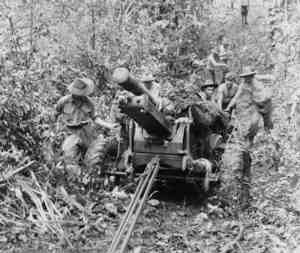
Aussie gunners on the Kokoda Trail
in New Guinea, September 1942.
Australian War Memorial photo 026852.
The 25-pounder had a theoretical range of 13,400 yards with
a supercharge, but this damaged the barrel fairly rapidly
even with the addition of a muzzle brake. The safer maximum
charge, “type 3,” gave a range of 11,875 yards
but the common type 2 provided 7,800-yard range. A good crew
could fire 6 to 8 rounds a minute, though this would damage
the barrel as well, and 3 per minute was more normal and the
recommended rate. Though called 25-pounder, its rounds varied
in weight. By other nations’ measurement systems, it
was a 3.45-inch or 87mm gun.
The “gunhow” fired three types of shell: armor-piercing,
smoke, and high explosive. There was also a chemical shell
designed and produced in limited quantities, that does not
appear to have been issued to any regiments in the field during
World War II.

Australia produced a “Short” version
with, appropriately, a shorter barrel. It
has less range, but could be broken down
into pack loads, considered highly important
in the jungle fighting in New Guinea. It
could not fire the supercharge, but this
was consdiered important only for firing
the anti-tank solid shot, and the 25-pounder
Short could dispose of what few Japanese
tanks it might encounter quite well without
it. A pair of British sergeants in a field
regiment serving in Burma produced a similar
narrow carriage, with the same barrel, that
could be broken down for pack loads, carried
in a C-47 transport plane or towed by a
jeep. Artillery crews converted their pieces
to this standard using locally-procured materials.
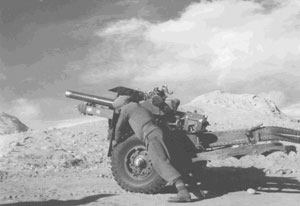
Did anyone actually tow these guns?
Sikh gunners manhandle a “Short” model
25-pounder during the 1962 Indo-Chinese War.
The 25-pounder remained the British Army’s standard
field piece untilt he late 1960s, and some training units
still had a few as late as 1989. They soldier on in a number
of Third World armies; Kurdish nationalists militiamen used
their handful against Saddam Hussein’s Iraqi Army in
2003.
In the Panzer Grenadier series, the 25-pounder
has special qualities in
limbering and unlimbering, due to its rugged construction
and ease of emplacement (thanks to that traverse wheel).
You can order Road to Dunkirk right here.
Sign up for our newsletter right here. Your info will never be sold or transferred; we'll just use it to update you on new games and new offers.
Mike Bennighof is president of Avalanche Press and holds a doctorate in history from Emory University. A Fulbright Scholar and NASA Journalist in Space finalist, he has published an unknowable number of books, games and articles on historical subjects.
He lives in Birmingham, Alabama with his wife, three children and his dog, Leopold.
Want to keep Daily Content free of third-party ads? You can send us some love (and cash) through this link right here.
|