South Pacific:
Cape Esperance, Part One
by Mike Bennighof, Ph.D.
August 2025
 During a tearful meeting held aboard the Combined Fleet flagship Yamato on 28 September 1942, fleet commander Isoroku Yamamoto agreed to give the Navy’s full support to bring massive Army reinforcements to Guadalcanal and finally eliminate the American presence there. During a tearful meeting held aboard the Combined Fleet flagship Yamato on 28 September 1942, fleet commander Isoroku Yamamoto agreed to give the Navy’s full support to bring massive Army reinforcements to Guadalcanal and finally eliminate the American presence there.
Those reinforcements would include the 2nd Infantry Division, moved from Java, plus additional heavy artillery (a dozen 150mm howitzers), tanks, and enough supplies to sustain those men for thirty days and also those already on the island. Destroyers would carry the men on fast runs down the channel between the Solomon Islands, known as “The Slot” to American sailors. The seaplane carriers Nisshin and Chitose would carry the vehicles and artillery, including their crews; the seaplane carriers had the cranes to rapidly unload their cargo without needing port facilities.
To help cover the operation, bombers would strike Henderson Field, and a fighter sweep with 27 planes would seek to suppress American air strike missions. A squadron of cruisers and destroyers would bombard the American airfield that night, and be available to help cover the troop convoy.
Signal intelligence warned the Americans of the Japanese intent, and they made their own preparations to counter the Japanese buildup. U.S. Army troops would finally be introduced to Guadalcanal, in the form of the Americal Division’s 164th Infantry Regiment, a North Dakota National Guard outfit. Task Force 64, a surface action group commanded by Rear Admiral Norman Scott, formed at Luganville on Espiritu Santo with two heavy cruisers, a large light cruiser, and three destroyers. They would at best match the Japanese cruiser force, so at the last minute, theater commander Robert Ghormley added another large light cruiser and two more destroyers.
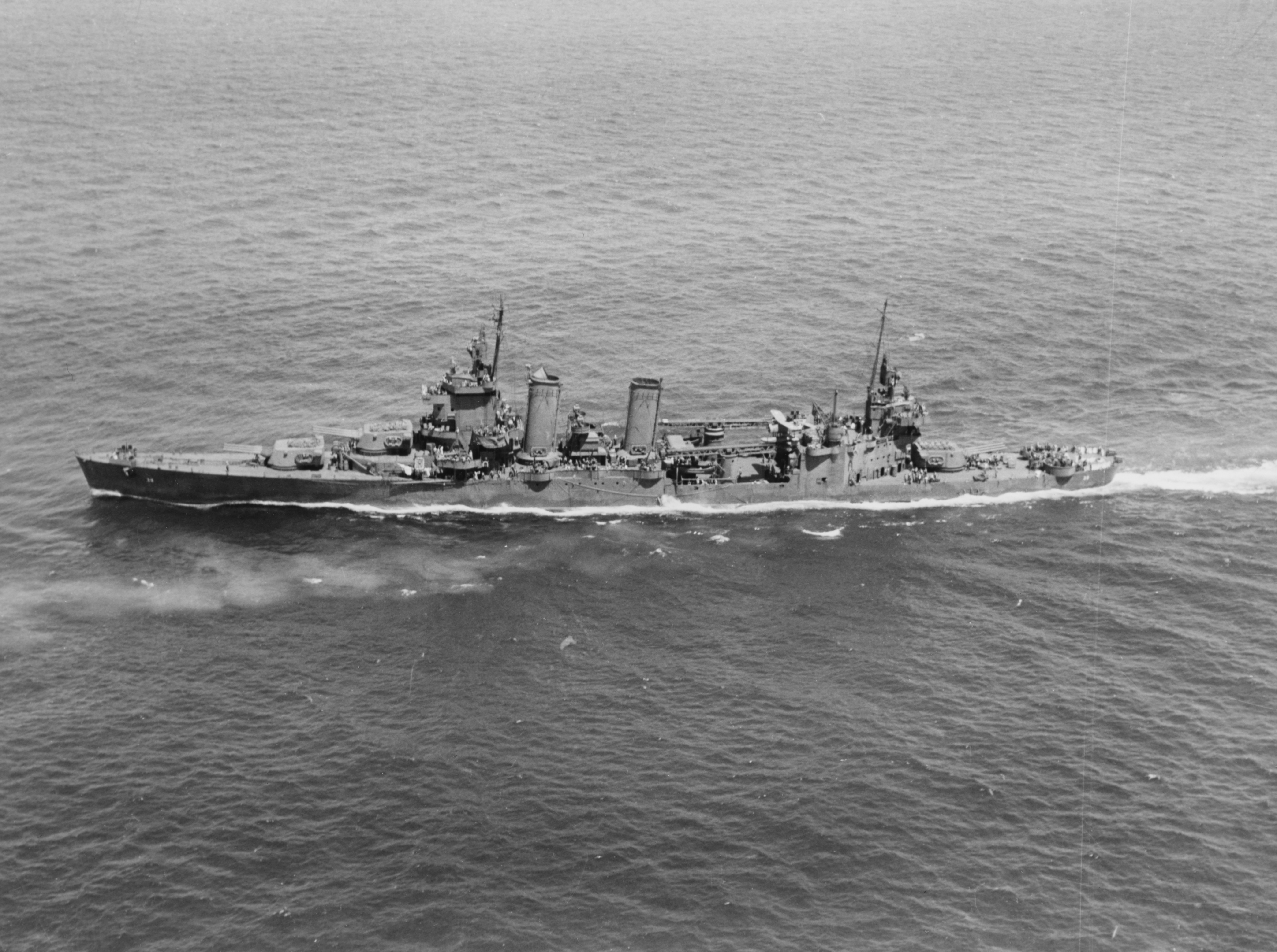
Frisco Maru seen at sea, April 1944.
Scott aggressively sought out the Japanese, setting out for Ironbottom Sound on 7 October. His task force entered the sound each night to await the Japanese, who did not show on the first two nights. The Americans would leave before daylight, wait until dusk south-east of Guadalcanal, and then return to try again. On the afternoon of the third day, 11 October 1942, aerial reconnaissance reported an approaching force of two cruisers and six destroyers. This time, Scott’s task force found the enemy.
Rear Admiral Aritomo Goto had led the Sixth Cruiser Division since September 1941. He’d commanded his cruisers at the Battle of Savo Island, under the overall command of Gunichi Mikawa, and was considered an expert in night-fighting tactics. He had his three surviving cruisers, Aoba, Furutaka, and Kinugasa, plus the large destroyers Fubuki and Hatsuyuki. Goto’s ships were the three oldest heavy cruisers in the Imperial Navy, each carrying six 203mm (8-inch) main guns; they had undergone reconstruction in the mid-1930’s. Though smaller than most heavy cruisers, they boasted superbly-trained crews, made very confident by their smashing victory at Savo Island in August. Fubuki (“Blizzard”) and Hatsuyuki (“First Snow”) had been commissioned in the late 1920’s as the first “Special” type destroyers, twice the size of most foreign contemporaries with powerful gun and torpedo armament.
The Japanese did not expect to meet American surface forces. Goto’s Bombardment Group trailed behind the Reinforcement Group (the two seaplane carriers plus six destroyers – the force actually spotted by American planes and reported to Scott); the heavy cruisers had their main guns loaded with Sanshikidan Type Three anti-aircraft shells, essentially massive, wooden shotgun shells packed with incendiaries. In theory, these would be used to shred the aircraft and facilities of Henderson Field, but the 203mm (8-inch) version had a range of only 1,000 meters, making it highly unlikely that any of them would reach their targets even if the cruisers carried out their bombardment.
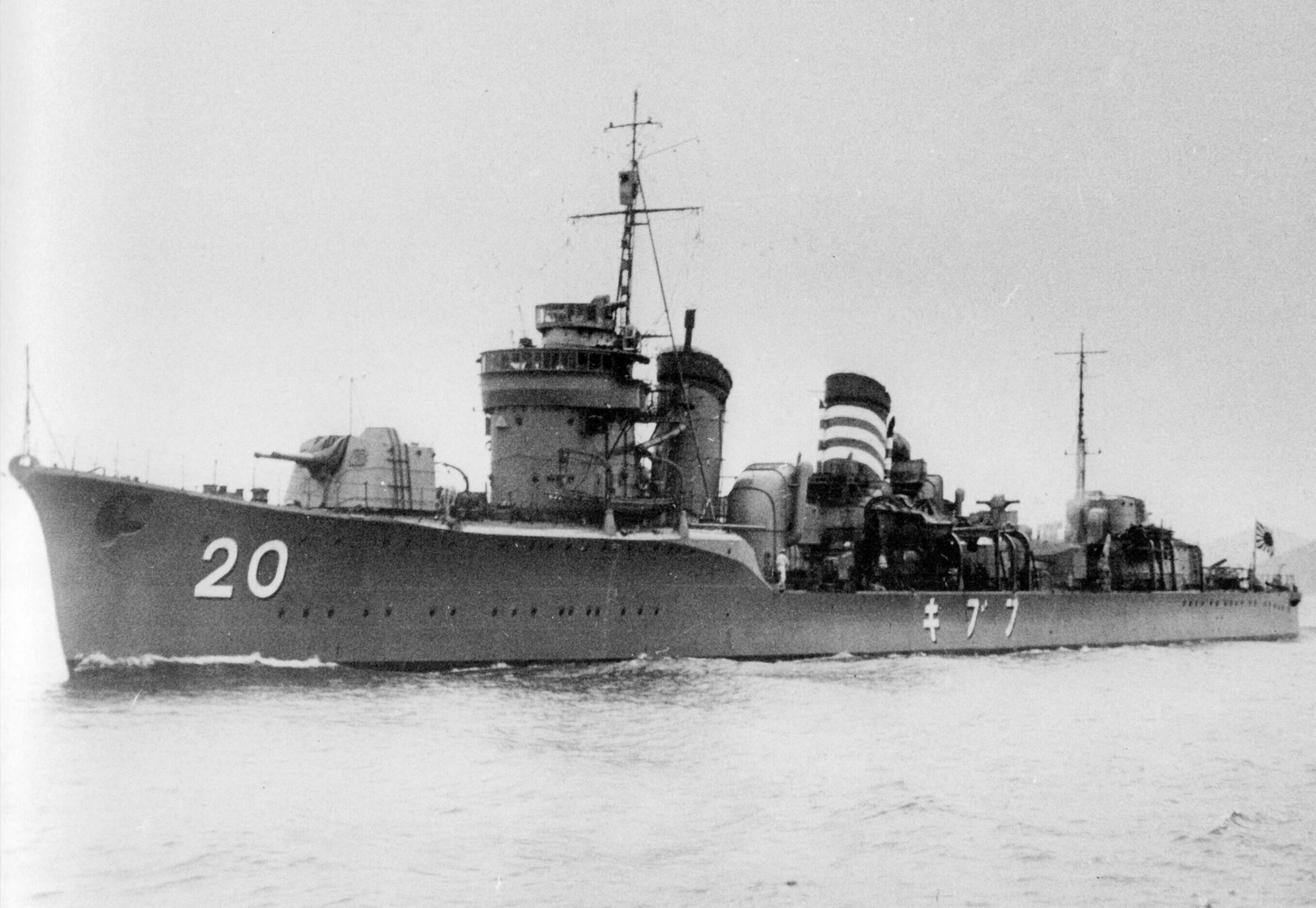
Destroyer Fubuki, seen pre-war.
Norman Scott had two heavy cruisers, Salt Lake City and San Francisco, and two Brooklyn-class light cruisers, Boise and Helena. Frisco Maru carried nine 8-inch guns, while Old Swayback had ten of them. The two light cruisers, actually larger than Salt Lake City and roughly the same size as San Francisco, each carried fifteen 6-inch guns. Scott’s five destroyers, while modern boats, lacked the size and firepower of the Japanese Special Type.
Granted a few days to await the Japanese, Scott drilled his task force in night fighting (the U.S. Navy at this point had no night-combat doctrine), and shared his battle plan with his captains in written instructions issued on 9 October. He arranged his ships in a line of battle, with three destroyers at the front of the column and two at the rear. Ships were to strictly maintain formation, to avoid friendly-fire incidents; only damaged ships would fall out of line, in which case they were to make for Tulagi at best speed. Every ship was to be prepared to two or be towed.
While the Japanese relied on torpedo attacks to open an engagement, Scott tasked his destroyers with firing starshells; they could use their guns against enemy destroyers and torpedoes against larger enemy ships, but the cruisers’ guns would be the decisive weapon in any encounter. The destroyers were to stay clear and give the bigger ships unimpeded fields of fire. Every ship had permission to open fire upon spotting the enemy, without awaiting Scott’s orders; Scott emphasized the Japanese practice seen at Savo Island of opening fire immediately upon switching on their searchlights.
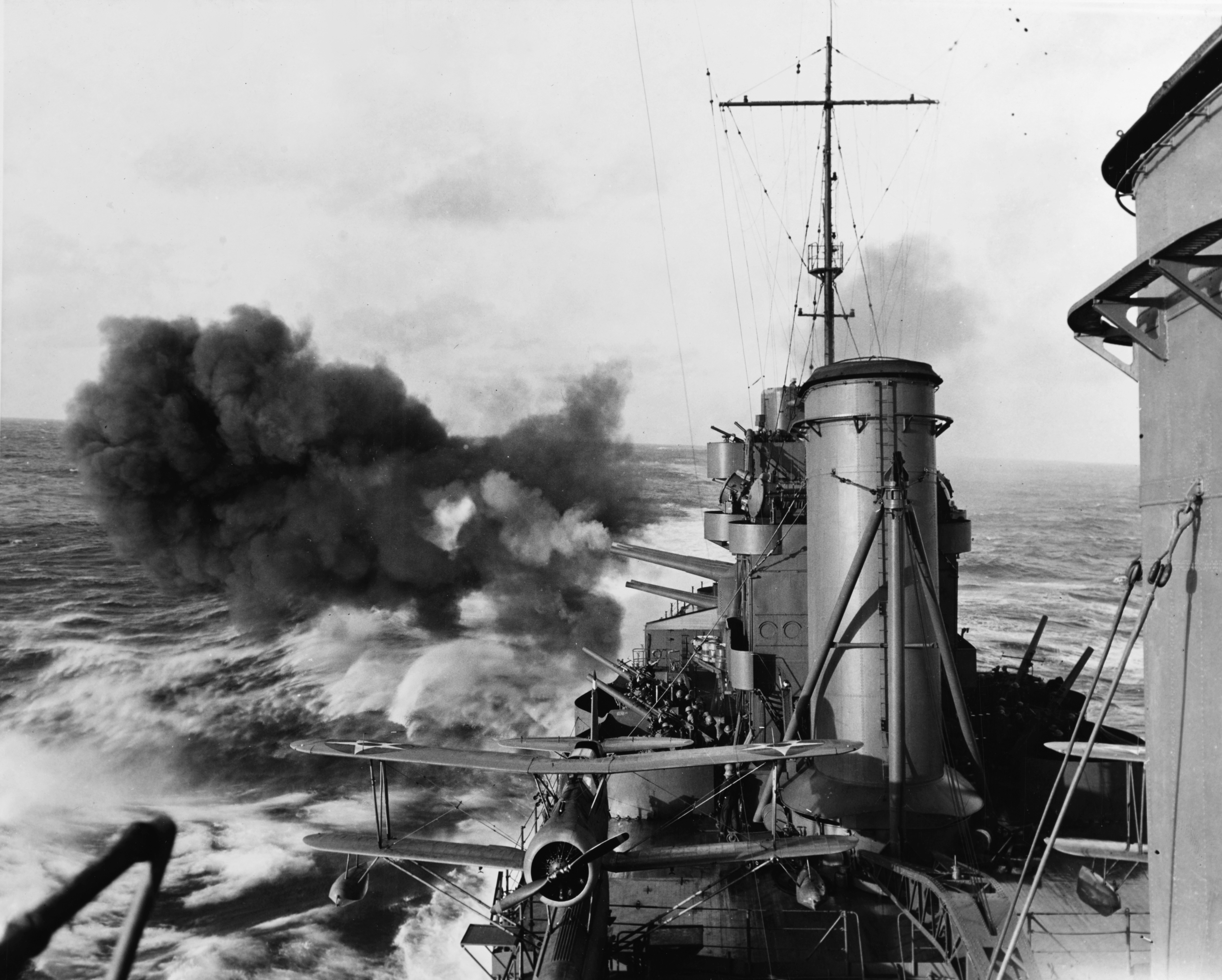
Salt Lake City bombards Japanese-held Wake Island. February 1942.
And then Scott made a crucial, though understandable, error. Only the light cruisers had the new, much more effective SG surface search radar. Scott chose San Franciso as his flagship, the most effective fighting unit of his four cruisers, but with much less capable SC radar, which Scott ordered switched off, as intelligence reports suggested (incorrectly, as it turned out) that the Japanese could detect SC radar impulses.
As night fell on 11 October, Scott ordered his cruisers to launch their floatplanes to drop flares over the Japanese, much as the Japanese had done at Savo Island in August. The plane aboard Helena caught fire, and sharp-eyed Japanese lookouts spotted the flames from 80 kilometers away. Goto believed these to be flares from the Reinforcement Group, and ordered a flare launched in response, which the Americans did not detect.
Task Force 64 rounded Cape Esperance, the north-western end of Guadalcanal, in their line-ahead formation, headed north-east. Helena, the last-minute addition to Task Force 64, picked up the approaching Japanese first, at 2325 at a range of 27,700 yards (just over 25 kilometers), but did not report this contact to Scott, nor did she open fire. At 2332 Scott ordered a turnabout, clumsily executed with the three lead destroyers ending up out of position.
Still, the Japanese approached, and now both Boise and Salt Lake City picked them up on radar as well, but none of their captains reported the contacts to Scott aboard San Francisco, the only cruiser unaware of the oncoming enemy. At 2343, Japanese lookouts on Goto’s flagship Aoba reported the silhouettes of three American ships at 11,000 yards; the admiral insisted that these were ships of the Reinforcement Group, and denied Capt. Hisamune Yonejiro’s request to open fire.
The Americans in their line-ahead formation, had “Crossed the T” of the Japanese, approaching in a column with Aoba in the lead followed by Furutaka and Kinugasa, with Fubuki to the column’s starboard side and Hatsuyuki to port. As they drew steadily nearer, sailors on both sides could see the enemy with the naked eye, yet no one opened fire. “What are we going to do?” Helena’s radar officer asked aloud. “Board them?”
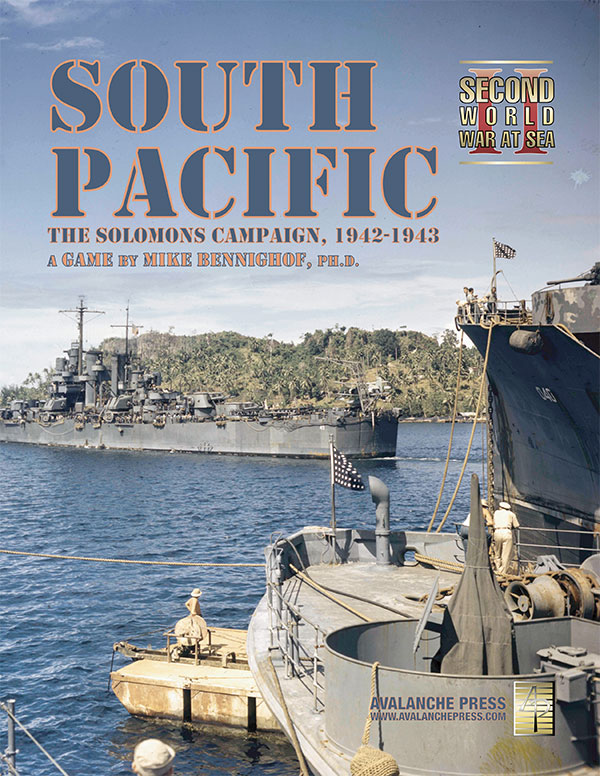
Order South Pacific Here.
Ironbottom Sound is a scenario book that expands Second World War at Sea: South Pacific. It comes with 36 new scenarios for South Pacific, extending the story through August 1943 and the campaign for New Georgia. All of the maps and pieces needed are included in South Pacific; the companion history book, Solomons Naval Campaign, comes bundled with Ironbottom Sound.
Order Ironbottom Sound Here.
Includes Solomons Naval Campaign book.
Order Solomons Naval Campaign Here.
Companion piece to Ironbottom Sound, or just read it separately.
Sign up for our newsletter right here. Your info will never be sold or transferred; we'll just use it to update you on new games and new offers.
Mike Bennighof is president of Avalanche Press and holds a doctorate in history from Emory University. A Fulbright Scholar and NASA Journalist in Space finalist, he has published a great many books, games and articles on historical subjects; people are saying that some of them are actually good.
He lives in Birmingham, Alabama with his wife, three children, and new puppy. He misses his lizard-hunting Iron Dog, Leopold.
Daily Content includes no AI-generated content or third-party ads. We work hard to keep it that way, and that’s a lot of work. You can help us keep things that way with your gift through this link right here.
|