South Pacific:
Cape Esperance, Part Two
by Mike Bennighof, Ph.D.
August 2025
 Helena finally opened fire at 2345, and the other cruisers quickly followed. A flurry of shells turned Aoba into a wreck, with a dud from Boise taking off Goto’s legs. As he bled out, he screamed, “Baka! Baka!” (“You fools! “You fools!”) at the firing ships, believing until his last breath that these were Japanese ships of the Reinforcement Group. Helena finally opened fire at 2345, and the other cruisers quickly followed. A flurry of shells turned Aoba into a wreck, with a dud from Boise taking off Goto’s legs. As he bled out, he screamed, “Baka! Baka!” (“You fools! “You fools!”) at the firing ships, believing until his last breath that these were Japanese ships of the Reinforcement Group.
Furutaka, second in line, swung around Aoba to try to shield the wounded flagship as Capt. Tsutau Araki placed his cruiser between Aoba and the Americans. A special “diving” armor-piercing shell from Furutaka penetrated Boise’s belt armor exactly as designed (the only time this occurred during the war), penetrating her forward magazine (some accounts attribute this hit to Kinugasa). Half a ton of propellant burned in the hoists and shell-handling rooms, and only the rush of seawater that followed kept the American cruiser from exploding. Furutaka succeeded in drawing American fire away from Aoba, but when a hit on a torpedo mount ignited the oxygen-fueled weapons, the massive fire made her a target for all four American cruisers and she quickly suffered over 90 shell hits.
Furutaka’s crew had a reputation in the Imperial Navy as one of its very best, and Araki’s men now showed why. With all three main gun turrets knocked out before they had fired 40 rounds and the torpedo mounts destroyed, Furutaka kept fighting with her anti-aircraft batteries – at this murderous point-blank range, even the light weapons could reach the enemy. Her engines failed, she began to list heavily to port, and fires raged as her black gang tried to stem the engine-room flooding with the bodies of their slain comrades. Furutaka sank stern-first at 0228, taking 258 men with her.
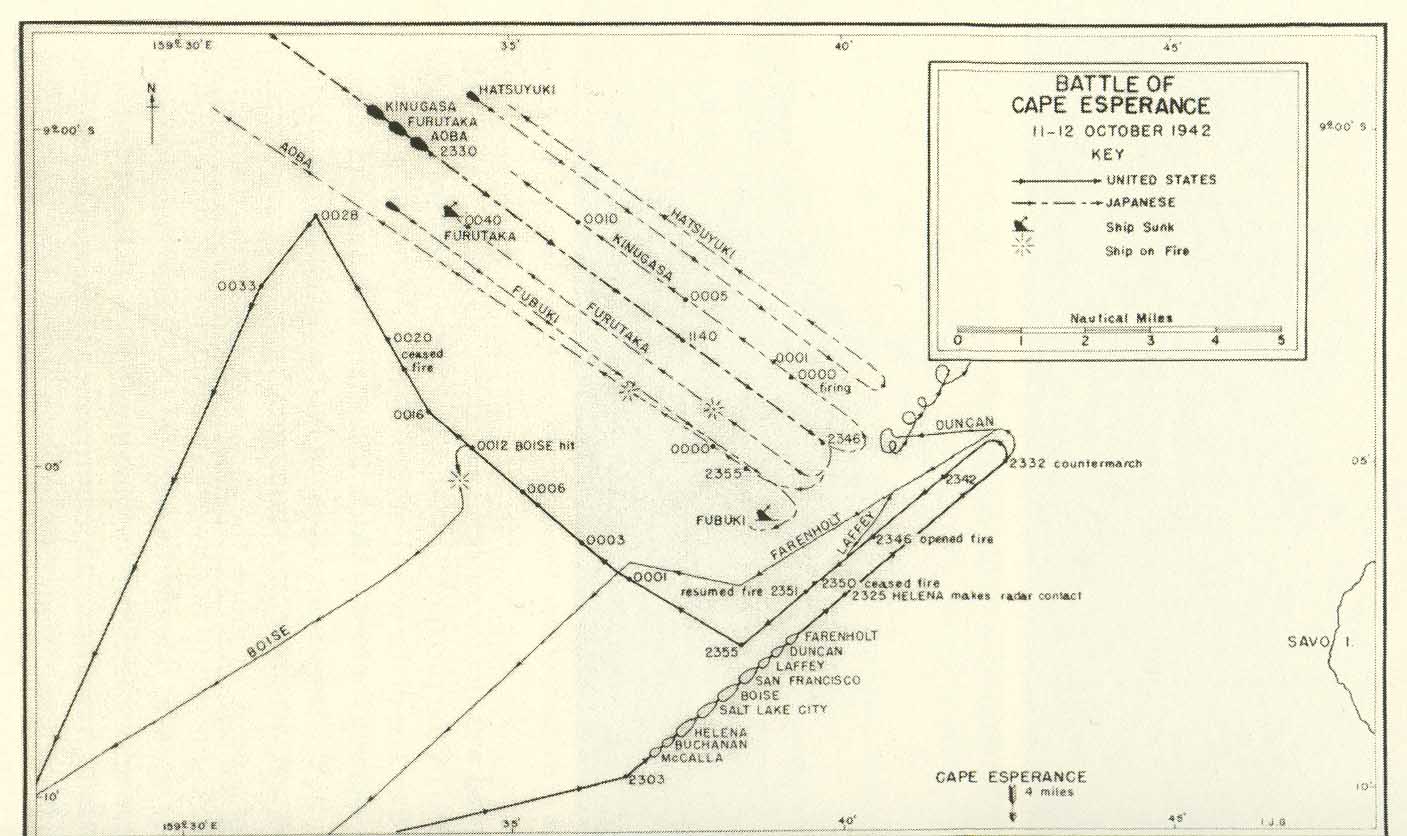
A chart of the battle; open in new tab to embiggen it.
Fubuki actually suffered the first hit, which started a fire amidships as she tried to track the movements of flagship Aoba. She was temporarily saved by Scott’s order to cease fire; the American admiral, much like Goto, feared that the three ships shot up by his cruisers were the three missing destroyers from the front end of his column. Once this had been sorted out, the Americans concentrated their fire on the burning Fubuki, which exploded and sank.
Kinugasa, the third cruiser in the column, turned to port (along with Hatsuyuki), while the other three ships turned to starboard. Her captain, Maso Sawa, was quite explicit in his after-action report: “The enemy’s preemptive attack was focused on the first ships in the column, Aoba and Furutaka. If we had followed this movement, we would have been exposed to concentrated enemy fire, so we decided to turn back.”
Scott had been right to fear a friendly-fire accident; the renewed American barrage now targeted the American destroyer Duncan, which had approached to launch two torpedoes at Furutaka (one of which hit). Kinugasa returned fire, but Helena laid down a devastating salvo that wrecked the destroyer, which sank later that morning along with 85 of her crew. The U.S. Navy’s version of events credits Kinugasa and does not mention Helena, but Sawa is clear that his ship scored no hits on the destroyer. All of the damage, and deaths, came at friendly hands. The destroyer Fahrenholt, another of the three wayward tin cans, took one hit from Hatsuyuki and two more from Helena, with three men killed and 43 wounded. Despite heavy flooding, she made it back to the repair base at Luganville on Espiritu Santo under her own power.
Kinugasa came under fire from Salt Lake City, which hit her four times but did only minor damage. Kinugasa in turn hit Old Swayback twice, killing two officers and destroying a floatplane. She also launched torpedoes at the stricken Boise, which missed, but hit her four times with shellfire.
“There was carelessness,” Combined Fleet chief of staff Matome Ugaki wrote in his war diary. “People did not assume that anyone they saw was a thief, and that anything they saw at night was an enemy, and so the first and second ships came under concentrated attack. It can be said that the battle was almost solely the battle of the Kinugasa.”
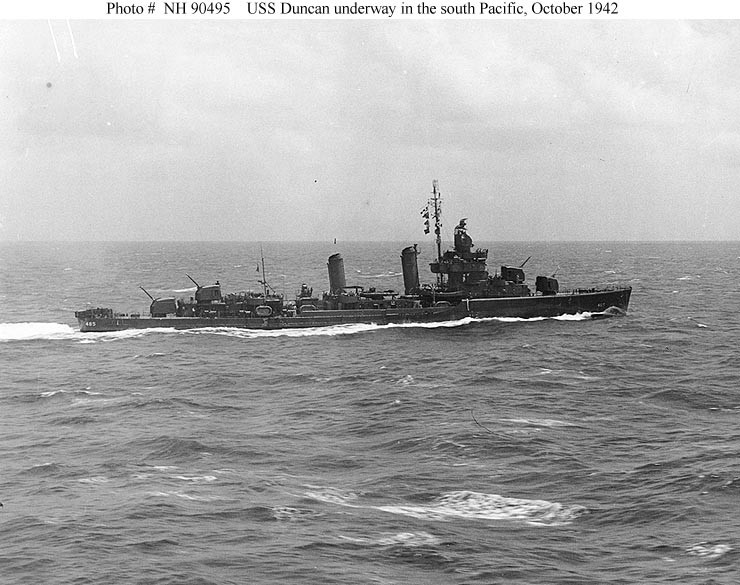
Destroyer Duncan, destroyed by friendly fire. Seen a few days before her end.
The Battle of Cape Esperance last approximately thirty minutes, and marked the first American victory in the Solomons naval campaign. The Japanese lost one cruiser and one destroyer, with another cruiser badly damaged. The Americans lost one destroyer sunk, one cruiser (Boise) badly damaged and one (Salt Lake City) moderately damaged.
Japanese casualties are unclear; American sources claim to have captured 109 crewmen from Fubuki, while Japanese sources state that eight men survived (acknowledging only those picked up by Japanese ships). Some of the Fubuki and Furutaka sailors fished out of Ironbottom Sound would be massacred by New Zealand troops four months after the battle.
The men rescued from the sunken Furutaka and Fubuki would eventually be sent to a prisoner of war camp in Featherston, New Zealand. Led by the English-speaking Lt. Cdr. Toshio Adachi, commander of Furutaka’s aft turret, they stoutly resisted the orders of camp guards to build a sports field for New Zealand troops, believing this labor to be dishonorable aid to the enemy. When Adachi confronted the guards on the morning of 25 February 1943, their commander, Lt. James Malcolm, shot him in the shoulder. The sailors grabbed rocks and sticks to attack the guards, who responded with machine-gun fire from the watchtowers, killing 48 Japanese and one New Zealander.
While the Americans justly celebrated their victory at sea, they had only stopped half of the Japanese operation. The seaplane carriers and destroyers of the Reinforcement Group successfully unloaded their troops and cargo, even as the battle took place just to the north-west. The Americans had steamed around the western end of Guadalcanal after the Reinforcement Group began unloading, and never spotted the Japanese ships though air attacks the next day sank two of the destroyers as they withdrew up The Slot.

The burned-out shellroom of Boise’s six-inch Turret Number Two. |
Despite their losses, the Japanese did not let up in their operations against Henderson Field. The next night, Goto’s Etajima Naval Academy classmate and friend Takeo Kurita led two battleships into Ironbottom Sound to work over Henderson Field, escorted by a light cruiser and nine destroyers. Kongo had a load of 356mm (14-inch) Sanshikidan shells, while Haruna carried conventional high-explosive rounds. Together they poured 918 rounds into Henderson Field and the nearby Fighter One auxiliary strip, and fired 48 152mm (6-inch) rounds at Marine shore batteries. Nine ammunition handlers aboard Haruna collapsed from heatstroke, and one of them died.
Kinugasa returned on the following night, along with Eighth Fleet flagship Chokai and two destroyers, to send 752 203mm shells into Henderson Field. These did a fraction of the damage dealt by the battleships. And on the night of the 14th, the heavy cruisers Maya and Myoko made it three nights in a row for the Marines and newly-arrived GI’s, firing 913 more 203mm rounds.
Japanese officers and crews did not expect to survive these missions, and were shocked to find that the Americans did not contest them. Myoko’s captain, Teruhiko Miyoshi, issued rifles to his crew and instructed them to make their way ashore after the ship had been sunk and join the ground assault on Henderson Field.
Under cover of the bombardments, the Japanese ran a convoy of six transports to Guadalcanal. Despite the damage to aircraft and airstrips, and the destruction of most of Henderson Field’s aviation gasoline supply, the Americans managed to get planes into the air to attack the transports as they finished unloading. They damaged five of the six transports, three of which ran aground so that their cargoes could be retrieved. American warships and planes destroyed the supplies stacked on the beach, killing many of the cargo specialists brought along the speed the unloading process.
At Pearl Harbor, the American failure to contest the bombardments shocked Chester Nimitz as much as it had Myoko’s Capt. Miyoshi. Nimitz fired theater commander Robert Ghormley, replacing him with the far more aggressive William Halsey and rushing repairs to the carrier Enterprise. Japanese efforts would no longer go uncontested.
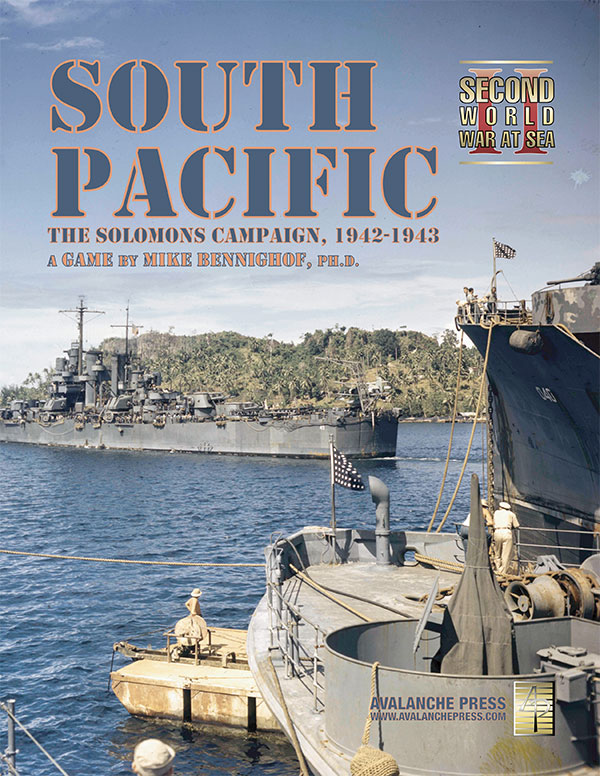
Order South Pacific Here.
Ironbottom Sound is a scenario book that expands Second World War at Sea: South Pacific. It comes with 36 new scenarios for South Pacific, extending the story through August 1943 and the campaign for New Georgia. All of the maps and pieces needed are included in South Pacific; the companion history book, Solomons Naval Campaign, comes bundled with Ironbottom Sound.
Order Ironbottom Sound Here.
Includes Solomons Naval Campaign book.
Order Solomons Naval Campaign Here.
Companion piece to Ironbottom Sound, or just read it separately.
Sign up for our newsletter right here. Your info will never be sold or transferred; we'll just use it to update you on new games and new offers.
Mike Bennighof is president of Avalanche Press and holds a doctorate in history from Emory University. A Fulbright Scholar and NASA Journalist in Space finalist, he has published a great many books, games and articles on historical subjects; people are saying that some of them are actually good.
He lives in Birmingham, Alabama with his wife, three children, and new puppy. He misses his lizard-hunting Iron Dog, Leopold.
Daily Content includes no AI-generated content or third-party ads. We work hard to keep it that way, and that’s a lot of work. You can help us keep things that way with your gift through this link right here.
|