War Plan Gold:
French Heavy Ships
by Mike Bennighof, Ph.D.
May 2026
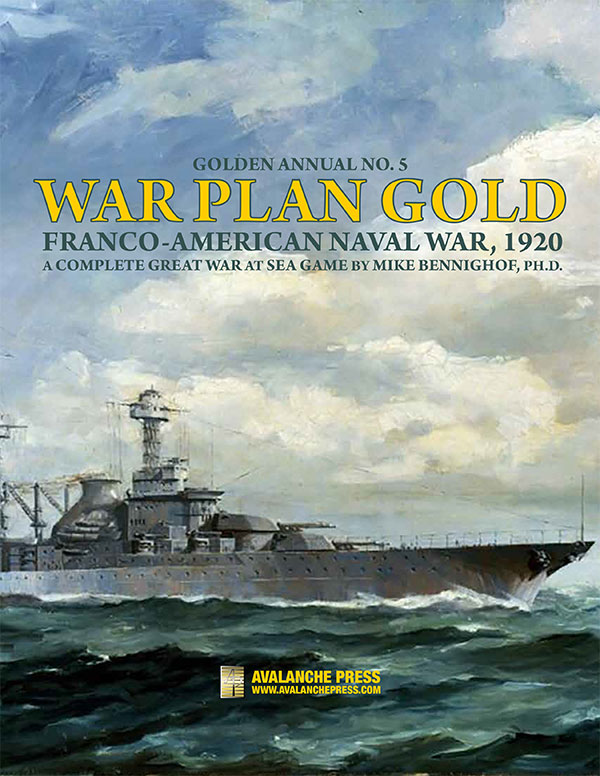 It’s an unusual game, our Great War at Sea: War Plan Gold. It’s based on an actual, though quite vague, U.S. Navy plan for a potential naval war with France. That wasn’t a very likely event, which is probably why the plan remained vague, but we’ve fleshed it out with a back story for our game. In it, the United States and France come to blows in the early 1920’s over their competing interests in Haiti. The French dispatch their most modern ships to the Caribbean, as do the Americans, and battle ensues. It’s an unusual game, our Great War at Sea: War Plan Gold. It’s based on an actual, though quite vague, U.S. Navy plan for a potential naval war with France. That wasn’t a very likely event, which is probably why the plan remained vague, but we’ve fleshed it out with a back story for our game. In it, the United States and France come to blows in the early 1920’s over their competing interests in Haiti. The French dispatch their most modern ships to the Caribbean, as do the Americans, and battle ensues.
The French fleet is built around the dreadnoughts and battle cruisers either laid down or projected at the outbreak of the Great War, but never completed (one of the dreadnought hulls would become an aircraft carrier). They are impressive ships, at least on paper. Let’s have a look at them.
French Battleships

All five battleships of the Normandie class steam to the Caribbean to put the Americans in their place. Laid down in 1913 (with one ship laid down in January 1914), they probably would have been completed sometime in 1916 had the war not intervened. We’ve posited that in the face of a naval war, all of the participants would have given shipyards much greater priority for labor and materials than was the case in the actual conflict, so all five battleships become available as planned, some of them slightly earlier (wartime urgency and all).
The Normandie design looked like a radical departure from earlier practice, but beneath her skin she was quite conservative. The biggest change was the adoption of a quadruple turret; three of them held a total of a dozen 13.4-inch guns; ten of the same weapons had armed the preceding Bretagne class. Normandie also adopted the same hull as Bretagne, slightly lengthened (which was, in turn, an enlarged version of Courbet, France’s first dreadnought design). She had somewhat improved armor protection, most importantly a functional torpedo bulkhead.
Normandie took a step backward with her propulsion, featuring a strange mixture of turbines driving a pair of inner propellers and vertical triple-expansion engines driving two outer propellers. Bretagne had been driven by turbines, as had the preceding Courbet class and France’s semi-dreadnought Danton class. Yet turbines consumed huge amounts of fuel, restricting a ship’s range. No other nation appears to have even considered solving that problem with a mix of turbines and VTE engines, though German designers tried to add a diesel “cruising engine” to increase the range of their dreadnoughts (a concept abandoned when the diesel contractor could not meet their delivery deadlines).

For their next class of battleships, French designers planned to retain the mixed power plant. The Lyon class design was an enlarged Normandie with a fourth quadruple turret for a total of sixteen 13.4-inch guns. Four ships were to be laid down, two in January 1915 and two more in April, on slipways vacated by Normandie-class ships. By then, workers had either been diverted to more pressing war work or drafted into the armed forces, and materials likewise diverted to other needs.
War Plan Gold takes the viewpoint that, facing the need to provide millions of demobilized soldiers with jobs, the French government would have resumed its dreadnought building. The new battleships would be laid down as soon as possible, to appear in 1921 (just like a wargame, at least a good one, it still takes a long time to build a battleship, at least a good one, no matter how hard you wish for it).
The Lyon class would have provided the same maintenance headaches as Normandie with their odd mixed power plants. They did have enormous firepower, but preliminary plans called for no improvements in armor over the Normandie class other than an unspecified new scheme for underwater protection.
Both classes would have carried an enormous number of 138mm (5.4-inch) secondary guns, but many of these would have been placed in citadels directly under the 13.4-inch turrets, exposing them to terrific blast effects.
We included all nine ships of these two classes in War Plan Gold.
French Battle Cruisers
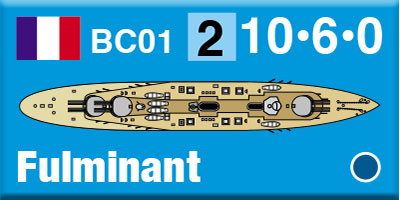
France built no battle cruisers during the time of the Great War, but did study the concept. Among several proposals was one from Paul Gille, the naval engineer supervising construction of the Normandie class. Gille, the brightest rising star of French naval architects, had taken a leading role in the design of France’s last armored cruisers and first dreadnoughts while still in his mid-20’s. After a 1911 visit to British shipyards, he returned with a novel view of the battle cruiser.
British designers, Gille believed, were mistaken in thinking that speed replaced the need for armor. Instead of a well-armed cruiser, Gille proposed a fast battleship with armor equivalent to that of the new dreadnoughts, but a much greater speed. He based his sketches on the new Lyon class, with the midships turret removed to make room for a larger power plant: one powered by oil fuel (unlike the coal-burning dreadnoughts) and consisting only of turbines. That still left the ship with a dozen heavy guns, the same as the Normandie class.
Gille’s design showed great promise, but work on it came to a halt with the outbreak of war. The Army’s personnel bureau declared that naval architects would not be needed for the duration of the war, and in the spring of 1915 Gille was drafted into the Army. His superiors could not obtain his release from service, but did manage to get him assigned to the engineering branch and he spent the war building and repairing bridges for the French Third Army. Horrified by what he witnessed during the war, Gille gave up naval architecture and devoted his talents to helping rebuild the Turkish city of Izmir, sacked and burned by Greek troops in 1922, and constructing a new mosque in Paris. He volunteered to rejoin the Army engineers during the Second World War, and died in 1970.
Another 1914 battle cruiser design proposal came from Lt. Georges Durand-Viel, then a 39-year-old who had interrupted his career as a gunnery and torpedo specialist to attend the naval academy. While there, he drafted a battle cruiser based on the Normandie class, also removing the amidships turret to give her eight heavy guns in a pair of quadruple turrets. Like Gille’s design, Durand-Viel’s ship depended on turbines alone for her power, to make 27 knots.
Durand-Viel, a consummate late bloomer, would rise to vice admiral by the 1930’s and head up the French naval general staff. He would be responsible for the concept of a Force de Raid of fast battle cruisers and battleships to counter German commerce raiders, and oversee the design of the Dunkerque and Richelieu classes. Both of those ships show the distinct influence of Durand-Viel’s student project.
War Plan Gold includes two examples of each battle cruiser. They’re both very capable ships: fast, well-protected and very well-armed. They make a formidable foe for the American battle cruiser squadron that roams the Caribbean as well.
Order War Plan Gold.
Order War Plan Gold (Anarchy) Here.
No rules! You’ll need the Second Edition rules from another Great War at Sea game. Earlier edition rules will not work with this game.
Sign up for our newsletter right here. Your info will never be sold or transferred; we'll just use it to update you on new games and new offers.
Mike Bennighof is president of Avalanche Press and holds a doctorate in history from Emory University. A Fulbright Scholar and NASA Journalist in Space finalist, he has published a great many books, games and articles on historical subjects; people are saying that some of them are actually good.
He lives in Birmingham, Alabama with his wife and three children.
Daily Content includes no AI-generated content or third-party ads. We work hard to keep it that way, and that’s a lot of work. You can help us keep things that way with your gift through this link right here.
|