| Ships of Pacific Crossroads
By Mike Bennighof, Ph.D.
December 2016
A few years ago, it became clear that the Great War at Sea series needed a low-priced introductory game. Pacific Crossroads is based on American and Japanese plans for war in the early 1920's. It's a small game, with some unique ship types. Designed to show off the system, it includes a dozen scenarios featuring most of the different types of actions found in Great War at Sea. But for veteran players — the ones who read this webpage — we know what they want to know. What about the toys? What new ships will we find in this game?
Here's a look at the toys.
American Ships
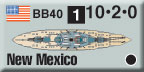 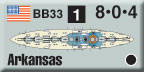 
At the heart of the American battle line are the three battleships of the New Mexico class, which would have been the U.S. Navy's newest in 1919. They are very powerful for the period, each carrying a dozen 14-inch guns. I'm pretty sure this marks their first appearance in the Great War at Sea series. Battleships Wyoming and Arkansas are here as well, having appeared in Jutland previously.
The Americans also have a pair of battleships not appearing in any naval lists, here named Alaska and Hawai'i. These are the Argentine dreadnoughts Rivadavia and Moreno, completed in 1914 and 1915, respectively. American naval officers studied the ships, built in private American yards, and made plans to take them over in case they were seized for American wartime use or if Argentina defaulted on payments and the U.S. Navy was forced to purchase them to bail out the builders. They appear in Cone of Fire in their proper Argentine colors, along with their projected but unbuilt sister ship, and in our Dreadnoughts supplement under several other flags but not that of the United States. I'd intended to include them there but somehow overlooked them (and even wrote scenarios and background for them). The names are purely speculative; if purchased/seized they would have taken the next names in the "state" sequence, probably Idaho and Mississippi, but using those (or any other "state" names) would have been very confusing for players.
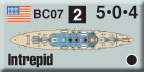
There are also two battle cruisers present, the 1910 design we profiled in an earlier Daily Content piece. These carry the names of two famous American warships, Intrepid and Bonhomme Richard. They're fast and much better-protected than the battle cruisers of other nations, but at the cost of firepower (similar to the trade-off made by German designers, and in contrast to British and Japanese thinking).
The American order of battle is weighted toward the big ships — this is an introductory game, and new players like big guns (well, so do old players). There's one older armored cruiser present: Seattle was a mainstay of the U.S. Pacific Fleet for decades. There are also three new scout cruisers, examples of the 1910 scout cruiser designed alongside the 1910 battle cruiser. This ship never made it to the keel-laying stage, despite the Navy's desperate need for new cruisers. The three examples provided in the game all bear the names of cities in the Philippines.
Japanese Ships
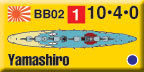 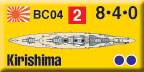 
Japan counters American might with the two new battleships of the Fuso class, each with a dozen 14-inch guns of their own, plus three of the powerful Kongo-class battle cruisers. Any of these are a match for the American New Mexico class, and much better fighting ships than the other American battleships or battle cruisers in the game.
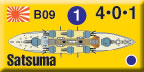
Japan also receives two semi-dreadnought battleships, Satsuma and Aki. They appeared in Cruiser Warfare but I regretted not having the chance to correct their ratings in that game, and this seemed like a good opportunity to do so. We ran a Daily Content piece about them as well.
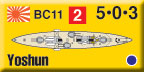 
There are some new Japanese ships too. The Japanese built their first "battle cruisers," actually large armored cruisers, after the British Inflexible had already made the design obsolete. Some in the Japanese Navy argued for a repeat of Inflexible built in a British yard; those discussions would eventually lead to an order for the battle cruiser Kongo.
Another opportunity for the Imperial Japanese Navy to obtain ships of this class came after the First World War. American intelligence analysts insisted that Britain had agreed to transfer eight capital ships to the Japanese at the war's end in return for Japanese support during the war. This does not seem to have been actually contemplated, but if the Americans had gone to war in 1919 they would have expected to encounter former British warships flying the Rising Sun. And so the game includes two Inflexible-class ships in Japanese colors.
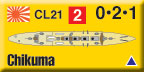
As with the American forces, the Japanese are weighted toward the big ships for the same reason. There are but three cruisers, those of the Chikuma class, based closely on the British Dartmouth. None of them survived into the Second World War, but they were the backbone of the modern Japanese cruiser force in the years just after the First World War.
Mike Bennighof is president of Avalanche Press and holds a doctorate in history from Emory University. A Fulbright Scholar and award-winning journalist, he has published over 100 books, games and articles on historical subjects.
He lives in Birmingham, Alabama with his wife, three children and his dog, Leopold.
|