East Indies Campaign
Publisher’s Preview
by Mike Bennighof, Ph.D.
July 2025
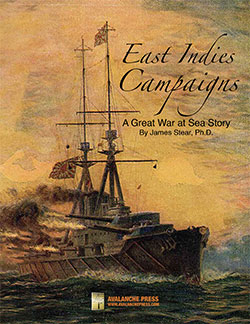 After a brief flurry of activity in the first weeks of the Great War, the Imperial Japanese Navy remained idle for the next four years of conflict. A destroyer flotilla served in the Mediterranean, hunting Austro-Hungarian submarines, supported by an armored cruiser to serve as flagship, but the battleships and battle cruisers built at such unaffordable expense remained in home waters. After a brief flurry of activity in the first weeks of the Great War, the Imperial Japanese Navy remained idle for the next four years of conflict. A destroyer flotilla served in the Mediterranean, hunting Austro-Hungarian submarines, supported by an armored cruiser to serve as flagship, but the battleships and battle cruisers built at such unaffordable expense remained in home waters.
That’s not what happens in Great War at Sea: East Indies Campaigns. The Japanese fleet strikes south in a campaign much like that from Second World War at Sea: Java Sea, except that they’re doing it with dreadnoughts, there is no appreciable air cover, and the Dutch defenders of the East Indies are ready to fight back with dreadnoughts of their own.
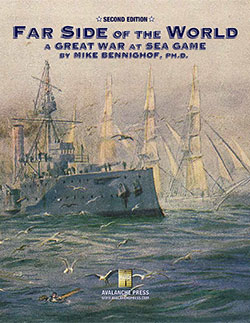
East Indies Campaigns is a Great War at Sea scenario book, telling the story of a Japanese campaign in the South Seas that never happened. It gives you, the player, the chance to use all of those beautiful Japanese ships (with brand-new artwork!) from Far Side of the World and Rise of the Dragon, plus the Dutch fleet from Jutland, on the maps from Second World War at Sea: Java Sea (or from War Plan Orange; they’re the same maps).
East Indies Campaigns is its own story; it doesn’t really form part of any of our ongoing alternative history story arcs. The Netherlands retains its colonies in the Second Great War (the one with The Cruel Sea) but not in the Long War (the one with Plan Z and The Emperor’s Sword). They don’t quite manage to do so here, either, even with some German assistance.
The Japanese are initially based out of Taiwan (historically, a Japanese colony since 1895), pressing south while avoiding British and American interests. Without aircraft (not even any airships), the fleets have to proceed as pre-war planners would have had it, with those fast scout cruisers probing ahead of the battle line in search of the enemy dreadnoughts.
A coal-fired fleet moves at a different pace than the oil-burning ships of 1942; they lack the great range of the later generation’s ships and take longer to re-fuel. That by itself changes the pace of operations, with the Japanese unable to maintain the relentless pace of their historical “Strike South” offensive and forced to move more deliberately, from island to island to secure coaling points for the fleet. They can try a daring leap forward, but it takes a lot of colliers to fill up all of those bunkers.

As in 1942, the ultimate Japanese objective is the teeming island of Java, the military, political and economic center of the Dutch East Indies. The tangled islands of the Indonesian archipelago with their narrow straits and nearly-enclosed seas offer numerous routes to the prize, and many choke points where the defenders can make their stand.
The 1942 Japanese offensive succeeded on a shoestring; the invaders spread their forces thinly and counted on speed and daring to bring them success – and it did. But in 1914, that’s going to be much harder to accomplish. Not only do the Japanese have to keep their fleets coaled, they’re facing a much stronger opponent. The Dutch defenders have a substantial fleet: a dozen dreadnoughts (some of them not very good), supported by a handful of useful cruisers, a larger number of less-useful cruisers, and some slow and weak coast-defense ships. The Royal Netherlands Navy’s East Indies Squadron is notably lacking in modern destroyers to escort the big ships, but does have some torpedo boats that can prove an unpleasant surprise to the invaders in some of those narrow straits between the many islands.
Assisting the Dutch are the cruisers of the German East Asia Squadron, which can’t stand up to the Japanese dreadnoughts (or even semi-dreadnoughts or pre-dreadnoughts) but can form a very helpful raiding force to endanger those long Japanese supply lines. The Dutch have been forced into the Central Powers camp by the long-awaited Japanese aggression, but Japan’s British and French allies offer no assistance for the attack on Dutch colonies and are highly opposed to the move, believing (correctly) that their own colonies are likely the next targets.
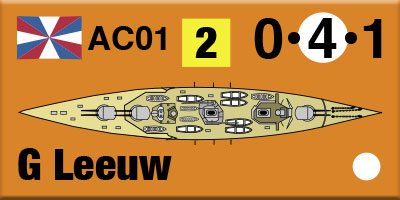
A Dutch fast armored cruiser from Far Side of the World.
The prize, as in 1942, is Java. The outer islands are rich in resources, with coal mined in Borneo and Sumatra, tin in Sumatra and the beginning of an oil industry also arising in Borneo and Sumatra. The Spice Islands (the Moluccas) still produce spices, and there are rubber plantations on Sumatra and timber on many of the islands. But Java is the center, with its huge population, modern ports and naval bases, and massive output of wet-cultivated rice.
Some years back, we finally wised up and brought what we learned from publishing role-playing books over to wargames. It’s just one concept: it’s all about the story. Center the story, whether it’s an alternative history, like East Indies Campaigns, or a historical one, like most of our other games. Games, good games, are exercises in interactive storytelling.
East Indies Campaigns, therefore, isn’t just a shotgun collection of scenarios with a connecting theme. We follow the campaign from the first Japanese moves southward, through a Dutch response, a reinforced Japanese push, German raiding on the supply lines, and finally the conclusion (I won’t spoil that part). The narrative and the scenarios are woven together to tell a cohesive story that you can play out on your game table. This Japanese war of conquest against Dutch colonies never happened, at least not in 1914, but the distraction afforded by the war in Europe did allow the Japanese to put extreme pressure on China in our actual history and would have likewise been an opportunity to seize the Netherlands East Indies.

A Dutch dreadnought from Far Side of the World.
The Netherlands did not actually build a powerful fleet of dreadnoughts; the Dutch made plans for such ships, but dithered over their design and capabilities until the Great War broke out in July 1914 and brought an abrupt end to any such possibilities, as they would likely have been built in foreign shipyards or at the very least with a great many imported components even if laid down in the Netherlands.
Far Side of the World includes four of the planned dreadnoughts, in two alternative designs, while eight more are found in Jutland to three more designs. Far Side of the World also includes an improved coast-defense ship (presented as a home-grown alternative to the dreadnought program) and a big, fast armored cruiser (likewise, a German-influenced but Dutch-built ship). Plus, fast cruisers and big destroyers. East Indies Campaigns is an opportunity to use all of them; in this story, the Dutch have answered the Japanese naval program with a buildup of their own.
East Indies Campaigns takes place over the largest stretch of water of any of the Great War at Sea games (not counting the world-wide scope of Far Side of the World, which isn’t exactly the same thing). The historical actions shown in the other games took place on very constricted waters: the North Sea, the Baltic Sea, the Adriatic Sea or the Black Sea. Campaigns in the decades before the Great War spanned the Yellow Sea, Sea of Japan, and Caribbean Sea.
The much larger battlefield makes for a very different challenge. You’re going to need to scout for the enemy; you can’t count on just running into them if you swan about long enough. East Indies Campaigns uses the parts from a few other games (Far Side of the World, Rise of the Dragon, Jutland, Java Sea) to give you a new game experience.
Join the Gold Club Here.
See your Gold Club Insider newsletter to order East Indies Campaigns.
Order Far Side of the World Here.
Sign up for our newsletter right here. Your info will never be sold or transferred; we'll just use it to update you on new games and new offers.
Mike Bennighof is president of Avalanche Press and holds a doctorate in history from Emory University. A Fulbright Scholar and NASA Journalist in Space finalist, he has published a great many books, games and articles on historical subjects; people are saying that some of them are actually good.
He lives in Birmingham, Alabama with his wife and three children. He misses his lizard-hunting Iron Dog, Leopold.
Daily Content includes no AI-generated content or third-party ads. We work hard to keep it that way, and that’s a lot of work. You can help us keep things that way with your gift through this link right here.
|