Far Side of the World:
Dutch Armored Ships
by Mike Bennighof, Ph.D.
May 2026
 Great War at Sea: Far Side of the World tackles the world-wide aspect of the First World War, during the conflict’s first five months (August through December 1914). You get to play with ships from all of the fleets that participated (Germany, Britain, France, Russia, Japan) and a few that did not, but might have. That latter list includes the East Indies Squadron of the Royal Netherlands Navy. Great War at Sea: Far Side of the World tackles the world-wide aspect of the First World War, during the conflict’s first five months (August through December 1914). You get to play with ships from all of the fleets that participated (Germany, Britain, France, Russia, Japan) and a few that did not, but might have. That latter list includes the East Indies Squadron of the Royal Netherlands Navy.
The Dutch contingent is unique in Far Side of the World, as it includes not just the ships present in the East Indies in 1914, but ships that the Royal Netherlands Navy planned and hoped to build, but did not complete. This allows for some what-if scenarios, and also for their use in expansions down the road (like the upcoming East Indies Campaigns). Let’s have a look at them:
Coast-Defense Ships
The RNN built a series of armored ships around the turn of the century, for service in both the East Indies and European waters. Usually called “coast defense ships” in English-language literature, they were definitely high seas warships and more of a slow armored cruiser than a small battleship. They lacked the heavy armor of the traditional coast defense monitor, but carried only 9.4-inch guns until the last of them, De Zeven Provencien, was laid down in 1908.
Koningin Regentes Class
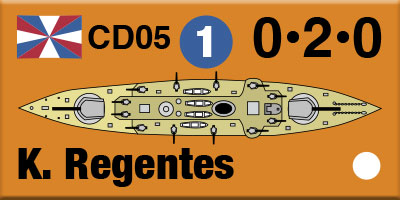
The Netherlands laid down her first coast-defense ship in 1891, and a class of three more in 1893. These turned out to be failures, not least because the Dutch re-cycled worn-out guns from still older ships in order to save money. By 1914 only one of them remained in service, as the station ship in the Dutch West Indies.
The Koningin Regentes class, also of three ships, at least marked an improvement over those worthless tubs, but not by much. The new ships, laid down between 1898 and 1901, displaced 5,000 tons and now at least carried cutting-edge armament. The main guns, two 240mm (9.4-inch) Krupp-made SK/L40 rifles in single turrets mounted fore and aft, were the most modern then available and armed the German and Austro-Hungarian battleships and armored cruisers then under construction. The secondary guns, four 150mm (5.9-inch) SK/L40 rifles, likewise were the latest that Krupp had to offer. The Dutch coast-defense ships carried the same armament as first-line battleships of other navies (though not up to Royal Navy standards). There concluded the positive aspects of the class.
They lacked the speed to keep up with potential enemy cruisers or, for that matter, most enemy battleships. Their triple-expansion engines could put out 6,500 horsepower, good for 16.5 knots when new. Intended to patrol the broad Indonesian archipelago as well as the Caribbean, and to transit between those posts and the homeland, they had very high freeboard to improve sea-keeping, and large coal bunkers to give them very long range.
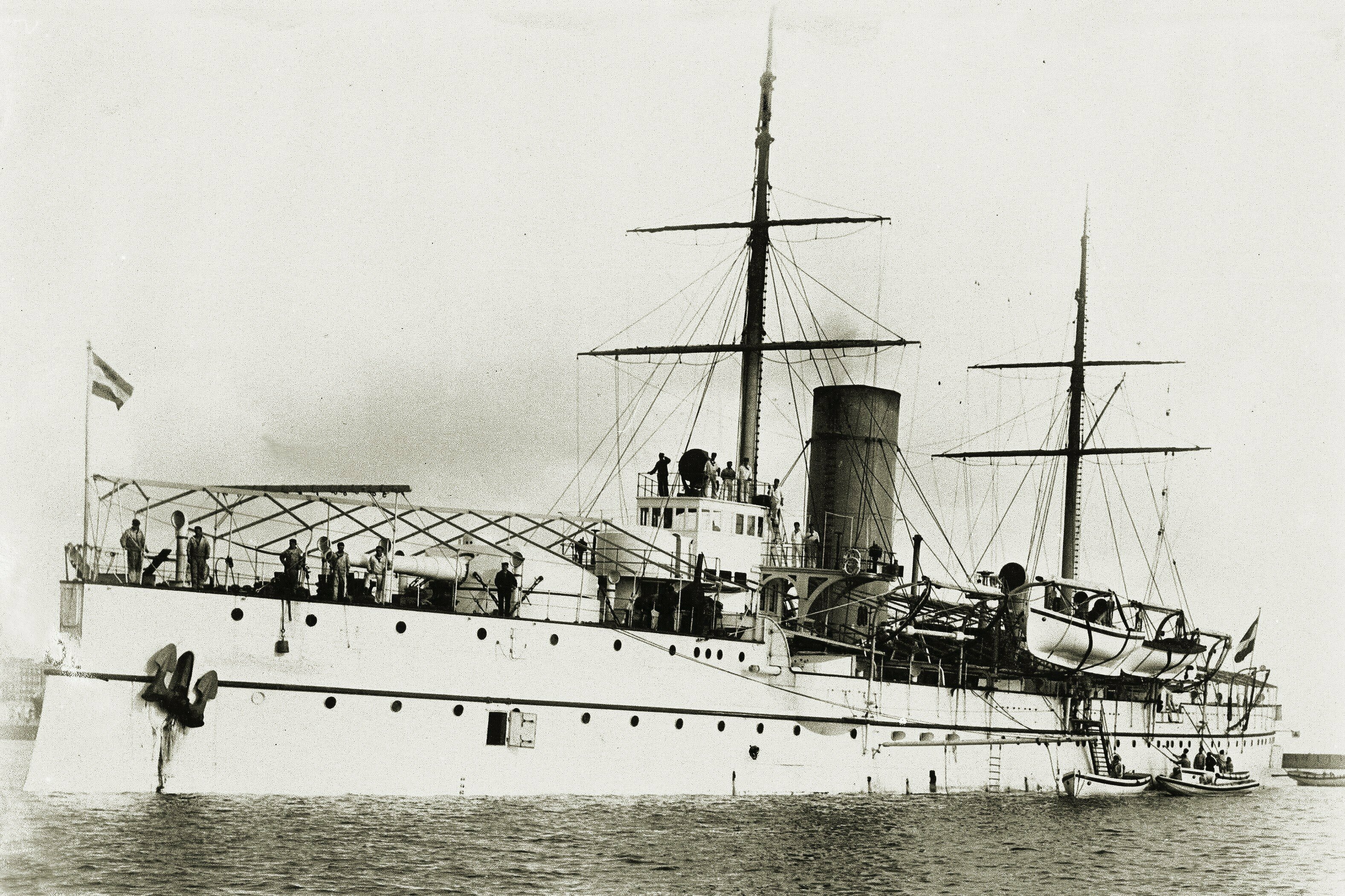
Koningin Regentes seen at Algiers, in 1902.
Their armor could not repel shells from their own armament, or anything likely to be carried by an enemy armored cruiser, let alone a battleship. They had 150mm (six inches) of Krupp steel on their belt, 51cm (two inches) on their decks. The exception were the rounded turrets, with 250mm (10 inches) of well-sloped armor.
The three ships rotated between the Netherlands and the East Indies, showing the flag while deployed and bombarding various unruly locals who did not appreciate the blessings of Dutch colonialism. When the First World War broke out, De Ruyter was at home, with Koningin Regentes and Hertog Hendrik on station in the East Indies (usually operating out of Soerabaja). De Ruyter and Koningin Regentes would be scrapped after the war, but Hertog Hendrik survived as a training ship. She escorted convoys during the Spanish Civil War, and became first a floating battery and then an accommodation ship during the Second World War. Scuttled by the Dutch, the Germans salvaged her and rebuilt the old scow as the anti-aircraft ship Ariadne. She survived the war, to become a barracks ship again. She finally went to the scrapyard in 1968.
Tromp
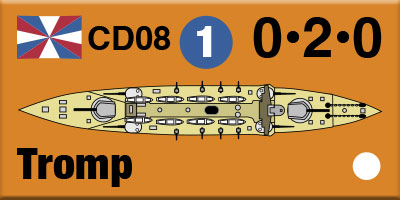
A near-sister to Koningin Regentes, Marten Harpertszoon Tromp carried the same armament, engines, and armor but had been lengthened slightly to provide more coal bunkerage and hopefully more speed, and so the Dutch considered her a separate class. The added four meters did not add any speed, just sufficing to balance the additional 200 tons’ displacement.
Tromp followed the same career path as her near-sisters, and in 1914 confronted the German light cruiser Emden, turning her away from neutral Dutch waters. She remained in service after the war, first in the East Indies and then in European waters, before decommissio0ning and scrapping in 1927.
De Zeven Provencien
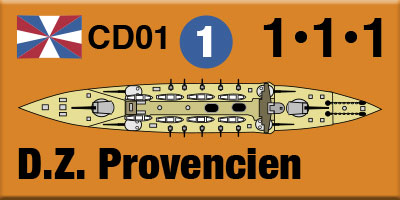
After building one more near-sister to Koningin Regentes, the Royal Netherlands Navy finally constructed a more capable ship. De Zeven Provencien. But only slightly more capable. Originally ordered as another near-sister, she was altered to carry a main armament of two 280mm (11-inch) guns instead. She had four 150mm guns like her near-sisters, since Tromp having moved to turrets, but no torpedo tubes. The increase in armament raised her displacement to 6,500 tons, though she was less than a meter longer than Tromp. She had more powerful engines, but still turned out to be even slower, and lacked the good steaming qualities of the previous ships.
She commissioned in 1910 and, other than a return to the Netherlands in 1918 for a lengthy overhaul, she spent her entire career in the East Indies. She suffered a mutiny in 1933 that in turn led to political upheaval in the Netherlands and a name change for the ship, to Soerabaja. In 1936 she underwent conversion to a training ship, and in February 1942 Japanese bombers sank her in the harbor of her namesake city. The Japanese occupiers of Java would later raise the wreck, salvage its armament, and scuttle it outside the harbor.
The 1912 Armored Ship
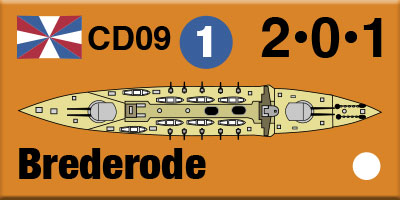
De Zeven Provencien proved a severe disappointment. With a maximum speed of just 16 knots she was much slower than foreign battleships, let alone cruisers. She did not have the armor to stand up to a battleship and probably not to an armored cruiser, and her two 11-inch guns were not likely to allow her to inflict much damage before her own destruction.
Debate raged among the kingdom’s Defense Council, as the admirals pushed for a true battleship and the political appointees refused to fund the massive improvements that the dockyards at Amsterdam and Soerabaja would need to service a larger vessel. For the 1912 Fiscal Year, the minister of naval affairs proposed an enlarged De Zeven Provencien.
Pantserschip 1912’s initial design called for four 280mm guns in twin turrets fore and aft, ten 105mm guns in shielded mounts, and three torpedo tubes. Displacement would rise to 7,200 tons, while top speed remained 16 knots with a similar armor scheme.
Members of the Dutch Parliament roasted the design. The Navy Minister offered a revised version, raising displacement to 7,600 tons and speed to 17 knots; the MPs again scorned the ship as a waste of money. This is the ship presented in Far Side of the World.
A third offering, a 10,500-ton ship adding a super-firing 280mm turret forward for six guns total and upping the speed to 18 knots, was also laughed out of Parliament; this ship could not be built at Amsterdam Naval Yard nor repaired in Soerabaja’s floating drydock, which would mean additional expenses to build her in a private yard and for new infrastructure.
If they were going to spend that sort of money, the Defense Council reasoned, they might as well go all in. The next Dutch capital ship would be a true dreadnought.
Order Far Side of the World Here.
Sign up for our newsletter right here. Your info will never be sold or transferred; we'll just use it to update you on new games and new offers.
Mike Bennighof is president of Avalanche Press and holds a doctorate in history from Emory University. A Fulbright Scholar and NASA Journalist in Space finalist, he has published a great many books, games and articles on historical subjects; people are saying that some of them are actually good.
He lives in Birmingham, Alabama with his wife and three children.
Daily Content includes no AI-generated content or third-party ads. We work hard to keep it that way, and that’s a lot of work. You can help us keep things that way with your gift through this link right here.
|