Elsenborn Ridge:
Scenario Preview, Chapter Four
by Mike Bennighof, Ph.D.
October 2025
 The very act of writing history is, in itself, a political act. You can’t “just state the facts”; for starters, there are way too many facts, about any event, to state them all. You have to choose which ones are worth stating and with that choice opinion enters the arena. Hopefully it’s well-informed and judicious opinion, expert opinion even, but history is not mathematics. There are no cold universal truths. Well, not many, anyway. The very act of writing history is, in itself, a political act. You can’t “just state the facts”; for starters, there are way too many facts, about any event, to state them all. You have to choose which ones are worth stating and with that choice opinion enters the arena. Hopefully it’s well-informed and judicious opinion, expert opinion even, but history is not mathematics. There are no cold universal truths. Well, not many, anyway.
One of those universal truths, in my universe, is that Nazis are and were just plain evil. I chose to design Panzer Grenadier: Elsenborn Ridge because the battle was a prime example of the United States Army taking a terrible blow from a force of evil, standing its ground, and then throwing back the minions of an evil master.
We hold these truths to be self-evident: That all men are created equal.
Nineteen thousand American soldiers gave their lives in the bitter cold of Belgium and Luxembourg to uphold that sacred principle. Let’s take a look at a few more of their great deeds, with Chapter Four.
Let’s continue our scenario review with Chapter Three.
Chapter Four
The Crossroads
About four kilometers to the south-west of the Twin Villages, the manor known as Domane Bütgenbach dominated one of the few crossroads in the immediate area. The road from the Twin Villages split here, to head southward to St. Vith and westward to Stavelot. When the Germans made their assault on the Twin Villages, only a small group of engineers, anti-aircraft guns and anti-tank guns held the crossroads.
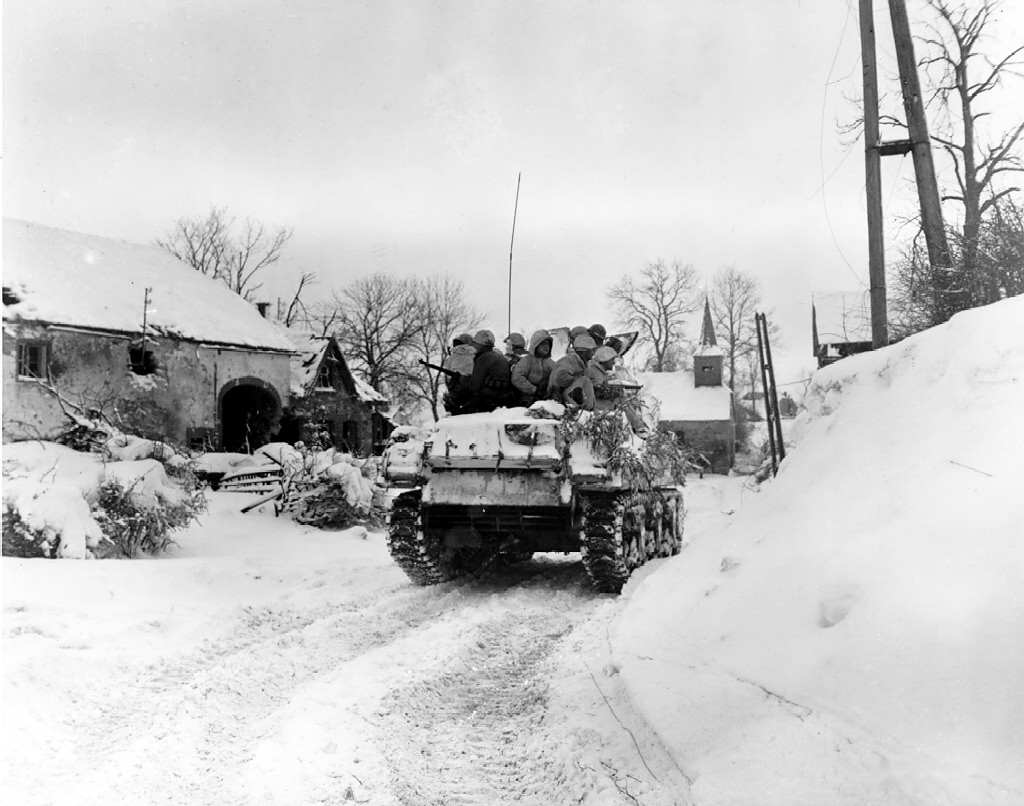 Men of the Big Red One advance aboard a Sherman tank in the Ardennes. Men of the Big Red One advance aboard a Sherman tank in the Ardennes.
Those outnumbered defenders proved sufficient to drive off a half-hearted probe nu the 1st SS Panzer Division on the 17th. Inexplicably to the Americans, the enemy militia then swung southward to try its luck on the narrow forest tracks to the south and did not force its way through to the better road heading west.
Taking advantage of that good fortune, the American VIII Corps rushed reinforcements to the sector from the crack 1st Infantry Division. The men of the Big Red One, having just pulled out of the line after bloody combat in the Hürtgen Forest, dug in quickly and waited for the Germans to realize that they needed the crossroads after all.
Scenario Sixteen
We Fight and Die Here
19 December 1944
Pulled out of the line after its failure at the Twin Villages, the Hitler Youth Division swung instead onto the road to the large farm known to the Americans as Dom Bütgenbach. At first, they found easier going over routes cleared by 1st SS Panzer Division, and then they ran head on into the U.S. 1st Infantry Division. The SS recon battalion blundered into the Big Red One on the afternoon of the 18th and was badly shot up; by the time the rest of the militia division was ready to attack in the wee hours of the next morning, the Americans were primed and ready for them. “We fight and die here,” Lt. Col. Derril Daniel told his 2nd Battalion of the 26th Infantry Regiment, a phrase his men would repeat to each other constantly over the next several days.
Conclusion
The Hitler Youth formed up just outside of American sighting range and then began a wild assault on the manor. But having been bounced by a good American division, they now found themselves facing a great one. The Americans lit up the night with illumination rounds, and then poured artillery fire on the advancing Germans. Three German tank destroyers actually made it to the farm, but were driven off by artillery fire and the threat of American bazooka teams. The remnants of the German force drew off into the night, and once again the Hitler Youth would have to dig a grossly outnumbered force out of a crossroads village. Daniel remained highly confident: with a Ph.D. in entomology from Clemson University, he was a recognized expert in the eradication of vermin.
Notes
I still love the last line of the conclusion. The scenario itself isn’t very big, but it is quite intense.
Scenario Seventeen
Goering’s Elite
19 December 1944
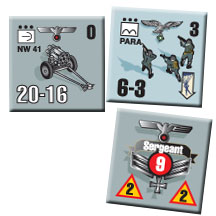 Expected to play a major role in the offensive, the 3rd Parachute Division failed to make much progress against very weak opposition. At one point, an entire Parachute regiment was held up for a day by a single American platoon, suffering hundreds of casualties. No longer “the best damn soldiers I ever saw” as one American colonel had called them six months earlier, the division dawdled along behind the SS panzers until ordered to resume attacking a newly-arrived American unit. Expected to play a major role in the offensive, the 3rd Parachute Division failed to make much progress against very weak opposition. At one point, an entire Parachute regiment was held up for a day by a single American platoon, suffering hundreds of casualties. No longer “the best damn soldiers I ever saw” as one American colonel had called them six months earlier, the division dawdled along behind the SS panzers until ordered to resume attacking a newly-arrived American unit.
Conclusion
Third Parachute Division made only what the U.S. official history called “desultory attacks” on the American position, showing little enthusiasm. Massive casualties during the Normandy campaign had led to the division being rebuilt with an infusion of surplus Air Force ground crews and raw recruits, but nothing could replace the experienced junior officers who had been lost. The Big Red One’s 16th Infantry Regiment easily fought off their attacks.
Notes
A mass of unwilling German airborne try to penetrate a pretty good distance into American positions held by the Big Red One. Even with all those numbers this is a really tough mission for the Germans, in the face of elite defenders backed by copious artillery.
Scenario Eighteen
Hunting Panthers
20 December 1944
After their repulse, the Hitler Youth pulled back and replenished fuel and ammunition while keeping up a slow but steady artillery bombardment of the American positions. The militia division’s poor march discipline wasted hours while reinforcements made their way to the front and supplies finally reached their destinations. Not until midnight was the new assault ready to step off.
Conclusion
Once again, the German tank destroyers made it into the farm buildings, and once again the American artillery fire and infantry defense drove off all their supporting panzer grenadiers. American tank-hunting teams tracked down and destroyed all the German vehicles wandering through their positions, including several of the gigantic Hunting Panthers. Enraged, Hitler Youth commander Hugo Kraas ordered a fresh attack a few hours later.
Notes
The Hunting Panthers might be a formidable foe if the Americans had any tanks, but against infantry they’re just like any other tank and vulnerable to close assault by the elite American foot soldiers. And then there are the guns. A rain of American shells will fall on any German advance.
Scenario Nineteen
Panzer Attack
20 December 1944
The Big Red One was adding to its huge list of battle honors, schooling the Hitler Youth in infantry anti-tank tactics. But as the officers of the 26th Infantry Regiment holding the manor farm took stock of their position, they found themselves almost out of anti-tank mines and bazooka rockets. If the Nazi tanks rolled forward again, it would be much harder to stop them.
Conclusion
The tired panzer grenadiers again suffered terrible casualties from American rifle, machine gun and artillery fire. Heavy fog limited visibility, making it easier for the veteran American infantry to stalk and destroy the tanks that once again broke into the farm without infantry support. The Hitler Youth fell back again, and though skirmishing continued throughout the day the battle seemed to have ended. But the 12th SS Division would not easily set aside its hard-won reputation for fanaticism.
Notes
We go back to the crossroads for an intense fight with lots of infantry and a handful of tanks on each side. This time the Germans have lined up some artillery of their own, but they have to face the stout infantry of the Big Red One.
Scenario Twenty
The Last Gasp
21 December 1944
After days of disorder, the Hitler Youth division finally assembled its full strength in front of the Dom Bütgenbach farm. The division command decided on another night attack in hopes of negating the American advantage in artillery. The Armed SS militia scorned the regular Army’s general staff traditions and schools, but after the division took two full days to finally assemble, some battalions promptly wandered off into the darkness. The attack only got underway more than three hours late, with dawn breaking and well after the preparatory artillery barrage had ended.
Conclusion
Once again, the Hitler Youth proved a dismal failure. The division was ordered out of the line again and sent south to attack Bastogne, where it would fail once more to break a determined American defense. The militia division left 782 dead lying in front of the American positions, and had lost over half its tanks in its defeats at the Twin Villages and the Dom Bütgenbach farm. American losses were also heavy, yet a single American infantry regiment had wrecked one of Hitler’s supposedly elite panzer divisions.
Notes
There’s just one board in play, but lots of units on it as the Hitler Youth make a two-pronged assault on some determined American defenders. There are many tanks involved in pretty dense terrain, and a rain of artillery fire.
And that’s Chapter Three. Next time, we dig into Chapter Five.
Order Elsenborn Ridge Here.
Sign up for our newsletter right here. Your info will never be sold or transferred; we'll just use it to update you on new games and new offers.
Mike Bennighof is president of Avalanche Press and holds a doctorate in history from Emory University. A Fulbright Scholar and NASA Journalist in Space finalist, he has published a great many books, games and articles on historical subjects; people are saying that some of them are actually good.
He lives in Birmingham, Alabama with his wife and three children. He misses his lizard-hunting Iron Dog, Leopold.
Daily Content includes no AI-generated content or third-party ads. We work hard to keep it that way, and that’s a lot of work. You can help us keep things that way with your gift through this link right here.
|