South Pacific:
First Guadalcanal, Part One
by Mike Bennighof, Ph.D.
October 2025
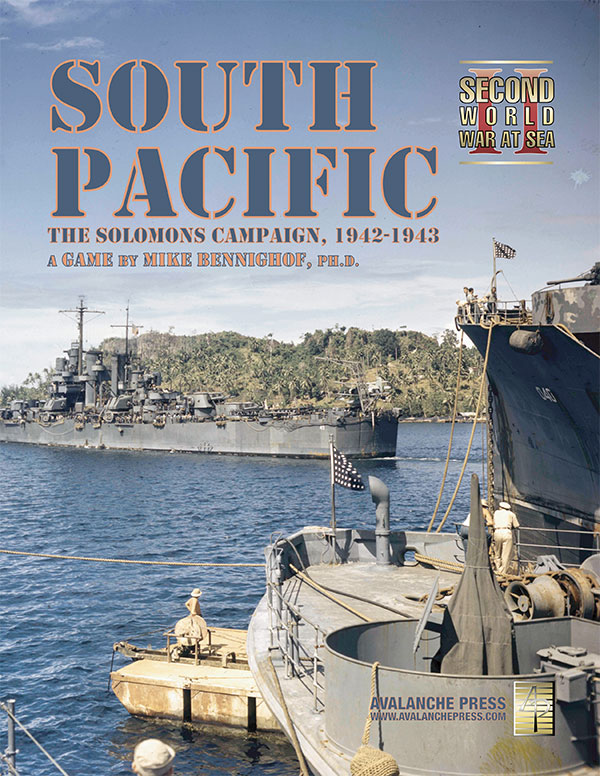 Following the destruction of both sides’ carrier strength at the Battle of the Santa Cruz Islands, through ships sunk or damaged, and aircraft destroyed, the next round of the naval struggle would fall to the surface ships. The Washington Naval Limitations Agreement had put strict limits on the number and size of battleships that each signatory could build, and though those limits had expired, the ships built afterwards had only just started to come into service. Following the destruction of both sides’ carrier strength at the Battle of the Santa Cruz Islands, through ships sunk or damaged, and aircraft destroyed, the next round of the naval struggle would fall to the surface ships. The Washington Naval Limitations Agreement had put strict limits on the number and size of battleships that each signatory could build, and though those limits had expired, the ships built afterwards had only just started to come into service.
The relatively scarcity of battleships made admirals of both sides loathe to risk them in combat. The Japanese leadership made excuses about them lacking the speed to escape the range of American air attacks by dawn after a nighttime bombardment of Henderson Field. The American counterparts cited the need to protect their carriers, or the shortage of tankers to keep them fueled. This was rationalization: the admirals did not want to risk the loss of a battleship in combat.
In place of the battleship, the heavy cruiser became by default the new capital ship. Limited by treaty to 10,000 tons’ displacement (not always honored) and 8-inch main guns, these would be the ships that fought the surface battles of the Solomons campaign. Until November 1942.
With Guadalcanal on the line, and with it the strategic initiative in the Pacific, both sides would finally lay down their most powerful cards. Or at least some of them.
In the days after the Japanese victory at the Battle of the Santa Cruz Islands, the Imperial Army’s chief of operations, Col. Takushiro Hattori, visited Guadalcanal and met with Army and Navy leaders at Rabaul and Truk. Hattori affirmed that the Army wished to make the South Seas a major front, and would provide the ground forces to do so, including the fresh 51st Infantry Division for Guadalcanal.
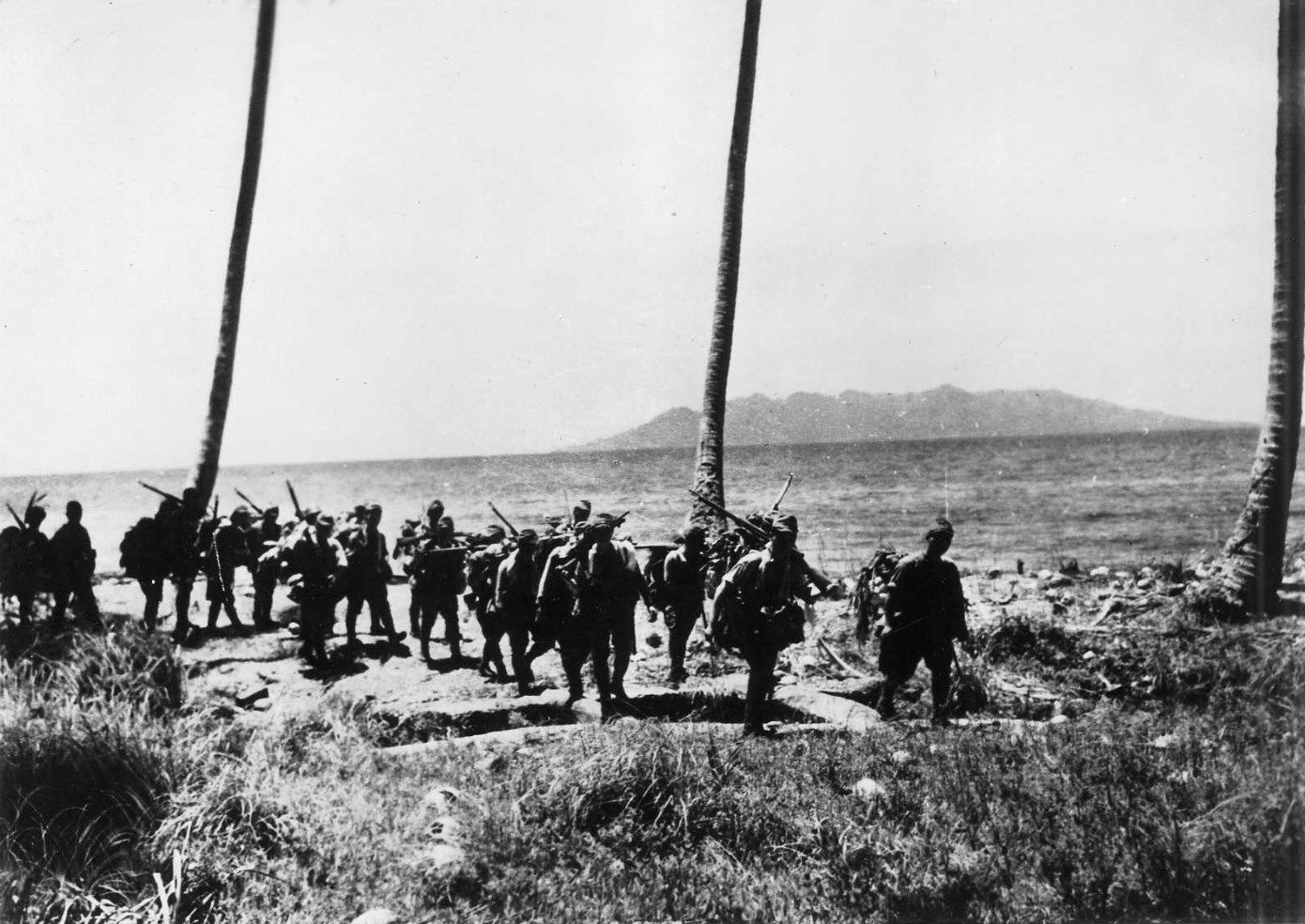
Japanese troops arrive on Guadalcanal. September 1942.
The Army would need several weeks to assemble the division, then located at Guangdong, China, and ship it to Rabaul. It would then need to be moved to Guadalcanal along with enough supplies to enable it to operate at full capacity, and its supporting arms including artillery. The situation on Guadalcanal, Hattori emphasized to his Army and Navy colleagues, had become unbelievably dire. The Army would provide fresh troops, but only if they and those already on Starvation Island were properly supplied and supported by the Navy. Hattori had initially thought that a new offensive could be opened in December, but upon seeing the conditions on Guadalcanal for himself, recommended a delay until January.
With the Army finally committing itself to the South Seas, the Navy leaders built their own planning around the soldiers’ needs. A thrust into the American rear areas to seek battle now made little sense; Guadalcanal had to be built up, and the American position there knocked down. That meant renewed supply convoys, still using destroyers and sometimes cruisers to carry men and materiel, and more bombardments of Henderson Field.
With a renewed carrier battle seeming unlikely, Combined Fleet commander Isoroku Yamamoto dispatched the carrier Zuikaku, undamaged at the Battle of the Santa Cruz Islands, back to Japan to train new aircrew while the three damaged flattops (Shokaku, Hiyo, and Zuiho) returned to the home islands for repairs. He retained one carrier, Junyo, with his fleet and sent the heavy cruisers Suzuya and Maya from the Combined Fleet at Truk to Gunichi Mikawa’s Eighth Fleet at the Shortlands anchorage in the upper Solomons, to replace the cruisers sunk or heavily damaged at the Battle of Cape Esperance in early October.
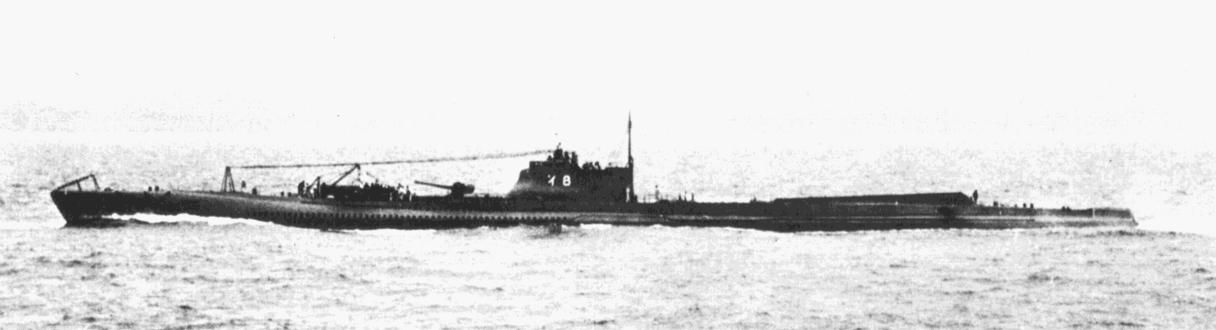
A seaplane from the Japanese submarine I-8 scouted Efate harbor in early November.
Combined Fleet now dispatched more radio specialists to Rabaul, to beef up their signals intelligence capability. Aircraft-carrying submarines reconnoitered the American bases at Nouméa, Efate, and Luganville (usually called “Espiritu Santo,” the name of the island on which is lay). The Japanese built up a fairly good picture of what they faced.
By the second week of November, the Japanese plan had come together. A convoy of 11 transports would carry the 38th Infantry Division’s artillery and heavy equipment, and those troops who had not yet made the voyage to Guadalcanal aboard cruisers and destroyers. They would also bear 30 days’ worth of food, ammunition, and medical supplies for both the new arrivals and those troops already on the island. Yamamoto chose 13 November as Z-Day, the date when the transports would arrive and disgorge their cargo.
On 10 November, Japanese land-based aircraft would begin a series of heavy attacks on Henderson Field and any American ships found nearby. On the following day, two Japanese fast battleships would bombard the Marine air base. And on the 12th, the carrier Junyo’s air group would conduct strikes against the airfield.
Notably, the plan left out the two powerful battleships also swinging on their anchor chains in Truk Lagoon. The new super-battleship Yamato, the only ship in the world armed with massive 18-inch guns, and the older Mutsu with her 16-inch guns, would not accompany the fleet. Their contribution would be limited to sharing their rice stores with the actual participants, which left the anchorage on 9 November.
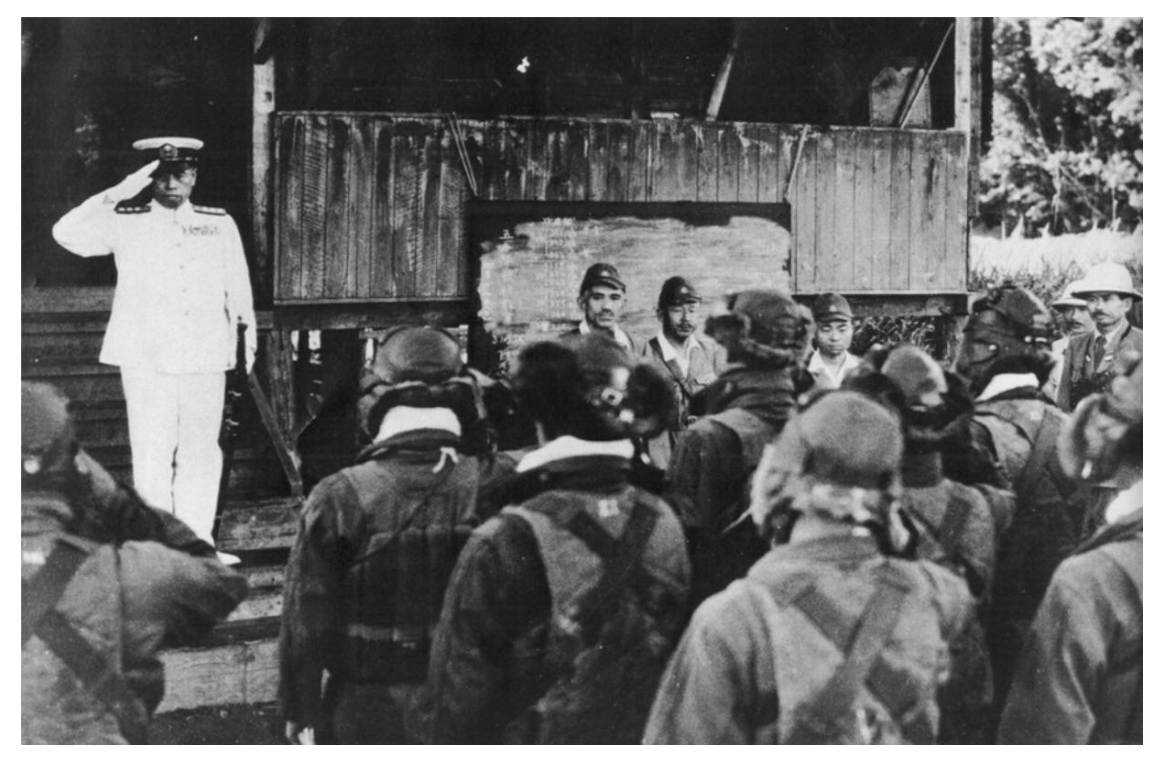
Admiral Isoroku Yamamoto salutes a group of Japanese naval pilots. April 1943.
The Americans also looked to reinforce Guadalcanal, as repair crews at Nouméa on New Caledonia worked frantically to restore Enterprise to at least some operability. Their own intelligence picked up the phrase “Z-Day,” and that it involved Guadalcanal. They identified Junyo as a participant, and that battleships would be involved. The Marines on Guadalcanal needed immediate reinforcement.
Theater commander William F. Halsey organized two convoys, one from Nouméa with the transports McCawley, Crescent City, President Adams and President Jackson. They carried the U.S. Army’s 182nd Infantry Regiment, Marine replacements, and Marine coast-defense artillery. To escort them, Rear Admiral Dan Callaghan, most recently chief of staff to Halsey’s predecessor, Robert Ghormley, had Task Group 67.4 with three heavy cruisers (San Francisco, Portland, and Pensacola), two light cruisers (Helena and the smaller anti-aircraft cruiser Juneau), and eight destroyers (Cushing, Laffey, Sterett, O’Bannon, Shaw, Gwin, Preston, and Buchanan).
The second convoy set out from Luganville on Espiritu Santo with the transports Zeilin, Libra, and Betelgeuse. They carried Marine ground crew and equipment for Henderson Field. Escorting them, Rear Admiral Norman Scott’s Task Group 62.5 had the light anti-aircraft cruiser Atlanta and destroyers Aaron Ward, Fletcher, McCalla, and Lardner.
The convoys both arrived off Lunga Point on the morning of 11 November. Halsey ordered the empty transports to sail back the next day, and re-ordered the surface ships. Portland, Shaw, Gwin, and Preston would escort the transports away and then join Task Force 16, Enterprise and her escorts. Scott’s small task group would take their place, with Callaghan in command of what was now termed Task Force 67. That night, Callaghan swept the western end of Ironbottom Sound, seeking any approaching Japanese, but none appeared.
Order South Pacific Here.
Ironbottom Sound is a scenario book that expands Second World War at Sea: South Pacific. It comes with 36 new scenarios for South Pacific, extending the story through August 1943 and the campaign for New Georgia. All of the maps and pieces needed are included in South Pacific; the companion history book, Solomons Naval Campaign, comes bundled with Ironbottom Sound.
Order Ironbottom Sound Here.
Includes Solomons Naval Campaign book.
Order Solomons Naval Campaign Here.
Companion piece to Ironbottom Sound, or just read it separately.
Sign up for our newsletter right here. Your info will never be sold or transferred; we'll just use it to update you on new games and new offers.
Mike Bennighof is president of Avalanche Press and holds a doctorate in history from Emory University. A Fulbright Scholar and NASA Journalist in Space finalist, he has published a great many books, games and articles on historical subjects; people are saying that some of them are actually good.
He lives in Birmingham, Alabama with his wife, three children, and new puppy. He misses his lizard-hunting Iron Dog, Leopold.
Daily Content includes no AI-generated content or third-party ads. We work hard to keep it that way, and that’s a lot of work. You can help us keep things that way with your gift through this link right here.
|