Far Side of the World:
French Armored Cruisers, Part One
by Mike Bennighof, Ph.D.
June 2026
 Great War at Sea: Far Side of the World tackles the world-wide aspect of the First World War, during the conflict’s first five months (August through December 1914). You get to play with ships from all of the fleets that participated (Germany, Britain, France, Russia, Japan) and a few that did not, but might have. Great War at Sea: Far Side of the World tackles the world-wide aspect of the First World War, during the conflict’s first five months (August through December 1914). You get to play with ships from all of the fleets that participated (Germany, Britain, France, Russia, Japan) and a few that did not, but might have.
France possessed a world-wide network of naval bases, and a fleet of long-range armored cruisers. They had not been built to hunt the Germans, but rather to conduct commerce raiding against the British.
Following the disastrous Franco-Prussian War, the nearly-untouched French fleet continued its cold-war rivalry with Britain and, by the 1880’s, with Italy as well. In the 1880’s the Young School, or Jeune École, arose centered on the writings of Admiral Théophile Aube and his son-in-law, naval journalist Gabriel Charmes. Technological advances, chiefly the appearance of the self-propelled torpedo, had completely changed the future of war at sea. The strategy called for a combination of swarms of torpedo boats for home defense and fast cruisers for commerce raiding. Aube wanted to retain the battleship, but his more radical adherents did not.
In 1896, Admiral François-Ernest Fournier wrote La flotte nécessaire, refining the commerce-raiding strategy. Britain depended on overseas trade, and cutting off the sea routes to British ports would collapse her economy. On this, the adherents of the big gun and the torpedo agreed.
Drawing on the results of the 1894 Battle of the Yalu between the Japanese and Chinese fleets (the first fleet action since the 1866 Battle of Lissa), Fournier like other observers pointed to the value of the middle-caliber quick-firing gun. While larger guns could penetrate armor, the ability to fire more shells more quickly and devastate the unarmored areas of an enemy ship would be more valuable in combat.
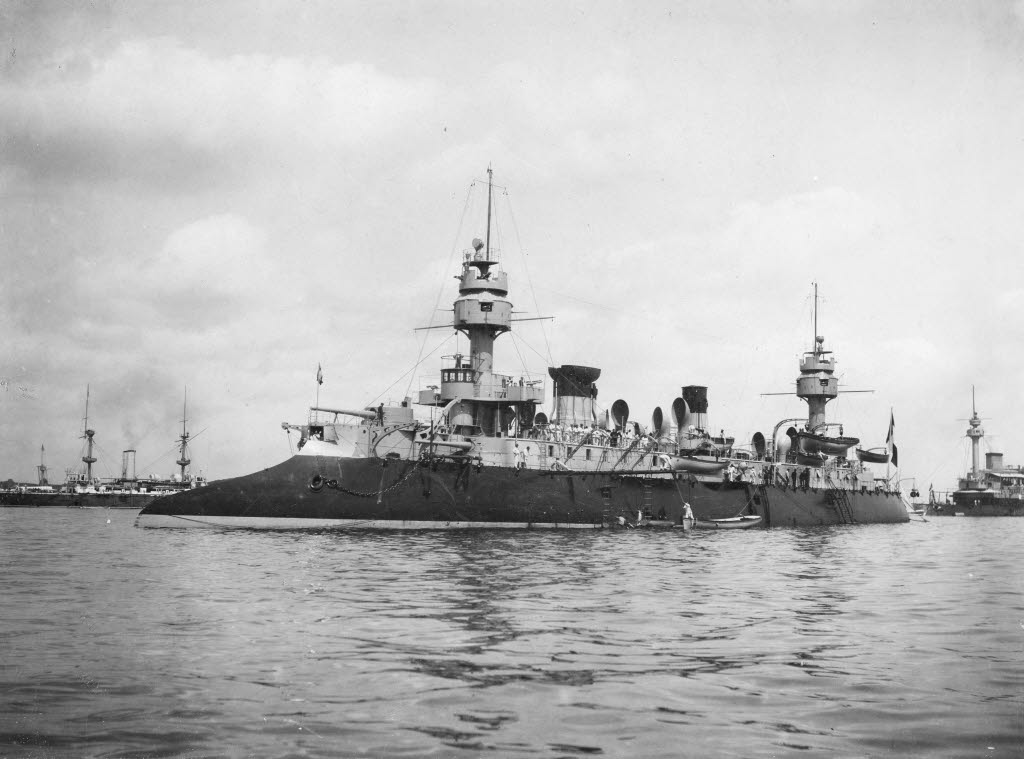
Dupuy de Lôme, seen in 1895.
Fournier pressed for the French Navy to build more armored cruisers. Fast ships, well-protected against their own type, armed with quick-firing, medium-caliber guns and able to fulfill any mission: Bon à tout faire (“good at everything,” that is, a jack of all trades). France had laid down the world’s first armored cruiser, Dupuy de Lôme, in 1888 and finally completed her in 1895. Fournier argued that ships like her could both fight in the battle line, scout for the enemy fleet, and raid enemy commerce.
Dupuy de Lôme turned out to be a dismal failure as a warship. Her boilers never operated properly, forcing the manufacturer to replace them during construction. Just six years after commissioning, she returned to the yard for a four-year spell while she received another set of new boilers. The hardened steel of her armor plates turned out not to have been properly hardened. She never came close to her designed speed, she rusted quickly, and her water distribution system was also defective. She spent less than a year in commission after the second boiler replacements, was sold to Peru at an inflated price and rejected, and ended up as a collier. On her first voyage, her load of coal caught fire.
When Fournier published his book, these problems had not become evident. And the French Navy had already committed to its next class of armored cruisers.
Amiral Charner Class

Dupuy de Lôme had been an expensive ship even before her repeated overhauls and reconstructions. The next class would be smaller and cheaper, maximized for the commerce-raiding role rather than aimed at service as a multi-role platform. At 4,681 tons’ displacement, they came in at a little more than two-thirds that of Dupuy de Lôme.
Thanks to the expected lower cost, the French Navy ordered four ships at 7 million francs apiece. Cost overruns and delayed construction times brought that figure up to 9.7 million. The Amiral Charner class would carry two 194mm (7.6-inch) guns in single turrets fore and aft, and six 138mm (5.4-inch) guns in single turrets, three along each broadside. An array of light guns to repel torpedo attack, and four torpedo tubes, completed the armament.
To save on costs, three of the four ships had older, horizontal expansion engines, rather than the then-new vertical type which put out more power but took up more space. None of the four sisters made her designed speed of 19 knots. Their armor, perfectly adequate by the standards of 1889 when design work began, could not hope to stand up to the modern weapons of 1914 – a belt of 60mm to 90mm, deck armor of up to 50mm, and up to 92mm on the main gun turrets. The nickel-steel armor used in these ships would quickly be supplanted by Harvey nickel steel within just a few years, and then by Krupp cemented armor not long after that. They did have substantial internal sub-division, and backed their armored belt with void spaces to limit torpedo or mine damage.
Three of the four ships commissioned in 1895; Bruix, with her different engines and engine spaces, took a year and a half longer and joined the fleet in December 1896. One of them, Chanzy, hit a shoal off the Chiense coast in 1907 and became a total loss. All three surviving ships mobilized in July 1914 and set out to defend French commerce, later shifting to secondary duties. The ships had little combat value in 1914, and fortunately never met enemy warships in battle. A German submarine sank Amiral Charner in February 1916, with the loss of all but one of her crew. Bruix and Latouche-Tréville survived the war, served in the French intervention against the Russian Bolsheviks, then rusted for a few years before going to the scrapyards in the 1920’s.
Pothuau
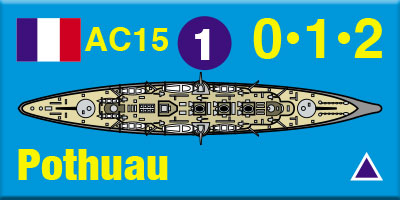
Before any of the preceding arrmored cruisers had been completed, the French Navy ordered one more, enlarging on the Amiral Charner design to add more guns and adopt several new features. Pothuau, laid down in 1893, displaced 5,460 tons and came in slightly longer and wider than Amiral Charner. Like the previous class, she carried single 194mm guns in turrets fore and after. She increased the secondary battery to ten 138mm guns, this time with eight of them in casemates (four on each broadside) and two in sponsons on either side amidships. And then the usual lightweight guns to fend off torpedo boats, and four torpedo tubes.
She actually slightly exceeded for design speed of 19 knots, and had such good seakeeping qualities that French President Félix Faure used her to steam to St. Petersburg for a state visit soon after her 1897 commissioning. After fleet service, she became a gunnery training ship in 1906 and remained in that role until mobilization in July 1914. She served in the Atlantic, briefly, the Mediterranean, and finally in the Red Sea and Pacific. After the war she lost her main armament, replaced by 75mm anti-aircraft guns, and resumed the role of gunnery training ship until her scrapping in 1929.
Pothuau was no better a fighting ship than Amiral Charner, but did mark an incremental improvement. Fortunately for her 459 crewmen, she did not encounter Graf Spee’s cruisers.
Order Far Side of the World Here.
Sign up for our newsletter right here. Your info will never be sold or transferred; we'll just use it to update you on new games and new offers.
Mike Bennighof is president of Avalanche Press and holds a doctorate in history from Emory University. A Fulbright Scholar and NASA Journalist in Space finalist, he has published a great many books, games and articles on historical subjects; people are saying that some of them are actually good.
He lives in Birmingham, Alabama with his wife and three children.
Daily Content includes no AI-generated content or third-party ads. We work hard to keep it that way, and that’s a lot of work. You can help us keep things that way with your gift through this link right here.
|