Ironbottom Sound:
Scenarios & History, Part One
by Mike Bennighof, Ph.D.
June 2025
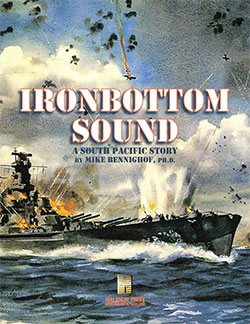 Ironbottom Sound is a scenario book that expands Second World War at Sea: South Pacific. It comes with 36 new scenarios for South Pacific, extending the story through August 1943 and the campaign for New Georgia. All of the maps and pieces needed are included in South Pacific; the companion history book, Solomons Naval Campaign, comes bundled with Ironbottom Sound. Ironbottom Sound is a scenario book that expands Second World War at Sea: South Pacific. It comes with 36 new scenarios for South Pacific, extending the story through August 1943 and the campaign for New Georgia. All of the maps and pieces needed are included in South Pacific; the companion history book, Solomons Naval Campaign, comes bundled with Ironbottom Sound.
The American invasion of Guadalcanal struck at a key moment, seizing the airfield at Lunga Point before the Japanese could bring it into operation. That justified Chief of Naval Operations Ernest J. King’s drive to launch the offensive as quickly as possible, rather than waiting to assemble more forces and improve supply lines as Pacific commander Chester Nimitz had wished.
Most secondary histories praise this initiative, and correctly identify possession of the Lunga Point airfield (what would soon become Henderson Field) as a crucial turning point in the Pacific War. What they rarely delve into, though, is what would have happened had the Japanese either completed the airfield sooner, or had the Americans waited longer to seize it.
The Japanese had very definite plans for what they would do next. Despite the loss of four heavy carriers at Midway, they would extend their conquests to the south and south-east. The Americans, outside of King, don’t seem to have had the necessary sense of urgency, with a definite undertone that the war had been won at Midway.
Chapter Zero of Ironbottom Sound is focused on operations that didn’t happen. The scenarios are based on actual plans by both sides, and they focus on the Lunga Point airfield, except now it’s in Japanese rather than American hands.

Lunga Point Airfield, July 1942. Still under Japanese construction.
We start off with the American invasion as it occurred, with one small wrinkle: instead of an incomplete airstrip, the Lunga Point airfield is an operational base well-stocked with long-range bombers, dive-bombers, and fighters. Instead of invading the island, the Americans have come to attack that base, and the Japanese convoy bearing troops and equipment for the island garrison. They don’t have to protect their own transports, since they’re not invading, and they do have a lot of firepower. But so do the Japanese, if their Third Fleet and the two remaining heavy carriers (Zuikaku and Shokaku) intervene.
Lunga Point in Japanese hands completely changes the situation. While they can operate attack planes from there, the real difference comes in terms of long-range reconnaissance. Those twin-engine bombers at Lunga and flying boats at Tulagi can cover a lot of ocean.
In tactical terms, with the Americans on the attack, they’re the ones trying to penetrate Ironbottom Sound at night. First, they come with cruisers, and then with their older battleships (because I wanted every possible excuse to use the old battleships on the Ironbottom Sound tactical map).
But the Japanese built the Lunga Point airfield with an offensive in mind, and even after the Midway debacle, the Naval General Staff insisted that Operation FS, the planned capture of Fiji and Samoa, could still be carried out with land-based planes taking the place of the lost heavy carrier air groups. This sort of insane magical thinking (it can’t really be called anything else) dominated Japanese planning until the very end of the war. So with two carriers plus some extra bomber squadrons, they continued planning to seize the New Hebrides and New Caledonia as the first step toward taking Fiji and Samoa (and severing communications between the United States and Australia). At worst, the loss of the carriers at Midway would set back the plan by two months.
And you get to play this out. The Naval General Staff is not completely wrong; the planes based at Lunga Point are very helpful, and it’s been enlarged to service a great many of them. But “a great many” has very different meanings in Japanese and in American English. The airfields on New Caledonia and the New Hebrides have plenty of fighters of their own to fend off attackers, and bombers to strike back (though many of these are heavy bombers of limited utility against ships).
And they have a fleet. The Americans have three heavy carriers and the Japanese but two (though at least the latter finally have full flight decks, which is not the case in most of the historical scenarios). The Japanese also have a light carrier, and following the new Japanese carrier doctrine enacted after Midway (and then ignored in practice), she’s stuffed with fighters to provide better air defense for the big flattops. They get to fight an airstrike battle, and then the cruiser-destroyer forces that clashed in the historical Battle of Savo Island meet in the open sea (and this time, the Americans and Australians know what’s coming).
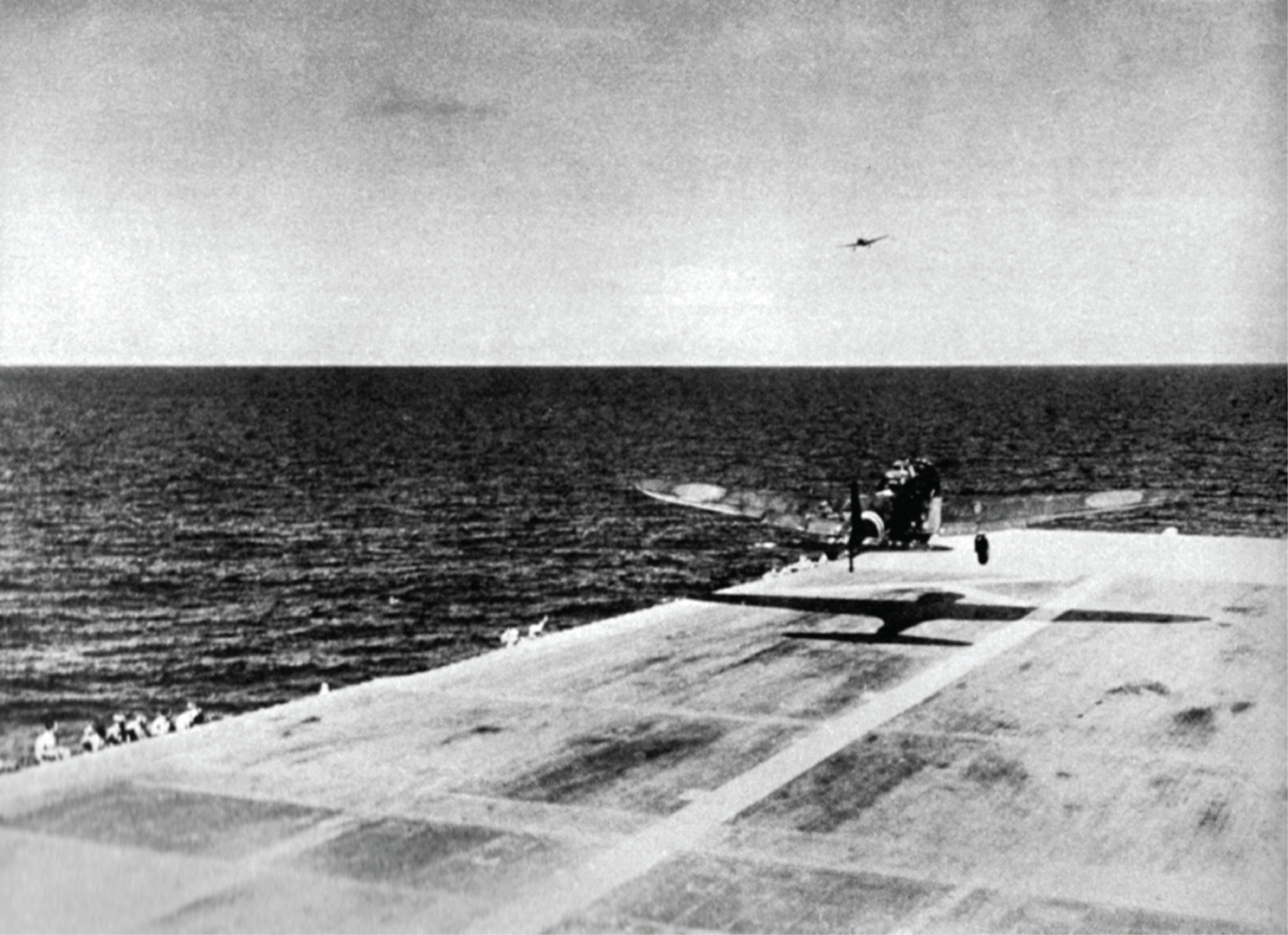
A B5N2 torpedo plane takes off from carrier Zuikaku. Japanese
aircraft carriers did not use catapults to launch their aircraft.
The plan wouldn’t be complete without an invasion of the New Hebrides, and that’s how the chapter wraps up. To even make this possible, we have to assume that the Japanese could inflict a lot more damage in their preparatory efforts than seems feasible, and that the Americans and Australians would have a harder time replacing their front-line losses than was actually the case.
What this does give, however, is the opportunity to use the Japanese fleet and its remaining carriers on the offensive. They’ve added two more “heavy” carriers to their strike force (converted liners initially called light carriers, but promoted to a front-line role after Midway. The Japanese carrier pilots are still elite, and they still operate very fine aircraft. They’ve made some needed adjustments to their doctrine.
But the plan is, as multiple Japanese naval staffers declared at the time, utterly insane. Even if the Japanese manage to take their objectives, they would have had to hold onto them. It would finally be cancelled (at the same time that the effort to capture Midway was formally cancelled), not because it was a stupid idea, but on the basis of aircraft production not having met its targets. In essence, the Naval General Staff blamed the factory workers for their own failings.
While these operations did not actually take place, I thought them important to include. We’re using a wargame to illustrate history, and the repeated Japanese efforts to re-capture Guadalcanal make much more sense when viewed through this lens. The island and its airfield weren’t just a vital part of the Japanese defensive perimeter; they were crucial to the offensive operations that would resume just as soon as enough replacement planes and pilots showed up. This is emblematic of the Japanese bent toward magical thinking when they needed hard-headed practicality.
Order Ironbottom Sound Here.
Includes Solomons Naval Campaign book.
Order Solomons Naval Campaign Here.
Companion piece to Ironbottom Sound, or just read it separately.
Order South Pacific Here.
Sign up for our newsletter right here. Your info will never be sold or transferred; we'll just use it to update you on new games and new offers.
Mike Bennighof is president of Avalanche Press and holds a doctorate in history from Emory University. A Fulbright Scholar and NASA Journalist in Space finalist, he has published a great many books, games and articles on historical subjects; people are saying that some of them are actually good.
He lives in Birmingham, Alabama with his wife and three children. He misses his lizard-hunting Iron Dog, Leopold.
Daily Content includes no AI-generated content or third-party ads. We work hard to keep it that way, and that’s a lot of work. You can help us keep things that way with your gift through this link right here.
|