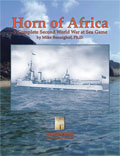
Caspian Princes:
Publisher’s Preview
by Mike Bennighof, Ph.D.
July 2025
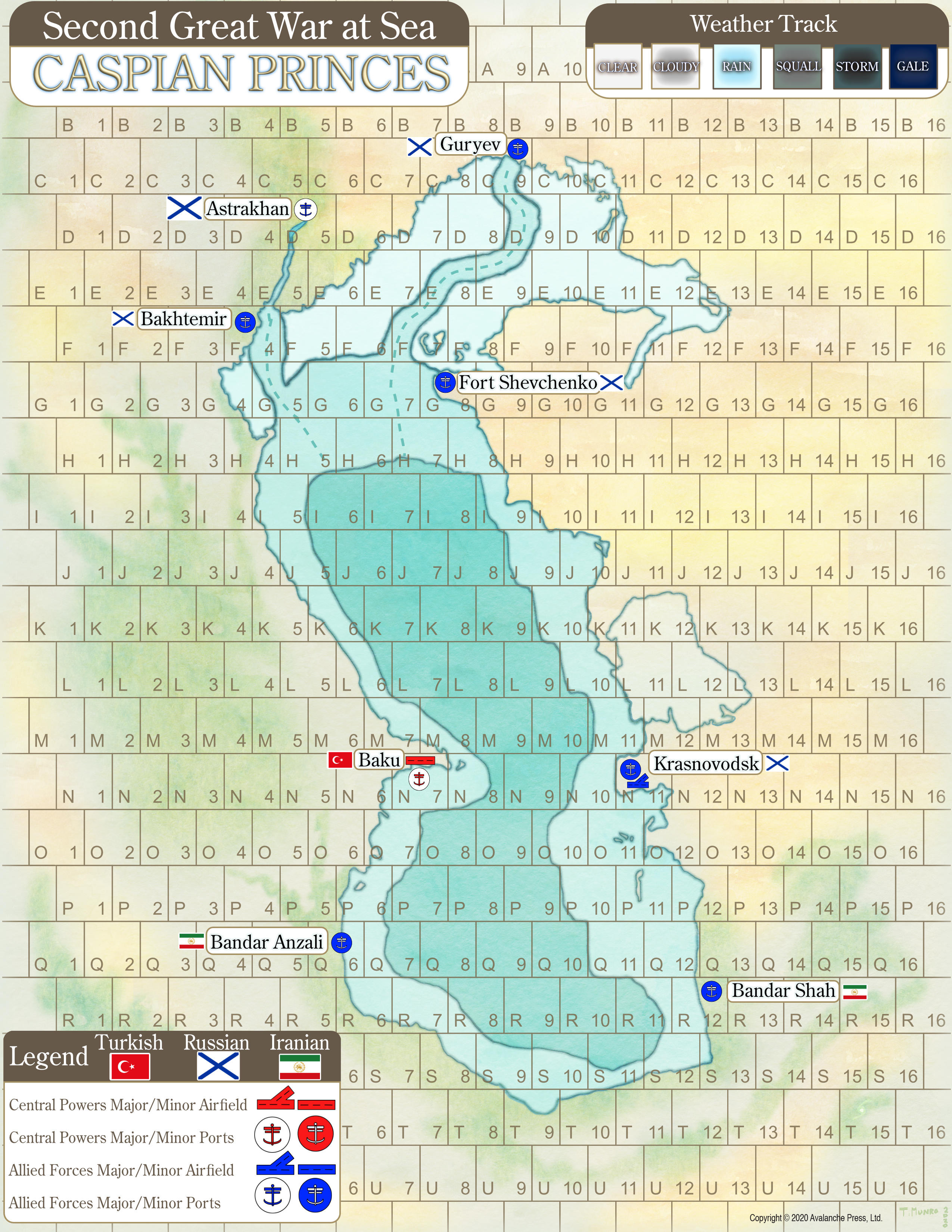
 Our smallest Second Great War at Sea game – our smallest game of any sort – takes place on the land-locked waters of the Caspian Sea. There, Turkish and Russian inland flotillas battle for control of the sea lanes (lake lanes?) and the rich oil fields of Baku. Our smallest Second Great War at Sea game – our smallest game of any sort – takes place on the land-locked waters of the Caspian Sea. There, Turkish and Russian inland flotillas battle for control of the sea lanes (lake lanes?) and the rich oil fields of Baku.
It should be obvious that such a campaign never actually happened. But the Caspian Sea fits quite nicely on an 8x10-inch map, and that makes it perfect for our Golden Journal, the little rag we publish whenever we feel like it. Caspian Princes is a complete game, with a real full-color map and real silky-smooth and die-cut pieces included inside Golden Journal No. 30.
Caspian Princes uses the same standard rulebook, tactical map, charts and play aids as the rest of the Second World War at Sea series. All of those come in a download for Caspian Princes,.
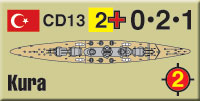
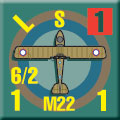
 Caspian Princes comes with ten “long” double-sized ship pieces and twenty normal-sized square ones. That provides just enough cardboard for two fleets, some markers and some transport pieces that both sides use, depending on the scenario. Caspian Princes comes with ten “long” double-sized ship pieces and twenty normal-sized square ones. That provides just enough cardboard for two fleets, some markers and some transport pieces that both sides use, depending on the scenario.
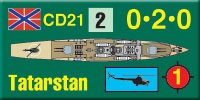
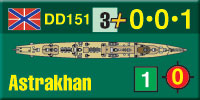
The Imperial Russian Caspian Flotilla is based at Astrakhan at the northern end of the sea. There’s a small coast-defense ship and four destroyers, plus a minelayer and minesweepers. The Russians also have an air arm with two squadrons of seaplanes.
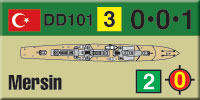
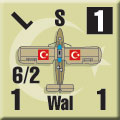
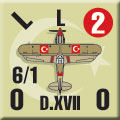
Facing them is the Turkish Caspian Fleet, based at Baku in Azerbaijan, annexed by the Ottoman Empire in 1917 following a post-war plebiscite. While the Russians could build their ships at their Black Sea shipyards and bring them to Astrakhan by way of rivers and canals, the Turkish ships were pre-fabricated elsewhere, transported at great difficulty by road and rail, and then assembled at Baku. The Turks have two coast-defense ships and three small destroyers, plus a pair of minelayers. They also have an air force, with one squadron of seaplanes and another of fighter planes.
 Russia is allied to Iran, which holds the southern coast of the Caspian Sea. I couldn’t fit an Iranian fleet onto the sheet of pieces, though I desperately wanted them in there. I’ll have to find some means to sneak them into a future Journal or something because they’re purple and that’s just cool. Russia is allied to Iran, which holds the southern coast of the Caspian Sea. I couldn’t fit an Iranian fleet onto the sheet of pieces, though I desperately wanted them in there. I’ll have to find some means to sneak them into a future Journal or something because they’re purple and that’s just cool.
The two fleets’ objectives are intertwined. The Russians wish to maintain communications with the Iranians, shipping them weapons, food and other supplies down the length of the Caspian. The Turks, battling the Iranians all along the frontier from the Persian Gulf to the Caspian Sea, are of course eager to interrupt this trade.
 Meanwhile the Turks have to defend the vulnerable oil fields of Baku, which extend down not only to the shoreline but beyond with some of the oil industry’s first offshore platforms. The Russians wish to destroy these and hamper the Central Powers’ oil supply, as Turkish oil drives not only the Ottoman war machine but those of Germany and Austria as well. Meanwhile the Turks have to defend the vulnerable oil fields of Baku, which extend down not only to the shoreline but beyond with some of the oil industry’s first offshore platforms. The Russians wish to destroy these and hamper the Central Powers’ oil supply, as Turkish oil drives not only the Ottoman war machine but those of Germany and Austria as well.
The Turks are also trying to infiltrate weapons and cadres across the Caspian to foment insurrection among the Kazakhs and other Turkic peoples of Russian-ruled Central Asia. The Caspian represents the border between Europe and Asia, but the Ottomans hope to make it a highway instead.
 With all of 30 pieces to work with, there’s a pretty strict limit on just how intensive this campaign can get. It’s centered on surface action, just because there aren’t many airplanes in the mix (and those that are present can’t do much damage to the ships) and surface combat is the part of the Second World War at Sea game system that I wanted to highlight. With all of 30 pieces to work with, there’s a pretty strict limit on just how intensive this campaign can get. It’s centered on surface action, just because there aren’t many airplanes in the mix (and those that are present can’t do much damage to the ships) and surface combat is the part of the Second World War at Sea game system that I wanted to highlight.
While the Caspian Sea is an odd topic for a naval wargame, it had some attractions to me. For one, it fits entirely on the map size I wanted to use: 8x10, so it fits within the book without folding and cheap to print, a valuable commodity these days. A large majority of Second World War at Sea games have the “edge of the world” effect (a few don’t, like Sea of Iron or Black Sea) and I very much like having a defined play area from a game design perspective. What you see is the entire battlefield, and you can’t leave it because then your ships run ground, not because of an arbitrary game rule.
 Since no naval combat took place on the Caspian Sea during the Second World War (there were some operations there during the Russian Civil War), by definition the game would have to be alternative-history. And I needed to make up the story anyway, so it would both fit the small format and produce the sort of action I wanted to show off the game system. Since no naval combat took place on the Caspian Sea during the Second World War (there were some operations there during the Russian Civil War), by definition the game would have to be alternative-history. And I needed to make up the story anyway, so it would both fit the small format and produce the sort of action I wanted to show off the game system.
That gave me an excuse to both introduce new players to the Second Great War alternative history, and expand the story a little bit. I had already written about the Russian-Turkish-Iranian dynamic in The Second Great War background book, and considered designing an extension for Defiant Russia to cover the action at an operational scale. That concept I rightly rejected as a pretty foolish expenditure of resources, but the seed of the story had been left behind in my brain.
 The scenarios unfold in a the story-telling format we’ve been using for a while now, with operational scenarios pushing the story line forward and battle scenarios expanding on the story. They’re also crafted to be fairly easy to play, without the unusual scenarios lathered in special rules we sometimes like to include in the books and boxed games because they’re fun for long-time players. Caspian Princes is intended for a more casual audience, so I wanted it to play fairly simply and give a taste of how the game unfolds in play while still giving enough of the story to make it worthwhile for experienced players. The scenarios unfold in a the story-telling format we’ve been using for a while now, with operational scenarios pushing the story line forward and battle scenarios expanding on the story. They’re also crafted to be fairly easy to play, without the unusual scenarios lathered in special rules we sometimes like to include in the books and boxed games because they’re fun for long-time players. Caspian Princes is intended for a more casual audience, so I wanted it to play fairly simply and give a taste of how the game unfolds in play while still giving enough of the story to make it worthwhile for experienced players.
 I wasn’t sure that a complete Second World War at Sea game could be jammed into such a small package; of all our game series it struck me as the most difficult to hone into a good, tiny game. I’d tried once before with the game that became Horn of Africa and it wasn’t even close. For what it is, I’m quite pleased with the little package. There’s a lot of fun stuffed in there. I wasn’t sure that a complete Second World War at Sea game could be jammed into such a small package; of all our game series it struck me as the most difficult to hone into a good, tiny game. I’d tried once before with the game that became Horn of Africa and it wasn’t even close. For what it is, I’m quite pleased with the little package. There’s a lot of fun stuffed in there.
 Order Caspian Princes Here. Order Caspian Princes Here.
Gold Club members can use their max discount.
Click Here to Join the Gold Club.
Add More Fun!
The Second Great War
A sourcebook for the Second Great War alternative history setting, laying out the background of the participants, their armed forces and the course of this war that never happened.
Fleets of the Second Great War: La Royale
A source book all about the real French Navy, and the French Navy of the Second Great War, too. Each class has its own description both in narrative and tabular form and schematics. $30.99
You can order La Royale right here.
Fleets of the Second Great War: Imperial Russia
A source book detailing the Imperial Russian ships of the Second Great War. All of them are covered: those present in The Cruel Sea, Sword of the Sea, Tre Kronor and more. Each class has its own description both in narrative and tabular form and schematics. $30.99
You can order Imperial Russia right here.
Sign up for our newsletter right here. Your info will never be sold or transferred; we'll just use it to update you on new games and new offers.
Mike Bennighof is president of Avalanche Press and holds a doctorate in history from Emory University. A Fulbright Scholar and NASA Journalist in Space finalist, he has published a great many books, games and articles on historical subjects; people are saying that some of them are actually good.
He lives in Birmingham, Alabama with his wife and three children.
Daily Content includes no AI-generated content or third-party ads. We work hard to keep it that way, and that’s a lot of work. You can help us keep things that way with your gift through this link right here.
|