North Sea 1914:
Design Notes
by Mike Bennighof, Ph.D.
April 2026
 It’s long been a mantra among role-playing game designers and publishers, that the story is the key. For a while now, I’ve been obsessed with applying this concept to wargames as well, to use them as a means to show the history, not just tell it. It’s long been a mantra among role-playing game designers and publishers, that the story is the key. For a while now, I’ve been obsessed with applying this concept to wargames as well, to use them as a means to show the history, not just tell it.
Applying that concept to the second edition of Great War at Sea: Jutland (and its upcoming replacement, Jutland 1916) resulted in a game tightly focused on the Battle of Jutland. Since Jutland is a rather complicated battle, the historical background and scenarios based just on the battle, alternative plans laid by both sides, and the aftermath filled up the scenario book. Yet the North Sea saw plenty of action between 1914 and 1918 that was not part of the Battle of Jutland.
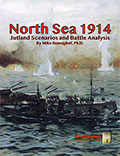
North Sea 1914 gives that same intense look to operations on the North Sea between the German High Seas Fleet and the British Grand Fleet (and sometimes Channel Fleet) during the first months of the First World War. It adds 43 scenarios: 16 operational scenarios, and 27 battle scenarios. Each of them also features historical analysis: what was each side after, and did they achieve their goals – why or why not? This story-arc model, as I call it, weaves together background, game scenarios and analysis, with the scenarios carrying a lot of the story-telling weight. It’s not for everyone, but the readers/players who like it seem to like it very much. And I find it much more satisfying to write.
World War One on the North Sea saw both fleets in a constant state of deployment and readiness. Most popular histories don’t have much to say about this aspect, implying (or sometimes outright stating) that the battleships swung at anchor for four and a half years, except for that one 48-hour period when they fought the Battle of Jutland. These writers will sometimes note the massive amount of maintenance the fleets needed (multiple important battleships and battle cruisers missed the Battle of Jutland); what they don’t say much about is just how the ships (and men, too) became so worn down.
And that’s because the ships were at sea, about as often as their fairly primitive machinery could stand. These were vessels that depended on human muscle power, in the form of stokers, trimmers and rakers, to handle their coal as an integral part of their power plants. Both man and machine broke down under heavy use. And the admirals pushed both of them to and beyond their breaking points.

Orion class dreadnoughts at sea.
When the fleets went to sea, they rarely encountered one another. The German High Seas Fleet, badly outnumbered, would only accept battle under very favorable conditions: their whole fleet against just part of the British lineup. Neither side had particularly good means of gather information on enemy fleet movements, with no satellites or long-range aircraft. Even when the technology existed, in the form of zeppelins and submarines and radio intercepts, information processing had not reached a stage where it could turn a series of disjointed reports into actionable intelligence that could be presented to a fleet commander.
But the fact that a fleet went to sea, looking for trouble, said to me that the game should include that operation, since it was usually no less likely to result in battle than the operations that really did lead to an exchange of gunfire and torpedoes.
North Sea 1914 covers the early days of the Great War, when the North Sea fleets were very active: the British Grand Fleet in conducting actual operations, the German High Seas Fleet mostly in planning them. Both sides deployed their obsolete pre-dreadnought battleships in the battle fleet, making the potential actions in the first weeks of war very different from the Battle of Jutland (and therefore something I wanted to show in the book scenarios). And the odds of such an action occurring were very good: the idea that the battleships remained hidden away from harm is simply false. The British definitely wanted to fight, and the Germans were willing to accommodate them: if, and only if, if they could do so on favorable terms.
Complicating the High Seas Fleet’s desire to fight the British was Kaiser Wilhelm II, using his position as Supreme Warlord to put restrictions on the use of German warships. These began as a stricture on deploying anything other than torpedo boats, submarines or minelayers outside of German waters, and eventually relaxed enough to allow the battle cruisers (and the fast armored cruiser Blücher) to operate farther afield. That forced the Germans to plan operations that might lure the enemy close enough to the German naval bases for the battle fleet to sortie and attack them without breaking the Kaiser’s rules any more than they already were by moving the battleships outside the harbors to be ready to respond.
For their part, the British conducted “sweeps” of the North Sea, seeking the German fleet, individual German warships, German merchant ships and most especially outbound German commerce raiders. The fleet moved out of its wartime base at Scapa Flow and proceeded southward behind a screen of cruiser squadrons before turning back northward for home. The Germans had some awareness of this, but their submarines proved far less adept at scouting than had been assumed before the war.

Taking off the crew of the
stricken light cruiser Mainz.
All of that activity adds up to a lot of potential scenarios, based on actual operations and plans. The first three and a half weeks of war, leading up to the First Battle of Helgoland Bight, generate nineteen scenarios: seven operational ones, and twelve battle scenarios. Helgoland Bight itself, and the aftermath (as both sides conducted new operations in response) generates four operational and eight battle scenarios, including a look at Alfred von Tirpitz’s desired reaction to the raid.
Helgoland Bight is also the subject for a new kind of operational scenario, a type introduced in Second World War at Sea games and also found in Great War at Sea’s Russo-Japanese War and Jutland Second Edition. Since we started making naval games, I’ve written the operational scenarios to cover the action in question from start to finish. There are good reasons for that, both in terms of fun play and historical insight. But that’s not the only way to do things, so we have some operational scenarios that start up with the action already underway. In this case, there’s a Helgoland Bight scenario that picks up the story after the Brits have ravaged the German cruiser force in the Bight and the High Seas Fleet is now in hot pursuit as Navy Secretary Alfred von Tirpitz thought they should have been.
Things slowed down after Helgoland Bight, as the Kaiser tightened his control of the High Seas Fleet, treating its dreadnoughts like a set of precious bathtub toys. Even if the British appeared right off the German coast, as they did two weeks after the battle, the fleet command had to telegraph the Supreme War Lord in Berlin for his expressed permission before setting out to fight them. The Germans instead had to rely on submarines (Wilhelm apparently did not care if they were sunk) and did so with some success.
Those successes in turn frightened Sir John Jellicoe, who moved the Grand Fleet out of Scapa Flow to Northern Ireland, far from where it could influence events in the North Sea. He still led it into hostile waters, believing the greatest danger lay in submarine penetration of Scapa Flow. The British continued to react to poorly-sourced reports, like one claiming that German cruisers had slipped through the Kiel Canal into the Baltic and thence through the Skagerrak into the North Sea. So, we let Sir John play out his fears, and send out the Germans on an operation they never undertook but the British believed they had.
North Sea 1914 (and the similar books like Dogger Bank 1915 follow) gives me, the designer, the opportunity to include all the scenarios I wish, to fully tell the story and explore the ramifications of certain inflection points, without worrying about overloading the game with too many scenarios (yes, there is such a thing) and too much history and analysis (that’s also possible). That’s a license to overload the book with those things; and that’s exactly what I did.
Order North Sea 1914 Here.
North Sea 1914 is also available as a digital download. This is not a physical product (you’ll get a .pdf microseconds after completing your order):
Download Jutland: North Sea 1914 Here.
It’s $25.99, but if you’re a Gold Club member, you can download for $17.49 using your private Gold Club link (That’s the only way to claim your Gold Club discount).
Sign up for our newsletter right here. Your info will never be sold or transferred; we'll just use it to update you on new games and new offers.
Mike Bennighof is president of Avalanche Press and holds a doctorate in history from Emory University. A Fulbright Scholar and NASA Journalist in Space finalist, he has published a great many books, games and articles on historical subjects; people are saying that some of them are actually good.
He lives in Birmingham, Alabama with his wife and three children.
Daily Content includes no AI-generated content or third-party ads. We work hard to keep it that way, and that’s a lot of work. You can help us keep things that way with your gift through this link right here.
|