War Plan Gold:
Publisher’s Preview
by Mike Bennighof, Ph.D.
March 2026
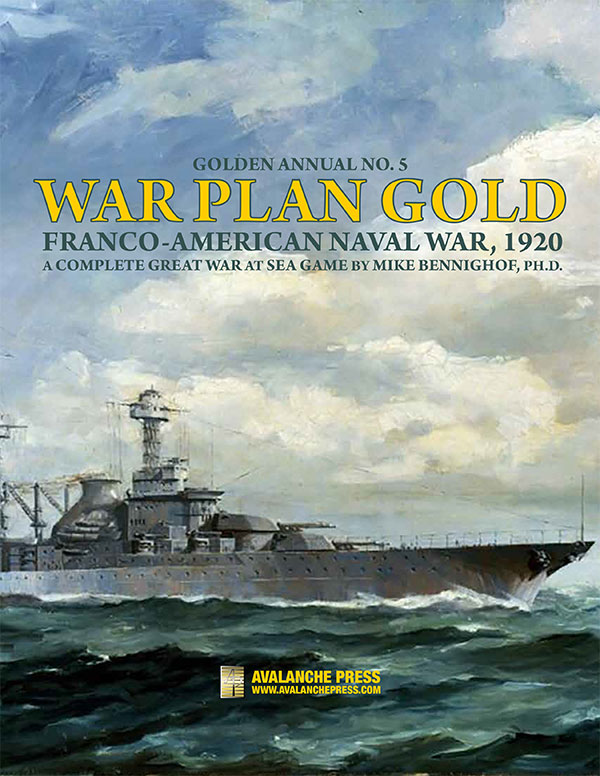 Publishing a game about American plans to fight a naval war with France in the early 1920’s was probably not one of my very best ideas. But we did so anyway, releasing Great War at Sea: U.S. Navy Plan Gold in 2006. And it did eventually sell out, marking it as a financial success. But we probably could have done something more successful instead. Publishing a game about American plans to fight a naval war with France in the early 1920’s was probably not one of my very best ideas. But we did so anyway, releasing Great War at Sea: U.S. Navy Plan Gold in 2006. And it did eventually sell out, marking it as a financial success. But we probably could have done something more successful instead.
Once the game was gone from our shelves, we had several leftover cartons of maps and pieces. Those went into deep storage, despite my assistant’s eagerness to set them on fire, until we were suddenly hit with unexpected import taxes on our playing pieces, which we make in China. We took a number of steps to fight off those possibly crippling levies, including taking those old pieces and using them as the basis for a new limited-edition game, Great War at Sea: War Plan Gold. They’ve spent the intervening years since their creation in climate-controlled storage, and they look just like they did when they first arrived in our hands.
War Plan Gold takes place in the Caribbean Basin, with the Americans holding Cuba, Puerto Rico, Panama and Florida. The French have bases at Guadeloupe and Martinique. The conflict is, at least initially, over dominance in Haiti. The United States invokes the Monroe Doctrine, France invokes colonial ties, both are cynically after dominance of local resources and extraction of Haitian gold to pay usurious debts to American and French banks, respectively (the bankster stuff actually happened).
The old Plan Gold pre-dated our current design philosophy by some years. Its scenarios had no relation to one another, and included some pretty weird ones added by a bored developer. These days we use what we call the story-arc format; the scenarios should help tell a story, whether it’s of a historical battle/campaign, or something (like War Plan Gold) that we mostly made up. I threw out all of the old ones, and made up a new story and designed new scenarios to tell it.

Since War Plan Gold uses the pieces from the old Plan Gold, the design had to follow a twenty-year-old concept. Fortunately, it was a simple concept that remains popular with wargamers: battleship action. Lots of battleship action, between ships that were planned but never built or completed. War Plan Gold holds even more tightly to that concept than did the original.
We start off with some cruiser skirmishes, but pretty soon, we get into the battleships. The Plan Gold counter mix laid down a pretty good basis for this: twelve battleships and six battle cruisers for the French, against eight battleships and five battle cruisers for the Americans. The Americans are generally larger, tougher, and they carry more and bigger guns, so the fleets are about equal in firepower and resistance to damage.
The old Plan Gold was the last of the four “Plan” games we created for Great War at Sea, based on American war plans to fight assorted enemies (Plan Orange for Japan, Plan Red for Britain, Plan Black for Germany). We strove to include ships that had been planned but never built, in keeping with the theme of wars that had been planned but never fought. That caters to the hard-core enthusiast, who’s not satisfied with just the ships that existed, but wants to delve into the drawing-board projects (and then fight with them). That describes a majority of the naval-game audience.
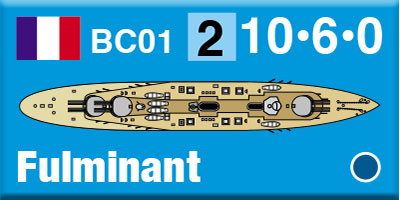
The French battle line comes for the most part from two classes of dreadnoughts. The Normandie class would have had a dozen 340mm (13.4-inch) guns in three quadruple turrets; these were laid down shortly before the Great War broke out and never completed. The four dreadnoughts of the Lyon class were similar, enlarged to add a fourth quadruple turret.
The former Austrian dreadnought Prinz Eugen, transferred to French control in August 1920, was expended as a gunnery target in June 1922. Here we provide her in French colors, as Corse. The French also received the German Thüringen in April 1920 and used her as a target before scrapping her in 1923. Neither ship would have gone to the breakers during a renewed war, and so she’s in the game as well, as Alsace. In 1914, Greece ordered a Provence-class battleship named Basileus Konstantinos. She had not been formally laid down when the First World War erupted but material had been gathered and the French navy considered completing her; in War Plan Gold she bears the name Vendée.
The French also get six battle cruisers, a pair each for three design proposals. Two of these are kind of weak, but they do carry seaplanes. The French round out the fleet with an aircraft carrier and thirteen light cruisers (two proposed designs get three examples each; the others are war prizes). And for support, eighteen oversized “destroyers of destroyers.”
The French also have something the Americans do not: an airship. This gives them a scouting advantage, and also, it’s just cool.
The U.S. Navy brings eight dreadnoughts to the fray, but these are ultra-dreadnoughts. Four of them are the Colorado class with eight 16-inch guns apiece; three of these actually existed, while the fourth (Washington) would be sacrificed under the terms of the 1922 Washington Naval Limitations agreement. Two are from the even larger South Dakota class, with a dozen 16-inch guns, and two more are the variant to the South Dakota design discussed but not implemented, with eight 18-inch guns instead. They’re also much larger and tougher to sink than the French dreadnoughts. The French do have a slight edge in total firepower, but the Americans get the benefit of greater range.
The Americans add five battle cruisers: three of one of the early design studies for what became the Lexington class (with ten 14-inch guns) and two of a proposed “light battle cruiser” with four 16-inch guns. As in the North Sea during the 1914-1918 war, the battle cruisers will get to fight one another early and often.
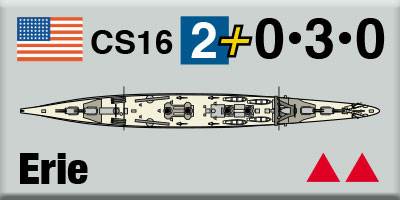
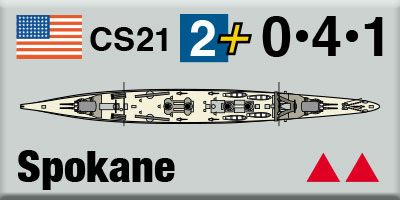
Plenty of cruisers round out the American fleet. The first heavy cruisers, here still called light cruisers, appear in Great War at Sea form: Salt Lake City and Pensacola. Plus, one of the preceding design proposals, with two examples. And twelve variations on the Omaha-class light cruiser; all of these were proposed and not built, and in War Plan Gold they include versions with four 8-inch guns, with two single 14-inch guns, and with their 6-inch guns in turrets rather than the awkward casemate mountings of the design chosen to be built.
American destroyer power is pretty awesome; the flush-decked, four-piped destroyers of the Wickes and Clemson classes were outmatched by modern Japanese boats in 1942, but twenty years earlier they were the cutting edge of tin can fighting power. They have twice as many torpedoes per boat as the bigger French destroyers, and they’re very fast, though they don’t have as many guns. But since they hunt in packs, that doesn’t really matter. They are a very definite threat to enemy battleships. And finally, the Americans have a trio of aging armored cruisers, two small aircraft carriers, and three fast-loading colliers.
While the Americans would seem to have the edge, they also have many more interests to defend. The French can cause them pain by attacking the Panama Canal, stirring up trouble in the Banana Republics, interfering in Cuba, assaulting the American colony of Puerto Rico or the American mainland itself (though in these times, no one lives in south Florida). The French just have their two bases to worry about, and if the Americans take them, the war isn’t over.
War Plan Gold includes 22 scenarios. It was designed with 24, but two of them wouldn’t fit in the scenario book so we gave them free to the Gold Club. It’s an odd but fun game, with plenty of battleship action between fleets you probably didn’t expect to see fight each other. But as the world constantly reminds us, nations don’t have friends. They have interests.
Order War Plan Gold.
Order War Plan Gold (Anarchy) Here.
No rules! You’ll need the Second Edition rules from another Great War at Sea game. Earlier edition rules will not work with this game.
|