Hot Action at Ponyri Station
By Mike Bennighof, Ph.D.
April 2026
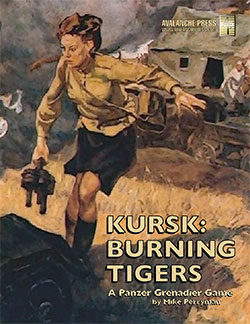 The Battle of Kursk may be history’s largest tank battle (if not, it’s close), but it’s definitely history’s best-known clash of armor. Some of the fiercest actions took place around Ponyri Station, an otherwise unremarkable whistle stop on the southern Russian steppe. The Battle of Kursk may be history’s largest tank battle (if not, it’s close), but it’s definitely history’s best-known clash of armor. Some of the fiercest actions took place around Ponyri Station, an otherwise unremarkable whistle stop on the southern Russian steppe.
The Germans planned a classic pincer attack on either side of the “bulge” in the Soviet lines centered on the city of Kursk. They delayed their offensive to bring their latest weapons to the front. Panther tanks and Ferdinand tank destroyers saw their first use at Kursk, while others finally saw large-scale deployment, like the Tiger I heavy tank, 75mm anti-tank gun, and Wespe and Hummel self-propelled artillery. The attackers brought 800,000 men and 3,000 tanks.
Those delays telegraphed their intentions to the Soviets, confirming the defenders’ intelligence. The city of Kursk’s central position in the “bulge” meant that the Soviets had a rail network in place to bring up troops, weapons, and construction materials, all in great quantities. The Soviets built massive lines of fortifications, fronting them with wide minefields and backing them with substantial reserves. Soviet forces came to 1,500,000 men and 5,000 tanks, with more of each arriving later when the counter-offensive began.
I designed the game that became Panzer Grenadier to model Eastern Front combat. It’s actually an infantry game first and foremost, with the tanks acting alongside them – exactly the way it worked in the real battles. Infantry remained the deciding arm on the battlefield, and so it is in the game as well. Even at Kursk.
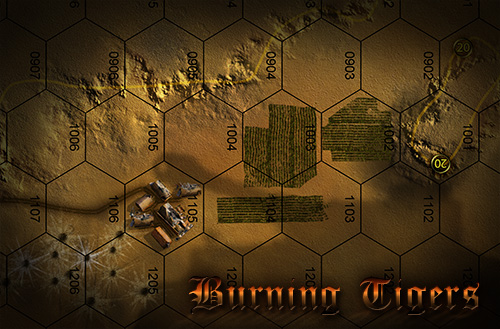 As in all Panzer Grenadier games, the maps, made of heavy cardstock, are what we call “geomorphic” – you place them together to form the battlefield for the scenario you’re about to play. Many times you’ll use just one, so you don’t have to fit them together, or you may be called to use other combinations up to all four. The maps are marked off in hexagons, each hexagon representing a piece of ground 200 meters across. As in all Panzer Grenadier games, the maps, made of heavy cardstock, are what we call “geomorphic” – you place them together to form the battlefield for the scenario you’re about to play. Many times you’ll use just one, so you don’t have to fit them together, or you may be called to use other combinations up to all four. The maps are marked off in hexagons, each hexagon representing a piece of ground 200 meters across.
The pieces represent platoons of infantry and tanks, squadrons of cavalry, and batteries of artillery. Individual leaders help rally your troops and move them toward the enemy. The game system is interactive (both players get to do things at the same time), but it’s pretty easy to learn and play.
Each game and expansion includes scenarios, so you can play out the battles that took place during the campaign. They’re grouped into chapters, each of those covering one segment of the campaign, with a “battle game” that ties the scenarios together.
So let’s have a look at the games and books that tell the story of the German Army at Kursk:
Burning Tigers
Kursk: Burning Tigers is the core game in this set, featuring the German Army’s role at Kursk (a sister game, called Kursk 1943, covers the Armed SS part of the battle). It’s a standard-sized Panzer Grenadier game: four maps, 517 pieces, and 40 scenarios.
At Kursk, you also get the massive clashes of tanks that gamers want. The battle marks the point when momentum shifted, and both sides are evenly matched, at least on the battlefield. That means both sides have to attack, both sides have to defend, and both sides get to wield masses and masses of armor.
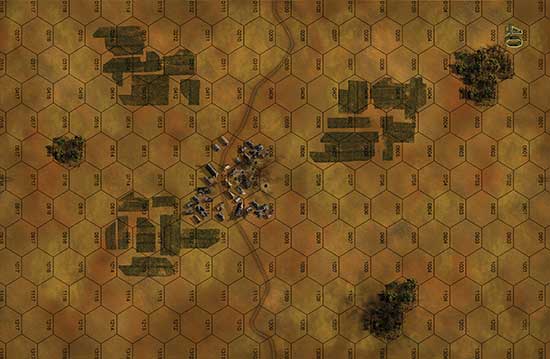
Burning Tigers is also designed to serve as an entry point to the vast world of Panzer Grenadier. It includes a simple introductory scenario, that shows you exactly what to do. You’ll be playing within minutes, and even better, you can play this game online through Panzer Grenadier Headquarters, with hundreds of friends you haven’t even met yet.
This is the ultimate World War II wargame, and your game table is crying out for it.
Order Burning Tigers Here.
Order Burning Tigers (Anarchy) Here.
No rules! You’ll need the Fourth Edition rules from another Panzer Grenadier game. Earlier edition rules will not work with this game.
Grossdeutschland at Kursk
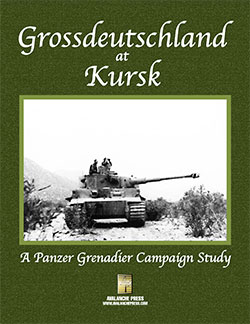 The German plan for the Kursk offensive expected great things from the elite Grossdeutschland Panzer Grenadier Division, and the formation indeed performed well (though not well enough to win the battle). It had been heavily reinforced and saw intense combat; Burning Tigers shows much of that, but not all, so Grossdeutschland at Kursk adds eleven more, all drawn from the Grossdeutschland Division’s actions at the Battle of Kursk, with two battle games to tie them together. The German plan for the Kursk offensive expected great things from the elite Grossdeutschland Panzer Grenadier Division, and the formation indeed performed well (though not well enough to win the battle). It had been heavily reinforced and saw intense combat; Burning Tigers shows much of that, but not all, so Grossdeutschland at Kursk adds eleven more, all drawn from the Grossdeutschland Division’s actions at the Battle of Kursk, with two battle games to tie them together.
These were some of the fiercest tank battles of the entre war (Grossdeutschland had an additional 100 brand-new Panther tanks attached). If you want to play the real battles, this is a must-have.
Order Grossdeutschland at Kursk Here.
Stalin’s Tanks
 The Soviet Union won the Great Patriotic War in part by focusing its industrial capacity on a limited number of proven, effective weapons. Where the German built an array of different tanks at once, the Soviets kept just one light, one medium, and one heavy tank design in production at the same time. The Soviet Union won the Great Patriotic War in part by focusing its industrial capacity on a limited number of proven, effective weapons. Where the German built an array of different tanks at once, the Soviets kept just one light, one medium, and one heavy tank design in production at the same time.
Stalin’s Tanksis a Golden Journal looking at some of the tank designs studied for possible use and rejected at the prototype stage: the T34/57 “Exterminator” with its long-barreled, ultra-high-velocity gun, the T34/95 that would have accompanied it to deal with soft targets, the massive KV5 “Tiger Hunter,” and the thickly-armored KV220.
None of these tanks saw combat (except the Exterminator, which did some exterminating on the Moscow front), but you can still play 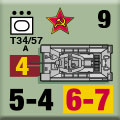 with them, in six scenarios (including the largest Panzer Grenadier scenario ever published, suitable for team play). with them, in six scenarios (including the largest Panzer Grenadier scenario ever published, suitable for team play).
Order Stalin’s Tanks Here.
Gold Club members can use their max discount.
Storm Division
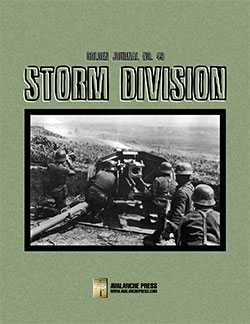 The German 78th Infantry Division had suffered heavy losses, and rather than rebuild it as a standard infantry division, the German Army re-cast it as a unique “storm division.” It wasn’t actually meant for storming; it had a great many automatic weapons and anti-tank guns, and its role was to follow the panzer spearheads and then protect their flanks against enemy counter-attack. So the “assault” part was pure propaganda. The division’s great weakness was that its infantry wasn’t motorized, and it couldn’t easily rush to its intended places. The German 78th Infantry Division had suffered heavy losses, and rather than rebuild it as a standard infantry division, the German Army re-cast it as a unique “storm division.” It wasn’t actually meant for storming; it had a great many automatic weapons and anti-tank guns, and its role was to follow the panzer spearheads and then protect their flanks against enemy counter-attack. So the “assault” part was pure propaganda. The division’s great weakness was that its infantry wasn’t motorized, and it couldn’t easily rush to its intended places.
Storm Division is a Golden Journal, with 24 new pieces showing those Storm Division platoons plus extra 75mm anti-tank guns and medium mortars. You also get nine scenarios, all of them based on the actual fighting around Ponyri Station involving 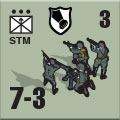 Storm Division units, and two battle games that tie the scenarios together. Storm Division units, and two battle games that tie the scenarios together.
Order Storm Division Here.
Gold Club members can use their max discount.
Ponyri Station
The northern flank of history’s greatest tank battle, as masses of German and Soviet armor fight in and around Ponyri Station. This special package includes the core game (Burning Tigers) and three expansions; a total of 566 pieces and 66 scenarios.
• Burning Tigers
• Grossdeutschland at Kursk
• Stalin’s Tanks
• Storm Division
Retail Price: $156.96
Package Price: $130
Gold Club Price: $104
Seize the Station.
Sign up for our newsletter right here. Your info will never be sold or transferred; we'll just use it to update you on new games and new offers.
Mike Bennighof is president of Avalanche Press and holds a doctorate in history from Emory University. A Fulbright Scholar and NASA Journalist in Space finalist, he has published a great many books, games and articles on historical subjects; people are saying that some of them are actually good.
He lives in Birmingham, Alabama with his wife and three children
Want to keep Daily Content free of third-party ads? You can send us some love (and cash) through this link right here.
|