South Pacific:
Santa Cruz Islands, Part One
by Mike Bennighof, Ph.D.
September 2025
 Defeat of the Japanese Sixth Cruiser Division at the Batte of Cape Esperance on the night of 11 October 1942 did not even slow Japanese attempts to reinforce their troops on the island and bombard the American airbase at Henderson Field. Combined Fleet commander Isoroku Yamamoto had set in motion a complicated operation involving his carrier fleet, surface forces, and the Army’s forces on Guadalcanal. It would not be derailed by a setback to just one of the many task forces involved. Defeat of the Japanese Sixth Cruiser Division at the Batte of Cape Esperance on the night of 11 October 1942 did not even slow Japanese attempts to reinforce their troops on the island and bombard the American airbase at Henderson Field. Combined Fleet commander Isoroku Yamamoto had set in motion a complicated operation involving his carrier fleet, surface forces, and the Army’s forces on Guadalcanal. It would not be derailed by a setback to just one of the many task forces involved.
The Americans, the putative winners at Cape Esperance, took a vastly different perspective. Theater commander Robert Ghormley did nothing to follow up the victory, allowing the Japanese to shell Henderson Field and run reinforcements to Guadalcanal with impunity. Pacific area commander Chester Nimitz, his boss, fired Ghormley one week after the battle and named Vice Admiral William F. Halsey, then on his way to the South Pacific aboard the newly-repaired carrier Enterprise, as his replacement.
Halsey, then as now, carried a reputation as an exceptionally aggressive commander, though he disliked the nickname “Bull” used by the American press; Halsey attributed it to “some drunken correspondent.” Yet he adapted his instincts to the new circumstances. The Japanese had numerical superiority, and despite the bloody nose at Cape Esperance, they retained the operational initiative.
Signals intelligence revealed that the enemy had selected 23 October as the date of their land assault on Henderson Field, which would have strong naval support as well. As Japanese ground forces increased their activity, seemingly confirming the intel reports, Halsey ordered Thomas Kincaid, commanding his carriers, to seek out his Japanese counterparts: “Attack. Repeat. Attack.”
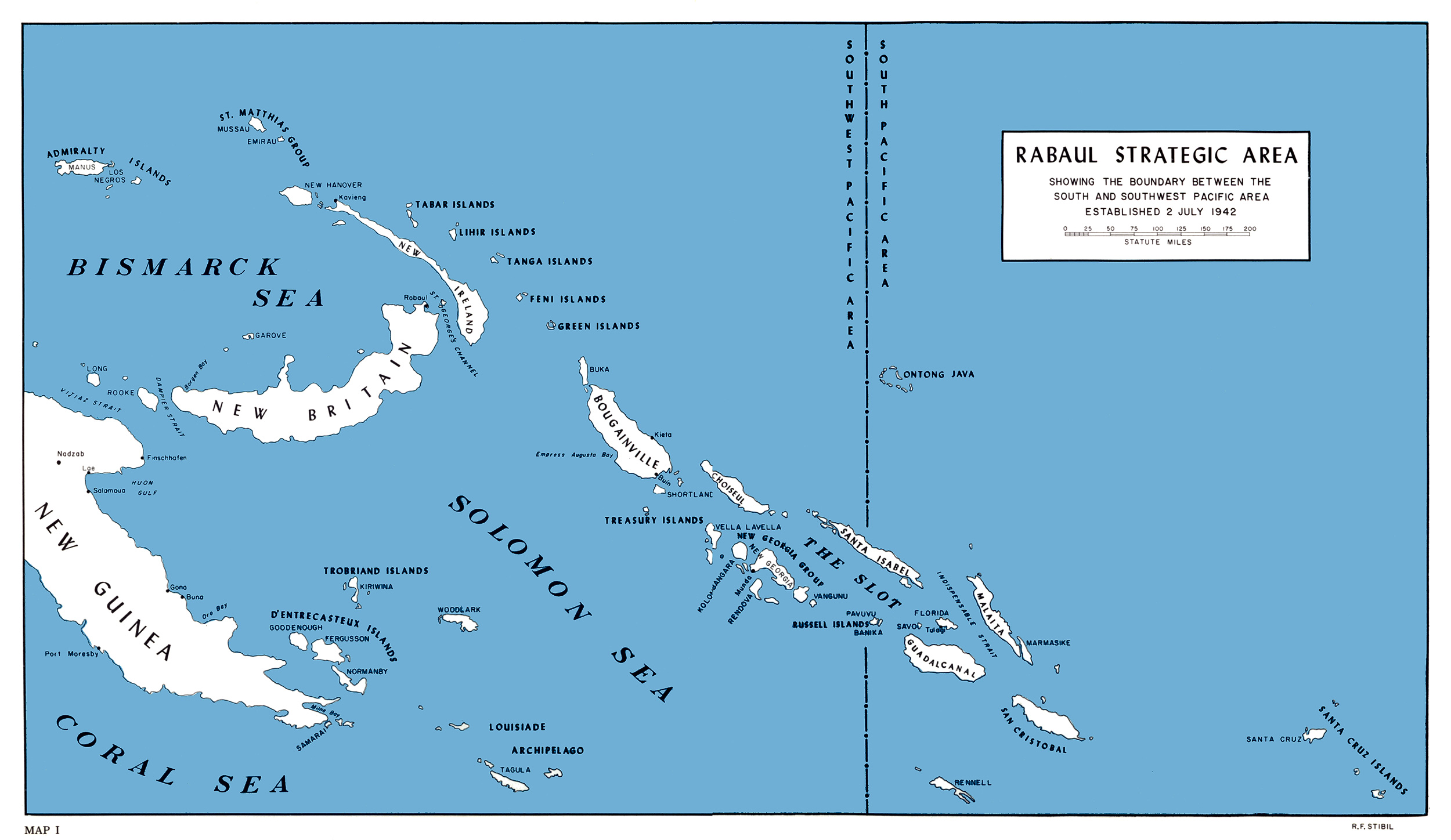
The Solomons theater. Open image in new tab to embiggen it.
On the 20th, the Japanese submarine I-176 spotted an American cruiser-destroyer force patrolling south-east of Guadalcanal and fired two torpedoes at the heavy cruiser Chester. One of them hit the cruiser amidships, killing 11 men and devastating her machinery space, destroying two engine rooms and damaging a third; she limped back to Luganville on her one remaining engine and eventually back to the United States after temporary. She would be out of action until August 1943.
The Japanese carrier force, commanded by Chuichi Nagumo, had the fleet carriers Shokaku and Zuikaku, the converted liners Junyo and Hiyo (initially designated light carriers, but promoted to fleet carrier status following the dramatic Japanese losses at the Battle of Midway), and light carrier Zuiho. The Japanese had spotted one American carrier in the waters south of Guadalcanal (Hornet), but based on their own signals intelligence suspected that a second flattop might be present as well.
Yamamoto and his chief of staff, Matome Ugaki, urged Nagumo and Third Fleet’s overall commander, Nobutake Kondo, toward an unprecedented incursion into Allied-controlled waters: to take the carriers south of the Solomons, into the waters between Guadalcanal and the Allied bases on New Caledonia and Espiritu Santo. There, they would seek out the Allied carrier or carriers and destroy them, while firmly halting Allied transport traffic between their rear-area bases and Guadalcanal.
Third Fleet’s chief of staff, Ryunosuke Kusaka, talked his bosses out of following through. Yamamoto and Ugaki had not made their suggestions a direct order, and until the presence of a second carrier could be confirmed, Kusaka counseled caution. Instead, the Japanese Third Fleet (the Carrier Striking Force and the Advance Force under Kondo’s personal command) would move south by day, into striking range of Guadalcanal, carry out air strikes in support of the land forces and against any American ships nearby, and then move north out of range of American retaliation.
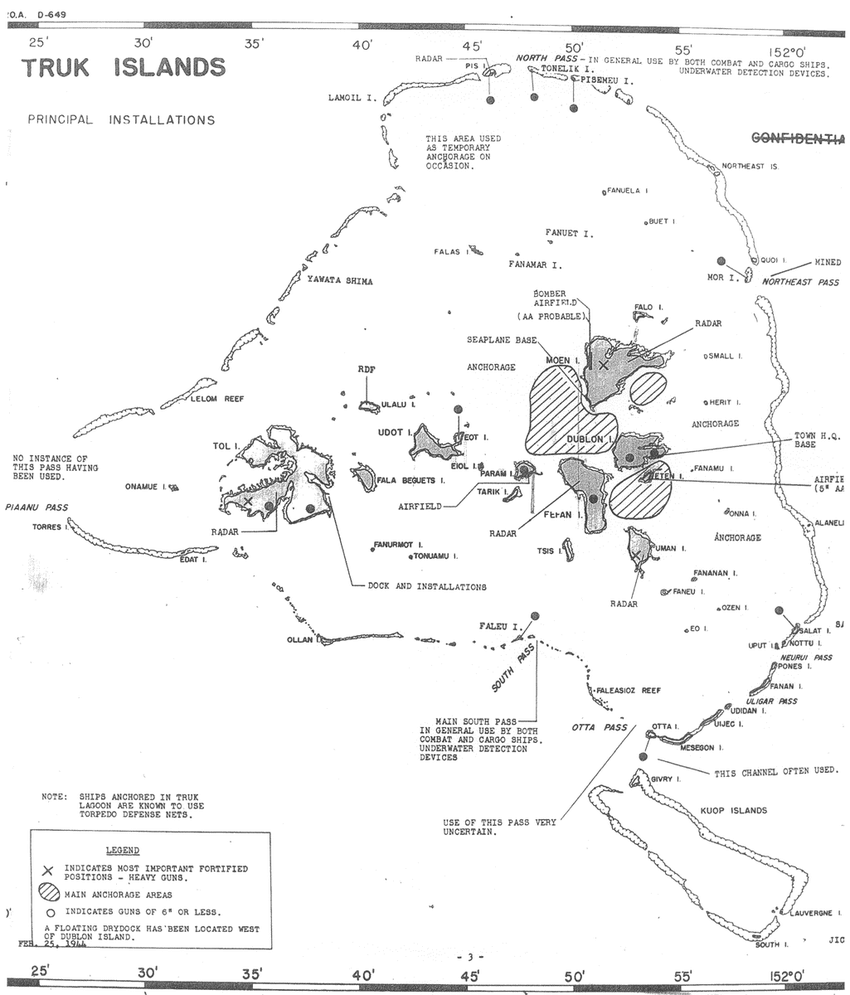
The Japanese base at Truk Lagoon, showing the three main anchorages (hatched).
The two Japanese carrier divisions (1st Division with Shokaku, Zuikaku, and Zuiho; 2nd Division with Hiyo and Junyo) operated separately. First Division launched a powerful strike on the 15th at a convoy headed for Guadalcanal. The convoy eluded them, having turned back on a false report of Japanese surface ships headed their way. The planes found two stragglers: the destroyer Meredith, and the ancient fleet tug Vireo, the latter towing a barge laden with gasoline and aerial bombs, for Henderson Field. Vireo had suffered an engine breakdown, and Meredith had taken off her crew and was preparing to sink her with a torpedo when the air strike pulverized the destroyer. Vireo was left adrift and eventually salvaged. With their surviving planes recovered (Meredith shot down three of them before succumbing to the avalanche of bombs and torpedoes), the carriers turned back to the north.
Second Division attacked Henderson Field on the 16th with 36 planes, switching targets to a pair of American destroyers they found bombarding Japanese positions. The planes suffered heavy losses, but inflicted no damage on the Americans. After recovering their aircraft (only one of Junyo’s attack planes made it home), they likewise headed north, away from any American response.
On the 17th, a fire broke out in Hiyo’s starboard engine room. Her captain, Akitomo Beppu, had also been her chief outfitter (the Navy officer overseeing construction), and had served the same role for Soryu. Despite that experience, things only got worse. With their ship’s top speed reduced to 16 knots, Beppu and Chief Engineer Shigehiro Matoba tried to push her to the limit to remain in formation. On the 21st, as Rear Admiral Kakuji Kakuta transferred his flag to Junyo, another fire erupted, further reducing her speed to six knots and knocking out power to her anti-aircraft batteries.
Beppu and Matoba couldn’t fake it this time. Hiyo sent nine planes to Junyo, re-filling her sister ship’s air group, and the rest to the airbase at Buin. With the destroyers Isonami and Inazuma, Hiyo headed back to Truk. The torpedo cruiser Oi took off most of her aircraft department – mechanics, bomb handlers, torpedo technicians, deck crew – and took them to Buin to support the carrier’s now land-based squadrons. Though all of Hiyo’s planes remained in the combat zone, the loss of their carrier still reduced Nagumo’s combat power.
On 24 October, Japanese signals intelligence scored another triumph. Two American carriers had been dispatched to operate east of Guadalcanal, just north of the Santa Cruz Islands. Ugaki finally issued a direct order on 24 October to move the Japanese carriers south-east and seek battle with the advancing Americans, appending, “Do not hesitate or waver!” Kusaka tried to dissuade Nagumo. The two men cleared Shokaku’s plot room for a shouting match. Nagumo wished to move south and attack. Kusaka countered that they could well steam into an ambush. And while Kusaka was correct, Nagumo wished to attack the ambushers.
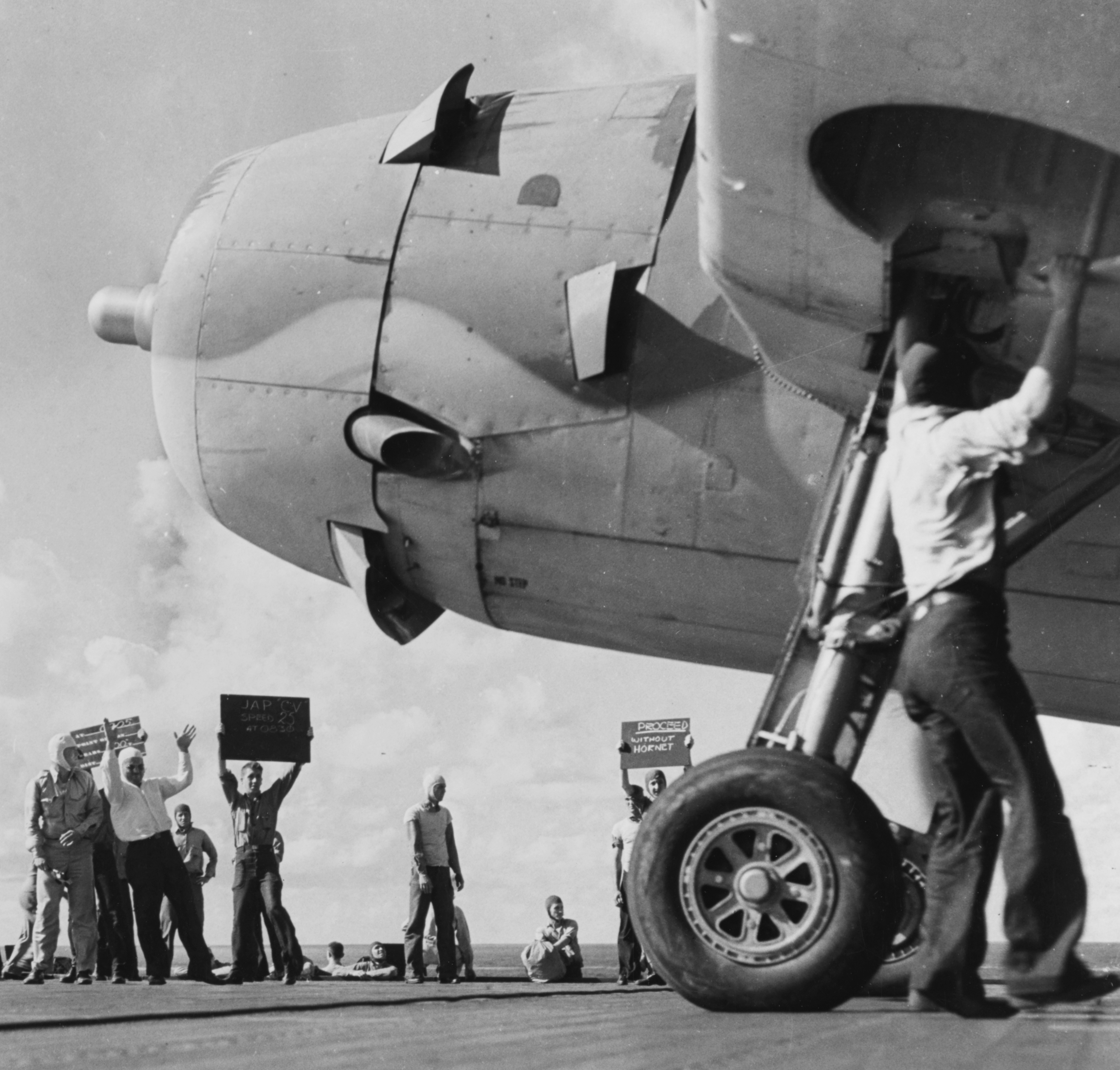
Preparing to launch a TBF Avenger aboard Enterprise. 26 October 1942. A crewman holds a sign telling the pilot to “Proceed Without Hornet.”
The Army’s attack, initially scheduled for the 23rd, finally went forward two days later after delays caused in traversing the heavy jungle. Marine artillery utterly devastated the Japanese infantry; they pressed forward regardless of losses to be almost annihilated along with the tanks so laboriously transported to the island. Despite this cataclysmic failure, they reported to the Navy that Henderson Field had fallen. Hours later, aircraft operating from Henderson Field sank the light cruiser Yura, part of a convoy bringing reinforcements to the island to secure the airbase.
Meanwhile, American flying boats spotted both Kondo’s advance force and Nagumo’s 1st Carrier Division, even attempting to bomb Zuikaku. Nagumo ordered a turn back to the north-west, which Yamamoto countermanded shortly afterwards. Junyo launched a strike aimed at Henderson Field that morning, finding (as the Navy suspected) that the Americans still held the vital airfield. Kincaid launched a strike from Enterprise on the afternoon of the 25th that failed to find the Japanese and stayed aloft so long trying to locate the enemy that they had to land after dark, costing the Americans eight planes.
Order South Pacific Here.
Ironbottom Sound is a scenario book that expands Second World War at Sea: South Pacific. It comes with 36 new scenarios for South Pacific, extending the story through August 1943 and the campaign for New Georgia. All of the maps and pieces needed are included in South Pacific; the companion history book, Solomons Naval Campaign, comes bundled with Ironbottom Sound.
Order Ironbottom Sound Here.
Includes Solomons Naval Campaign book.
Order Solomons Naval Campaign Here.
Companion piece to Ironbottom Sound, or just read it separately.
Sign up for our newsletter right here. Your info will never be sold or transferred; we'll just use it to update you on new games and new offers.
Mike Bennighof is president of Avalanche Press and holds a doctorate in history from Emory University. A Fulbright Scholar and NASA Journalist in Space finalist, he has published a great many books, games and articles on historical subjects; people are saying that some of them are actually good.
He lives in Birmingham, Alabama with his wife, three children, and new puppy. He misses his lizard-hunting Iron Dog, Leopold.
Daily Content includes no AI-generated content or third-party ads. We work hard to keep it that way, and that’s a lot of work. You can help us keep things that way with your gift through this link right here.
|