South Pacific:
Santa Cruz Islands, Part Two
by Mike Bennighof, Ph.D.
September 2025
 At 0600 on the 26th, Enterprise launched sixteen dive bombers to scout for the Japanese carriers. Fifty minutes later, a Japanese scout reported the American carriers. Nagumo immediately ordered a full-strength attack, and his carriers put aloft a first wave of 21 fighters, 20 torpedo bombers and 21 dive bombers, followed by nine fighters, nineteen dive bombers and sixteen torpedo planes, sent aloft forty minutes later - as soon as the carriers could ready them, the torpedo bombers taking longer to ready and launch thanks to the sheer weight of their weapons. Nagumo also ordered his surface component to speed toward the Americans and attack them. Meanwhile the converted liner Junyo, racing to join the other carriers as Kondo’s surface ships set out to attack the Americans, launched her own strike of seventeen dive bombers escorted by a dozen fighters. At 0600 on the 26th, Enterprise launched sixteen dive bombers to scout for the Japanese carriers. Fifty minutes later, a Japanese scout reported the American carriers. Nagumo immediately ordered a full-strength attack, and his carriers put aloft a first wave of 21 fighters, 20 torpedo bombers and 21 dive bombers, followed by nine fighters, nineteen dive bombers and sixteen torpedo planes, sent aloft forty minutes later - as soon as the carriers could ready them, the torpedo bombers taking longer to ready and launch thanks to the sheer weight of their weapons. Nagumo also ordered his surface component to speed toward the Americans and attack them. Meanwhile the converted liner Junyo, racing to join the other carriers as Kondo’s surface ships set out to attack the Americans, launched her own strike of seventeen dive bombers escorted by a dozen fighters.
While the Japanese 1st Carrier Division readied the second wave, Enterprise’s scout bombers found them. Two of them dove on the light carrier Zuiho, both of them scoring hits on the aft end of her flight deck that left Zuiho unable to operate aircraft; the pilots reported their target as a Shokaku-class carrier. Fortunately for Zuiho and her crew, these planes only carried 500-pound bombs in their scouting role, as opposed to the 1,000-pound ship killers deployed for strike missions.

Shokaku prepares to launch her planes. Zuikaku in the background.
With the Japanese carriers located, the Americans launched their own strikes – plural, as Enterprise and Hornet sent their planes aloft separately and piecemeal. The opposing strikes spotted each other along the way, and the nine fighters from Zuiho peeled off to attack the Enterprise torpedo bombers. They splashed five planes and damaged three more, losing four of their own with one damaged. But the remaining Zuiho fighters headed back to their carrier, unaware that they would have to land elsewhere, and this meant that the Japanese strike would try to reach the American carriers with far less fighter support than intended.
The Japanese reached their target first. American radar operators, confusing the incoming strike with their own outgoing planes, gave very little warning of the oncoming hammer blow. Their Combat Air Patrol had no chance to intercept. With Enterprise under the cover of a rain squall, the Japanese went after her sister ship, Hornet.
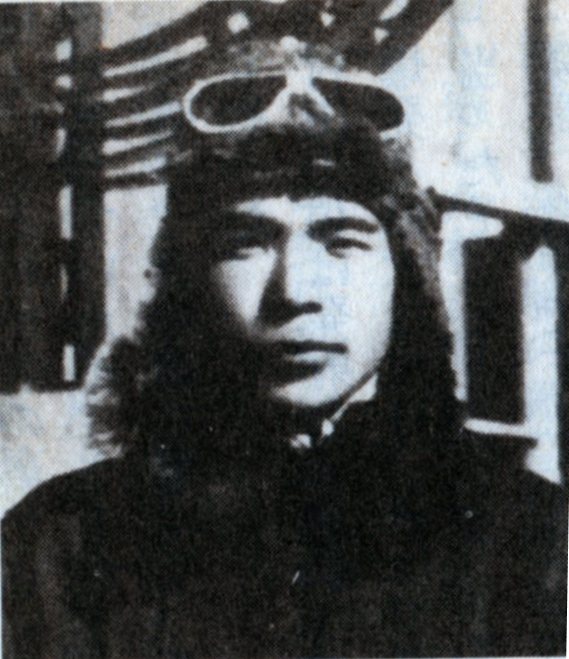
Shigeharu Murata, The God of Lightning. |
Lt. Commander Shigeharu Murata, the legendary “God of Lightning” to Japanese carrier aviators thanks to his unusually large penis and his talent for draining beer bottles in a single pull (“trumpet drinking” in Japanese naval slang), single-handedly sank the American river gunboat Panay in 1937, led the torpedo planes at Pearl Harbor, and now led the first wave into a wall of anti-aircraft fire. Four cruisers and six destroyers surrounded the carrier and poured their fire into Murata’s oncoming planes, which did not waver. Seventeen of twenty-one dive bombers, sixteen of twenty torpedo planes and five of twelve fighters fell to the steel tornado. Murata himself was killed, but his pilots hit Hornet with two torpedoes and three bombs. The pilots of two damaged dive bombers crashed their planes into the carrier, one of them hitting the island and spreading burning gasoline across the flight deck.
Ten minutes after the attack, Hornet lost power. Multiple fires raged across the ship, her forward engine room steadily flooded, and worst of all her water mains had been knocked out. Sailors fought the fires with buckets of water, while the heavy cruiser Northampton established a tow.
As Hornet burned, the Americans reached the Japanese carriers. Radar spotted them 100 miles out, but Combat Air Patrol fighters only managed to shoot down two dive bombers. Once again, the Americans did not spot the lucky Zuikaku, but they did sight Shokaku and Zuiho, and went after the bigger target. English-speaking Japanese radio operators, well-prepared for this moment, entered the chat on American frequencies, inserting incorrect information and general babble that helped confuse the attackers, enraging a number of American pilots who cursed and shouted, not realizing they addressed their enemies.
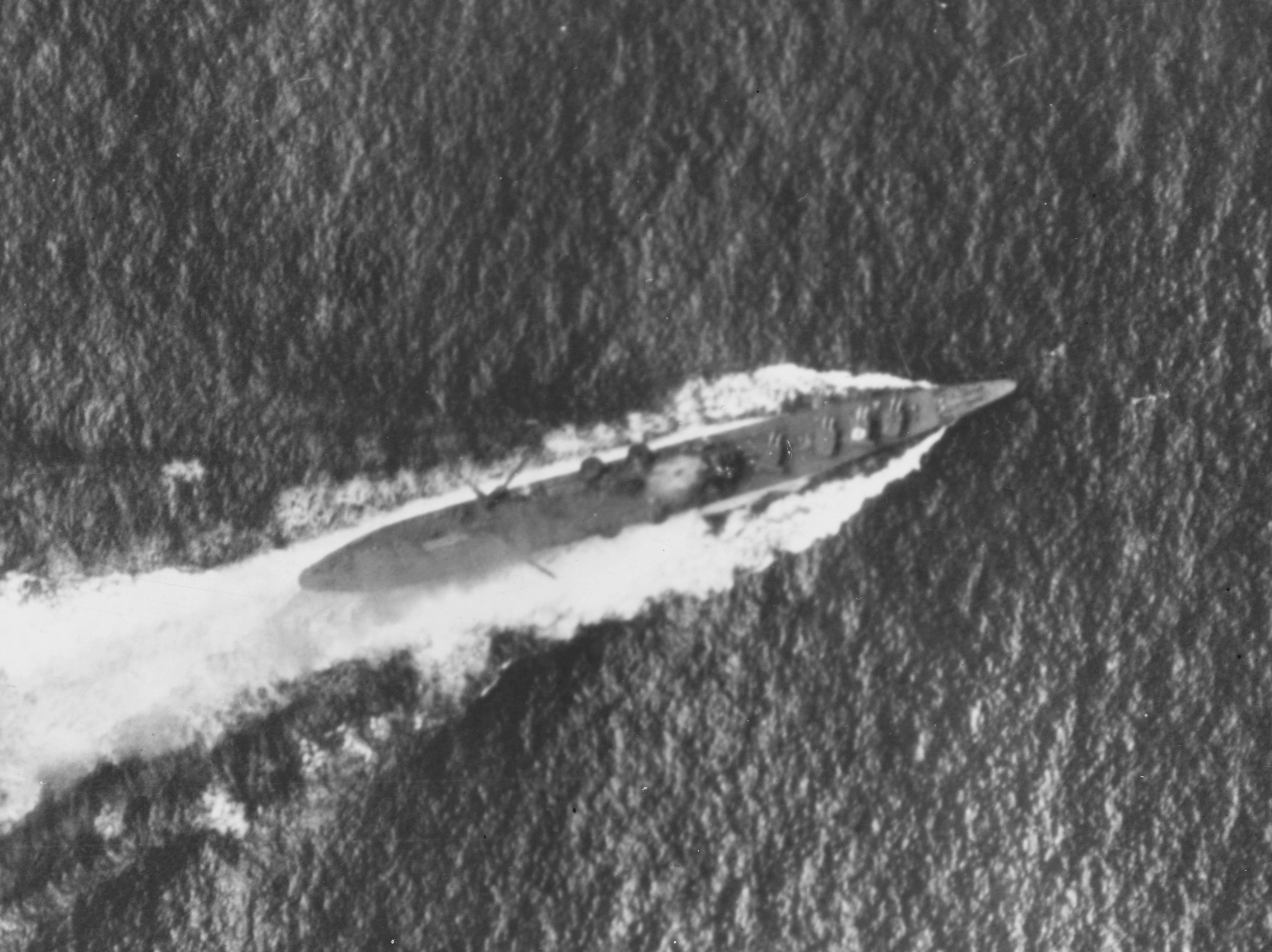
Japanese heavy cruiser Chikuma under attack by American planes.
Despite that effort, ten Hornet bombers dove on the carrier, which dodged the first four bombs with the wild maneuvers dictated by Japanese doctrine. At least four of the remaining planes, and possibly all six, hit the carrier with their 1,000-pound bombs. The bombs absolutely wrecked Shokaku amidships, destroying hangars, elevators, anti-aircraft batteries, and the flight deck. With her deck and hangars emptied by the full-strength air strike, exploding planes did not become a problem, but at least fifty anti-aircraft gunners and eighty aircraft handlers and mechanics were killed instantly. Only two planes had been left behind: one torpedo plane in the hangar was turned to ash, but a second perched at the aft end of the flight deck somehow survived unscratched.
Despite the massive damage, Shokaku’s strength deck held and she suffered no injuries below the waterline. She could still make 30 knots, and maintained her position. Hornet’s dive bombers would be the only American planes to find the Japanese carriers; the others attacked the cruisers Tone and Suzuya, with no result. But waves of them struck the heavy cruiser Chikuma, hitting her with two bombs and scoring many near-misses. She took heavy damage, losing 190 sailors killed and 154 wounded. The battered cruiser withdrew to Truk, accompanied by the destroyers Tanikaze and Urakaze.
At about 1000, two TBF Avenger torpedo bombers approached Enterprise, looking to touch down after suffering mechanical problems. One of them still had its torpedo, and the carrier’s air control ordered the pilot to ditch near one of the accompanying destroyers which could then pick up the crew – a landing with a fully-armed torpedo could not be risked. The plane came down near the destroyer Porter, and the torpedo armed itself, circling around the destroyer before hitting her engine room. The boat quickly took on water and within two hours she had to be abandoned. The destroyer Shaw sank the wreck with gunfire.
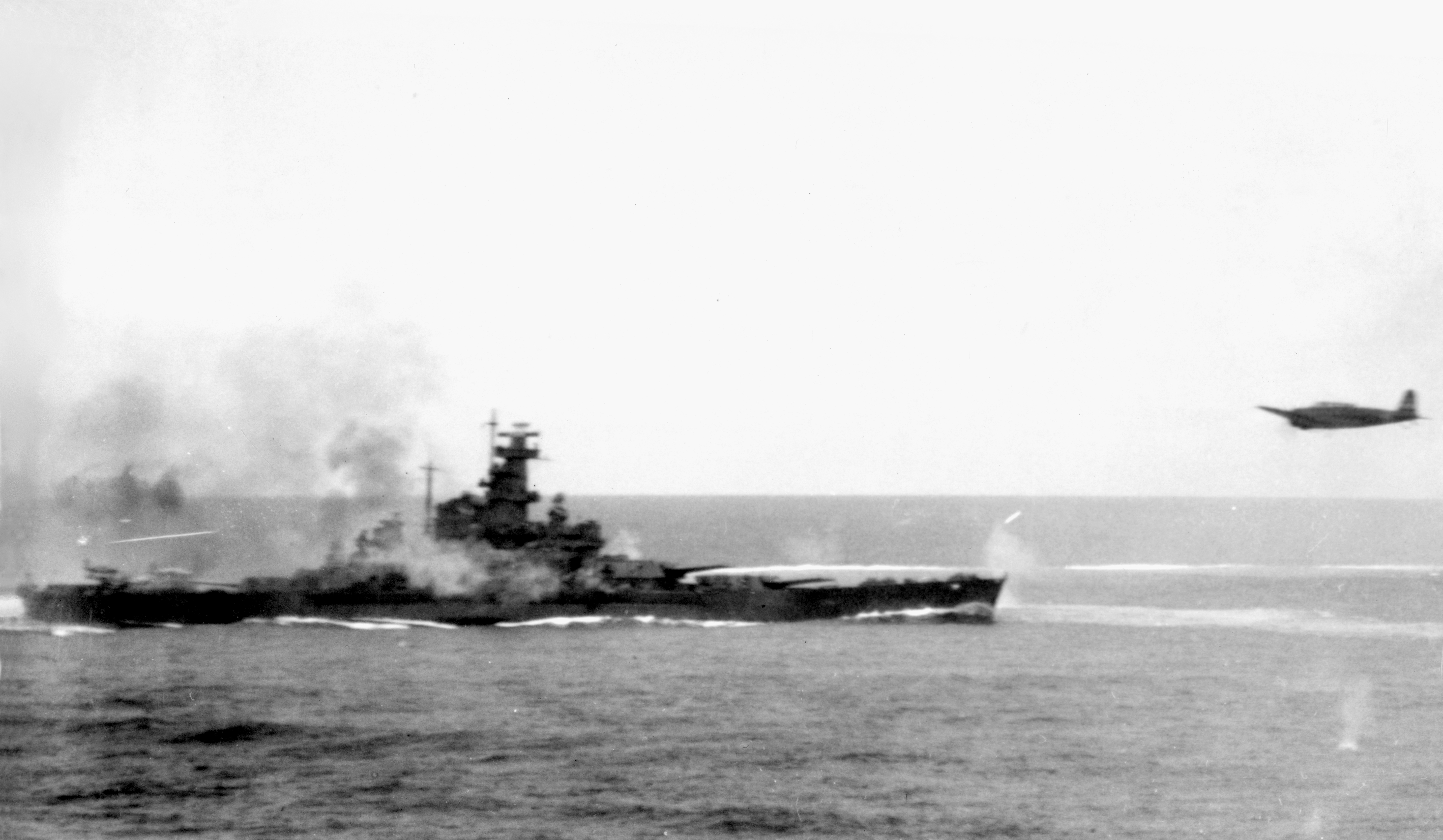
A Japanese torpedo plane flies past the battleship South Dakota.
And then the second wave of Japanese bombers reached the American carriers. Mamoru Seki, Shokaku’s air group commander and Murata’s Academy classmate, led nineteen dive bombers. He passed by the burning Hornet, knowing that the Americans had a second carrier. He led his planes out of the sun to dive on Enterprise. The heavy flak put up by two cruisers, seven destroyers and a battleship flamed ten of the planes, but not before they rocked Enterprise with two bomb hits and a damaging near-miss. The first bomb hit, delivered by Lt. Keiichi Arima, scored the first hit, the bomb passing through the carrier’s flight and hangar decks to explode in the water. Arima, the bombardier, had also hit Enterprise at the Battle of the Eastern Solomons. The feat was enough to earn Arima and his pilot, Kiyoto Furuta, a rare ticket back to Japan to serve as instructors. Both survived the war.
Following up on Seki’s strike, Lt. Shigeichio Imajuku led 16 Zuikaku torpedo planes against Enterprise. Eight of the planes would be shot down, including Imajuku’s, and the carrier’s violent maneuvering – with the battleship South Dakota staying right on her tail at 27 knots – caused several pilots to switch targets. Two planes attacked South Dakota without result, and at least three scored hits on the heavy cruiser Pensacola, but dropped their torpedoes too close to the target and they failed to arm themselves. Enterprise claimed to have dodged nine torpedoes during the attack.
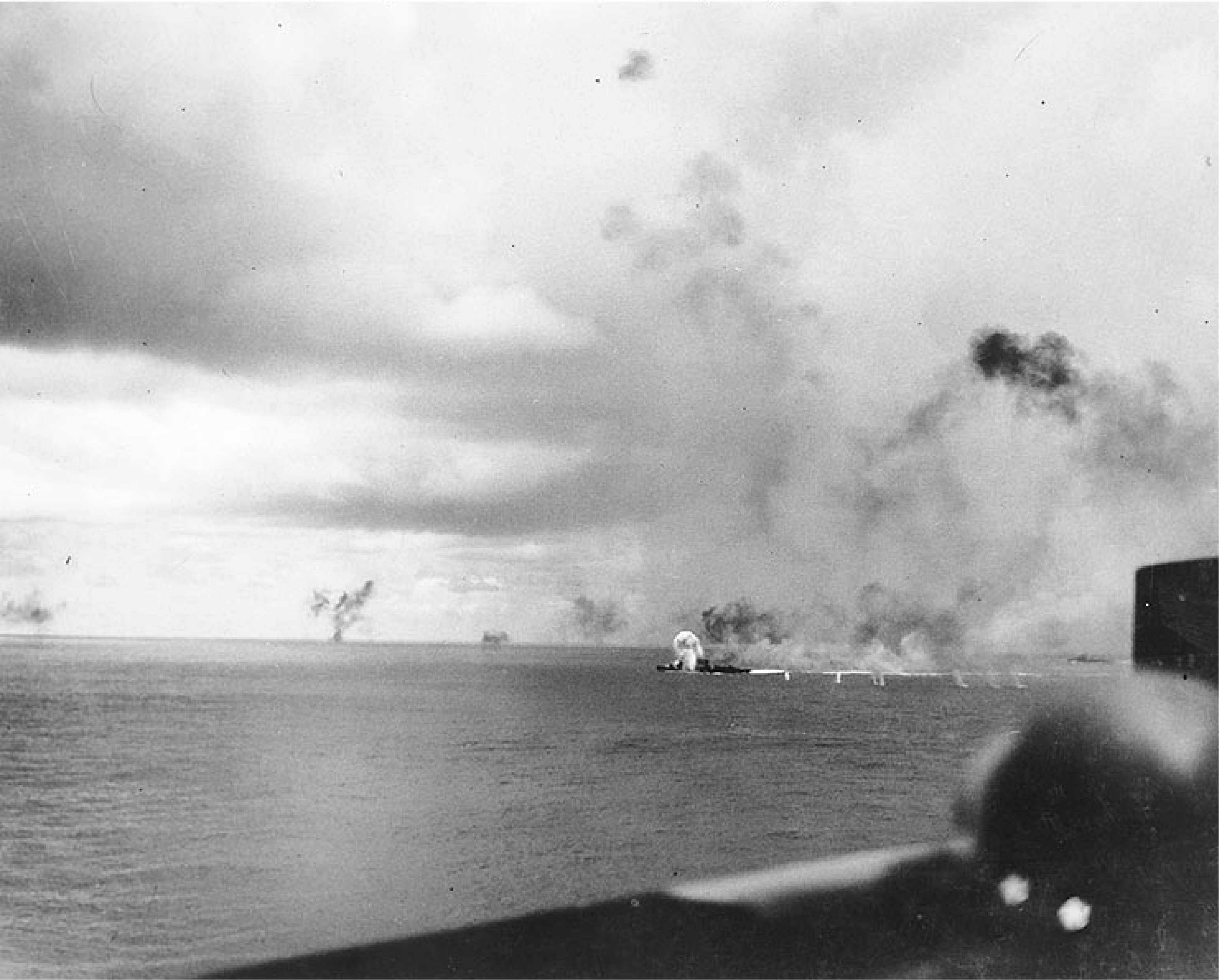
The moment when Kiyomi’s plane strikes the destroyer Smith.
Seaman-Pilot Takei Kiyomi crashed his burning plane into the destroyer Smith; the aircraft fell into the sea but some minutes later, its torpedo exploded. With the front half of his ship enveloped in flames, Smith’s skipper, Lt. Commander Hunter Wood, steering from auxiliary control (the bridge having caught fire as well), brought his boat close behind South Dakota to allow the speeding battleship’s massive wake to drench the fire. Her aft guns continued to fire at the Japanese planes overhead. Despite his quick ship-handling, Smith still lost 57 dead and a dozen wounded. But the crew did recover Kiyomi’s codebook.
Order South Pacific Here.
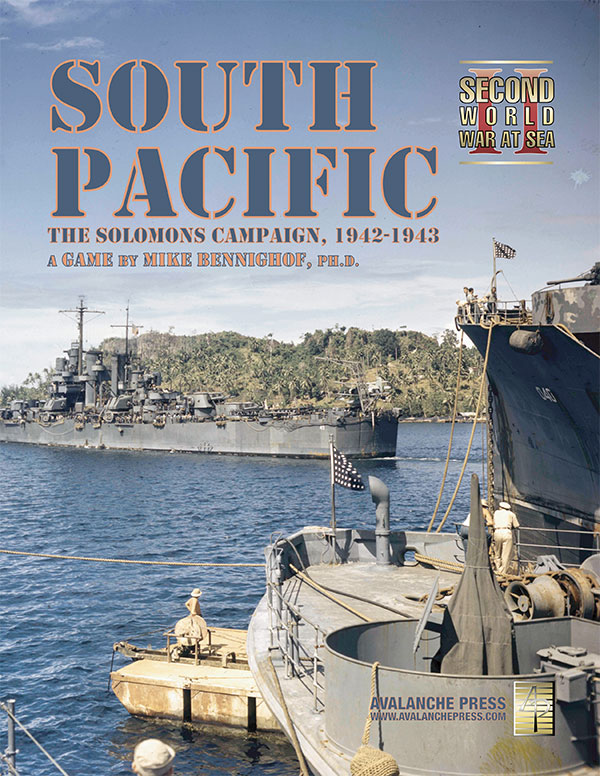
Ironbottom Sound is a scenario book that expands Second World War at Sea: South Pacific. It comes with 36 new scenarios for South Pacific, extending the story through August 1943 and the campaign for New Georgia. All of the maps and pieces needed are included in South Pacific; the companion history book, Solomons Naval Campaign, comes bundled with Ironbottom Sound.
Order Ironbottom Sound Here.
Includes Solomons Naval Campaign book.
Order Solomons Naval Campaign Here.
Companion piece to Ironbottom Sound, or just read it separately.
Sign up for our newsletter right here. Your info will never be sold or transferred; we'll just use it to update you on new games and new offers.
Mike Bennighof is president of Avalanche Press and holds a doctorate in history from Emory University. A Fulbright Scholar and NASA Journalist in Space finalist, he has published a great many books, games and articles on historical subjects; people are saying that some of them are actually good.
He lives in Birmingham, Alabama with his wife, three children, and new puppy. He misses his lizard-hunting Iron Dog, Leopold.
Daily Content includes no AI-generated content or third-party ads. We work hard to keep it that way, and that’s a lot of work. You can help us keep things that way with your gift through this link right here.
|