South Pacific:
Santa Cruz Islands, Part Three
by Mike Bennighof, Ph.D.
September 2025
 Next, Junyo’s seventeen dive bombers arrived. Ten of them attacked Enterprise, opening a huge gash in her hull from a very close near-miss. Five attacked the battleship South Dakota, jamming the turntable of her forward 16-inch turret and putting it out of action. It would still be unusable when “Shitty Dick” fought a surface action in Ironbottom Sound two and a half weeks later. The last two went after the anti-aircraft cruiser San Juan, scoring one hit that disabled her rudder. Next, Junyo’s seventeen dive bombers arrived. Ten of them attacked Enterprise, opening a huge gash in her hull from a very close near-miss. Five attacked the battleship South Dakota, jamming the turntable of her forward 16-inch turret and putting it out of action. It would still be unusable when “Shitty Dick” fought a surface action in Ironbottom Sound two and a half weeks later. The last two went after the anti-aircraft cruiser San Juan, scoring one hit that disabled her rudder.
Shortly after noon, Zuikaku and Junyo launched a strike that did not locate the damaged Enterprise, instead targeting Hornet – initially believed to be a third, undamaged American carrier. Zuikaku, her flight operations overwhelmed by the need to recover planes from Shokaku and Zuiho as well as her own, loaded her torpedo planes with heavy Type 99 No. 80 land-attack bombs (designed to penetrate reinforced concrete) rather than torpedoes to speed the process. A Zuikaku torpedo plane hit the stricken Hornet with a 1,720-pound No. 80 bunker-smashing bomb, and at least one Junyo torpedo plane scored with a torpedo. That finished the ship; most of the crew had already been taken off, and the remainder had been rescued by the time darkness fell. Two American destroyers launched nine torpedoes at the hulk and fired hundreds of 5-inch rounds at her, but she refused to sink. Later that night, after some consideration of trying to tow her away as a prize, the Japanese destroyers Makigumo and Akigumo finished her with four massive Type 93 “Long Lance” torpedoes.
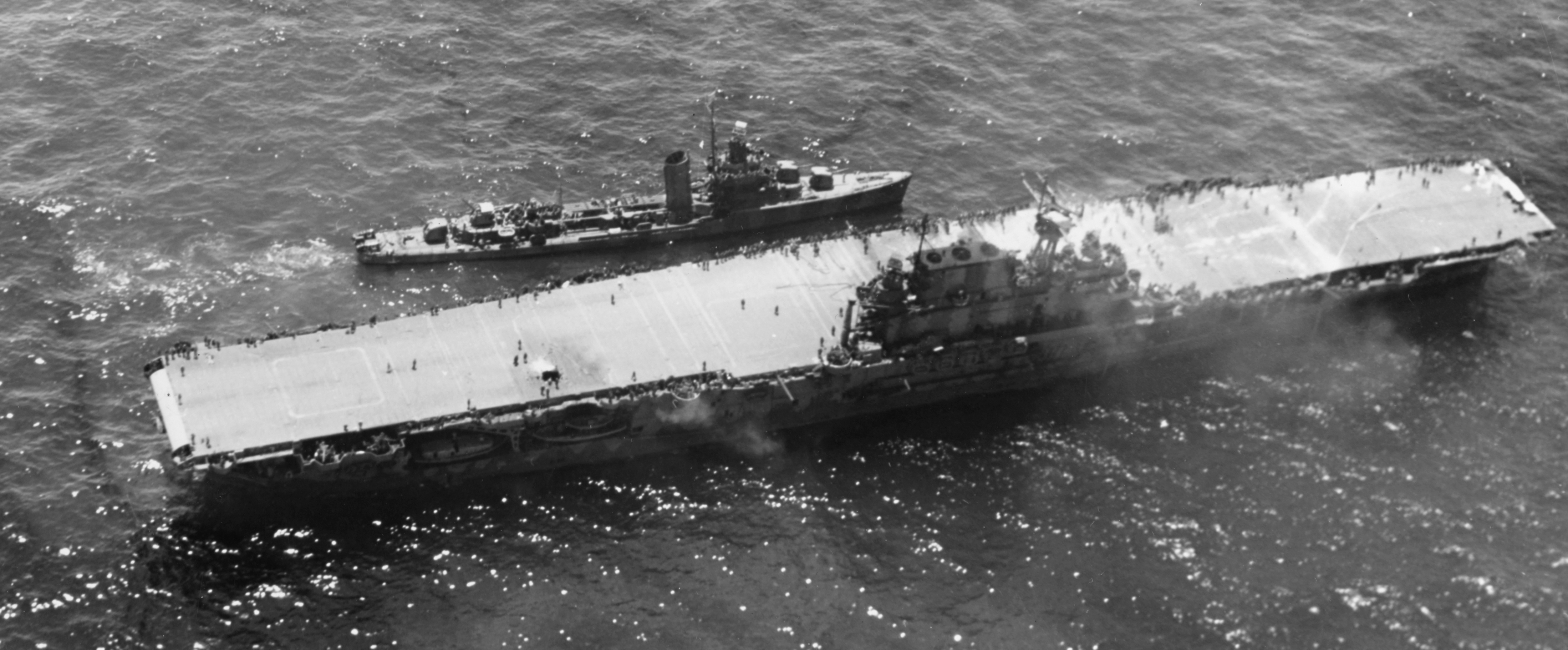
The destroyer Russell comes alongside to take off Hornet’s crew.
Now down to one limping carrier, Kincaid considered his next move. Halsey had been adamant, that he should attack the enemy at all costs. And he did have more or less a full carrier air group now that Enterprise had recovered Hornet’s orphaned planes. Operations would be slowed by the damage to the forward elevator, but strike aircraft could still be armed and launched. And scouting reports indicated that the Japanese had lost two of four carriers, with the remaining two damaged. Should he press on, and attack with what he had?
On the Japanese side, Nagumo remained out of communication aboard the damaged Shokaku, leaving the operable carriers under the command of Kakuta, aboard Junyo. Kakuta had 97 operational aircraft between the two carriers, though his aircrew were exhausted and shaken by their exposure to the volume of American anti-aircraft fire. The admiral suspected that many of the “operational” planes were not in fact fit for combat. And every level of the Japanese higher commands believed that a third, undamaged American carrier remained out there somewhere.
The Japanese carriers turned back for Truk, but the surface ships still had an outside chance of running down the Americans. Kincaid eventually reversed course and withdrew, a decision later affirmed by Halsey. Kondo, placed in charge of all of the surface ships speeding after the Americans, did not press the pursuit and the American destroyers attempting to sink Hornet actually sighted his approaching ships. At this point, Kondo’s force lay about sixty miles from Kincaid, though the Japanese were not laying on all speed.
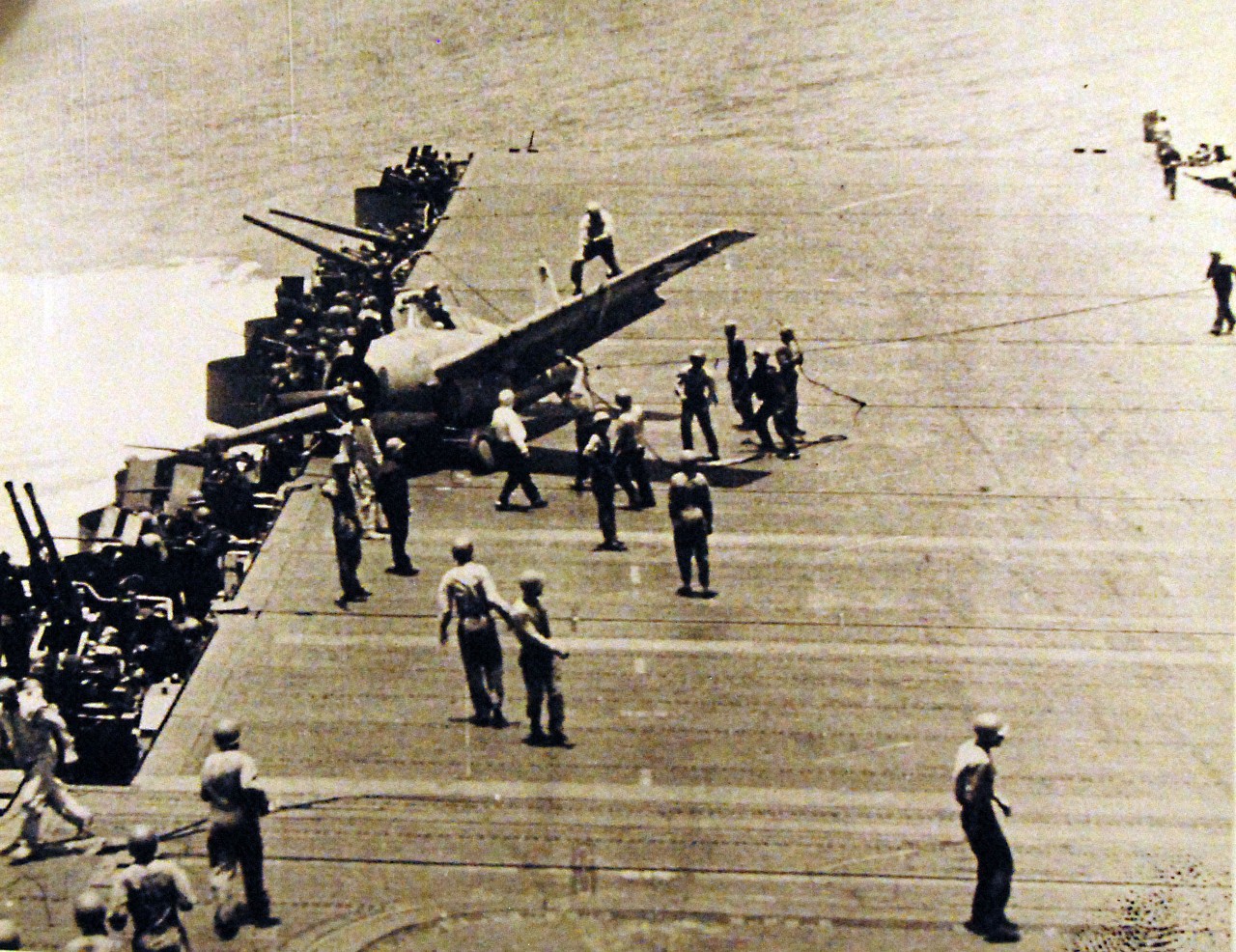
Enterprise deck crew corral a rogue F4F Wildcat fighter.
Wargames conducted before the war began indicated that unless a pursuing surface force made contact with the enemy before nightfall, their prey would always escape in the darkness. Yamamoto ordered Kondo to pursue and destroy the enemy, but when the Japanese found the derelict Hornet, Kondo decided that the Americans had slipped away, and abandoned his pursuit. The Batte of the Santa Cruz Islands had ended.
Both sides claimed victory, though post-war historians have given the nod to the Japanese. The Americans had lost one carrier sunk and the other damaged, leaving them with no operational aircraft carriers in the South Pacific. Halsey recommended to Nimitz that the Americans ask the British for the loan of one or more of theirs, which would eventually result in HMS Victorious deploying to the Solomons. The Americans had one destroyer badly damaged and had also torpedoed and sunk one of their own destroyers, but this usually went unmentioned in official accounts.
The Japanese lost no warships, but one of their heavy carriers suffered heavy damage, one light carrier sustained moderate damage, and one heavy cruiser also took serious damage. In addition, the carrier Hiyo had suffered serious mechanical breakdowns and would not return to front-line duty until March 1943. Shokaku would be out of action until May 1943, Zuiho until January 1943, and Chikuma until March 1943. But thanks to the loss of aircraft and need to train new aircrew, Zuikaku would not return to the Solomons until late January. Junyo, operating an air group slapped together from planes and crews left by all four departing carriers, remained at Truk to give cover to operations in the Solomons.
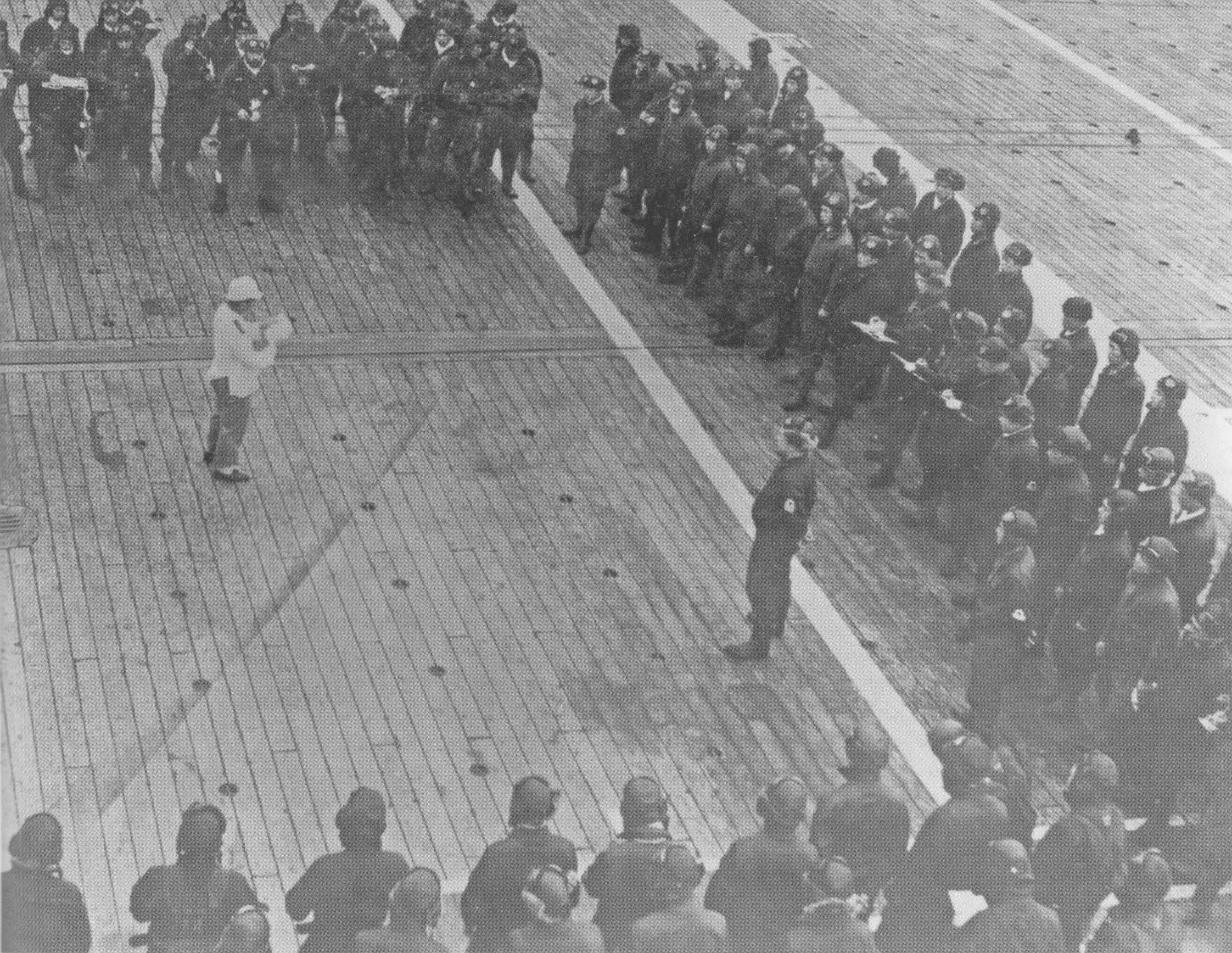
Zuikaku aircrew receive a briefing.
The Japanese began the battle with 203 operational carrier aircraft. Of those, 99 were destroyed, with heavy losses among the dive- and torpedo-bombers. Thanks to the newly-deployed Bofors 40mm, American anti-aircraft fire had become far more deadly than just weeks earlier. Much worse for the Imperial Navy was the loss of aircrew; 145 of them died at Santa Cruz, 68 pilots and 77 second-seaters, the total including 23 section, squadron, or air group commanders. With those men died a great deal of the hard-won collective expertise of the carrier air arm. In comparison, 110 aircrew had died at the Battle of Midway. As the late historian John Prados wrote, it was the Solomons campaign, not Midway, that broke Japanese naval air power.
When the battle opened, the two American carriers had 175 operational aircraft between them. Of these, 80 planes had been lost, but only 22 aircrew. And unlike the Japanese, the Americans had the ability to quickly replace their losses of both men and machines.
As for the next steps, Halsey and his boss, Nimitz, prepared for more aggressive action even without carrier air cover. Halsey prepared to replace the exhausted 1st Marine Division on Guadalcanal with fresh regiments, and supply them liberally with artillery, food, and ammunition. These new forces would then take the offensive and expel the Japanese from the island.
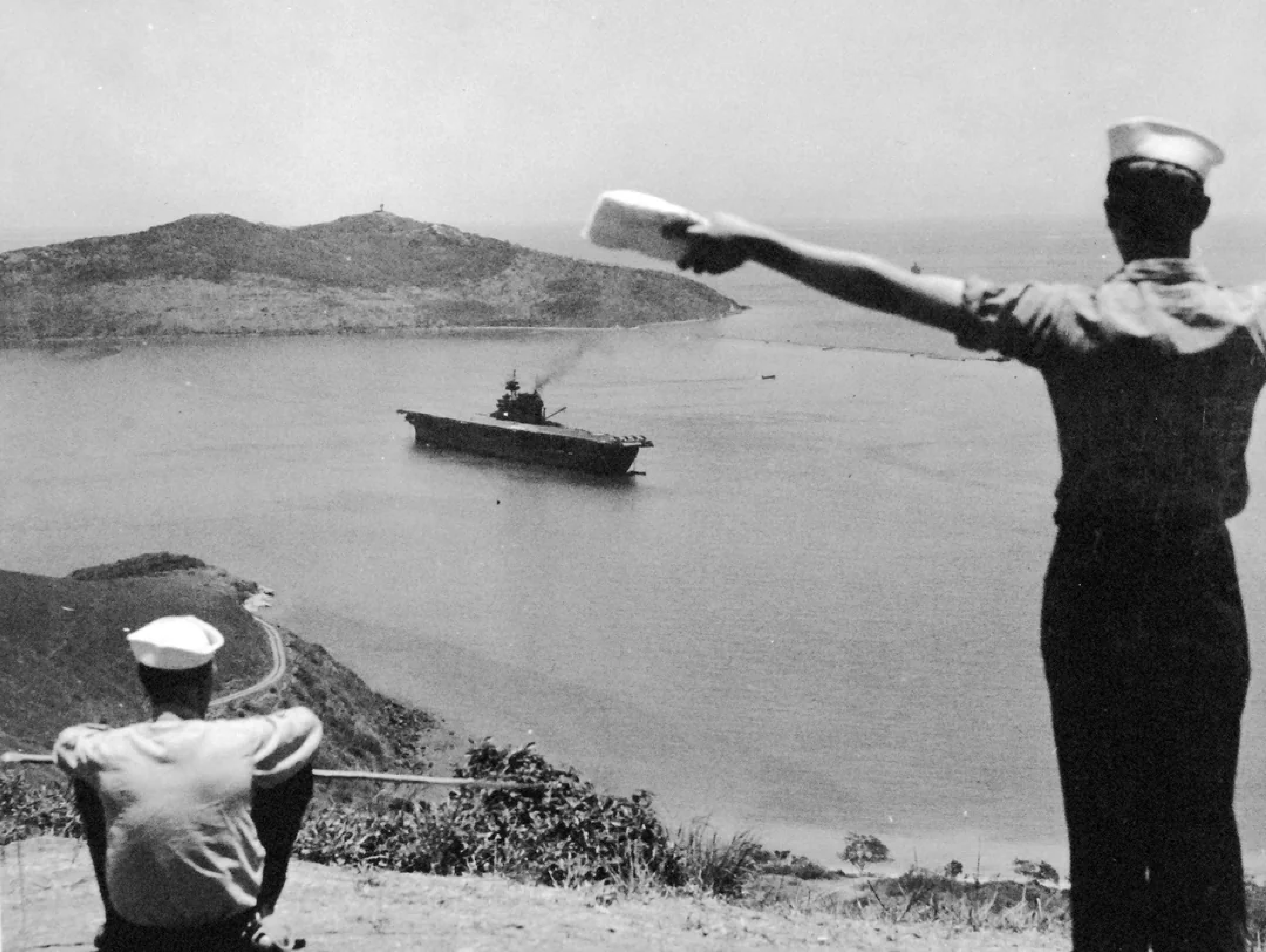
Enterprise at
Nouméa, 8 November 1942. Temporary repairs are almost complete.
Rather than send Enterprise to Pearl Harbor for desperately-needed drydock work, Halsey ordered her repaired at Nouméa by the repair ship Vestal, her own crew, and teams of Navy Seabee construction specialists. By 10 November she had returned to operations, though with canvas curtains walling off her still-inoperable forward elevator and hull plates in constant danger of springing open again.
Yamamoto and Ugaki seem to have had no firm idea of what they might do next. This would be another moment when decisive action could have brought them victory. They and Army planners eventually decided to bring another fresh division to Guadalcanal and renew their support efforts with surface forces. But they still seemed to consider the waters south of the Solomons as falling off the edge of the map. The idea of slapping together another air group for the undamaged Zuikaku and pressing their advantage with attacks on the American rear areas does not seem to have been discussed.
The result would be another, even more intense round of night-time surface battles in Ironbottom Sound.
Order South Pacific Here.
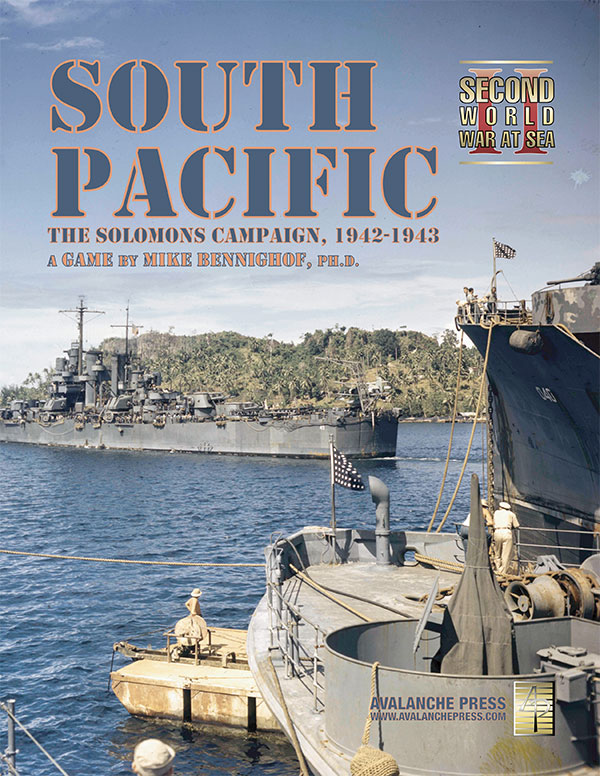
Ironbottom Sound is a scenario book that expands Second World War at Sea: South Pacific. It comes with 36 new scenarios for South Pacific, extending the story through August 1943 and the campaign for New Georgia. All of the maps and pieces needed are included in South Pacific; the companion history book, Solomons Naval Campaign, comes bundled with Ironbottom Sound.
Order Ironbottom Sound Here.
Includes Solomons Naval Campaign book.
Order Solomons Naval Campaign Here.
Companion piece to Ironbottom Sound, or just read it separately.
Sign up for our newsletter right here. Your info will never be sold or transferred; we'll just use it to update you on new games and new offers.
Mike Bennighof is president of Avalanche Press and holds a doctorate in history from Emory University. A Fulbright Scholar and NASA Journalist in Space finalist, he has published a great many books, games and articles on historical subjects; people are saying that some of them are actually good.
He lives in Birmingham, Alabama with his wife, three children, and new puppy. He misses his lizard-hunting Iron Dog, Leopold.
Daily Content includes no AI-generated content or third-party ads. We work hard to keep it that way, and that’s a lot of work. You can help us keep things that way with your gift through this link right here.
|