South Pacific:
Second Guadalcanal, Part One
by Mike Bennighof, Ph.D.
December 2025
 The destructive surface battle in the early morning hours of 13 November resulted in a draw: the Japanese lost a battleship, and had their plans delayed by a day. The American task force had been essentially annihilated, with two destroyers left fit for action. The campaign’s decisive moment had arrived. But the poker-playing Isoroku Yamamoto, commanding the Combined Fleet, hedged his bet. William Halsey, in charge of the South Pacific theater, went all in. The destructive surface battle in the early morning hours of 13 November resulted in a draw: the Japanese lost a battleship, and had their plans delayed by a day. The American task force had been essentially annihilated, with two destroyers left fit for action. The campaign’s decisive moment had arrived. But the poker-playing Isoroku Yamamoto, commanding the Combined Fleet, hedged his bet. William Halsey, in charge of the South Pacific theater, went all in.
With no cruisers available for action other than the captain-less Helena, which had expended most of her 6-inch ammunition, Halsey turned to his battleships. Two fast battleships (Washington and South Dakota) accompanied the carrier Enterprise. He detached them, and four destroyers, ordering this Task Force 64, commanded by five-time Olympic gold medalist Willis “Ching Chong” Lee, into Ironbottom Sound on the night of the 14th, the earliest moment they could arrive. Two older battleships, Colorado and Maryland, were on their way from Pearl Harbor but would not reach Fiji until the 17th.
Yamamoto ordered Nobutake Kondo, commanding the Second Fleet, to reinforce the Bombardment Force and repeat the mission. Kondo needed another day to refuel his ships, and so Yamamoto directed Gunichi Mikawa’s Eighth Fleet to hit the airfield the next night with its heavy cruisers.
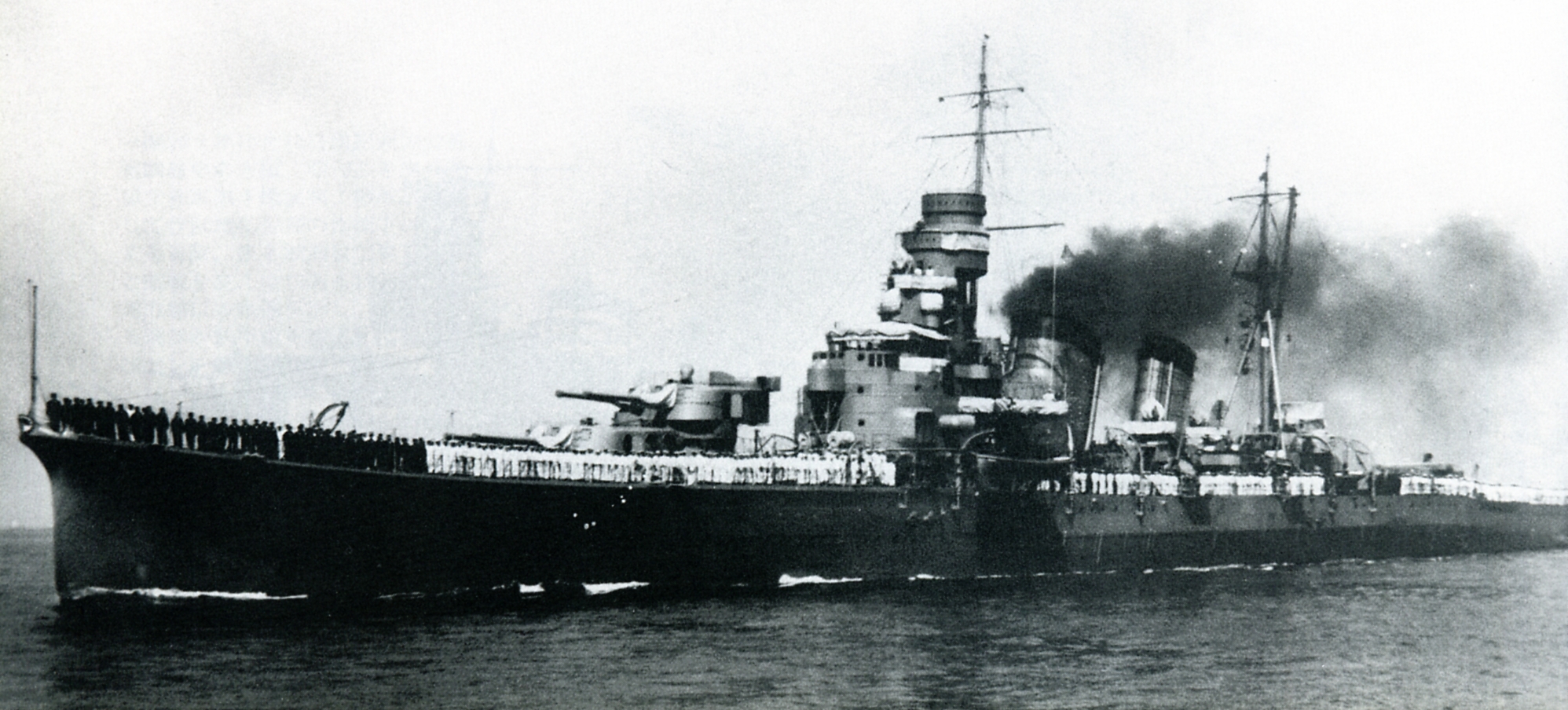
Commissioning ceremony for the heavy cruiser Kinugasa. Kobe, 27 September 1930.
Mikawa’s plan called for Suzuya and Maya, newly added to his force, to shell the airfield at 0200. Just before dawn, his other two heavy cruisers, Chokai and Kinugasa, would remain well outside Ironbottom Sound as support, and then join up with the bombardment force for the return trip. All this really did was expose two more heavy cruisers to American air attack, but add nothing to the weight of the bombardment.
At the Ontong Java reef north of the Solomons, a frequent assembly point for the Japanese, Kondo refueled his destroyers from the battleships Kongo and Haruna, and then sent them back to re-join the carrier Junyo. What’s not clear, almost a century later, is why he did so, and did not direct them to instead join the Emergency Bombardment Force (as Combined Fleet tagged the mission). Neither had any Sanshikidan Type Three incendiary shells aboard, as they had not been intended to join the bombardment when they left Truk on the 9th. According to the 3rd Battleship Division’s War Diary, both battleships had transferred some of their own ammunition to Hiei and Kirishima before their departure from Truk; it’s not clear what type of shells were moved or how many. The ammunition transfer implies that no stocks of 14-inch shells were available at Truk (which was an anchorage, not a full-fledged naval base); it’s possible that Kongo and Haruna simply did not have enough in their magazines to engage in a bombardment or surface action.
Even if they had enough ammunition to fight the Americans, sending along a pair of battleships that would not add much to the bombardment, only serving as escorts, would still expose them to American air attack and burn the fuel to get there and back. That probably was not considered worthwhile against the unlikely event of American battleships entering Ironbottom Sound. Kondo added two heavy cruisers to the force, balancing the loss of Hiei, and that fit the Japanese practice of only committing enough force to accomplish the mission.
Mikawa set out from the Shortland anchorage at 0730 on the 13th, even as Hiei’s escorts fended off the first of the American air attacks that would finish her. His ships reached Ironbottom Sound without incident, where at midnight, Rear Admiral Shoji Nishimura took his force to shell Lunga Point: the heavy cruisers Maya and Suzuya, the aged light cruiser Tenryu, and the destroyers Kazigumo, Makigumo, Michishio, and Yugumo. Mikawa awaited them south-west of the New Georgia Islands, outside the channel known as “The Slot,” with Chokai and Kinugasa plus the light cruiser Isuzu and the destroyers Arashio and Asashio.
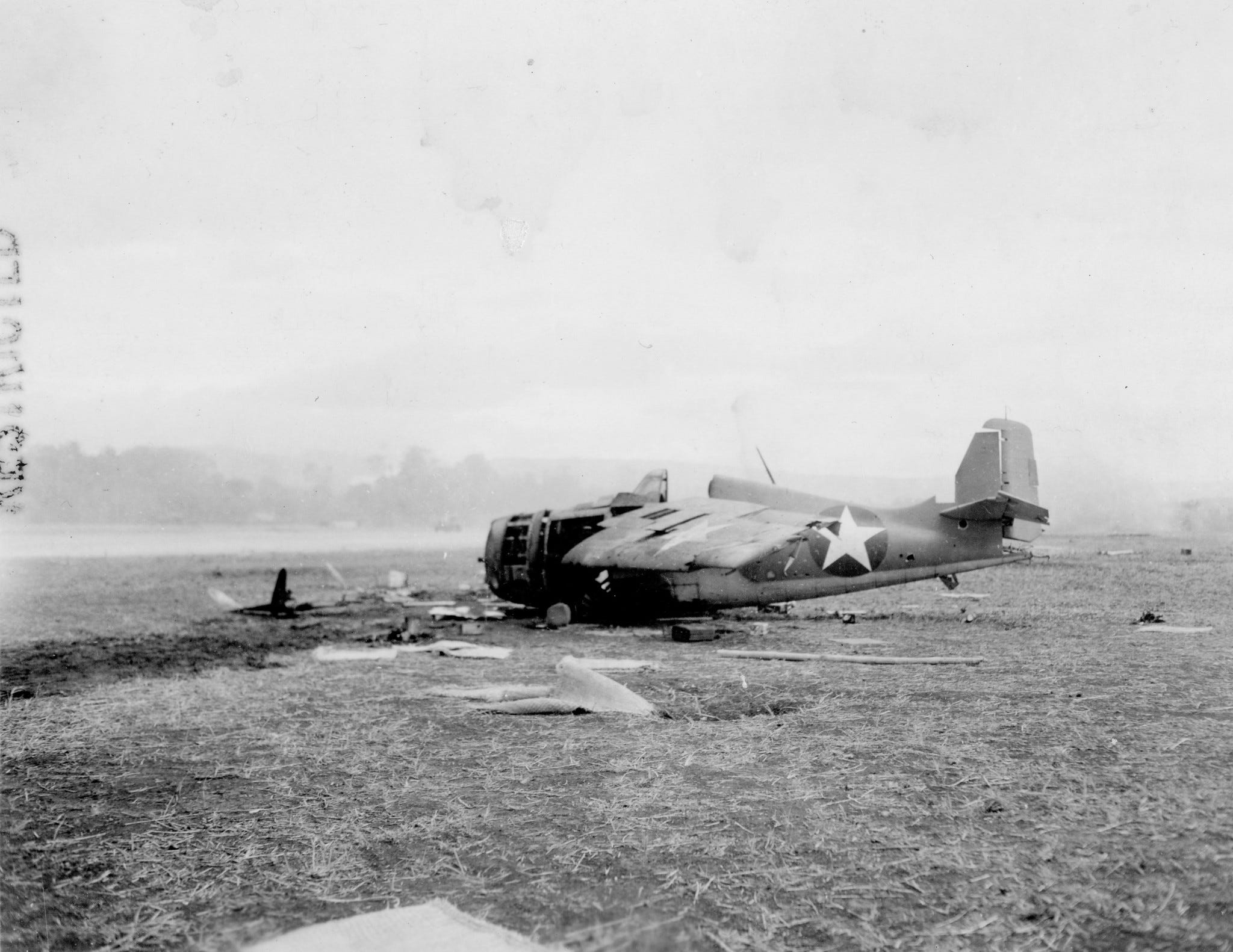
This F4F Wildcat fighter did not escape the Japanese shelling.
Nishimura sent a floatplane from Suzuya over the target area to drop flares. The pilot apparently could not distinguish between Henderson Field proper and the smaller auxiliary field, called Fighter One, completed in September about a half-mile to the south-east. The spotter plane dropped its flares between the two airstrips, and most of the shells (504 from Suzuya and 485 from Maya) fell between them and did little damage. The Japanese would claim 18 planes destroyed and 32 damaged, while the Americans admitted to three aircraft lost. Both airstrips had resumed full operational status by dawn.
Nishimura re-joined Mikawa at 0750, and the ships headed north-west, along the southern edge of the Solomons chain, bound for the Shortland anchorage. An American submarine fired six torpedoes at the cruisers, without result. But then came the planes, from both Henderson Field and Enterprise.
At 0830 Marine dive-bomber placed a 1,000-pound bomb directly in front of Kinugasa’s bridge, plunging deep into the ship’s vitals before exploding. The blast killed her captain and executive officer, caused great rents in her hull, and started multiple fires. Four more bombs exploded nearby, opening still more seams to the sea. The torpedo officer, Lt. Hirokuni Tanaka, righted the listing ship with counter-flooding, had some of the fires extinguished and got her moving again, though very slowly.
A strike of 16 Enterprise dive bombers, led by the legendary Bucky Lee, at first passed over the cruisers, thinking they might be part of a carrier task force’s screen. When they could find no carriers, they returned to attack Mikawa’s squadron at 0915. Two planes dove on the still-smoldering Kinugasa from astern, both scoring near-misses that knocked out her engines and electrical system, and provoked still more flooding. At 1122 she rolled over and sank, taking 51 of her crew with her.
As the Marine dive-bombers assailed Kinugasa, six Marine torpedo bombers attacked the fleet flagship Chokai, in a hammer-and-anvil approach from both sides. The Marines claimed five hits, but in reality, all six torpedoes missed. At 0930, five Enterprise dive bombers attacked. All of their bombs failed to hit the cruiser, but a pair of near-misses opened some compartments to the sea and temporarily knocked two of her boilers out of service. She could still make 29 knots, and reached Shortland with the rest of the squadron.
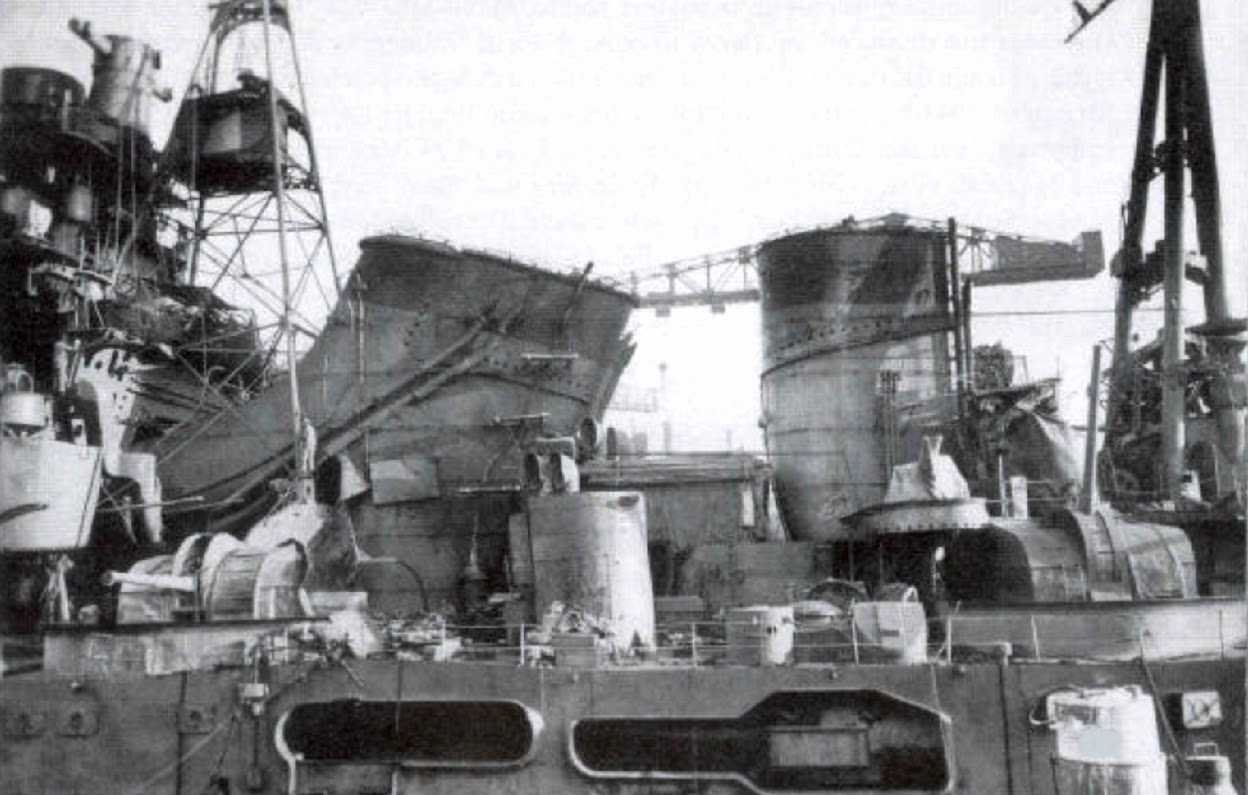
Maya seen in January 1943, still showing damage from Halloran’s suicide attack.
Some of Bucky Lee’s planes attacked Maya, scoring no hits with their bombs, but Ensign Paul Halloran crashed his Dauntless into the cruiser’s upper anti-aircraft deck, igniting ready ammunition there and starting a fire. Maya’s captain Shunsaku Nabeshima ordered the ship’s torpedoes jettisoned before they could cook off, but even so 37 sailors died and 24 were wounded.
Five planes attacked the light cruiser Isuzu, missing the elderly ship but causing extensive flooding through two near-misses by 1,000-pound bombs. Two of her boiler rooms were knocked out as well as her steering, and she made it back to the Shortland anchorage limping along at 15 knots and steering manually, accompanied by the destroyer Asashio.
While the Combined Fleet staff revised their plans, Rear Admiral Raizo Tanaka had remained at sea with the convoy of 11 transports and its escort. At 0344 on 13 November, Yamamoto formally delayed the transports’ landing, and Tanaka turned the convoy around to chug back up The Slot at 15 knots. Henderson Field would have to be put out of action before the troops and supplies could be unloaded safely – or at all.
The convoy and its escorts reached Shortland at 1300, and by 1530 had turned around and departed again, heading back down the Slot toward Guadalcanal. To cover the 11 transports, Tanaka had 11 destroyers, which had no hope of darting down the Slot under cover of darkness, as had been the practice for destroyer reinforcement runs (“rat missions”). With the first battleship bombardment having been turned away by the sacrifice of Callaghan’s Task Force 67, and Nishimura’s cruisers having plowed up the ground between the two American airstrips but failed to shoot up their actual target, the American planes operating from an undamaged airfield ranged over the Slot in search of the Japanese. And just after dawn on the 14th, they found them.
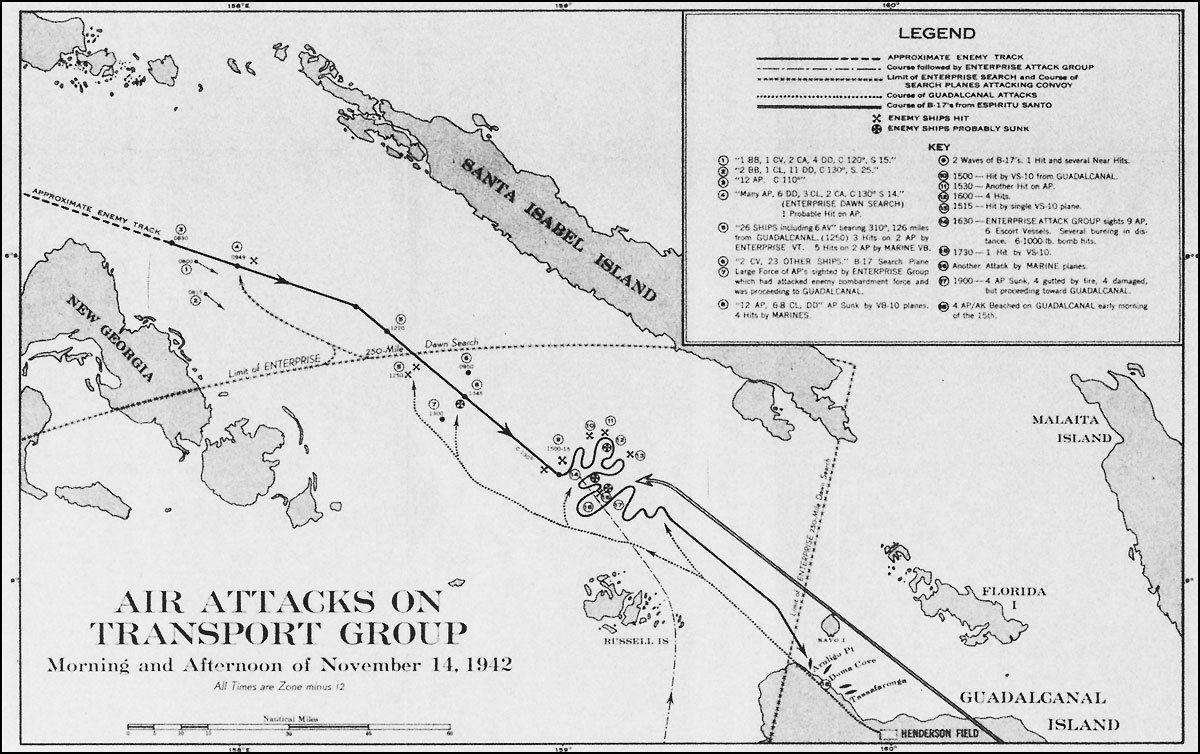
A U.S. Navy chart of the air attacks against the transport convoy.
The American planes came in waves, from both the carrier Enterprise and Henderson Field. Japanese Zero fighters from Rabaul, and seaplanes from the Shortland anchorage, tried to provide cover. Even the surviving floatplane from the sunken Hiei joined the combat air patrol. The Japanese pilots fended off the first American attacks, but then came a wave of over 40 planes including carrier planes, planes from Henderson Field, and B-17 heavy bombers flying from Espiritu Santo. They sank two of the transports despite the frantic efforts of the combat air patrol; one Japanese floatplane rammed an American Dauntless dive bomber. A third transport carrying the 38th Division’s staff, Sado Maru, survived a torpedo hit and staggered back to Shortland accompanied by the destroyers Amagiri and Mochizuki.
Seeing their convoy about to the destroyed, the Combined Fleet staff radioed Seventeenth Army headquarters on Guadalcanal, urging them to shell Henderson Field immediately, with their artillery. The reply came back, that perhaps they could do something on the following day. The Navy was on its own.
More air attacks followed in the early afternoon, sinking three more transports. A final flurry just before sunset sent a sixth transport to the bottom. Tanaka’s destroyers rescued 5,000 men from the water, but could do nothing about the equipment and supplies sunk with the ships. Now down to four transports and nine destroyers, Tanaka pulled back to Rendova Island in the New Georgia group to re-form the convoy and ask for instructions.
Yamamoto ordered him to continue his mission, now changing the orders and telling Tanaka to run the transports ashore on Guadalcanal. Kondo replied as well, telling Tanaka that he was coming, and would put the airfield out of operation by morning – an important detail, since the transports could not make it to Guadalcanal before the sun rose.
Order South Pacific Here.
Ironbottom Sound is a scenario book that expands Second World War at Sea: South Pacific. It comes with 36 new scenarios for South Pacific, extending the story through the Battle of Tassafaronga. All of the maps and pieces needed are included in South Pacific; the companion history book, Solomons Naval Campaign, comes bundled with Ironbottom Sound.
Order Ironbottom Sound Here.
Includes Solomons Naval Campaign book.
Order Solomons Naval Campaign Here.
Companion piece to Ironbottom Sound, or just read it separately.
Sign up for our newsletter right here. Your info will never be sold or transferred; we'll just use it to update you on new games and new offers.
Mike Bennighof is president of Avalanche Press and holds a doctorate in history from Emory University. A Fulbright Scholar and NASA Journalist in Space finalist, he has published a great many books, games and articles on historical subjects; people are saying that some of them are actually good.
He lives in Birmingham, Alabama with his wife, three children, and new puppy. He misses his lizard-hunting Iron Dog, Leopold.
Daily Content includes no AI-generated content or third-party ads. We work hard to keep it that way, and that’s a lot of work. You can help us keep things that way with your gift through this link right here.
|